Fluke 365 Clamp Meter Review: Detachable Jaw, Features, Accuracy and Buying Guide
The Fluke 365 Clamp Meter is designed for electricians and technicians who need to measure current in crowded electrical panels without constantly repositioning their hands or tools. Its standout feature is the removable jaw, which makes it easier to reach conductors in tight spaces.
As an electrical engineer, I look at clamp meters beyond their advertised specifications. For field work, jaw access, current range, safety category, display visibility, handling, and measurement reliability often matter more than having the longest feature list. This review covers where the Fluke 365 fits, its strengths and limitations, and whether it is worth adding to an electrician’s test kit.
Fluke 365 Clamp Meter Quick Specifications
| Feature | Specification |
|---|---|
| AC current | Up to 200 A |
| DC current | Up to 200 A |
| AC/DC voltage | Up to 600 V |
| Resistance | Up to 600 Ω |
| Jaw type | Detachable/removable jaw |
| Jaw opening | Approximately 18 mm |
| Display | Digital backlit display |
| Measurement style | True-RMS |
| Safety rating | CAT III 600 V / CAT IV 300 V |
| Main advantage | Easy access in confined spaces |
| Best suited for | Electricians, HVAC technicians, maintenance and service work |
| Brand | Fluke |
| Product type | AC/DC clamp meter |
Specifications can vary slightly by market, package, or documentation revision, so check the manufacturer's documentation for the exact version before purchase.
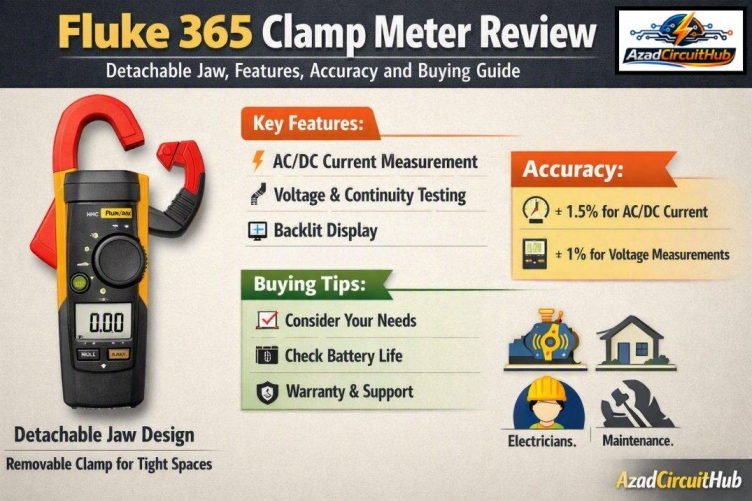
Table of Contents
Table of Contents
What Makes the Fluke 365 Different?
The biggest reason to consider the Fluke 365 Clamp Meter is its detachable current jaw. Instead of trying to maneuver the entire meter around a conductor, you can separate the jaw from the main body and position it around the wire.
That can be particularly useful inside crowded control panels, motor control cabinets, distribution boards, and electrical equipment where space is limited.
The meter is also built around AC and DC current measurement. That gives it wider application than a basic AC-only clamp meter.
For technicians working with motors, batteries, solar equipment, control circuits, and general electrical systems, the combination of AC/DC current and voltage measurement makes the tool considerably more versatile.
Key Features and Benefits
Detachable Clamp Jaw
The removable jaw is the defining feature of this meter.
When several conductors are packed closely together, getting a conventional clamp meter around the correct conductor can be frustrating. The detachable jaw provides another way to access the conductor while keeping the meter body easier to position.
This design is especially useful during troubleshooting where access is more important than speed.
AC and DC Current Measurement
The meter can measure both AC and DC current up to 200 A.
That makes it useful for applications such as:
- Motor current testing
- Automotive electrical troubleshooting
- Battery systems
- Control panels
- HVAC equipment
- Industrial machinery
- Solar and DC electrical systems
- General electrical maintenance
For higher-current industrial applications, however, a 200 A clamp range may not be enough. Always select a meter based on the maximum expected circuit current and the measurement method required.
True-RMS Measurements
True-RMS measurement is valuable when working with modern electrical equipment that does not produce clean sine-wave current or voltage.
Variable frequency drives, electronic power supplies, UPS systems, LED drivers, and other nonlinear loads can produce distorted waveforms. A True-RMS meter can provide more meaningful readings on these types of loads than a basic average-responding instrument.
Voltage and Resistance Testing
The Fluke 365 Clamp Meter also works as a general electrical tester for voltage and resistance measurements.
Its voltage capability extends to 600 V AC/DC, giving it a useful range for many commercial, industrial, and residential troubleshooting tasks.
Resistance measurement is useful when checking continuity-related conditions, coils, control components, and de-energized circuits.
Always de-energize and verify circuits according to the applicable electrical safety procedure before performing resistance or continuity tests.
Fluke 365 Clamp Meter Performance in Real-World Work
A clamp meter can have impressive specifications and still be awkward to use. This is where the Fluke 365 Clamp Meter has a practical advantage.
The detachable jaw addresses a common field problem: restricted conductor access.
Imagine troubleshooting a motor control cabinet where several cables enter a terminal block from different directions. A standard clamp meter may require significant repositioning to get around the conductor. The removable jaw can make that task easier.
The compact form factor is another benefit. It is easier to carry alongside a conventional multimeter, voltage tester, and insulated hand tools.
For routine electrical maintenance, this can make the meter a practical middle ground between a full-size industrial clamp meter and a compact pocket tester.
Fluke 365 Clamp Meter Pros and Cons
| Pros | Cons |
|---|---|
| Detachable jaw improves access | 200 A current range limits some applications |
| Measures AC and DC current | Not intended to replace every specialized tester |
| True-RMS capability | Premium pricing compared with basic clamp meters |
| 600 V AC/DC measurement | Small jaw opening may not suit large conductors |
| Fluke build quality and reputation | Some users may not need the detachable-jaw design |
| Useful for crowded panels | Higher-end Fluke models offer more advanced functions |
Who Should Buy the Fluke 365?
The Fluke 365 Clamp Meter is a strong choice for professionals who frequently troubleshoot equipment in confined spaces.
It makes the most sense for:
- Electricians working inside distribution and control panels
- Industrial maintenance technicians
- HVAC service professionals
- Motor troubleshooting technicians
- Solar and electrical service technicians
- Maintenance engineers
- Field service professionals
It may be excessive for someone who only needs to check household circuits occasionally. In that case, a simpler clamp meter can provide the basic current and voltage functions at a lower cost.
If you are comparing several Fluke models before choosing one for professional electrical work, see our guide to the Best Fluke Clamp Meter for Electrician for a broader comparison of current models and applications.
Is the Fluke 365 Good for Electricians?
For professional electrical troubleshooting, the Fluke 365 Clamp Meter has a very practical feature set.
Its 200 A AC/DC current capability covers many everyday electrical measurements, while the detachable jaw helps when working around tightly packed conductors. The 600 V voltage range also suits a broad range of low-voltage electrical systems.
The main consideration is the jaw size. An electrician who routinely works with large feeder conductors may need a larger clamp opening and a higher current rating.
For control panels, branch circuits, machinery, HVAC equipment, and general maintenance, however, its compact design can be very useful.
Fluke 365 Clamp Meter vs Regular Clamp Meter
A conventional clamp meter is often easier to use because its jaw is permanently attached. The Fluke 365 takes a different approach by prioritizing access.
| Consideration | Fluke 365 | Basic Clamp Meter |
|---|---|---|
| AC current | Yes | Usually |
| DC current | Yes | Model dependent |
| True-RMS | Yes | Model dependent |
| Detachable jaw | Yes | Usually no |
| 600 V measurement | Yes | Model dependent |
| Tight-space access | Excellent | Moderate |
| Professional troubleshooting | Excellent | Basic to moderate |
| Cost | Higher | Usually lower |
The detachable jaw is therefore not simply a marketing feature. It solves a genuine access problem that technicians encounter in crowded electrical equipment.
Buying Recommendation
If you regularly work around control panels, motors, HVAC equipment, or electrical systems where conductor access is difficult, the Fluke 365 Clamp Meter deserves serious consideration.
For current Amazon availability and the latest package options, you can check the product here:
Amazon prices, sellers, bundles, and availability can change, so compare the included accessories and warranty details before ordering.
For readers who want to compare this model with other professional Fluke options, our Best Fluke Clamp Meter for Electrician guide can help narrow down the right model based on current range, jaw size, and application.
What I Like About the Fluke 365
From an electrical engineering and field-troubleshooting perspective, I particularly like the focus on accessibility.
Many electrical measurements are straightforward once you can physically reach the conductor. The removable jaw addresses that issue without requiring a large industrial clamp meter.
The combination of True-RMS measurement, AC/DC current capability, voltage testing, and resistance measurement also makes it suitable as a general-purpose troubleshooting instrument.
It is not the right choice for every electrician, but its design makes sense for technicians who regularly encounter restricted working spaces.
Final Verdict
The Fluke 365 Clamp Meter is a professional AC/DC clamp meter built around one particularly useful idea: making current measurement easier in confined spaces. Its detachable jaw, True-RMS measurement, 200 A current range, and 600 V voltage capability give it a practical feature set for electrical troubleshooting.
It is best suited to electricians, maintenance professionals, HVAC technicians, and engineers who value accessibility and dependable field equipment. The relatively small jaw and 200 A current limit are the main points to consider before buying.
For the right application, the Fluke 365 Clamp Meter is a specialized tool that can make difficult current measurements considerably easier.
Frequently Asked Questions
Is the Fluke 365 a True-RMS clamp meter?
Yes. The Fluke 365 is designed with True-RMS measurement capability, making it suitable for measuring AC signals from many nonlinear electrical loads where accurate waveform-related readings are important.
How many amps can the Fluke 365 measure?
The Fluke 365 can measure AC and DC current up to 200 A. If your application regularly exceeds this level, select a clamp meter with a higher current rating.
Does the Fluke 365 measure DC current?
Yes. DC current measurement is one of its useful features, making it suitable for applications involving batteries, DC systems, automotive circuits, and some solar installations.
Is the Fluke 365 suitable for electricians?
Yes. Its detachable jaw is particularly useful for electricians working in crowded panels and restricted spaces. However, electricians working with large feeder conductors should verify that the jaw opening and current rating meet their requirements.
Is the Fluke 365 worth buying?
For professional users who need AC/DC current measurement and frequently work in confined spaces, it can be worth the investment. Buyers with only occasional household testing needs may get better value from a simpler clamp meter.
Get new guides in your feed. Follow Electrical Insights on LinkedIn for new electrical standards guides, calculators and design tips from Azad Circuit Hub.
#Fluke365, #ClampMeter, #FlukeClampMeter, #ElectricalTesting, #ElectricianTools, #DigitalClampMeter, #TrueRMS, #ElectricalTools, #Multimeter, #ClampMeterReview