
Fluke 393 FC Solar Clamp Meter Review: CAT III 1500 V Solar Clamp Meter Tested for Field Use
The Fluke 393 FC is built for electricians, solar technicians, and electrical engineers who need to measure DC current and voltage in demanding PV environments. In this Fluke 393 FC Solar Clamp Meter Review, I look at its safety rating, thin jaw design, DC power measurement, iFlex probe, Fluke Connect features, and practical value for solar troubleshooting.
As an electrical engineer with hands-on experience in electrical troubleshooting, power systems, automation, and renewable energy projects, I look at clamp meters from a field-use perspective. For solar work, a meter needs more than basic current measurement. High DC voltage, crowded combiner boxes, large conductors, and limited working space all affect which test instrument makes sense.
Fluke 393 FC Key Features at a Glance
The Fluke 393 FC combines high-voltage DC capability with a narrow clamp jaw and several features aimed specifically at solar and industrial electrical work.
| Feature | Fluke 393 FC Specification |
|---|---|
| Product type | Solar clamp meter |
| Maximum DC voltage | Up to 1500 V DC |
| Safety rating | CAT III 1500 V |
| Ingress protection | IP54 |
| DC current | Clamp measurement |
| AC current | Clamp measurement |
| DC power measurement | Yes |
| Jaw design | Thin jaw for restricted spaces |
| Flexible probe | iFlex included |
| Polarity indication | Audio polarity indicator |
| Continuity | Visual continuity indication |
| Connectivity | Fluke Connect enabled |
| Typical applications | Solar PV, DC systems, industrial electrical work |
| Brand | Fluke |
For technicians working on modern photovoltaic systems, the combination of high-voltage DC measurement and a compact jaw is one of the main reasons to consider this instrument.
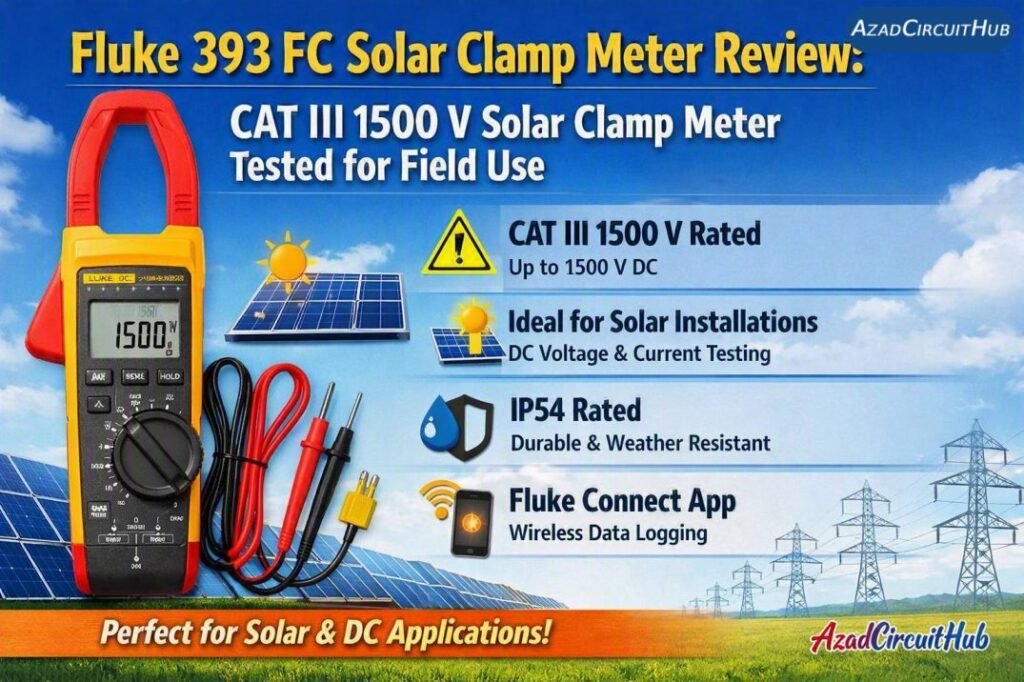
Table of Contents
Table of Contents
What Makes the Fluke 393 FC Different?
The biggest advantage is its focus on high-voltage DC environments. Many general-purpose clamp meters are excellent for building electrical systems but are not designed around the requirements of utility-scale or high-voltage solar installations.
A 1500 V DC rating gives the meter a useful safety margin for modern PV systems that operate at higher string voltages. The CAT III 1500 V rating is also important because the meter is intended for use in appropriate high-energy electrical environments.
The thin jaw is another practical advantage. Solar technicians often need to access conductors inside combiner boxes, inverter cabinets, disconnects, and other areas where a conventional clamp meter can be difficult to position.
Thin Jaw for Crowded Solar Equipment
A narrow clamp jaw can make a significant difference when testing DC conductors. Instead of disconnecting wiring simply to obtain access, the technician may be able to position the clamp around the conductor directly.
This is particularly useful during:
- PV string current checks
- Combiner box inspections
- DC cable troubleshooting
- Inverter input testing
- Solar array commissioning
- Battery and DC distribution work
- Field fault diagnosis
The included iFlex flexible current probe extends the meter's usefulness when conventional jaw access is difficult.
DC Power Measurement for Solar Troubleshooting
One of the more useful functions is DC power measurement. Current alone does not always tell the full story when diagnosing a photovoltaic system.
For example, two PV strings may have similar current readings but different voltage conditions. Looking at both electrical parameters can help identify problems such as poor connections, damaged modules, abnormal string behavior, or inverter-side issues.
The Fluke 393 FC Solar Clamp Meter Review is especially relevant for technicians who regularly need to evaluate DC systems without relying on a conventional bench-style test setup.
Practical Solar Measurement Guide
| Measurement | Useful for |
|---|---|
| DC voltage | PV string and inverter input checks |
| DC current | String output and load current |
| AC current | AC-side inverter and distribution checks |
| DC power | Evaluating electrical output |
| Continuity | Circuit verification when safely isolated |
| Polarity | Checking correct DC polarity |
| Flexible current measurement | Difficult-to-access conductors |
For safety, continuity and resistance functions should only be used on circuits that have been properly de-energized and verified safe.
Audio Polarity Indicator and Visual Continuity
Solar DC systems make polarity verification particularly important. Reversed polarity can create commissioning problems and may damage equipment if an incorrectly connected circuit is energized.
The polarity indicator provides an additional way to identify DC polarity during testing. The visual continuity indication is also useful when checking isolated conductors and circuits.
These features may appear simple, but they can save time during commissioning and troubleshooting when multiple conductors are present.
Want to compare other Fluke models before buying? Check our guide to the best fluke clamp meter for electrician for more options based on current range, safety category, and application.
Is the Fluke 393 FC Good for Solar Installers?
For professional solar work, the 393 FC has several characteristics that make it more suitable than a basic electrician's clamp meter.
The 1500 V DC capability is particularly relevant to newer PV installations. Many residential and commercial solar systems operate below this level, but high-voltage commercial and utility-scale systems can require instruments designed for higher DC voltage.
The IP54 rating provides protection against limited dust and water exposure, which is useful for field technicians. It does not mean the meter is waterproof, so it should still be protected from heavy rain and unsuitable environmental conditions.
The meter is best suited to professionals who will actually use its high-voltage DC and solar-oriented functions. For occasional household electrical measurements, a less specialized model may provide better value.
Fluke 393 FC Connectivity and Fluke Connect
Fluke Connect adds a useful digital workflow for technicians working on larger projects. Compatible measurements can be transferred to a connected mobile device, helping users document readings and monitor measurements from a safer position where supported.
This can be valuable during commissioning, maintenance inspections, and troubleshooting where readings need to be recorded for later analysis.
For engineering teams, digital measurement records can also make it easier to communicate field findings with supervisors or other technicians.
If you are comparing Fluke clamp meters for different electrical applications, our best fluke clamp meter for electrician guide can help you select a model based on your working environment and measurement needs.
Fluke 393 FC vs a Standard Clamp Meter
A normal clamp meter can be perfectly adequate for low-voltage electrical work. The difference becomes clearer when the job involves high-voltage DC systems.
| Requirement | Basic Clamp Meter | Fluke 393 FC |
|---|---|---|
| General AC measurements | Yes | Yes |
| Solar DC applications | Limited on some models | Strong fit |
| 1500 V DC capability | Usually unavailable | Yes |
| CAT III 1500 V | Uncommon | Yes |
| Restricted-access conductors | Depends on jaw | Thin jaw |
| Flexible current probe | Model dependent | Included |
| DC power measurement | Model dependent | Yes |
| Fluke Connect | Model dependent | Yes |
| Field solar troubleshooting | Moderate | Excellent fit |
This comparison does not mean every solar technician needs a 393 FC. The correct instrument depends on system voltage, measurement requirements, work environment, and applicable safety procedures.
For a broader model-by-model evaluation, see our fluke clamp meter comparison chart before making a final purchase.
Pros and Cons
Pros
- Rated for high-voltage DC applications up to 1500 V
- CAT III 1500 V safety category
- Thin jaw helps with restricted access
- DC power measurement
- Included iFlex flexible current probe
- Audio polarity indication
- Visual continuity indication
- Fluke Connect connectivity
- IP54-rated construction
- Strong fit for professional solar maintenance
Cons
- More expensive than basic clamp meters
- Specialized features may be unnecessary for simple residential work
- High-voltage capability requires proper training and safe working procedures
- iFlex and advanced functions can be excessive for technicians who only perform basic AC measurements
Who Should Buy the Fluke 393 FC?
The meter makes the most sense for:
- Solar PV installation technicians
- Solar commissioning engineers
- Electrical engineers
- Commercial solar maintenance teams
- Industrial electricians
- Inverter service technicians
- Electrical troubleshooting professionals
- Utility-scale PV maintenance personnel
It is less compelling for someone who only needs to measure household AC current and voltage. In that case, a less specialized Fluke clamp meter could offer better value.
Check the Latest Amazon Availability
If you work regularly on PV strings, inverter DC inputs, or high-voltage solar equipment, the combination of 1500 V DC capability, the thin jaw, and flexible probe makes this model worth considering.
Check the latest Fluke 393 FC price and availability on Amazon before purchasing, since pricing, bundles, and seller availability can change.
Final Verdict
The Fluke 393 FC Solar Clamp Meter Review shows why this meter has a strong position among professional solar electrical test instruments. Its biggest strengths are not simply the Fluke name or high voltage rating. The combination of CAT III 1500 V protection, DC power measurement, thin jaw access, polarity indication, Fluke Connect, and the included iFlex probe makes it a specialized tool for demanding DC applications.
From an electrical engineering and field troubleshooting perspective, I would consider it particularly useful where conventional clamp meters become restrictive around high-voltage PV systems and crowded equipment.
If your work includes regular solar commissioning, PV troubleshooting, or high-voltage DC maintenance, the additional capabilities can justify the higher purchase price. For basic electrical work, however, a simpler model may be more economical.
For electricians who want to evaluate alternative Fluke models, visit our best fluke clamp meter for electrician guide before choosing your meter.
Frequently Asked Questions
Is the Fluke 393 FC suitable for solar panels?
Yes. The meter is designed with high-voltage DC applications in mind and is particularly well suited to professional solar PV testing, commissioning, and troubleshooting.
What is the voltage rating of the Fluke 393 FC?
The Fluke 393 FC is rated up to 1500 V DC and carries a CAT III 1500 V safety rating. Always follow the manufacturer's instructions and applicable electrical safety procedures when working at these voltages.
Does the Fluke 393 FC measure DC current?
Yes. DC current measurement is one of its key functions and makes it useful for checking PV strings, DC conductors, and other solar electrical circuits.
Does the Fluke 393 FC include an iFlex probe?
Yes. The specified package includes an iFlex flexible current probe. It can help measure conductors that are difficult to access with the meter's standard clamp jaw.
Is the Fluke 393 FC worth buying for electricians?
It can be a worthwhile investment for electricians who regularly work with solar PV, high-voltage DC, industrial systems, or difficult-to-access conductors. For basic household electrical testing, its advanced features may not be necessary.
Related Guides
- Best 1000A Clamp Meter
- Fluke 377 FC Clamp Meter Review
- Fluke 381 Clamp Meter Review
- Fluke 375 FC Clamp Meter Review
- best clamp multimeter for electricians
Get new guides in your feed. Follow Electrical Insights on LinkedIn for new electrical standards guides, calculators and design tips from Azad Circuit Hub.
#Fluke393FC, #SolarClampMeter, #FlukeClampMeter, #SolarPVTesting, #CATIII1500V, #ElectricalTesting, #SolarTechnician, #ClampMeterReview, #PVTechnician, #FlukeTools
