
Best Low Current DC Clamp Meter: Top 3 Picks for Accurate Electrical Testing
Finding a clamp meter that can measure small DC currents accurately is harder than choosing a general-purpose clamp meter. Many models are built for high-current electrical work, while low-current measurements need better resolution, stable readings, and a clamp design that can fit around smaller conductors.
If you are looking for the best low current dc clamp meter for electronics, automotive diagnostics, solar systems, control panels, or light electrical work, three models deserve a close look: the UNI-T UT210E, UNI-T UT210D, and KAIWEETS HT206D.
The UNI-T UT210E is our top choice because it combines useful DC current resolution, a compact body, and a relatively affordable price. The UT210D is another compact option, while the KAIWEETS HT206D offers a higher current range for users who also work on larger circuits.
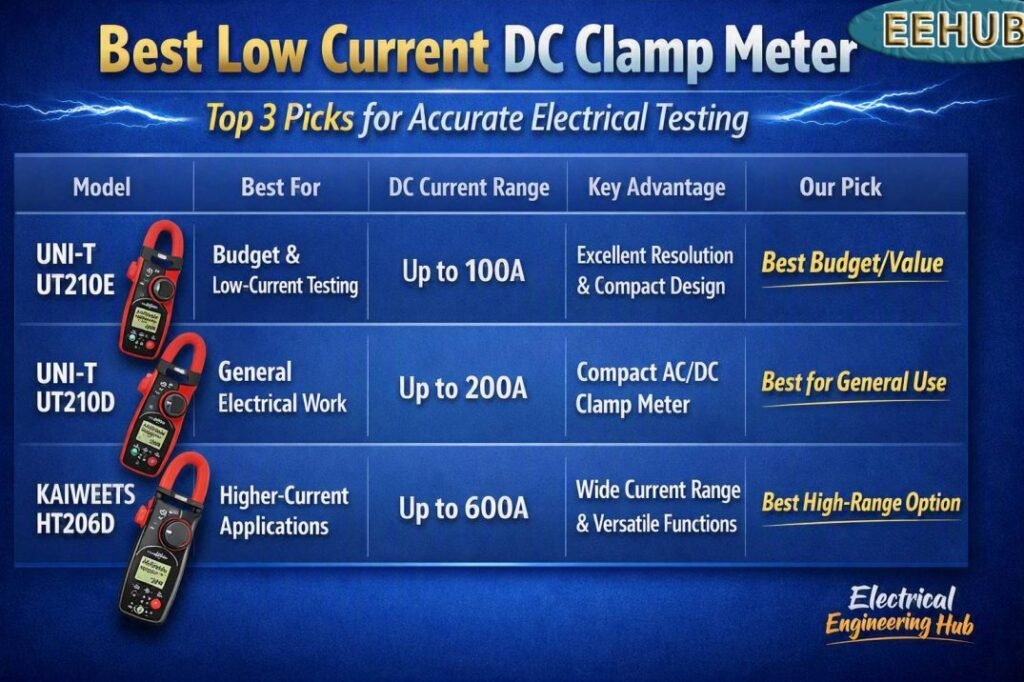
Table of Contents
Table of Contents
1. UNI-T UT210E — Best Budget and Best Value
The UNI-T UT210E is our top recommendation for anyone who needs a compact clamp meter that can also handle relatively small DC current measurements. Its small jaw makes it easier to work inside crowded electrical panels and around individual wires.
Unlike large clamp meters designed mainly for industrial feeders, the UT210E is comfortable for electronics work, automotive troubleshooting, solar wiring, control circuits, and smaller DC loads.
Its DC current function is particularly useful when you want to check current without disconnecting the conductor. The meter also provides conventional multimeter functions, making it more useful than a dedicated current clamp.
Key Features of the UT210E
| Feature | UNI-T UT210E |
|---|---|
| Clamp type | Mini clamp |
| Maximum AC/DC current | 100A |
| DC current measurement | Yes |
| AC current measurement | Yes |
| Resistance | Yes |
| Capacitance | Yes |
| Frequency | Yes |
| Continuity test | Yes |
| Diode test | Yes |
| Display | Digital LCD |
| Best use | Low-current electrical and DC troubleshooting |
The compact jaw is one of its biggest advantages. It can be positioned around smaller conductors without the bulk associated with full-size clamp meters.
Another benefit is its ability to work as a normal digital multimeter. You can measure voltage, resistance, continuity, capacitance, and other electrical parameters without carrying a second instrument.
Why Buy the UT210E?
If your work regularly involves solar panels, battery systems, automotive circuits, instrumentation, or control wiring, the UT210E makes a strong case. It is small enough to keep in a tool bag and capable enough for many everyday electrical measurements.
For electricians who want a compact meter rather than a large industrial clamp meter, this is the model I would choose first.
2. UNI-T UT210D — Best Compact General-Purpose Option
The UNI-T UT210D is another member of UNI-T's compact clamp meter family. It is designed for technicians who want the convenience of clamp-style current measurement without carrying a large meter.
With AC and DC current measurement and a higher current capacity than the UT210E, it can be useful for general electrical troubleshooting, automotive applications, maintenance work, and smaller power systems.
UNI-T UT210D Features
| Feature | UNI-T UT210D |
|---|---|
| Clamp design | Compact |
| Maximum current | Up to 200A |
| AC current | Yes |
| DC current | Yes |
| Voltage measurement | Yes |
| Resistance | Yes |
| Continuity | Yes |
| Diode testing | Yes |
| Frequency | Yes |
| Best use | General electrical troubleshooting |
The UT210D is worth considering when you want more current capacity but still prefer a compact form factor.
Its smaller physical size is particularly helpful when working inside distribution boards where several cables are packed close together. A smaller clamp can make it easier to isolate and measure one conductor at a time.
However, if your priority is specifically very small DC current measurements, the UT210E remains the more attractive value choice.
3. KAIWEETS HT206D — Best for Higher Current Capacity
The KAIWEETS HT206D takes a different approach. Instead of concentrating mainly on compact low-current work, it provides a much wider current measurement range, making it suitable for users who need one meter for both everyday troubleshooting and higher-current applications.
It can measure AC and DC current and includes several functions expected from a modern digital clamp meter.
KAIWEETS HT206D Features
| Feature | KAIWEETS HT206D |
|---|---|
| Clamp type | Digital clamp meter |
| Maximum AC/DC current | Up to 600A |
| DC current | Yes |
| AC current | Yes |
| Voltage | Yes |
| Resistance | Yes |
| Continuity | Yes |
| Frequency | Yes |
| Capacitance | Yes |
| Best use | Automotive, electrical and higher-current work |
The major advantage is flexibility. A 600A range gives you considerably more headroom than a mini clamp meter. That can be useful for technicians who work on larger battery banks, electrical equipment, vehicles, and power circuits.
The trade-off is size. If your main job is measuring tiny currents in crowded control cabinets, a compact UNI-T meter may be more convenient.
Best Low Current DC Clamp Meter: Which One Should You Buy?
The best low current dc clamp meter depends on the type of work you perform.
Choose the UNI-T UT210E if you want the best combination of compact size, useful DC current measurement, and affordability. It is the strongest choice for homeowners, technicians, solar installers, automotive users, and electricians who regularly deal with smaller conductors.
Choose the UT210D if you want a compact meter with a higher current range for general troubleshooting.
Choose the KAIWEETS HT206D if your work covers both low-current testing and higher-current electrical systems and you prefer having a wider measurement range.
If you are building a professional electrical test kit, our guide to the best clamp meter for electricians can also help you compare full-size clamp meters, accuracy requirements, safety features, and application-specific options.
What to Look for in a Low-Current DC Clamp Meter
Before buying, pay attention to more than the maximum amp rating. The ability to resolve small changes in current is often more important.
DC Current Resolution
A meter may advertise a high maximum current, but that does not automatically mean it performs well at low current. Check the lowest measurement range and resolution before buying.
Clamp Size
A compact jaw is valuable when measuring individual conductors inside crowded panels. It also makes automotive and electronic troubleshooting easier.
Zero Function
A DC clamp meter can develop a small offset caused by the Hall-effect sensor. A zero or relative function helps compensate for this and can improve practical measurement accuracy.
Safety Rating
For electrical work, look for a meter with an appropriate CAT safety rating for the environment where it will be used. Never assume that a high amp rating means the instrument is safe for every electrical installation.
Additional Multimeter Functions
Voltage, resistance, continuity, frequency, capacitance, and diode testing can turn a clamp meter into a versatile troubleshooting instrument.
If you regularly work on panels, motors, feeders, or industrial equipment, see our detailed guide to the best clamp meter for electricians before choosing a professional model.
Low-Current DC Clamp Meter vs Traditional Multimeter
A clamp meter has one major advantage: you can measure current without opening the circuit. This is especially useful when testing operating equipment.
A traditional multimeter usually requires the current to pass through the meter leads. That means the circuit must be opened and the meter inserted correctly. For small electronic currents, a quality multimeter can still provide better resolution, but for practical field testing, a clamp meter is much faster and safer when used within its ratings.
Our Final Verdict
The UNI-T UT210E earns our top position because it offers the most attractive combination of compact design, DC current capability, useful multimeter functions, and value.
The UT210D is a good alternative when you want a compact meter with a higher current range, while the KAIWEETS HT206D is better suited to users who need substantially more current capacity.
For most buyers searching for the best low current dc clamp meter, the UT210E is the model to start with.
Frequently Asked Questions
1. What is the best low current dc clamp meter for electricians?
The UNI-T UT210E is an excellent budget choice for electricians who frequently test smaller DC circuits. Its compact design makes it practical for control panels, automotive systems, batteries, and solar wiring.
2. Can a clamp meter measure very small DC currents?
Yes, but accuracy depends heavily on the meter's resolution, sensor design, measurement range, and zeroing function. Always check the lowest specified measurement range rather than looking only at the maximum amp rating.
3. Is the UNI-T UT210E good for solar systems?
Yes. Its DC current measurement capability makes it useful for checking current in battery connections, solar wiring, charge-controller circuits, and other low-to-moderate current DC applications. Always verify the meter's CAT rating and current limits before testing a live system.
4. Is the KAIWEETS HT206D better than the UT210E?
Not necessarily. The HT206D offers a much higher current capacity, which is useful for larger electrical and automotive applications. The UT210E is more attractive when compact size, low-current work, and value are the main priorities.
5. Should I buy a clamp meter or a multimeter?
For current testing without disconnecting a circuit, a clamp meter is usually more convenient. A conventional multimeter can provide finer resolution for very small currents, voltage, resistance, and electronic troubleshooting. Many compact clamp meters, including the models discussed here, combine both approaches.
Get new guides in your feed. Follow Electrical Insights on LinkedIn for new electrical standards guides, calculators and design tips from Azad Circuit Hub.
LowCurrentDCClampMeter, #DCClampMeter, #ClampMeter, #ElectricalTesting, #DCCurrentMeter, #ElectricianTools, #ElectricalTesters, #Multimeter, #ElectricalMeasurement, #TestingTools
