
Fluke 374 FC Clamp Meter Review: Features, Accuracy, Pros, Cons & Buying Guide
The Fluke 374 FC is a professional True-RMS clamp meter designed for electricians, maintenance technicians, HVAC professionals, and industrial electrical troubleshooting. It combines AC/DC current measurement with voltage, resistance, capacitance, frequency, inrush current, and Fluke Connect wireless capabilities.
In this fluke 374 fc clamp meter review, I will look at its specifications, practical performance, safety ratings, key features, limitations, and whether it is worth buying for professional electrical work.
As an electrical engineer with 15 years of field experience across industrial electrical systems, automation, and renewable-energy projects, I generally look beyond a meter’s headline specifications. Jaw size, measurement stability, safety category, inrush capability, and usability around energized equipment can matter just as much as the maximum current rating.
Fluke 374 FC at a Glance
| Feature | Fluke 374 FC Specification |
|---|---|
| Meter type | True-RMS AC/DC clamp meter |
| AC current | Up to 600 A |
| DC current | Up to 600 A |
| AC voltage | Up to 1000 V |
| DC voltage | Up to 1000 V |
| Resistance | Up to 6 kΩ |
| Frequency | Yes |
| Capacitance | Yes |
| Inrush current | Yes |
| Low-pass filter | Yes |
| Jaw opening | Approximately 34 mm |
| Display | Digital backlit display |
| Wireless connectivity | Fluke Connect |
| Safety rating | CAT IV 600 V / CAT III 1000 V |
| Measurement type | True-RMS |
| Best suited for | Industrial, commercial and electrical maintenance |
| Brand | Fluke |
The combination of 600 A AC/DC current measurement and True-RMS capability makes the meter suitable for many demanding electrical troubleshooting tasks.
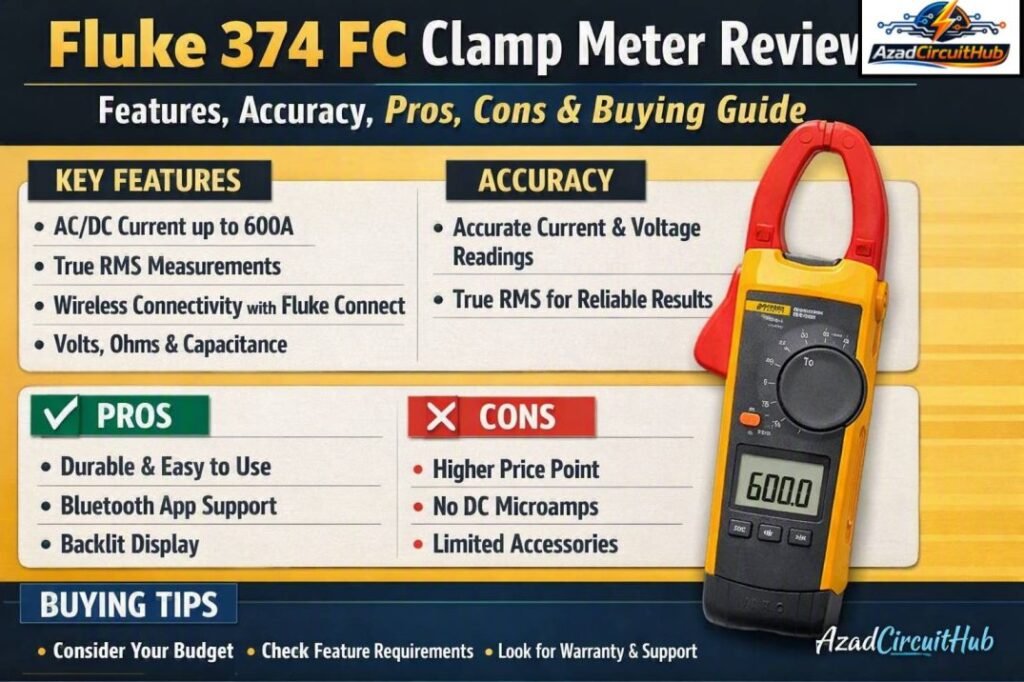
Table of Contents
Table of Contents
What Is the Fluke 374 FC Clamp Meter?
The fluke 374 fc clamp meter is part of Fluke's professional 370 FC Series of clamp meters. It is built for measuring current without disconnecting a conductor from the circuit.
That is one of the biggest advantages of a clamp meter. Instead of opening a circuit and placing meter leads in series, you simply place the current-carrying conductor inside the clamp jaw.
The 374 FC adds wireless measurement capability through Fluke Connect. This can be useful when an electrician needs to monitor measurements while standing away from an energized panel or when measurements need to be documented for maintenance work.
Its True-RMS measurement also makes it better suited to modern electrical systems than basic average-responding meters.
Key Features of the Fluke 374 FC
True-RMS AC and DC Current Measurement
One of the main reasons to consider this meter is its ability to measure both AC and DC current.
The 600 A current range covers many common applications, including:
- Motor current checks
- Distribution-panel troubleshooting
- HVAC equipment
- Battery systems
- Industrial machinery
- Control panels
- Solar and DC electrical systems
- Generator circuits
- Power supplies
True-RMS measurement is particularly useful when working with non-linear loads. Variable-frequency drives, switching power supplies, LED drivers, UPS systems, and modern electronic equipment can produce waveforms that are not clean sine waves.
A True-RMS clamp meter can provide a more meaningful current measurement on these types of loads.
1000 V AC/DC Voltage Measurement
The meter can also be used as a conventional digital multimeter for voltage measurements up to 1000 V, subject to the applicable safety category and operating conditions.
This means you do not necessarily need to carry a separate voltage meter for routine troubleshooting.
For electricians, that combination is practical because the same instrument can check voltage, current, resistance, continuity-related measurements, and other electrical parameters.
Inrush Current Measurement
Motor starting current can be several times higher than normal running current.
A standard current measurement may not capture this short-duration event accurately. The inrush function is designed specifically for this type of troubleshooting.
It can help identify problems such as:
- Motors struggling during startup
- Oversized or undersized protective devices
- Compressor starting issues
- Transformer energization behavior
- High starting current
- Equipment that trips a circuit breaker during startup
For industrial maintenance, this can be a valuable feature.
Fluke 374 FC Features and Measurement Capability
| Capability | Why It Matters |
|---|---|
| AC current | Measures current in AC circuits without opening the circuit |
| DC current | Useful for batteries, solar and DC systems |
| True-RMS | Better measurement of distorted waveforms |
| Inrush current | Helps troubleshoot motor and compressor startup |
| AC/DC voltage | Useful for general electrical troubleshooting |
| Resistance | Supports component and circuit checks |
| Capacitance | Useful for checking capacitors |
| Frequency | Helps verify electrical signal frequency |
| Low-pass filtering | Helps when working around variable-frequency drives |
| Fluke Connect | Enables wireless measurement monitoring and documentation |
Low-Pass Filter for Variable-Frequency Drives
A particularly useful feature for industrial electricians is the low-pass filter.
Variable-frequency drives can generate high-frequency components and electrical noise that may interfere with conventional measurements. A low-pass filter helps the meter focus on the fundamental signal when troubleshooting drive-controlled motors.
This does not mean the filter should be used for every measurement. The correct measurement mode depends on what you are trying to diagnose.
For VFD troubleshooting, however, having a dedicated filtering function can make measurements easier to interpret.
Fluke Connect Wireless Function
The FC designation indicates Fluke Connect compatibility.
With compatible Fluke equipment and the appropriate mobile device or system, measurements can be transmitted wirelessly for remote viewing and documentation.
This can be especially useful when testing equipment inside electrical panels or other locations where remaining close to the energized equipment is undesirable.
Typical applications include:
- Remote measurement monitoring
- Preventive maintenance
- Recording electrical readings
- Troubleshooting equipment
- Sharing measurements with a maintenance team
- Creating measurement records
For larger maintenance teams, this feature can provide more value than it would for someone doing occasional residential electrical work.
Build Quality and Ergonomics
Fluke's professional meters are designed for demanding field environments, and the 374 FC follows that approach.
The clamp mechanism is large enough for many typical conductors and cables, while the meter's layout keeps the primary controls accessible during testing.
A clamp meter must also be easy to operate while wearing gloves or working in a crowded electrical panel. In practical use, simple controls can save time and reduce the need to reposition the meter.
The approximately 34 mm jaw opening is suitable for many individual conductors and smaller cables, although it is not intended to replace a larger flexible current probe when measuring very large conductors or busbars.
Safety Rating
Electrical safety should be considered before measurement range.
The fluke 374 fc clamp meter carries CAT IV 600 V and CAT III 1000 V safety ratings. These ratings indicate the measurement environments for which the instrument is designed when used according to Fluke's instructions.
CAT III applications generally include distribution-level installations, while CAT IV relates to the service entrance and utility-connected portions of an installation.
Always select test equipment according to the actual installation category, voltage, available fault energy, and measurement procedure. A high voltage rating alone does not make an instrument safe for every electrical environment.
Fluke 374 FC vs a Basic Clamp Meter
A basic clamp meter can be perfectly adequate for occasional current measurements. The 374 FC is aimed at users who need considerably more capability.
| Requirement | Basic Clamp Meter | Fluke 374 FC |
|---|---|---|
| AC current | Yes | Yes |
| DC current | Depends on model | Yes |
| True-RMS | Depends on model | Yes |
| Inrush measurement | Limited models | Yes |
| VFD filtering | Rare | Yes |
| 1000 V measurement | Depends on model | Yes |
| Wireless measurement | Rare | Fluke Connect |
| Professional safety rating | Depends on model | CAT IV 600 V / CAT III 1000 V |
| Industrial troubleshooting | Limited to moderate | Excellent fit |
If you only need to check whether a residential circuit is carrying 10 or 15 amps, the extra features may not justify the cost.
For industrial maintenance, motor troubleshooting, commercial electrical work, and technicians who use a clamp meter frequently, the additional functionality makes more sense.
For a broader comparison of professional models, see my guide to Best Fluke Clamp Meter for Electrician to compare the 374 FC with other Fluke clamp meters.
Pros and Cons
Pros
- Measures both AC and DC current
- True-RMS measurement
- 600 A current capacity
- 1000 V AC/DC voltage capability
- Inrush current measurement
- Low-pass filter for VFD applications
- Fluke Connect wireless functionality
- Professional CAT IV/CAT III safety ratings
- Useful for industrial troubleshooting
- Strong overall build quality
Cons
- More expensive than entry-level clamp meters
- 600 A jaw capacity is not intended for very large conductors
- Wireless functions may be unnecessary for occasional users
- Professional features can be excessive for basic residential testing
- A dedicated multimeter may still be preferable for some precision diagnostic work
Is the Fluke 374 FC Worth Buying?
For a professional electrician or electrical maintenance technician, the answer is generally yes if you will actually use its advanced functions.
The combination of True-RMS, AC/DC current measurement, inrush testing, VFD filtering, high-voltage measurement, and wireless connectivity gives it a strong position in the professional clamp meter category.
It is especially attractive for industrial environments where equipment downtime can be expensive and troubleshooting needs to be performed quickly.
If your work mainly involves basic residential circuits, a less expensive clamp meter may provide better value.
Before choosing a model, it is worth comparing the 374 FC with other Fluke options based on current range, jaw capacity, measurement functions, and budget.
Where to Buy the Fluke 374 FC
If you have decided that the 374 FC matches your electrical testing requirements, checking the current Amazon price is a practical next step. Pricing, availability, and included accessories can change, so verify the current listing before ordering.
For electricians who want professional-grade current measurement without moving into the larger and more specialized clamp-meter models, this is one of the Fluke products worth considering.
If you are still deciding between several models, compare them first in Best Fluke Clamp Meter for Electrician before making your purchase.
Who Should Buy the Fluke 374 FC?
The meter is a strong choice for:
- Industrial electricians
- Electrical maintenance engineers
- Commercial electricians
- HVAC technicians
- Motor technicians
- Automation technicians
- Solar and battery-system technicians
- Facility maintenance teams
- Electrical contractors
- Troubleshooting professionals
It may be unnecessary for a homeowner or occasional DIY user who only needs basic AC current measurement.
Fluke 374 FC Clamp Meter: Final Verdict
The fluke 374 fc clamp meter is a well-rounded professional instrument for electricians who need more than simple current measurement. Its 600 A AC/DC capability, True-RMS technology, inrush function, VFD low-pass filtering, 1000 V measurement capability, and Fluke Connect compatibility make it particularly useful for industrial and commercial troubleshooting.
The biggest question is not whether it has enough features. It does. The question is whether your work requires those features.
For professionals working around motors, drives, control panels, distribution equipment, HVAC systems, and DC power systems, the 374 FC offers a practical combination of measurement capability and safety.
If your priority is professional electrical troubleshooting and you want one clamp meter that can handle a broad range of AC and DC applications, the 374 FC deserves a place on your shortlist.
For more options before buying, visit Best Fluke Clamp Meter for Electrician and compare the 374 FC against other professional Fluke models.
Frequently Asked Questions
Is the Fluke 374 FC a True-RMS clamp meter?
Yes. The 374 FC uses True-RMS measurement for AC applications, making it suitable for many modern electrical loads with distorted or non-sinusoidal waveforms.
Can the Fluke 374 FC measure DC current?
Yes. The meter supports DC current measurement up to 600 A. This makes it useful for applications such as battery systems, solar installations, and DC electrical equipment.
Is the Fluke 374 FC good for HVAC work?
Yes. Its AC/DC current measurement, True-RMS capability, inrush measurement, voltage testing, and professional safety ratings make it useful for HVAC troubleshooting, including motor and compressor applications.
Does the Fluke 374 FC measure inrush current?
Yes. The inrush function is designed to help capture short-duration startup current from equipment such as motors and compressors.
Is the Fluke 374 FC worth it for electricians?
For electricians who regularly perform commercial or industrial troubleshooting, its advanced measurement functions can justify the higher price. For occasional residential work, a less expensive clamp meter may offer better value.
Get new guides in your feed. Follow Electrical Insights on LinkedIn for new electrical standards guides, calculators and design tips from Azad Circuit Hub.
#Fluke374FC, #FlukeClampMeter, #ClampMeterReview, #FlukeTools, #ElectricalTesting, #DigitalClampMeter, #ElectricianTools, #TrueRMS, #ElectricalTestEquipment, #ClampMeter
