
765 KV Phase to Phase Clearance: Standards, Calculation and Practical Guide
For a 765 kV phase to phase clearance, the required separation depends on whether the value is being determined for air-insulated substations, overhead lines, or equipment, and whether the voltage is the nominal system voltage or the highest system voltage. There is no single universal clearance value that applies to every 765 kV installation.
765 kV Phase to Phase Clearance — Quick Reference
| Parameter | Typical / Reference Value | Standard Basis |
|---|---|---|
| Nominal system voltage | 765 kV | IEC/utility system designation |
| Highest system voltage, Um | 800 kV | IEC 60071 / IEC 62271 practice |
| Rated power-frequency withstand voltage | Project-specific | IEC 60071 insulation coordination |
| Rated lightning impulse withstand voltage (LIWV) | Project-specific | IEC 60071 |
| Rated switching impulse withstand voltage (SIWV) | Project-specific | IEC 60071 |
| Minimum phase-to-phase air clearance | Project/calculation specific | IEC 60071 insulation coordination |
| Minimum phase-to-earth air clearance | Project/calculation specific | IEC 60071 |
| Altitude correction | Required above reference altitude | IEC 60071 |
| Pollution correction | Site dependent | IEC 60071 / IEC 60815 |
765 kV Air Clearance Reference
| Voltage Class | Highest System Voltage (Um) | Typical Insulation Coordination Level | Phase to Phase Clearance |
|---|---|---|---|
| 765 kV | 800 kV | Determined from required withstand levels | Must be calculated/project specified |
Important: IEC 60071 does not simply prescribe a universal “765 kV = X meters” Phase to Phase Clearance. The air-clearance requirement is derived from the required withstand voltage, electrode configuration, atmospheric conditions, altitude, and applicable safety/design margins.
Why 765 kV Clearance Is Not a Single Fixed Number
| Design Factor | Effect on Required Clearance |
|---|---|
| Switching impulse withstand voltage | Major factor for EHV systems |
| Lightning impulse withstand voltage | Determines impulse insulation requirement |
| Electrode configuration | Changes air-gap withstand strength |
| Altitude | Higher altitude generally requires increased clearance |
| Atmospheric pressure | Influences dielectric strength of air |
| Conductor movement | Must be considered for overhead installations |
| Wind loading | Can reduce phase-to-phase separation |
| Ice and contamination | Important for outdoor installations |
| Safety clearances | May require additional separation beyond insulation coordination |
| Utility design standard | Can specify conservative minimum values |
765 kV Clearance: Standards to Check
| Standard | Relevance |
|---|---|
| IEC 60071-1 | Definitions and general principles of insulation coordination |
| IEC 60071-2 | Application guidelines for insulation coordination and air clearances |
| IEC 62271 series | High-voltage switchgear and controlgear requirements |
| IEC 60815 series | Selection and dimensioning of high-voltage insulators for polluted conditions |
| IEEE Std 1313.1 | Insulation coordination for power systems |
| IEEE Std 1313.2 | Application guide for insulation coordination |
| IEEE/utility design standards | May establish additional substation or transmission clearances |
Practical 765 kV Design Rule
For a 765 kV substation or transmission installation, do not use a generic 765 kV clearance number as a final design value. Determine the required insulation withstand level first, then establish the corresponding air gap using the applicable IEC/IEEE methodology and correct it for altitude and site conditions.
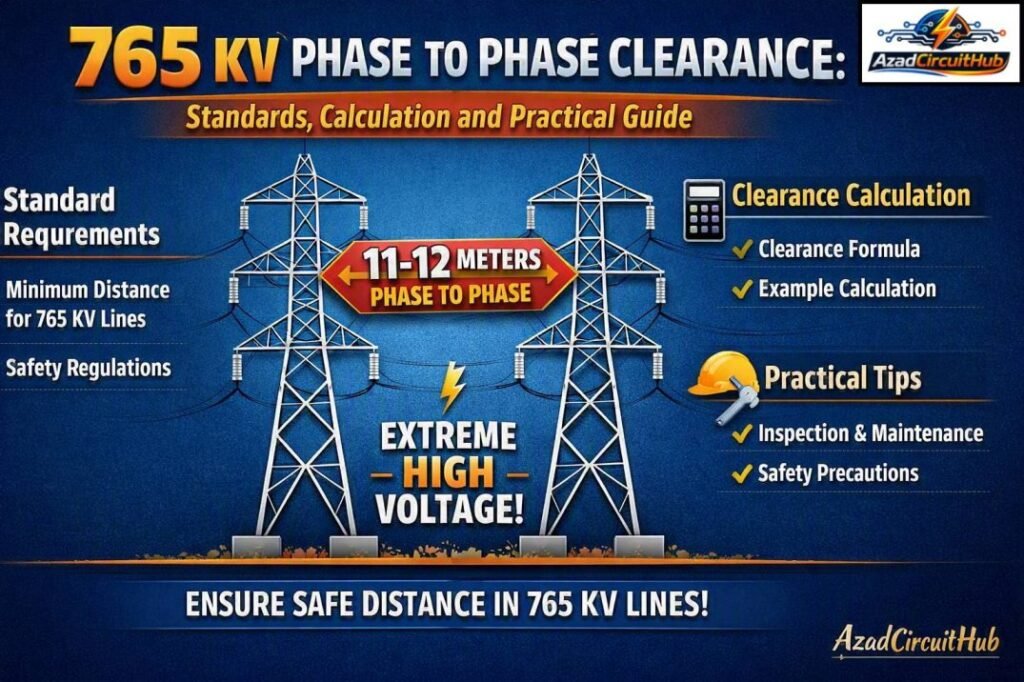
Table of Contents
Table of Contents
What Is 765 kv phase to phase clearance?
The 765 kv phase to phase clearance is the shortest air distance that must be maintained between two different energized phases to prevent electrical flashover under specified operating and transient conditions.
Unlike a low-voltage installation, a 765 kV substation is strongly influenced by switching overvoltages. At extra-high voltage levels, switching impulses can become a major factor in determining the required phase separation.
The clearance must also remain adequate when conductors move because of wind, short-circuit forces, temperature changes, or mechanical loading.
For an outdoor air-insulated substation, the designer normally evaluates:
- Power-frequency withstand voltage
- Lightning impulse withstand voltage
- Switching impulse withstand voltage
- Temporary overvoltages
- Atmospheric conditions
- Altitude
- Conductor configuration
- Wind loading
- Equipment tolerances
- Maintenance requirements
- Safety clearances
The final arrangement should provide sufficient margin rather than simply matching a calculated minimum air gap.
Why 765 kV Requires Large Air Clearances
At 765 kV, the electric field around conductors can become extremely high. If the air gap is too small, the electrical stress can exceed the withstand capability of the air insulation.
Air is commonly used as insulation in outdoor substations because it is readily available and does not require a solid dielectric between exposed conductors. However, its dielectric strength changes with atmospheric pressure, temperature, humidity, conductor geometry, and impulse waveform.
This makes EHV substation layout more complex than simply applying a voltage-to-distance ratio.
Sharp conductor surfaces can also increase local electric-field stress. Corona, radio interference, and audible noise become important considerations in EHV equipment design.
Standards Used for 765 kV Insulation Coordination
There is no single IEC table that should be used blindly to select every 765 kV air clearance. The designer should first establish the insulation coordination requirements and then determine the corresponding minimum distances.
| Standard | Main Application |
|---|---|
| IEC 60071-1 | Insulation coordination terminology and principles |
| IEC 60071-2 | Application guidelines for insulation coordination |
| IEC 61936-1 | Power installations exceeding 1 kV AC |
| IEC 62271 series | High-voltage switchgear and controlgear |
| IEEE 605 | Design of electrical power substations |
| IEC 60060 series | High-voltage test techniques |
IEC 60071 is particularly important because it provides the framework for selecting insulation levels and coordinating them with system overvoltages.
IEC 61936-1 is also relevant when designing an outdoor substation because it addresses power installations above 1 kV AC, including electrical clearances and safety considerations.
For projects using IEEE-based engineering practices, IEEE 605 is another useful reference for substation physical arrangement and electrical clearances.
Phase-to-Phase vs Phase-to-Earth Clearance
Phase to Phase Clearance and phase-to-earth clearance are related but should not be confused.
| Clearance | Definition | Typical Design Concern |
|---|---|---|
| Phase-to-phase | Distance between two energized phases | Phase-to-phase flashover |
| Phase-to-earth | Distance between energized conductor and grounded structure | Phase-to-ground flashover |
| Section clearance | Separation between isolated electrical sections | Safety and insulation |
| Working clearance | Space required for personnel and maintenance | Electrical safety |
| Bus clearance | Separation between adjacent bus conductors | Electrical and mechanical design |
In many substation arrangements, phase-to-phase separation may be greater than the minimum phase-to-earth distance. However, the actual relationship depends on conductor geometry, insulation coordination, equipment type, and the selected standard.
How Is 765 kv phase to phase clearance Determined?
The engineering process usually starts with the highest system voltage and the expected overvoltages.
A simplified design sequence is:
- Determine the maximum operating voltage.
- Establish the system earthing arrangement.
- Determine temporary and transient overvoltages.
- Select the required insulation level.
- Determine lightning and switching impulse withstand requirements.
- Calculate the required air insulation distance.
- Apply atmospheric and altitude corrections.
- Consider conductor swing and mechanical movement.
- Add appropriate design and construction tolerances.
- Verify the final layout through the applicable standard.
For a 765 kV network, switching impulse coordination deserves particular attention. A value calculated only from the nominal RMS voltage may be inadequate.
Typical Factors Affecting Air Clearance
Several variables can change the required distance between conductors.
| Factor | Effect on Clearance |
|---|---|
| System voltage | Higher voltage generally requires greater separation |
| Switching surge | Can govern EHV air-gap design |
| Lightning impulse | Influences insulation withstand requirement |
| Altitude | Reduced air density can increase required distance |
| Temperature | Changes air density and conductor conditions |
| Humidity | May affect external insulation performance |
| Conductor diameter | Influences electric-field concentration |
| Wind | Causes conductor displacement |
| Bus arrangement | Changes electrical field distribution |
| Equipment tolerances | Require practical design margin |
Altitude is particularly important. Air has lower dielectric strength at higher elevations, so a substation located at significant altitude may require an increased clearance compared with a similar installation at sea level.
Conductor Swing and Dynamic Clearance
A major practical issue in outdoor EHV substations is conductor movement.
A rigid bus arrangement may have predictable geometry, but flexible jumpers and conductors can move under wind and electromagnetic forces. The engineering team therefore needs to consider the minimum separation under the most unfavorable operating condition.
For this reason, the physical distance measured on a static drawing should not automatically be considered the final electrical clearance.
The layout should account for:
- Maximum conductor sag
- Wind deflection
- Temperature expansion
- Short-circuit forces
- Flexible jumper movement
- Equipment tolerances
- Seismic movement where applicable
The minimum distance should remain safe throughout the expected range of operating conditions.
765 kV Substation Bus Arrangement
Bus configuration has a direct effect on phase separation. Common arrangements include single bus, double bus, breaker-and-a-half, and ring bus configurations.
At 765 kV, equipment such as circuit breakers, disconnectors, current transformers, voltage transformers, surge arresters, and bus supports must all be coordinated within the available electrical clearances.
A well-designed layout balances electrical insulation requirements with:
- Land requirements
- Maintenance access
- Switching flexibility
- Equipment transportation
- Safety zones
- Mechanical loading
- Future expansion
The phase spacing should therefore be considered during the complete substation layout rather than after equipment has already been positioned.
Difference Between Electrical Clearance and Creepage Distance
Electrical clearance is measured through air, while creepage distance is measured along the surface of an insulating material.
| Property | Clearance | Creepage |
|---|---|---|
| Path | Through air | Along insulation surface |
| Main concern | Flashover through air | Surface tracking |
| Important for | AIS and exposed conductors | Bushings, insulators, composite insulation |
| Influenced by altitude | Yes | Less directly |
| Influenced by pollution | Yes | Strongly |
| Typical application | Phase-to-phase spacing | Insulator design |
This distinction is important because increasing creepage distance does not automatically replace the required air clearance between exposed 765 kV conductors.
Design Margin and Safety Considerations
The minimum theoretical air gap is not necessarily the same as the dimension shown on the final substation drawing.
Engineers normally include suitable allowances for manufacturing tolerances, construction deviations, conductor movement, measurement uncertainty, and environmental conditions.
Safety clearances also need to be considered separately from insulation coordination distances. A distance that is electrically adequate may not necessarily provide sufficient space for safe maintenance activities.
For practical substation design, electrical clearances should therefore be checked against both the insulation coordination requirements and the applicable safety requirements.
Related Clearance Guide
If you are also working with low-voltage switchgear and panel assemblies, compare these requirements with phase to phase clearance as per iec 61439 to understand how clearance and creepage requirements are applied under the IEC 61439 framework.
IEC 61439 and 765 kV Applications
IEC 61439 is primarily associated with low-voltage switchgear and controlgear assemblies. It should not be used as the primary standard for determining 765 kV outdoor substation air clearances.
This distinction matters because engineers sometimes encounter the terms clearance and creepage in IEC 61439 and assume the same rules directly apply to EHV substations.
For 765 kV installations, IEC 60071 and IEC 61936-1 are much more relevant to insulation coordination and installation clearances, while appropriate high-voltage equipment standards apply to individual apparatus.
The voltage class, equipment technology, installation environment, and governing project standard should always be confirmed before selecting a clearance.
Practical 765 kV Clearance Checklist
Before approving a substation layout, engineers can use the following checklist:
| Check | Requirement |
|---|---|
| Nominal voltage verified | Yes |
| Maximum operating voltage verified | Yes |
| Insulation level selected | Yes |
| Switching impulse evaluated | Yes |
| Lightning impulse evaluated | Yes |
| Altitude correction checked | Yes |
| Wind movement considered | Yes |
| Conductor sag considered | Yes |
| Phase-to-earth distance checked | Yes |
| Phase-to-phase distance checked | Yes |
| Equipment tolerances included | Yes |
| Maintenance clearance verified | Yes |
| Applicable standards confirmed | Yes |
Common Mistakes in 765 kV Clearance Design
One common mistake is using a fixed clearance value from an unrelated voltage class. EHV air clearances should be based on the actual insulation coordination study and applicable installation requirements.
Another mistake is ignoring altitude. A clearance suitable for sea level may not provide the same insulation performance at a high-elevation site.
Engineers should also avoid checking only the normal operating position of flexible conductors. Wind and short-circuit forces can temporarily reduce the actual phase separation.
Finally, electrical clearance should not be confused with safe working distance. Both need separate verification during substation design.
Check the Applicable IEC Requirements
For projects involving LV assemblies, you can also review phase to phase clearance as per iec 61439 to compare the terminology and design principles used for clearance and creepage in IEC 61439 assemblies.
765 kv phase to phase clearance: Key Takeaways
The 765 kv phase to phase clearance is a critical part of extra-high-voltage substation insulation coordination. It cannot be safely selected from nominal voltage alone.
The final dimension depends on insulation withstand levels, switching impulses, lightning impulses, atmospheric conditions, altitude, conductor movement, equipment geometry, and the governing engineering standard.
For outdoor 765 kV substations, IEC 60071 provides the insulation coordination framework, while IEC 61936-1 is important for installation design. IEEE 605 may also be relevant for projects following IEEE-based substation design practices.
Always verify the final clearance against the project’s approved insulation coordination study, equipment specifications, applicable standards, and utility requirements.
FAQs About 765 kv phase to phase clearance
1. What is the 765 kv phase to phase clearance?
The 765 kv phase to phase clearance is the minimum air distance maintained between conductors belonging to different energized phases. The final value depends on insulation coordination, impulse withstand requirements, altitude, conductor movement, and the applicable design standard.
2. Which IEC standard is used for 765 kV clearance?
IEC 60071 is a key standard for insulation coordination, while IEC 61936-1 addresses power installations above 1 kV AC. High-voltage equipment standards such as the IEC 62271 series may also apply depending on the equipment being designed.
3. Does IEC 61439 specify 765 kV substation clearance?
No. IEC 61439 covers low-voltage switchgear and controlgear assemblies and is not the primary standard for 765 kV outdoor substation clearances. EHV installations require the appropriate high-voltage insulation coordination and installation standards.
4. Does altitude affect 765 kV air clearance?
Yes. Higher altitude reduces air density and can reduce the dielectric withstand capability of air. An altitude correction may therefore be required when establishing the design clearance for an EHV substation.
5. Is Phase to Phase Clearance the same as phase-to-earth clearance?
No. Phase to Phase Clearance is the air distance between different energized phases, whereas phase-to-earth clearance is the distance between an energized conductor and a grounded object. Both must be evaluated independently during substation insulation coordination.
Final Thoughts
The 765 kv phase to phase clearance should always be treated as an engineered value rather than a universal number. Before construction, confirm the selected dimension against the project’s insulation coordination calculations, site altitude, conductor configuration, equipment data, and the latest applicable standards.
If your work also involves LV switchboards, MCCs, or control panels, use phase to phase clearance as per iec 61439 as a related reference for understanding how IEC 61439 treats clearance and creepage in low-voltage assemblies.
Get new guides in your feed. Follow Electrical Insights on LinkedIn for new electrical standards guides, calculators and design tips from Azad Circuit Hub.
#765KVPhaseToPhaseClearance, #765KVClearance, #HighVoltageClearance, #ElectricalClearance, #TransmissionLineClearance, #HVEngineering, #PowerTransmission, #ElectricalSafety, #IECStandards, #HighVoltageEngineering
