
220kV Phase to Phase Clearance: IEC Requirements, Distances and Design Guide
Understanding 220kV Phase to Phase Clearance is essential when designing high-voltage substations, switchyards, overhead lines, and air-insulated equipment. At this voltage level, even a small reduction in air distance can increase the risk of flashover, especially during switching surges, lightning events, or under polluted and humid conditions.
For a 220 kV system, the nominal voltage is normally associated with a highest voltage for equipment of 245 kV. The required air clearance is not selected from nominal voltage alone. Engineers must consider the rated withstand voltage, insulation coordination, altitude correction, environmental conditions, and the arrangement of energized conductors.
220kV Phase to Phase Clearance Table
| Design parameter | Typical value / consideration |
|---|---|
| Nominal system voltage | 220 kV |
| Highest voltage for equipment | 245 kV |
| Typical phase-to-earth air clearance | About 1.9 m |
| Typical phase-to-phase air clearance | About 2.1 m |
| Main reference for HV installations | IEC 61936-1 |
| Insulation coordination reference | IEC 60071 series |
| Clearance basis | Rated impulse and power-frequency withstand |
| Altitude consideration | Required above the applicable reference altitude |
| Pollution consideration | May require increased insulation performance |
| Application | AIS substations, switchyards and HV installations |
These values are useful for preliminary design, but they should not replace the clearance calculation for a specific project.
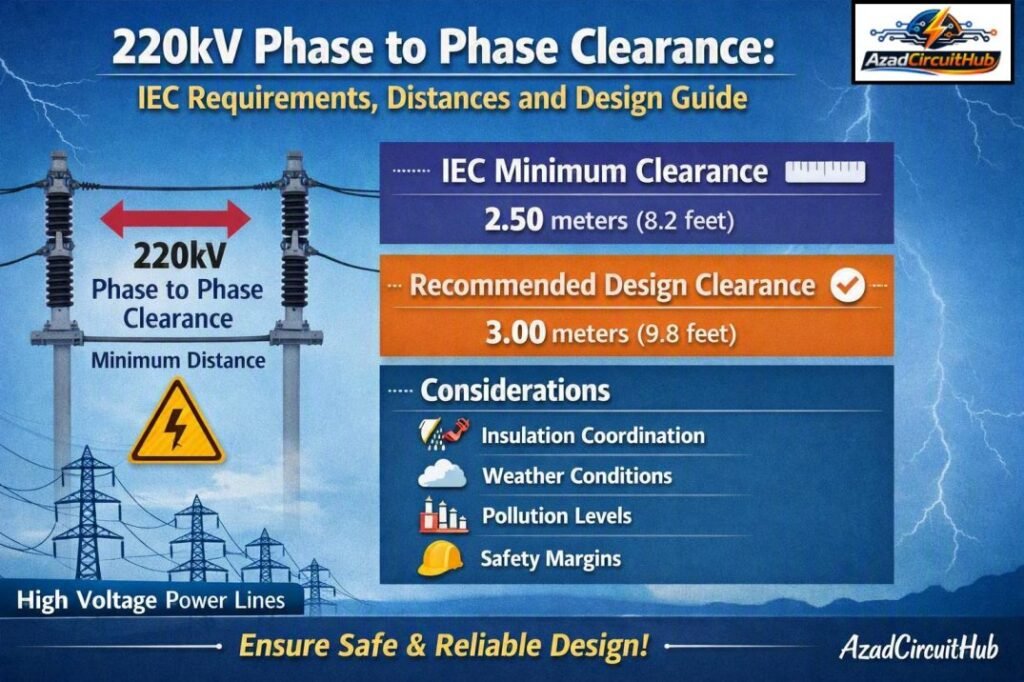
Table of Contents
Table of Contents
What Is 220kV Phase to Phase Clearance?
220kV Phase to Phase Clearance is the shortest air distance maintained between two different energized phases of a 220 kV system. The distance prevents electrical breakdown through the surrounding air when the conductors are operating at normal voltage or exposed to temporary, switching, and lightning overvoltages.
Air behaves as an electrical insulator under normal conditions. However, its insulation strength is affected by pressure, temperature, humidity, conductor geometry, pollution, and the magnitude and duration of the applied voltage.
At 220 kV, the conductor arrangement also becomes important. A sharp metal edge, unsuitable hardware, or an unfavorable conductor configuration can increase the electric field and reduce the practical withstand capability.
For this reason, clearance should be considered together with creepage distance, insulation level, electric-field distribution, and equipment geometry.
IEC Standards Used for 220 kV Clearance
IEC 61936-1 provides requirements for power installations exceeding 1 kV AC and is one of the principal references for air clearances in substations and other high-voltage installations.
IEC 60071-1 and IEC 60071-2 are used for insulation coordination. They help engineers select insulation levels and coordinate equipment withstand capability with expected overvoltages.
It is important not to use IEC 61439 as the primary clearance standard for a 220 kV outdoor installation. IEC 61439 mainly covers low-voltage switchgear and controlgear assemblies. Therefore, searches for phase to phase clearance as per iec 61439 should be interpreted carefully when dealing with 220 kV equipment.
Typical IEC-Based 220 kV Air Clearance
For equipment with a highest voltage for equipment of 245 kV, a commonly used preliminary value for phase-to-phase air clearance is approximately 2.1 m. A typical phase-to-earth clearance is approximately 1.9 m.
| Voltage class | Highest voltage for equipment | Typical phase-earth clearance | Typical phase-phase clearance |
|---|---|---|---|
| 110 kV | 123 kV | Approx. 1.1 m | Approx. 1.3 m |
| 132 kV | 145 kV | Approx. 1.3 m | Approx. 1.5 m |
| 220 kV | 245 kV | Approx. 1.9 m | Approx. 2.1 m |
| 400 kV | 420 kV | Approx. 2.9 m | Approx. 3.4 m |
The table is intended for preliminary engineering reference. Actual project requirements can differ because IEC clearance selection depends on insulation coordination and installation conditions.
Why Is Phase-to-Phase Clearance Greater Than Phase-to-Earth?
In many high-voltage installations, phase-to-phase clearance is greater than phase-to-earth clearance. The reason is that two energized conductors can have a substantial potential difference between them.
Consider two phases of a balanced three-phase system. Their instantaneous voltage difference can reach a value significantly higher than the phase-to-ground voltage. This creates a stronger electrical stress across the air gap.
The conductor arrangement also affects the electric field. When two phases are close together, the field between them becomes stronger. Increasing the physical separation reduces the possibility of an air breakdown path developing between the conductors.
This is why designers cannot simply use the phase-to-earth distance as the phase-to-phase distance.
Factors That Affect 220 kV Clearance
The basic clearance table is only the starting point. Several factors can change the required distance.
1. Switching Overvoltages
Switching operations can produce temporary high-voltage stresses. Circuit breakers, disconnectors, transformers, and transmission lines can all contribute to switching surges.
The insulation coordination study determines whether the selected air gap can withstand the expected overvoltage.
2. Lightning Impulse
Lightning produces very short but extremely high voltage impulses. The equipment insulation level must be selected so that the installation can withstand the expected lightning impulse stresses.
This is particularly important in outdoor substations and transmission line terminals.
3. Altitude
Air density decreases as altitude increases. Lower air density reduces the dielectric strength of air.
Therefore, a clearance suitable at low elevation may not provide the same insulation performance at a high-altitude installation.
An altitude correction should be applied when required by the applicable IEC design method.
4. Pollution
Dust, salt, industrial contamination, and moisture can reduce external insulation performance. Although creepage distance is particularly important for contaminated surfaces, pollution can also affect practical outdoor insulation performance.
Coastal substations and industrial areas often require additional insulation considerations.
5. Conductor Geometry
A conductor with sharp edges or poorly designed fittings can create a concentrated electric field. Corona and local discharge may occur before the theoretical air-gap limit is reached.
Rounded fittings and suitable grading arrangements help control electric-field stress.
Phase-to-Phase vs Phase-to-Earth Clearance
| Clearance type | Purpose | Typical 245 kV equipment value |
|---|---|---|
| Phase-to-phase | Prevents flashover between energized phases | About 2.1 m |
| Phase-to-earth | Prevents flashover from energized phase to grounded structure | About 1.9 m |
| Conductor-to-grounded steelwork | Maintains insulation from structures | Project dependent |
| Busbar-to-busbar | Prevents phase-to-phase breakdown | Based on insulation coordination |
| Disconnector gap | Provides required insulation and isolation | Equipment/design dependent |
The actual value should always be checked against the manufacturer’s equipment data and the project’s insulation coordination study.
Clearance in a 220 kV AIS Substation
Air-insulated substations require careful control of conductor spacing because the energized busbars, disconnectors, circuit breakers, instrument transformers, and supporting structures are exposed directly to atmospheric conditions.
A preliminary layout normally considers:
- Phase-to-phase spacing
- Phase-to-earth spacing
- Busbar height
- Equipment-to-fence distance
- Maintenance access
- Working clearances
- Switching-device geometry
- Lightning protection
- Conductor sag and swing
- Wind loading
- Altitude
- Pollution level
For a 245 kV equipment class, approximately 2.1 m may be used as an initial phase-to-phase air-gap reference, but the final substation layout must follow the applicable IEC requirements and utility specifications.
If you are comparing voltage-clearance requirements across different equipment standards, our guide to phase to phase clearance as per iec 61439 can help clarify where IEC 61439 applies and where higher-voltage installation standards should be used instead.
Clearance for 220 kV Overhead Lines
Transmission-line design introduces additional variables because conductors move under wind, temperature, and mechanical loading.
The static distance between conductors is therefore not enough. Engineers must check the minimum clearance under the most unfavorable operating condition.
Important conditions include:
- Maximum conductor sag
- Maximum wind displacement
- Temperature rise
- Ice loading where applicable
- Bundle conductor configuration
- Tower geometry
- Insulator-string movement
- Phase arrangement
- Lightning performance
- Required electrical clearances
A line designer should use the relevant overhead-line standard and utility design rules rather than directly applying a substation air-clearance table to an overhead line.
How to Calculate Phase-to-Phase Clearance
A practical clearance design follows several steps.
First, identify the nominal voltage and highest voltage for equipment. For a typical 220 kV system, this is commonly 220 kV nominal and 245 kV highest voltage for equipment.
Next, establish the required insulation level. Lightning impulse withstand voltage and switching impulse withstand voltage are important inputs.
Then determine the applicable air-clearance relationship from the relevant IEC requirements.
Finally, apply required corrections and verify the physical layout.
A simplified engineering workflow is:
- Identify system voltage.
- Determine highest voltage for equipment.
- Select insulation withstand levels.
- Assess lightning and switching overvoltages.
- Determine basic air clearance.
- Apply altitude and environmental corrections.
- Check conductor movement and geometry.
- Verify phase-to-earth and phase-to-phase distances.
- Confirm the final arrangement against the project specification.
Common Mistakes in 220 kV Clearance Design
One common mistake is selecting a distance only from the nominal system voltage. The insulation level and highest voltage for equipment also matter.
Another mistake is treating phase-to-phase and phase-to-earth distances as interchangeable. They represent different electrical stresses and should be checked separately.
Ignoring altitude is another problem. High-altitude installations may require increased air gaps because the reduced air density lowers insulation strength.
Engineers should also avoid measuring only the center-to-center distance between conductors. The relevant clearance is the shortest air path between the applicable energized surfaces.
220 kV Clearance and Electrical Safety
Electrical clearance is not the same as safe working distance.
A substation may have a specified phase-to-phase insulation clearance while also requiring a much larger restricted or approach distance for personnel. Maintenance access must account for the movement of workers, tools, temporary equipment, and vehicles.
Therefore, an engineering drawing should clearly distinguish electrical insulation clearance from occupational safety clearance.
For a broader comparison of IEC terminology and clearance requirements, see our detailed resource on phase to phase clearance as per iec 61439, especially if your project includes both LV assemblies and HV installations.
Quick Design Checklist
| Check | Required? |
|---|---|
| 220 kV nominal voltage confirmed | Yes |
| 245 kV highest voltage for equipment considered | Yes |
| Lightning impulse level checked | Yes |
| Switching impulse considered where applicable | Yes |
| Phase-to-phase clearance checked | Yes |
| Phase-to-earth clearance checked | Yes |
| Altitude correction evaluated | Yes |
| Pollution/environment reviewed | Yes |
| Conductor movement considered | Yes |
| Equipment manufacturer’s data verified | Yes |
| Utility/project specification checked | Yes |
FAQs About 220kV Phase to Phase Clearance
What is the typical 220 kV phase-to-phase clearance?
For a 220 kV system using equipment with a highest voltage for equipment of 245 kV, approximately 2.1 m is commonly used as a preliminary phase-to-phase air-clearance value. The final value must be verified using the applicable IEC requirements and project insulation coordination.
What is the phase-to-earth clearance for 220 kV?
A typical preliminary value for 245 kV equipment is around 1.9 m for phase-to-earth air clearance. Actual requirements can vary with insulation level, altitude, installation arrangement, and other design conditions.
Is IEC 61439 applicable to 220 kV clearance?
No. IEC 61439 is primarily concerned with low-voltage switchgear and controlgear assemblies. For installations above 1 kV AC, IEC 61936-1 and the IEC 60071 insulation-coordination series are more relevant references.
Does altitude affect 220 kV clearance?
Yes. Air density decreases as altitude increases, which reduces the dielectric strength of air. The applicable IEC correction method should be used for installations where altitude requires adjustment.
Is 2.1 m always enough for a 220 kV installation?
No. The 2.1 m figure should be treated as a typical preliminary reference, not a universal minimum for every 220 kV installation. Final clearance depends on the highest voltage for equipment, insulation withstand levels, overvoltages, altitude, conductor geometry, and applicable project standards.
Final Takeaway
220kV Phase to Phase Clearance is a critical parameter in the design of high-voltage substations and transmission installations. For equipment in the 245 kV highest-voltage class, approximately 2.1 m is a useful preliminary phase-to-phase air-clearance reference, while approximately 1.9 m is commonly associated with phase-to-earth clearance.
However, these figures should never be applied blindly. IEC 61936-1, IEC 60071, equipment specifications, utility requirements, altitude, environmental conditions, and the actual insulation coordination study must all be considered before finalizing a design.
For projects that involve different voltage classes, understanding the scope of each IEC standard is equally important. This prevents the common mistake of applying LV assembly requirements to HV substation equipment and helps produce a safer, more reliable electrical layout.
Get new guides in your feed. Follow Electrical Insights on LinkedIn for new electrical standards guides, calculators and design tips from Azad Circuit Hub.
#220kVPhaseToPhaseClearance, #220kVClearance, #IECClearance, #ElectricalClearance, #HighVoltage, #HVSubstation, #SubstationDesign, #IECStandards, #InsulationCoordination, #ElectricalSafety
