400kV Phase to Phase Clearance: Standards, Calculation, and Practical Guide
The 400kV phase to phase clearance is the minimum air distance required between energized conductors or live parts belonging to different phases. Unlike low-voltage installations, 400kV clearances are governed by insulation coordination, switching and lightning overvoltages, atmospheric conditions, conductor movement, and the applicable utility or national standard.
For a 400kV system, it is important to distinguish the nominal system voltage (400kV) from the maximum system voltage (Um). Under IEC 60071 practice, a 400kV network commonly has Um = 420kV.
400kV Phase to Phase Clearance — Quick Reference
| Parameter | 400kV System Value |
|---|---|
| Nominal system voltage | 400kV |
| Maximum system voltage, Um | 420kV |
| Frequency | 50Hz or 60Hz, depending on system |
| Typical IEC voltage class | 420kV |
| Insulation coordination standard | IEC 60071 series |
| Minimum phase-to-phase clearance | Project/insulation-coordination dependent |
| Typical AIS phase-to-phase design value | ≈ 3.5–4.0m |
| Typical engineering reference value | 3.6m |
| Final clearance | Must be verified against applicable standard, utility specification and site conditions |
400kV Electrical Clearance Reference
For outdoor 400/420kV air-insulated switchgear (AIS), a commonly used engineering value for phase-to-phase clearance is around 3.6m, but 3.6m should not be presented as a universal IEC minimum. IEC 60071 establishes insulation-coordination principles rather than giving one blanket phase-to-phase distance for every 400kV installation.
| Clearance Type | Typical 400kV/420kV AIS Reference | What It Protects Against |
|---|---|---|
| Phase-to-phase | ≈ 3.6m | Electrical flashover between phases |
| Phase-to-earth | ≈ 3.0–3.6m | Flashover from energized part to grounded structure |
| Conductor-to-ground | Project-specific | Insulation and safety clearance |
| Section clearance | Project-specific | Safe isolation between sections |
| Maintenance clearance | Project-specific | Personnel and equipment access |
| Busbar phase spacing | Project-specific, often around 3.5–4.0m | Electrical and mechanical requirements |
Why 400kV Clearance Is Not Just a Fixed Number
The required air gap depends on the withstand voltage, electrode configuration, altitude, pollution, atmospheric conditions and type of overvoltage. For example, a 420kV AIS installation may have different clearances from another installation because one site is at high altitude or uses different insulation-coordination parameters.
The basic design relationship is:
Required clearance ≥ required withstand distance under the applicable installation conditions
Therefore, the final 400kV phase to phase clearance should be established during insulation coordination rather than simply multiplying 400kV by a fixed factor.
IEC 60071-1 and IEC 60071-2 should be used for insulation coordination, while the applicable IEC 62271 requirements and utility specifications should be checked for high-voltage switchgear and substation arrangements. The 3.6m value above is a typical engineering reference for 400/420kV AIS, not a universal IEC-prescribed minimum.
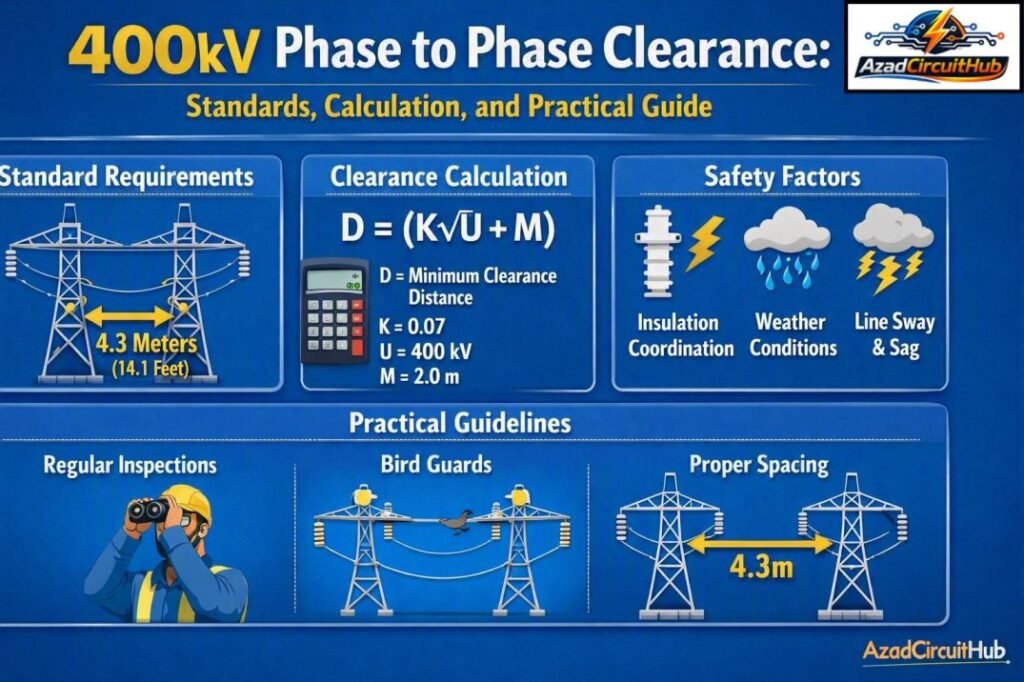
Table of Contents
Table of Contents
What Does 400kV Phase to Phase Clearance Mean?
400kV phase to phase clearance is the shortest air distance between two conductors or conductive parts belonging to different phases of a 400 kV circuit.
For example, in a three-phase outdoor switchyard, the A, B, and C phase conductors are maintained at calculated distances from each other. The spacing must remain adequate even when conductors experience wind, thermal expansion, mechanical movement, or switching forces.
The clearance is different from creepage distance. Clearance is measured through air, while creepage distance is measured along the surface of an insulating material.
| Term | Meaning |
|---|---|
| Phase-to-phase clearance | Air distance between conductors of different phases |
| Phase-to-earth clearance | Air distance between an energized conductor and grounded structure |
| Creepage distance | Distance along an insulation surface |
| Electrical clearance | Minimum air gap required to withstand specified voltage stress |
| Insulation coordination | Selection of insulation withstand levels and clearances for expected overvoltages |
How Is 400kV Phase to Phase Clearance Determined?
A simple voltage divided by an assumed dielectric strength calculation is not suitable for final 400 kV design. High-voltage air insulation is affected by several variables.
The engineering process generally starts with the highest system voltage and then establishes the expected overvoltage conditions. The insulation withstand levels are selected according to the insulation coordination study.
Important inputs include:
- Highest voltage for equipment
- Lightning impulse withstand voltage
- Switching impulse withstand voltage
- Temporary overvoltages
- Atmospheric correction factors
- Installation altitude
- Electrode configuration
- Conductor geometry
- Pollution and environmental conditions
- Safety and maintenance requirements
The resulting minimum air distance is then checked against the physical substation arrangement.
Switching Impulse and Lightning Impulse Clearance
At 400 kV, switching surges are particularly important because the voltage stress produced by switching operations can be significant. Circuit breaker operation, fault clearing, line energization, and fault initiation can produce transient overvoltages.
Lightning impulse withstand is also important for equipment connected to overhead transmission lines.
| Voltage stress | Typical source | Design relevance |
|---|---|---|
| Power-frequency voltage | Normal system operation | Basic insulation stress |
| Temporary overvoltage | Earth faults and load rejection | Equipment insulation |
| Switching impulse | Switching operations | Very important at EHV levels |
| Lightning impulse | Atmospheric lightning | Transmission line and substation insulation |
| Transient overvoltage | Network disturbances | Insulation coordination |
The designer should therefore avoid using a single generic clearance figure for every 400 kV application.
Typical Substation Factors Affecting Phase Clearance
Outdoor 400 kV switchyards are exposed to changing environmental and mechanical conditions. A clearance that works under laboratory conditions may not provide the same margin in an actual installation.
Altitude is one of the most important factors. Air density decreases as altitude increases, reducing the dielectric strength of air. An installation at high elevation may therefore require increased clearance.
Wind can also move flexible conductors and jumper connections. Thermal loading causes conductors to expand and change their position. Equipment tolerances and construction deviations must also be considered.
| Design factor | Effect on clearance |
|---|---|
| High altitude | May require increased air clearance |
| Strong wind | Causes conductor movement |
| High conductor temperature | Changes conductor position |
| Pollution | Affects external insulation performance |
| Rain and humidity | Can influence insulation performance |
| Switching surges | Increase transient electrical stress |
| Lightning | Creates high impulse voltage |
| Maintenance access | Requires safe working separation |
For this reason, the final physical arrangement should include appropriate engineering margins rather than relying only on the theoretical minimum.
400kV Phase to Phase Clearance vs Phase to Earth
Phase-to-phase and phase-to-earth clearances serve different purposes. A phase-to-earth clearance protects against flashover between an energized conductor and a grounded structure. Phase-to-phase clearance prevents an electrical arc from developing between different energized phases.
In a substation, both distances must be checked.
| Clearance | Between | Main purpose |
|---|---|---|
| Phase-to-phase | Two energized phases | Prevent interphase flashover |
| Phase-to-earth | Energized phase and grounded object | Prevent earth flashover |
| Conductor-to-structure | Conductor and steelwork | Maintain insulation and safety |
| Busbar-to-busbar | Adjacent bus conductors | Prevent phase faults |
| Jumper-to-jumper | Flexible connections | Maintain safe electrical separation |
A switchyard layout should therefore be reviewed in three dimensions because the closest point may not occur at the same elevation or conductor section.
Is IEC 61439 Applicable to 400 kV Clearance?
IEC 61439 is primarily concerned with low-voltage switchgear and controlgear assemblies. It is not the governing standard for determining 400 kV outdoor transmission switchyard phase spacing.
This distinction is important when selecting standards for an engineering project. If your work involves LV switchboards or assemblies, you may need to review phase to phase clearance as per iec 61439. For a 400 kV installation, however, insulation coordination and high-voltage installation requirements must be assessed using the relevant high-voltage standards.
IEC 60071 is particularly important for insulation coordination, while equipment-specific IEC standards may apply to circuit breakers, disconnectors, instrument transformers, busbars, and other substation equipment.
Practical Clearance Design Checklist
Before approving a 400 kV switchyard layout, engineers should verify the following:
- Confirm the highest system voltage.
- Establish the required insulation withstand levels.
- Perform an insulation coordination study.
- Consider switching and lightning impulse stresses.
- Apply altitude correction where necessary.
- Check phase-to-phase and phase-to-earth distances.
- Allow for conductor sag and thermal movement.
- Consider wind-induced conductor displacement.
- Check equipment dimensional tolerances.
- Review maintenance and safety requirements.
- Verify the approved utility or grid-code requirements.
- Confirm the final arrangement against applicable IEC and local standards.
For LV assemblies, understanding phase to phase clearance as per iec 61439 can also help engineers distinguish low-voltage assembly requirements from EHV substation insulation coordination.
Common Mistakes in 400 kV Clearance Design
One common mistake is selecting a clearance solely from the nominal voltage. The 400 kV label describes the system voltage, but the actual insulation stress can be considerably higher during transient events.
Another mistake is ignoring altitude. Atmospheric pressure has a direct influence on air insulation performance. Conductor movement is another frequent issue, particularly where flexible jumpers are used.
| Mistake | Why it matters |
|---|---|
| Using nominal voltage only | Does not account for impulse stresses |
| Ignoring altitude | Air insulation strength decreases with altitude |
| Ignoring conductor movement | Actual operating gap can become smaller |
| Confusing clearance with creepage | They protect against different insulation stresses |
| Using an LV standard for EHV design | Standards have different application ranges |
| Omitting maintenance conditions | Personnel and equipment clearances may be inadequate |
Frequently Asked Questions
What is the standard phase-to-phase clearance for 400 kV?
There is no single universal clearance value that applies to every 400 kV installation. The required distance depends on insulation coordination, impulse withstand levels, altitude, conductor configuration, environmental conditions, and the applicable installation standard.
Why is clearance needed between 400 kV phases?
The clearance prevents flashover between phases when the system experiences normal voltage, switching surges, lightning impulses, and other transient conditions. Adequate spacing is essential for system reliability and personnel safety.
Is 420 kV equipment used on a 400 kV system?
Yes. Many 400 kV networks use equipment with a highest voltage for equipment around 420 kV. The exact equipment rating depends on the grid specification and applicable IEC requirements.
Does altitude affect 400 kV air clearance?
Yes. At higher altitude, air density and dielectric strength decrease. An appropriate altitude correction must therefore be considered when determining external insulation distances.
Does IEC 61439 specify 400 kV phase clearance?
No. IEC 61439 covers low-voltage switchgear and controlgear assemblies. It should not be treated as the primary standard for determining phase spacing in a 400 kV transmission switchyard. High-voltage insulation coordination standards, including the IEC 60071 series, are more relevant.
Final Considerations
Proper 400kV Phase to Phase Clearance design requires more than selecting a distance from a voltage chart. Engineers must evaluate insulation coordination, switching impulses, lightning impulses, altitude, conductor movement, environmental conditions, equipment geometry, and applicable utility requirements.
For practical design work, the final clearance should come from the project’s approved insulation coordination study and applicable standards rather than from a generic online value. This approach provides a better safety margin and helps prevent costly flashovers, equipment damage, and unplanned outages.
Get new guides in your feed. Follow Electrical Insights on LinkedIn for new electrical standards guides, calculators and design tips from Azad Circuit Hub.
#400kVPhaseToPhaseClearance, #400kVClearance, #HighVoltageClearance, #ElectricalClearance, #PowerTransmission, #HVEngineering, #ElectricalSafety, #SubstationDesign, #IECStandards, #TransmissionLines