
Fluke 355 True RMS Clamp Meter Review: Features, Accuracy & Buying Guide
The Fluke 355 True RMS Clamp Meter is a heavy-duty clamp meter built for electricians, maintenance engineers, and technicians who regularly work around high-current conductors. Unlike compact clamp meters designed mainly for residential troubleshooting, this model is aimed at demanding electrical measurements where a wide current range and large jaw opening are important.
As an electrical engineer with more than 15 years of field experience in electrical panels, industrial automation, PLCs, SCADA systems, and power equipment, I look at clamp meters from a practical point of view. Current range matters, but so do jaw size, True RMS accuracy, voltage measurement, frequency, resistance, and how easily the meter can be used around large conductors.
Fluke 355 True RMS Clamp Meter Features at a Glance
| Feature | Fluke 355 Specification |
|---|---|
| AC Current | Up to 2,000A |
| DC Current | Up to 2,000A |
| Measurement Type | True RMS |
| Jaw Opening | Up to 58 mm |
| Voltage Measurement | AC/DC |
| Resistance | Yes |
| Frequency | Yes |
| Display | Digital display |
| Primary Use | Industrial and high-current electrical work |
| Product Type | Heavy-duty AC/DC clamp meter |
The standout feature is the combination of 2,000A AC/DC current measurement and a large 58 mm jaw opening. That makes the meter suitable for larger conductors where a standard electrician's clamp meter may physically struggle.
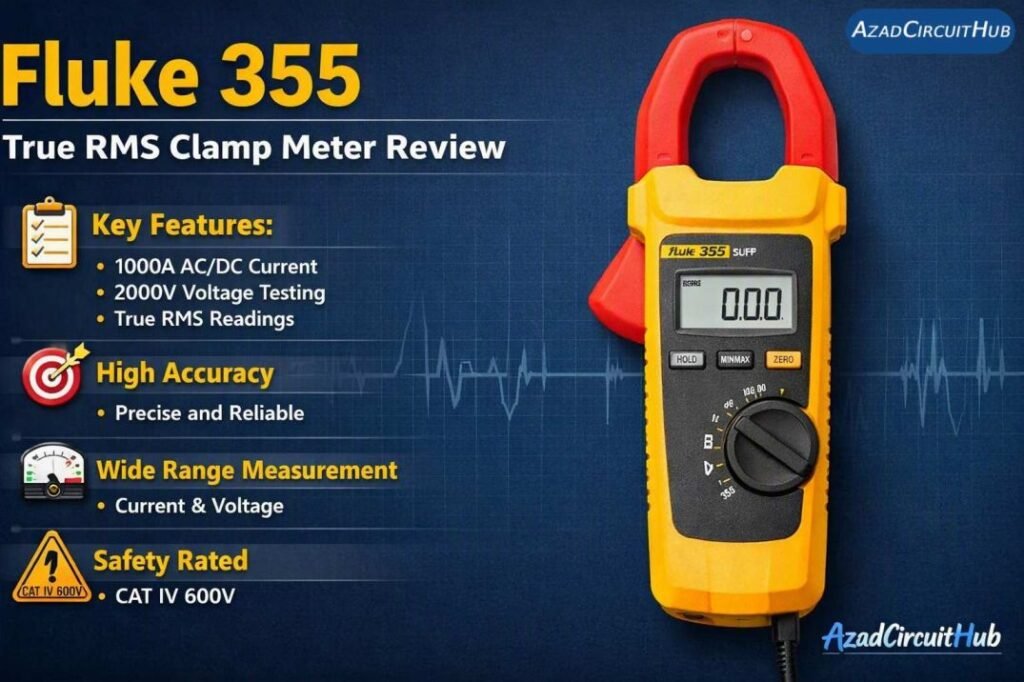
Table of Contents
Table of Contents
What Makes the Fluke 355 Different?
The Fluke 355 is designed around high-current electrical work. Its 2,000A AC/DC capability gives technicians considerably more measurement headroom than many general-purpose clamp meters.
The large jaw is equally important. A clamp meter can have an impressive current specification but still be difficult to use if its jaw cannot fit around the conductor.
The 58 mm jaw opening gives the Fluke 355 enough clearance for many larger cables and conductors used in industrial distribution systems, motor circuits, generators, and electrical equipment.
True RMS measurement is another useful feature. It helps the meter measure AC signals more accurately when the waveform is not a clean sine wave. This matters around variable frequency drives, power electronics, UPS systems, and other nonlinear loads.
For readers comparing different Fluke models, my guide to the best fluke clamp meter for electrician covers additional options for residential, commercial, and industrial work.
2,000A AC/DC Current Measurement
The main reason to buy this meter is its high current measurement capability.
The Fluke 355 can measure AC and DC current up to 2,000A. This makes it particularly useful when troubleshooting large electrical equipment where lower-range clamp meters may not be suitable.
AC current measurement is useful for checking:
- Motor loads
- Distribution feeders
- Generator output
- Large HVAC equipment
- Industrial machinery
- Battery and DC systems
- Inverter and power-conversion equipment
- Large electrical panels
DC current capability is especially useful for technicians working around batteries, DC power systems, and industrial control equipment.
The actual accuracy and measurement limits depend on the selected range and operating conditions, so the manufacturer's specifications should be checked before using the meter for critical measurements.
58 mm Jaw Opening for Large Conductors
One of the practical advantages of the Fluke 355 is its large clamp jaw.
A 58 mm opening provides significantly more physical clearance than many compact clamp meters. This is useful when measuring thick cables or multiple conductors where access is limited.
The clamp design also allows current to be measured without disconnecting the conductor. That can reduce the amount of circuit interruption required during troubleshooting.
However, the normal clamp-meter rule still applies: clamp around the intended conductor only. If multiple conductors carrying opposing currents are inside the jaw, their magnetic fields can affect the reading.
True RMS Measurement in Real Electrical Systems
True RMS is particularly useful in modern electrical installations.
A basic averaging meter may produce inaccurate readings when the current waveform is distorted. Industrial loads often create these conditions because of switching power supplies, variable frequency drives, rectifiers, UPS equipment, and other electronic loads.
The Fluke 355 True RMS Clamp Meter is therefore better suited to environments where waveform distortion is part of normal operation.
For example, if I were checking the current of a motor supplied through a drive, I would want a meter designed to handle non-linear waveforms rather than relying only on a basic average-responding instrument.
Voltage, Resistance and Frequency Measurements
The Fluke 355 is not limited to current measurement. It also provides voltage, resistance, and frequency functions.
| Measurement | Practical Application |
|---|---|
| AC Voltage | Distribution and equipment checks |
| DC Voltage | Batteries and DC systems |
| AC Current | Motors, feeders and loads |
| DC Current | Battery and DC equipment |
| Resistance | Continuity and component checks |
| Frequency | Supply and equipment verification |
These additional functions make the meter more useful during fault finding. Instead of carrying a current clamp and separate basic multimeter for every job, technicians can perform several common measurements from one instrument.
Still, a clamp meter should not automatically replace a dedicated high-accuracy multimeter for every application. Instrument selection should follow the measurement and safety requirements.
Is the Fluke 355 Good for Industrial Electrical Work?
This is where the Fluke 355 makes the most sense.
For industrial maintenance, the combination of high current capacity, large jaw clearance, AC/DC measurement, and True RMS capability gives it a practical advantage over smaller clamp meters.
I would consider it particularly relevant for technicians working with:
- Industrial motor feeders
- Main distribution systems
- Large generators
- Industrial HVAC
- Control panels
- UPS installations
- Battery banks
- Large DC systems
- Power distribution equipment
If your work is mostly household circuits and small control panels, the 2,000A capacity may be more than you need.
For a broader comparison of clamp meters for different electrical jobs, see my best clamp meter guide before choosing a model.
Fluke 355 True RMS Clamp Meter vs a Standard Clamp Meter
The difference becomes clearer when the intended application is considered.
| Requirement | Fluke 355 | Basic Clamp Meter |
|---|---|---|
| High-current measurement | Excellent fit | May be limited |
| Large conductors | 58 mm jaw | Usually smaller |
| AC/DC current | Yes | Depends on model |
| True RMS | Yes | Depends on model |
| Industrial troubleshooting | Well suited | Model dependent |
| Small residential circuits | More capability than necessary | Often sufficient |
A larger instrument is not automatically better for every job. The Fluke 355 is valuable when its high-current and large-conductor capabilities are actually required.
Buying the Fluke 355 on Amazon
If you regularly measure high-current AC and DC circuits, the Fluke 355 is worth considering because its specifications are aimed at demanding electrical environments.
Check today's Fluke 355 price on Amazon
Before ordering, verify the current seller, warranty coverage, included accessories, and exact product configuration. Amazon pricing and availability can change, so checking the current listing is important.
If you are comparing several Fluke instruments before buying, my best clamp meter reviews guide provides a wider look at options for electricians and technicians.
Practical Tips for Using the Fluke 355
A high-current clamp meter still needs to be used correctly. I recommend checking these points before taking measurements:
- Select the correct AC or DC current function.
- Make sure the jaws fully close around the conductor.
- Keep other current-carrying conductors outside the clamp where appropriate.
- Confirm the meter's voltage and current ratings before testing.
- Use the correct PPE and safe working practices.
- Do not exceed the meter's measurement limits.
- Check the instrument and test leads for damage.
- Follow the manufacturer's safety instructions.
For high-energy industrial systems, the meter is only one part of the safety process. Isolation, verification, arc-flash procedures, and appropriate PPE remain essential.
Fluke 355 True RMS Clamp Meter Review: Pros and Cons
| Pros | Considerations |
|---|---|
| 2,000A AC/DC measurement | Larger than needed for simple residential work |
| 58 mm jaw opening | Less compact than small clamp meters |
| True RMS technology | Premium instrument category |
| Measures voltage and resistance | Not intended as a tiny pocket meter |
| Frequency measurement | High-current capability may be unnecessary for some users |
| Strong fit for industrial troubleshooting | Check exact safety requirements for your application |
Frequently Asked Questions
What is the maximum current of the Fluke 355?
The Fluke 355 is rated for current measurement up to 2,000A AC/DC, making it suitable for many high-current industrial applications.
What size conductor can the Fluke 355 clamp around?
The clamp has a jaw opening of up to 58 mm. The actual conductor configuration should always be checked before measurement.
Is the Fluke 355 a True RMS meter?
Yes. True RMS measurement makes it suitable for measuring AC signals where waveform distortion may be present.
Can the Fluke 355 measure DC current?
Yes. DC current measurement is one of the important capabilities of the Fluke 355, making it useful for battery systems and other DC applications.
Is the Fluke 355 suitable for electricians?
It can be a strong fit for electricians and industrial technicians who work with large conductors and high-current AC/DC systems. For routine residential work, a smaller clamp meter may provide the functions needed at a lower cost.
Final Verdict on the Fluke 355
The Fluke 355 True RMS Clamp Meter is designed for a specific type of electrical work: high-current measurement around larger conductors. Its 2,000A AC/DC capability, 58 mm jaw opening, True RMS measurement, and additional voltage, resistance, and frequency functions make it particularly relevant to industrial maintenance and power-system troubleshooting.
From my experience working around electrical panels and industrial systems, I would focus on the actual application before buying. If your work involves large feeders, motors, generators, battery systems, or industrial equipment, the Fluke 355 offers useful measurement headroom. If most of your jobs involve smaller circuits, a more compact Fluke clamp meter may be easier to carry and sufficient for the measurements you perform.
Related Guides
- Fluke 301D Clamp Meter Review
- Fluke T5-600 Electrical Tester Review
- Fluke 393 FC Solar Clamp Meter Review
- Best 1000A Clamp Meter for Industrial Use
Get new guides in your feed. Follow Electrical Insights on LinkedIn for new electrical standards guides, calculators and design tips from Azad Circuit Hub.
#Fluke355, #Fluke355ClampMeter, #TrueRMSClampMeter, #ClampMeter, #FlukeClampMeter, #ElectricalTesting, #ElectricianTools, #PowerMeasurement, #ElectricalEngineering, #TestEquipment
