
Fluke 301D Clamp Meter Review: 600A AC/DC Testing, Slim Jaw & Field Performance
The Fluke 301D/ESP is a compact 600A AC/DC clamp meter designed for electricians and technicians who need current measurement in crowded electrical panels, control cabinets, and tight cable spaces. Its slim body and thin jaw arm make it easier to position around conductors where a larger clamp meter can be awkward.
As an electrical engineer with hands-on experience in electrical troubleshooting, automation, power systems, and field maintenance, I look at clamp meters beyond the specification sheet. Jaw access, current range, display usability, measurement flexibility, and practical handling all matter when a meter is used repeatedly on live equipment.
Fluke 301D Clamp Meter: Key Features at a Glance
| Feature | Fluke 301D/ESP Specification |
|---|---|
| AC current | Up to 600 A |
| DC current | Up to 600 A |
| Clamp design | Slim jaw arm |
| Body | Compact and slim |
| Current measurement | AC/DC |
| Application | Electrical troubleshooting, maintenance, HVAC, industrial work |
| Jaw advantage | Designed for access around tightly packed conductors |
| Display | Digital display |
| Product type | Clamp meter |
| Best suited for | Electricians, technicians and maintenance engineers |
| Affiliate availability | Amazon |
The combination of 600A AC/DC current measurement and a narrow clamp profile is the main reason to consider this model. It targets users who want a practical field meter without carrying a bulky instrument for routine current checks.
Check the Fluke 301D/ESP on Amazon if you need a compact 600A AC/DC clamp meter for electrical troubleshooting and maintenance work.
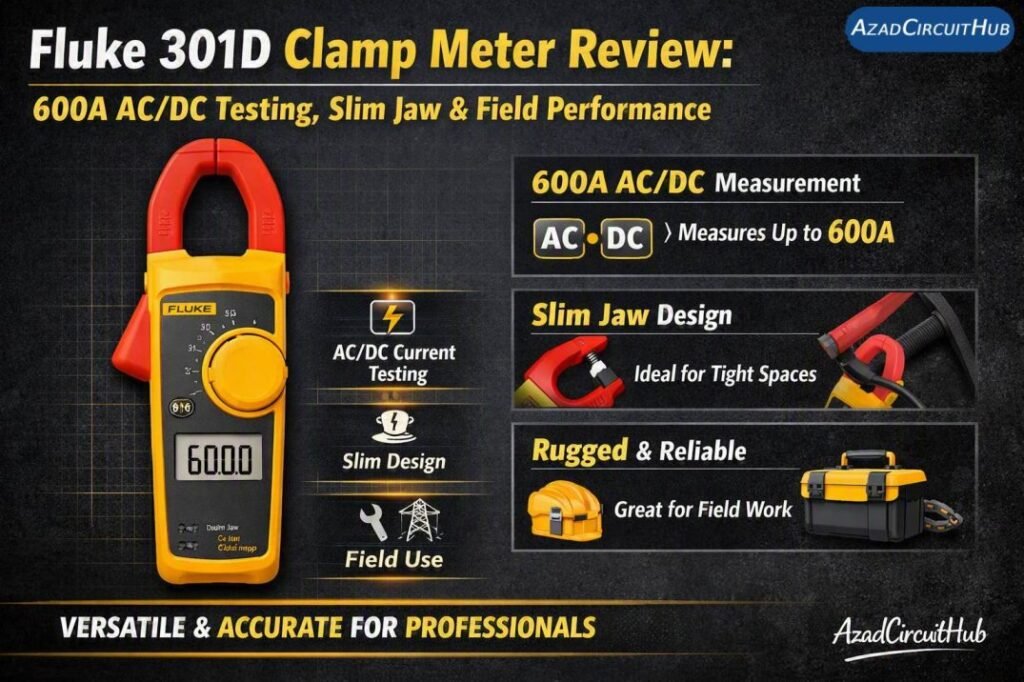
Table of Contents
Table of Contents
What Makes the Fluke 301D Clamp Meter Different?
The biggest practical advantage is its physical design. A clamp meter can have excellent electrical specifications, but if its jaw cannot reach a conductor in a crowded panel, those specifications have limited value.
The thin jaw arm on the Fluke 301D Clamp Meter is intended for this type of situation. It can be easier to position around individual conductors in distribution boards, control panels, motor circuits, and other restricted spaces.
For field engineers, this can reduce the need to move adjacent wiring simply to get a current reading.
The 600A range also covers many common electrical maintenance tasks. It can be used for checking load current, investigating unbalanced circuits, troubleshooting motors, and verifying current draw during equipment operation.
AC and DC Current Measurement
One important feature is the ability to measure both AC and DC current.
| Measurement | Typical Field Use |
|---|---|
| AC current | Distribution circuits, motors, HVAC equipment, general loads |
| DC current | Battery circuits, control systems, DC equipment and automotive applications |
| Current up to 600A | Medium-to-high current troubleshooting |
| Clamp measurement | Current testing without disconnecting the conductor |
For AC systems, a clamp meter is particularly useful when you need to measure operating current without opening the circuit.
DC current measurement can also be valuable for battery-backed systems, control equipment, and other DC applications. However, the exact accuracy and measurement limitations should always be checked against the manufacturer's current specification before using the instrument for critical measurements.
For routine maintenance, having AC and DC current capability in one compact instrument is more convenient than carrying separate meters.
Slim Body and Thin Jaw Arm
The physical design deserves attention because it affects everyday usability.
Large clamp meters can struggle when several cables are packed closely together. A narrow jaw can make it easier to isolate the conductor you actually want to measure.
| Design Feature | Practical Benefit |
|---|---|
| Slim body | Easier to carry and store |
| Thin jaw arm | Better access around crowded conductors |
| Clamp measurement | No need to disconnect the conductor |
| Compact format | Useful for field service |
| 600A capacity | Covers many maintenance applications |
This is especially useful when troubleshooting control panels where cable spacing is limited. It can also help when measuring individual conductors inside distribution equipment.
If most of your work involves large switchgear or very large conductors, compare the jaw opening and conductor capacity with your application before purchasing.
Fluke 301D Clamp Meter for Electricians
Electricians often need one instrument that can handle several routine diagnostic tasks without taking up much space in a tool bag.
The Fluke 301D Clamp Meter fits this type of workflow particularly well when current measurement is a regular requirement.
Common applications include:
- Checking motor operating current
- Measuring feeder current
- Troubleshooting electrical loads
- Checking DC battery circuits
- Investigating current imbalance
- Testing equipment during maintenance
- Measuring current in confined panels
- Performing preventive electrical inspections
It is also useful for technicians working on HVAC, industrial machinery, building services, and general electrical systems.
If you are comparing several models before buying, our best fluke clamp meter for electrician guide can help you compare different Fluke clamp meters according to application and features.
Measurement Applications in Industrial Maintenance
In industrial environments, clamp meters are often used during troubleshooting rather than laboratory testing.
For example, an engineer may measure motor current on each phase to identify an abnormal load condition. Current readings can then be compared with the motor nameplate rating and other operating parameters.
A clamp meter can also help during preventive maintenance. Repeated measurements can reveal changes in equipment current over time.
| Application | What to Check |
|---|---|
| Three-phase motor | Phase current and load balance |
| Pump motor | Running current against rated current |
| HVAC equipment | Compressor and fan current |
| Distribution board | Feeder and branch circuit current |
| Battery system | DC current |
| Control panel | DC loads and individual circuits |
Current measurements should not be treated as a complete diagnostic by themselves. Voltage, power factor, temperature, insulation condition, mechanical loading, and equipment specifications may also need to be considered.
How Easy Is the Fluke 301D to Use?
A clamp meter is only useful in the field if its controls and physical design are straightforward.
The compact format of the Fluke 301D Clamp Meter makes it suitable for technicians who frequently move between equipment and need quick current checks.
The basic clamp-meter workflow is simple:
- Select the appropriate current function.
- Confirm the expected current range.
- Open the clamp jaw.
- Position the jaw around the conductor.
- Keep the conductor centered where practical.
- Read the displayed measurement.
- Remove the meter after completing the test.
For accurate current measurement, make sure the clamp surrounds only the conductor being measured. If both the outgoing and return conductors pass through the jaw, their magnetic fields can cancel and produce an incorrect reading.
Fluke 301D Clamp Meter vs. a Standard Multimeter
A clamp meter and a conventional multimeter serve different purposes.
A multimeter is often better when you need detailed voltage, resistance, continuity, or other electrical measurements. A clamp meter becomes particularly useful when measuring current without breaking the circuit.
| Requirement | Clamp Meter | Standard Multimeter |
|---|---|---|
| Current without circuit disconnection | Excellent | Generally unsuitable |
| Voltage testing | Model dependent | Excellent |
| Resistance | Model dependent | Excellent |
| Measuring high current | Practical with suitable rating | Requires appropriate current input/accessories |
| Tight conductor access | Depends on jaw design | Probe access required |
| Motor load checks | Very useful | Less convenient for current |
For electricians who already own a good multimeter, adding a compact clamp meter can expand troubleshooting capability.
For a broader side-by-side look at available models, see our fluke clamp meter comparison chart before deciding which meter fits your work.
Is the Fluke 301D Good for HVAC and Motor Work?
The 600A AC/DC capacity makes this model relevant to many HVAC and motor troubleshooting tasks.
For motors, technicians can measure running current and compare the readings between phases. Significant differences can indicate that further investigation is needed.
For HVAC equipment, current measurement can help check compressor and fan operation. The meter can also be useful during service calls where equipment must be tested without disconnecting conductors.
However, current alone does not confirm that a motor or compressor is healthy. Electrical and mechanical measurements should be considered together.
Buying Considerations Before Ordering
Before purchasing, check the meter's current specifications, jaw capacity, accuracy, safety ratings, and functions against your intended work.
| Buying Check | Why It Matters |
|---|---|
| 600A current rating | Determines the applications it can handle |
| AC/DC capability | Important for mixed electrical systems |
| Jaw dimensions | Critical for crowded panels |
| Accuracy | Important for diagnostic measurements |
| Safety category | Must match the electrical environment |
| Display | Affects readability in field conditions |
| Size and weight | Matters for everyday tool-bag use |
Availability and pricing on Amazon can change, so check the current product listing before ordering.
See the Fluke 301D/ESP on Amazon for the latest price, availability, specifications, and customer feedback.
Who Should Consider the Fluke 301D?
The Fluke 301D Clamp Meter is worth considering if your work involves frequent current measurements and you value a compact instrument.
It can be particularly relevant for:
- Electricians
- Electrical maintenance technicians
- Industrial technicians
- HVAC technicians
- Automation engineers
- Building maintenance teams
- Field service engineers
It may be less suitable if your primary requirement is advanced power-quality analysis, waveform capture, high-end logging, or specialized electrical measurements. In those cases, a more advanced Fluke instrument may be more appropriate.
For electricians who want to compare models by current capacity, jaw design, measurement functions, and intended applications, our Best Clamp Meter for Electricians resource provides additional buying information.
Pros and Cons
| Pros | Considerations |
|---|---|
| 600A AC/DC current capability | Check specifications for critical measurements |
| Slim body | Compact design may not replace larger specialty meters |
| Thin jaw arm | Verify jaw capacity for your conductors |
| Useful for field troubleshooting | Advanced power analysis requires a different instrument |
| Suitable for many electrical applications | Always match CAT rating to the work environment |
| Fluke professional instrument design | Price may be higher than basic clamp meters |
Frequently Asked Questions
Is the Fluke 301D Clamp Meter suitable for electricians?
Yes. Its compact design, thin jaw arm, and 600A AC/DC current capability make it suitable for many electrical maintenance and troubleshooting tasks. Electricians should still verify the meter's safety rating and specifications for their particular installation.
Can the Fluke 301D measure DC current?
Yes, the 301D/ESP is designed for AC and DC current measurement up to 600A. This makes it useful for both conventional AC electrical systems and suitable DC applications.
What is the main advantage of the thin jaw?
The thin jaw arm can make it easier to access individual conductors in crowded electrical panels and equipment. This is useful where a larger clamp meter cannot be positioned comfortably.
Can I use this clamp meter for motor current?
Yes, provided the motor circuit falls within the meter's specified measurement range and electrical safety rating. It can be used to check running current and compare phase currents during troubleshooting.
Is the Fluke 301D suitable as my only electrical meter?
That depends on your work. A clamp meter is excellent for current measurement, but electricians who also need extensive voltage, resistance, continuity, insulation, frequency, or advanced power-quality testing may require additional instruments.
Final Buying Perspective
The Fluke 301D/ESP combines a 600A AC/DC current range with a slim body and thin jaw arm, making it particularly relevant to field technicians who regularly work around confined wiring. Its strongest practical use case is straightforward current measurement during electrical maintenance and troubleshooting.
If compact access is important in your daily work, the physical design deserves as much attention as the electrical specifications. Before purchasing, compare the current rating, jaw capacity, safety category, accuracy, and functions with the circuits you normally service.
For current Amazon pricing and availability, check the Fluke 301D/ESP on Amazon before making your purchase.
Get new guides in your feed. Follow Electrical Insights on LinkedIn for new electrical standards guides, calculators and design tips from Azad Circuit Hub.
#Fluke301D, #ClampMeter, #FlukeClampMeter, #ClampMeterReview, #ElectricalTesting, #ElectricianTools, #ACDCClampMeter, #ElectricalTestTools, #FlukeTools, #Multimeter
