DEWALT 48A Level 2 EV Charger Review: Specs, Charging Speed & Buying Guide
The DEWALT 48A Level 2 EV Charger is designed for EV owners who want faster home charging without moving into an oversized commercial-style charging system. It is a 240V hardwired wall-mounted charger with up to 48 amps of output, Wi-Fi and Bluetooth connectivity, a 25-foot charging cable, and indoor or outdoor installation capability.
I have spent more than 15 years working as an electrical engineer in panel work, industrial automation, PLCs, SCADA systems, and electrical troubleshooting. When I review an EV charger, I look beyond the headline amperage. I also consider the electrical installation, charging cable length, connectivity, enclosure, continuous load, and how practical the unit is for daily home charging.
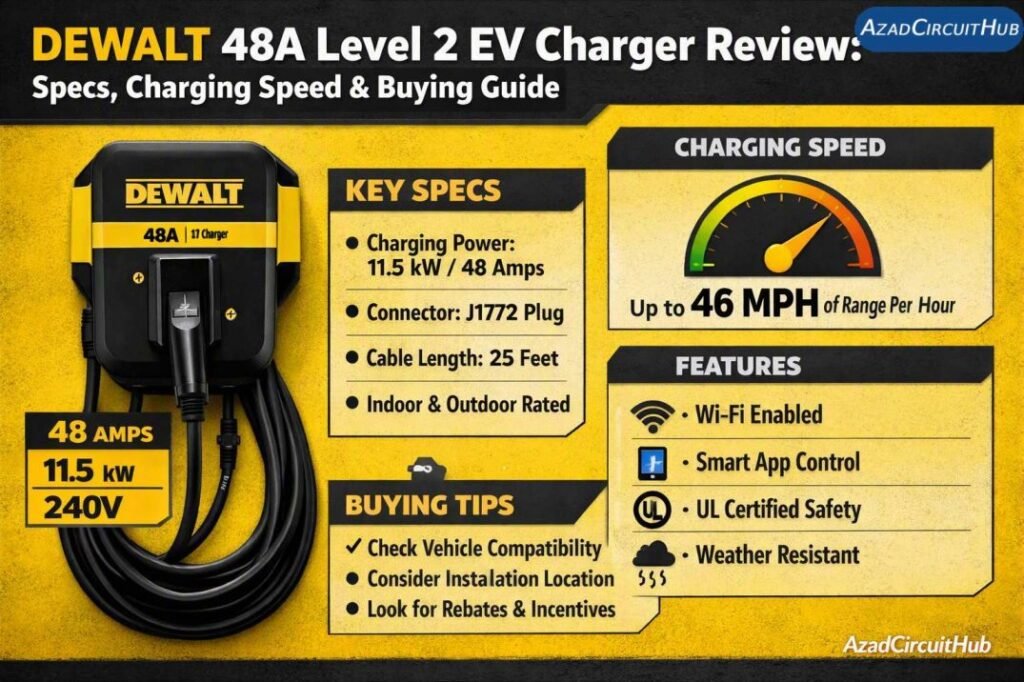
Table of Contents
Table of Contents
DEWALT 48A Level 2 EV Charger Specifications
| Feature | Specification |
|---|---|
| Charger type | Level 2 AC EV charger |
| Maximum output | 48A |
| Supply voltage | 240V |
| Installation | Hardwired |
| Cable length | 25 feet |
| Connectivity | Wi-Fi and Bluetooth |
| Mounting | Wall mounted |
| Location | Indoor / outdoor |
| Certification | CSA certified |
| Charging connector | J1772 |
| Maximum theoretical power | 11.5 kW |
| Main use | Residential EV charging |
The combination of 48A output and a long cable makes this DEWALT charging station particularly interesting for garages and driveways where the electrical panel is not directly beside the vehicle.
48A Charging Performance
At 240V, a 48A EV charger has a theoretical output of approximately 11.5 kW.
That is considerably faster than a typical 16A or 32A Level 2 charger. However, the actual charging rate depends on the vehicle's onboard AC charger. If your EV accepts only 7.2 kW or 9.6 kW from AC charging, installing a 48A EVSE will not make the vehicle charge beyond its onboard limit.
The 48A capacity is therefore most useful with EVs capable of accepting higher AC charging power.
Because EV charging is a continuous electrical load, the circuit must be designed accordingly. A qualified electrician should verify conductor sizing, overcurrent protection, service capacity, grounding, and local code requirements before installation.
25-Foot Charging Cable
One feature I particularly like from a practical installation perspective is the 25-foot cable.
A short EV charger cable can become frustrating when the parking position is not directly beside the wall unit. A 25-foot cable gives considerably more flexibility for positioning the vehicle.
This can be useful when:
- The charging station is mounted on a garage side wall.
- Two parking positions share one charger.
- The electrical panel is located away from the ideal parking position.
- The charger is installed outside.
- The vehicle's charging port is toward the front or rear of the vehicle.
Cable management still matters. The cable should be routed and stored so that it does not create a trip hazard or experience unnecessary mechanical stress.
Wi-Fi and Bluetooth Connectivity
The DEWALT 48A Level 2 EV Charger includes both Wi-Fi and Bluetooth connectivity. Smart connectivity can make a home EV charger more convenient because the user can interact with the charging equipment through compatible controls or applications.
Wi-Fi is particularly useful when the charger is permanently installed and within reliable network range. Bluetooth can provide another local communication option during setup or operation.
Smart charging features are useful, but I would not make connectivity the main reason to buy an EV charger. The electrical rating, vehicle compatibility, installation quality, and reliability should come first.
For a wider comparison of residential charging equipment, see my guide to the best level 2 ev charger options.
Indoor and Outdoor Installation
The charger is designed for indoor and outdoor use, which gives homeowners more installation flexibility.
An outdoor EVSE installation needs more attention than simply mounting the charger on an exterior wall. The mounting surface, cable routing, weather exposure, electrical connections, and local requirements should all be considered.
For outdoor installations, I would also pay attention to where the charging connector rests when it is not connected to the vehicle. Keeping the connector properly supported helps protect it from unnecessary exposure and physical damage.
The charger should be installed according to the manufacturer's instructions and applicable electrical codes.
Hardwired Installation
The DEWALT charger is designed as a hardwired wall-mounted charging station. This is important because it is different from plug-in Level 2 EV chargers that use a NEMA 14-50 receptacle.
Hardwiring provides a permanent installation and is appropriate for a 48A charger. It also avoids relying on a high-current plug and receptacle connection for long-duration EV charging.
Before purchasing, check whether your home's electrical service can accommodate the charger along with existing loads such as:
- Central air conditioning
- Electric water heater
- Electric range
- Heat pump
- Electric dryer
- Pool equipment
- Other large loads
A load calculation can help determine whether the existing service and panel have adequate capacity.
Is 48A Enough for Home EV Charging?
For many EV owners, 48A provides plenty of charging capacity.
| Charging Current | Approx. Power at 240V | Typical Use |
|---|---|---|
| 16A | 3.8 kW | Basic Level 2 |
| 24A | 5.8 kW | Moderate charging |
| 32A | 7.7 kW | Common home charging |
| 40A | 9.6 kW | Faster home charging |
| 48A | 11.5 kW | High-power residential charging |
The important factor is not simply the charger's maximum rating. Check the vehicle manufacturer's AC charging specification before paying extra for higher amperage.
DEWALT 48A Level 2 EV Charger Buying Considerations
The DEWALT charger has several features that make it worth considering:
- 48A maximum charging output
- 240V Level 2 charging
- 25-foot cable
- Wi-Fi connectivity
- Bluetooth connectivity
- Hardwired installation
- Indoor and outdoor suitability
- Wall-mounted design
- CSA certification
- Compatibility with J1772 vehicles
The long cable is especially useful for larger garages and exterior installations. The smart connectivity is another advantage for users who want a connected home charging setup.
Check the current DEWALT 48A Level 2 EV Charger price on Amazon: Buy DEWALT 48A EV Charger on Amazon
Who Should Buy the DEWALT 48A Charger?
This charger makes the most sense for an EV owner who has a suitable 240V electrical supply and wants a permanent home charging station.
It can be a good fit if you:
- Drive significant daily mileage.
- Have an EV capable of higher AC charging power.
- Want an 11.5 kW-class home charger.
- Need a 25-foot cable.
- Prefer hardwired installation.
- Want Wi-Fi and Bluetooth connectivity.
- Need indoor or outdoor installation flexibility.
If your vehicle can only accept 32A or 40A AC charging, a lower-current EVSE may provide similar real-world charging performance.
For a broader comparison of this product family and competing models, you can also read my dewalt ev charger review guide.
DEWALT 48A Level 2 EV Charger Pros and Cons
| Pros | Cons |
|---|---|
| Up to 48A charging | Requires hardwired installation |
| 240V Level 2 charging | Higher electrical installation requirements |
| 25-foot cable | Cable can be bulky to manage |
| Wi-Fi and Bluetooth | Smart features depend on connectivity |
| Indoor/outdoor use | Requires suitable mounting location |
| CSA certified | Vehicle must support the available charging rate |
My Electrical Engineer's Take
From an installation perspective, I would treat the DEWALT 48A Level 2 EV Charger as a high-current electrical load rather than simply another wall-mounted appliance.
The 48A rating is useful, but the home's electrical infrastructure determines whether that capacity can be used safely. A proper circuit, suitable overcurrent protection, correctly sized conductors, reliable grounding, and adequate service capacity are all important.
The 25-foot cable is a genuine practical advantage. In real garages, the ideal charger position and the ideal vehicle parking position are not always the same.
If you are comparing this model against other DEWALT products, my dewalt ev charger review hub provides a broader look at the available charging options.
Frequently Asked Questions
How many watts is a 48A EV charger?
At 240V, a 48A charger has a theoretical output of 11,520 watts, or approximately 11.5 kW. Actual vehicle charging power can be lower depending on the EV's onboard charger.
What size breaker is needed for a 48A EV charger?
EV charging is generally treated as a continuous load. A 48A charging load commonly requires a larger-rated branch circuit than the charger output itself, but the exact breaker and conductor requirements should be determined according to applicable electrical code and the manufacturer's installation instructions.
Is the DEWALT 48A EV charger hardwired?
Yes. The model covered in this review is a hardwired 240V wall-mounted EV charging station. It is not a NEMA 14-50 plug-in charger.
Does the DEWALT EV charger work outdoors?
The product is designed for indoor and outdoor installation. Outdoor installation should still follow the manufacturer's mounting and wiring requirements and applicable local electrical regulations.
Does a 48A charger charge every EV at 48A?
No. The vehicle's onboard AC charger determines how much power it can accept. An EV with a lower AC charging limit will not charge at the full 48A output of the EVSE.
Final Verdict
The DEWALT 48A Level 2 EV Charger combines high-current 240V charging with a 25-foot cable, Wi-Fi, Bluetooth, and indoor/outdoor installation capability. Its 48A output provides up to about 11.5 kW when the vehicle and electrical installation can support it.
I would pay particular attention to the hardwired installation and available electrical capacity before ordering. If those requirements fit your home and your EV supports higher AC charging, the DEWALT unit offers a practical combination of charging power and installation flexibility.
For readers comparing several charging stations, continue with my dewalt ev charger review hub to compare DEWALT models, specifications, and alternatives before buying.
Get new guides in your feed. Follow Electrical Insights on LinkedIn for new electrical standards guides, calculators and design tips from Azad Circuit Hub.
#DEWALT48AEVCharger, #DEWALTEVCharger, #Level2EVCharger, #EVChargerReview, #48AEVCharger, #HomeEVCharging, #ElectricVehicleCharger, #EVChargingStation, #EVChargerGuide, #EVCharging