
Best Ford Level 2 EV Charger: PRIMECOM 80 Amp 22kW 220V Review
Finding the best ford level 2 ev charger can make a major difference in daily charging time, especially for Ford EV owners who want faster home charging without relying on public stations. The PRIMECOM 80 Amp 22kW Level-2 EV Charger is built for high-power home and commercial charging and offers substantially more output than typical 32A or 40A portable chargers.
For Ford owners with a compatible vehicle and electrical service, this charger stands out because of its high 80A rating, 220V operating voltage, and 22kW maximum charging capability. However, the actual charging rate depends on the Ford model, its onboard AC charger, circuit capacity, and installation configuration.
PRIMECOM 80 Amp 22kW Features at a Glance
| Feature | PRIMECOM 80 Amp 22kW |
|---|---|
| Charger type | Level 2 AC EV charger |
| Maximum current | 80A |
| Maximum power | Up to 22kW |
| Voltage | 220V class |
| Connector | Verify connector configuration before purchase |
| Installation | Dedicated high-capacity circuit |
| Best suited for | High-demand home or commercial charging |
| Ford compatibility | Compatible when vehicle connector and electrical requirements match |
| Charging advantage | High-output AC charging |
| Use case | Home garage, workshop, fleet and commercial applications |
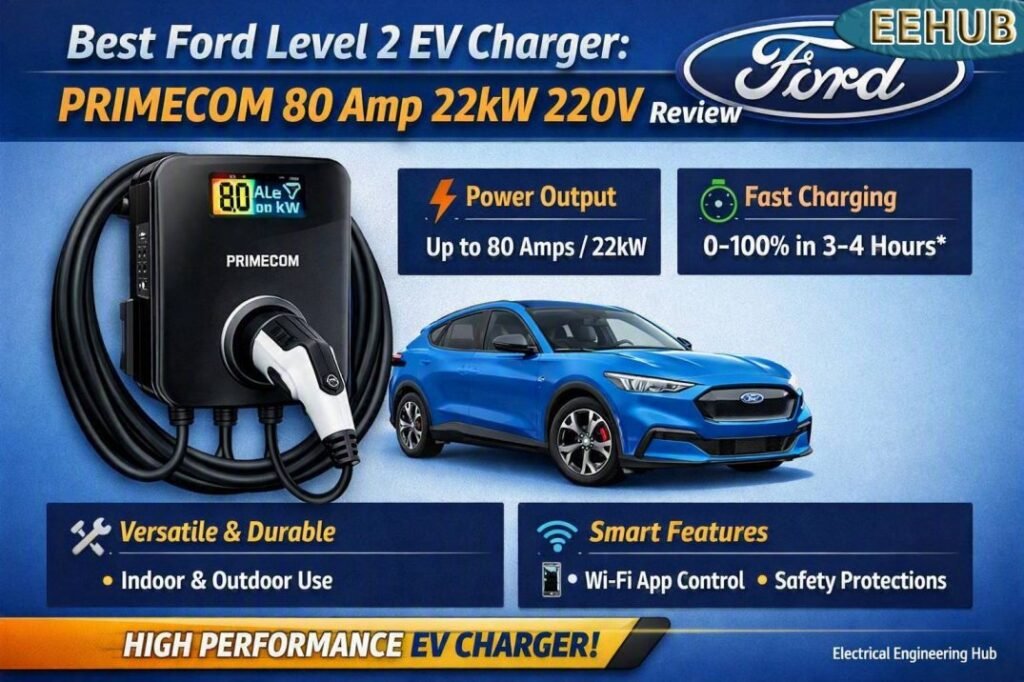
Table of Contents
Table of Contents
Why Consider the PRIMECOM 80 Amp Charger for a Ford EV?
The biggest advantage of the PRIMECOM unit is its high charging capacity. Many residential Level 2 chargers operate between 32A and 48A, while this model is rated at up to 80A. That gives it considerably more available charging power when paired with an EV capable of accepting that level of AC input.
For example, an EV charging at 48A on a 240V-class supply can receive roughly 11.5kW. An 80A charger can provide much higher available power, although the vehicle itself may limit the actual charging rate.
This is important for Ford owners because the charger does not automatically force 80A into the vehicle. The Ford's onboard charger determines how much AC power it can accept. Therefore, buying a high-amperage EVSE is most beneficial when your vehicle, wiring, breaker, and electrical service can support the installation.
If you are comparing several options, check the PRIMECOM 80 Amp 22kW EV Charger on Amazon for the latest price, availability, and current configuration.
Charging Performance for Ford EVs
The best ford level 2 ev charger should be selected based on the vehicle's maximum AC charging capability rather than the charger's headline amperage alone.
Ford has offered several EV models with different charging specifications. The Mustang Mach-E, F-150 Lightning, and other Ford electric vehicles can have different onboard charging limits depending on model year and configuration.
A high-power charger can still be useful even when a vehicle cannot consume the full 80A. It provides additional capacity and may be useful for future EVs, fleet applications, or another vehicle that supports higher AC charging.
Approximate Charging Power
| Charging Current | Approx. Power at 240V |
|---|---|
| 32A | 7.7kW |
| 40A | 9.6kW |
| 48A | 11.5kW |
| 60A | 14.4kW |
| 80A | 19.2kW |
The advertised 22kW figure should not be interpreted as the guaranteed charging speed for every Ford EV. Charging power depends on voltage, vehicle acceptance rate, installation, and charger configuration.
Is 80A Too Much for Home Charging?
For some homes, yes. An 80A EV charger requires careful electrical planning because the circuit must be sized according to the continuous-load requirements that apply to EV charging.
Under NEC continuous-load principles, EV charging is generally treated as a continuous load. An 80A charging load can therefore require a circuit with substantial capacity. The exact breaker, conductor size, disconnect requirements, and service capacity should be determined by a qualified electrician based on the installation.
Before purchasing, check:
- Available electrical service capacity
- Main panel rating
- Distance from panel to charger
- Conductor size and installation method
- Required breaker size
- Local electrical code
- Vehicle maximum AC charging rate
- Charger installation instructions
Do not install an 80A EV charger on an existing circuit simply because a lower-power charger used that circuit previously.
For readers comparing additional residential models, best level 2 ev chargers for home is a useful next step for evaluating charging speed, installation requirements, features, and overall value.
PRIMECOM 80 Amp vs Typical Level 2 Chargers
The PRIMECOM model is aimed at buyers who want substantially more capacity than a basic residential EVSE.
| Factor | Typical 32A Charger | Typical 48A Charger | PRIMECOM 80A |
|---|---|---|---|
| Current | 32A | 48A | Up to 80A |
| Approx. 240V output | 7.7kW | 11.5kW | 19.2kW |
| Charging capacity | Moderate | High | Very high |
| Electrical demand | Lower | Medium-high | High |
| Best for | Basic home charging | Most EV homes | High-demand charging |
| Future-proofing | Moderate | Good | Excellent if installation supports it |
For most drivers, overnight Level 2 charging at 9.6kW to 11.5kW is already sufficient. The 80A advantage becomes more meaningful for high daily mileage, larger battery packs, multiple EVs, fleet charging, or situations where minimizing charging downtime matters.
Installation Requirements Matter
A high-output EV charger is only as useful as the electrical system supporting it. The PRIMECOM 80 Amp unit should be installed according to its manufacturer's instructions and applicable electrical codes.
A professional electrician can evaluate the service panel, calculate the continuous load, inspect the grounding arrangement, select suitable conductors, and determine whether an electrical service upgrade is needed.
If your panel is already heavily loaded, adding a high-amperage EV charging circuit may require load management or another electrical solution.
For homeowners who are still comparing options, see our guide to best level 2 ev chargers for home to compare high-output and standard residential chargers before choosing a model.
Who Should Buy the PRIMECOM 80 Amp EV Charger?
The best ford level 2 ev charger for one homeowner may not be the right choice for another. The PRIMECOM model makes the most sense for buyers who specifically need high charging capacity.
It can be a strong choice if you:
- Drive long distances every day
- Own a Ford EV with high AC charging capability
- Have adequate electrical service capacity
- Want a high-power EVSE for future vehicles
- Charge more than one EV
- Operate a small fleet
- Want to reduce charging downtime
It may be unnecessary if your Ford already reaches its maximum AC charging rate with a 32A or 48A charger and you have no plans to add another high-demand EV.
What to Check Before Buying
Before ordering the PRIMECOM charger, confirm the connector type, voltage requirements, amperage configuration, installation method, and your Ford's maximum AC charging rate.
Also check the latest Amazon listing because product specifications, included accessories, connector configurations, and availability can change.
See the PRIMECOM 80 Amp 22kW EV Charger on Amazon to check the current listing, price, customer reviews, and available configuration.
Is This the Best Ford Level 2 EV Charger for You?
The best ford level 2 ev charger should match both the vehicle and the home's electrical infrastructure. The PRIMECOM 80 Amp 22kW model is attractive because it provides far more charging capacity than conventional Level 2 units.
Its biggest strength is also its biggest consideration: 80A charging demands a properly designed electrical installation. If your Ford cannot accept the full available output, the extra capacity will not necessarily shorten charging beyond the vehicle's own limit.
For buyers who have the required electrical capacity and want a powerful charger with room for future EVs, the PRIMECOM is worth considering.
Pros and Cons
Pros
- Very high 80A charging capability
- Up to 22kW advertised charging capacity
- Suitable for high-demand charging applications
- Useful for larger battery EVs
- Potentially good future-proofing
- Can reduce charging downtime when the vehicle supports high AC input
For a broader comparison of residential options, explore best level 2 ev chargers for home and compare charging speed, installation requirements, connector type, and overall value.
Cons
- Requires substantial electrical capacity
- May need professional installation
- Extra charger capacity can be unused by some Ford models
- Higher installation cost than lower-amperage EVSEs
- Vehicle compatibility should be confirmed before purchase
Frequently Asked Questions
1. Is the PRIMECOM 80 Amp charger compatible with Ford EVs?
It can be compatible with Ford EVs when the connector, electrical configuration, and vehicle charging requirements match. Always verify the specific Ford model and model year before ordering.
2. Can a Ford EV actually charge at 80 amps?
Not necessarily. The vehicle's onboard AC charger determines its maximum charging rate. An 80A EVSE can provide high available capacity, but it cannot make a vehicle accept more power than its onboard system allows.
3. Is 22kW charging available on every Ford EV?
No. The maximum AC charging rate varies by vehicle, model year, and configuration. The advertised 22kW capability of the charger should not be confused with the actual AC charging limit of a particular Ford.
4. Does an 80A EV charger require a special electrical circuit?
Yes, a high-amperage EV charger requires an appropriately sized dedicated circuit and sufficient service capacity. A qualified electrician should determine the correct breaker, conductors, protection, and installation method.
5. Is the PRIMECOM 80 Amp better than a 48A Level 2 charger?
It depends on your needs. An 80A charger offers substantially more available charging capacity, but a 48A charger may be more practical and economical for a Ford that cannot use the additional power. The higher-output option is most useful when your vehicle and electrical system can take advantage of it.
Final Verdict
The PRIMECOM 80 Amp 22kW charger is a high-capacity Level 2 EVSE designed for drivers who want more charging power than conventional 32A and 48A units provide. Its 80A rating makes it especially interesting for high-mileage drivers, larger EV batteries, multiple-EV households, and future-proof home charging installations.
Still, the best ford level 2 ev charger is not simply the one with the highest amperage. Your Ford's onboard charger, electrical service, circuit capacity, connector, installation requirements, and daily driving needs all matter.
If those factors line up, the PRIMECOM 80 Amp can be a powerful home charging solution. Check the latest PRIMECOM 80 Amp EV Charger price and availability on Amazon before making your purchase.
Related Guides
- EVIQO Level 2 EV Charger Review
- Best Level 2 EV Charger for Jeep 4xe
- Hardwired vs Plug In EV Charger
- Level 1 vs Level 2 EV Charger
- Best EV Charger Under $300
Get new guides in your feed. Follow Electrical Insights on LinkedIn for new electrical standards guides, calculators and design tips from Azad Circuit Hub.
#FordEV, #Level2EVCharger, #PrimecomEVCharger, #FordEVCharger, #EVCharging, #ElectricVehicle, #HomeEVCharger, #80AmpEVCharger, #22kWEVCharger, #EVChargerReview
