
Is the Federal EV Charger Tax Credit Still Available in 2026?
If you are planning to install a home EV charger in 2026, the federal tax credit deadline matters more than ever. The federal EV charger tax credit 2026 rules changed after the passage of the One Big Beautiful Bill Act, which ended the federal Alternative Fuel Vehicle Refueling Property Credit for most property placed in service after June 30, 2026.
That means homeowners who want to claim the credit need to pay close attention to when their EV charging equipment is actually installed and placed in service. Simply purchasing a charger before the deadline may not be enough.
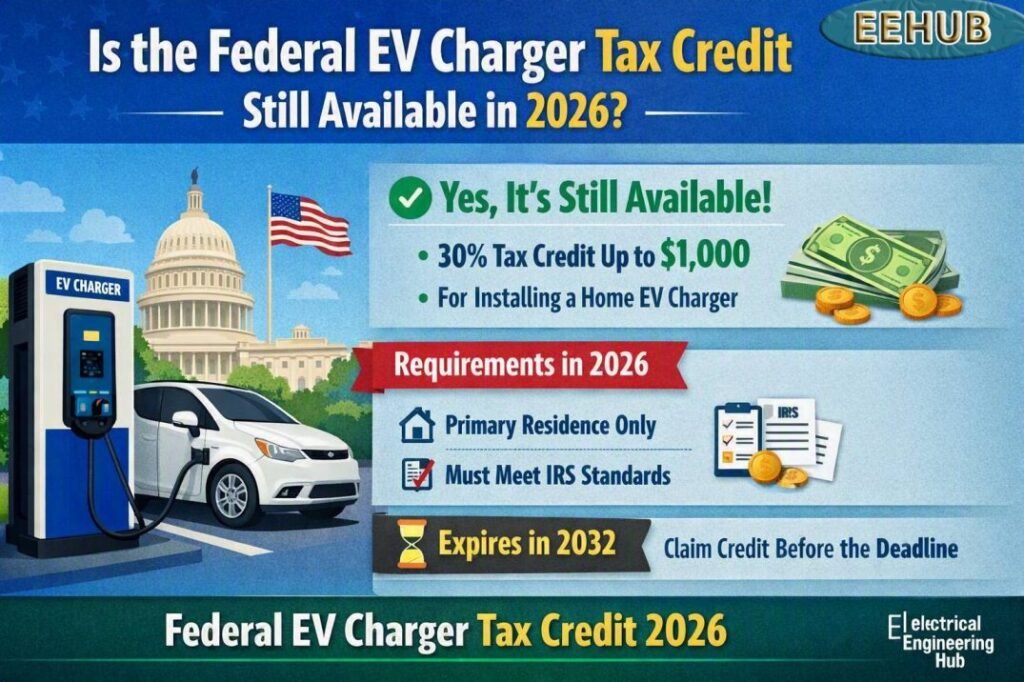
Table of Contents
Table of Contents
Here is a quick overview before we explain the eligibility rules, credit amount, and qualifying equipment in detail.
Federal EV Charger Tax Credit 2026 at a Glance
| Item | 2026 Rule |
|---|---|
| Federal credit | Up to 30% for qualifying residential property |
| Maximum residential credit | $1,000 |
| Important deadline | June 30, 2026 |
| Applies after June 30, 2026? | Generally no |
| Qualifying equipment | EV charging equipment and related installation costs |
| Home installation | Must meet federal eligibility requirements |
| IRS form | Form 8911 |
| Location requirement | Property must meet applicable eligible-area rules |
| Tax benefit type | Nonrefundable federal tax credit |
This table provides the basic answer, but the details below are important because eligibility depends on more than simply owning an electric vehicle or buying a Level 2 charger.
Is the Federal EV Charger Tax Credit Still Available in 2026?
The federal EV charger tax credit 2026 is effectively ending for new residential installations after June 30, 2026.
The credit comes from Section 30C, officially known as the Alternative Fuel Vehicle Refueling Property Credit. The law previously allowed homeowners to receive a credit for qualifying EV charging equipment installed at their primary residence.
However, the federal rules were changed in 2025. Under the updated rules, the credit generally applies only to qualifying property placed in service on or before June 30, 2026.
This creates an important distinction between buying an EV charger and placing it in service. Ordering a charger before the deadline does not automatically guarantee the credit. The qualifying property must meet the applicable installation and placed-in-service requirements.
How Much Is the 2026 EV Charger Tax Credit?
For eligible residential installations, the credit can generally cover 30% of the qualifying cost, subject to a maximum of $1,000.
The qualifying cost can include the EV charging equipment and eligible installation expenses.
For example:
| Eligible Cost | 30% Credit | Potential Credit |
|---|---|---|
| $500 | 30% | $150 |
| $1,000 | 30% | $300 |
| $2,000 | 30% | $600 |
| $3,000 | 30% | $900 |
| $3,333+ | 30% | Up to $1,000 |
The $1,000 limit means spending more than about $3,333 on qualifying residential costs will not increase the federal credit beyond the maximum.
Remember that a tax credit is different from a tax deduction. A credit directly reduces your federal income tax liability, subject to the applicable tax rules and your eligibility.
What EV Chargers Qualify?
A qualifying home EV charger can include equipment designed to supply electricity to an eligible electric vehicle.
Level 2 chargers are particularly popular for residential installations because they provide substantially faster charging than a standard 120-volt Level 1 connection.
Popular home charging features include:
- 240-volt charging
- 32-amp to 48-amp output
- Wi-Fi connectivity
- Smartphone charging controls
- Scheduled charging
- Energy monitoring
- NEMA 14-50 plug options
- Hardwired installation
- Adjustable charging current
If you are shopping for a Level 2 charger, compare electrical requirements before purchasing. A 48-amp charger, for example, normally requires a properly sized circuit and appropriate electrical installation.
For homeowners who want a smart charger with strong app controls, you can check the latest ChargePoint Home Flex price on Amazon. Always verify the product’s current specifications and installation requirements before ordering.
EVIQO 30% Credit Eligibility Callout
EVIQO 30% Federal Credit Eligibility: If your qualifying EVIQO EV charger installation was placed in service on or before June 30, 2026, you may be eligible to claim up to 30% of qualifying residential costs, subject to the $1,000 federal limit and all applicable Section 30C requirements. Eligibility is not based on the charger brand alone, so confirm the installation date, location, tax situation, and IRS requirements before claiming the credit.
If you are considering this charger for a home installation, our eviqo level 2 ev charger review covers its charging performance, installation requirements, features, and overall value.
Does Installation Cost Count Toward the Credit?
Potentially, yes. For qualifying residential property, the credit can apply to eligible equipment and installation costs.
This is particularly useful for homeowners installing a hardwired Level 2 EV charger because electrical work can add significantly to the project cost.
A typical installation may involve:
- Electrical panel inspection
- Dedicated circuit installation
- Appropriate breaker installation
- Conduit or cable installation
- EV charger mounting
- Electrical connections
- Testing and commissioning
However, not every project expense automatically qualifies. Keep your charger receipt, electrician invoice, installation documentation, and other relevant records.
What Are the Location Requirements?
Location is an important part of the federal EV charger tax credit 2026 rules.
Section 30C eligibility includes location requirements for the property. The applicable rules generally require qualifying property to be installed in an eligible low-income community or a non-urban census tract.
Therefore, living in the United States and installing an EV charger at your home does not automatically make the installation eligible.
Before relying on the credit, check whether your installation address satisfies the applicable IRS location requirements.
What About State EV Charger Rebates?
The federal credit is only one possible source of savings.
Your state, utility company, municipality, or electric provider may offer separate EV charger rebates or incentives. These programs can have their own income limits, equipment requirements, application deadlines, and approved-product lists.
For example, some utility programs may require a smart EV charger, while others may provide incentives for installing a dedicated 240-volt charging circuit.
This means you should check both federal and local incentives before purchasing equipment.
For homeowners looking for a lower-cost smart charging option, you can check the current Emporia EV Charger price on Amazon.
Best Home EV Chargers to Consider
Even with the federal deadline approaching, choosing the right charger should not be based only on the potential tax savings.
Consider:
- Maximum charging amperage
- Circuit requirements
- Plug-in versus hardwired installation
- Indoor or outdoor rating
- Wi-Fi and app functionality
- Cable length
- Energy monitoring
- Warranty
- Vehicle compatibility
- Utility demand-response programs
If EVIQO is on your shortlist, our eviqo level 2 ev charger review can help you compare its features and electrical requirements before buying.
What Documents Should You Keep?
Tax-credit claims are easier to support when you maintain complete installation records.
Keep copies of:
- EV charger purchase receipt
- Electrician invoice
- Installation date
- Equipment model number
- Proof of payment
- Property address
- Manufacturer documentation
- Relevant utility rebate paperwork
- IRS Form 8911 information
Do not rely solely on a product listing that says an EV charger is “tax credit eligible.” Federal eligibility depends on the applicable law and your specific installation.
For a rugged charger with flexible installation options, you can also see the latest Grizzl-E EV charger deals on Amazon.
How to Claim the EV Charger Tax Credit
Eligible taxpayers generally use IRS Form 8911, Alternative Fuel Vehicle Refueling Property Credit, when claiming the applicable credit.
The form is used to calculate the credit and report the qualifying property.
Because tax laws and individual circumstances can affect eligibility, review the current IRS instructions or consult a qualified tax professional before filing.
Most importantly, do not assume that purchasing equipment before the deadline is sufficient. The placed-in-service date is a key consideration under the updated rules.
What Happens to the Credit After June 30, 2026?
For most new residential EV charger installations, the federal Section 30C credit is not available for property placed in service after June 30, 2026.
This makes 2026 different from previous years when homeowners had a longer window to plan an installation.
If you are already planning a home EV charger installation, it is worth checking your eligibility, equipment requirements, installation schedule, and location as early as possible.
Frequently Asked Questions
Is the federal EV charger tax credit available in 2026?
Yes, but only for qualifying property that meets the applicable requirements and is placed in service by June 30, 2026. The credit generally ends for new property placed in service after that date.
How much can I claim for a home EV charger?
Eligible residential property can generally qualify for a credit of 30% of qualifying costs, up to a maximum of $1,000. Equipment and certain installation costs may qualify.
Can I claim the credit if I buy my charger before June 30, 2026?
Not necessarily. Purchasing the charger before the deadline does not by itself establish eligibility. The qualifying property generally must be placed in service by June 30, 2026, along with meeting the other Section 30C requirements.
Does a Level 2 EV charger qualify for the federal tax credit?
A Level 2 charger can qualify when the equipment and installation meet the applicable federal requirements. The charger’s Level 2 classification alone does not guarantee eligibility.
Can I combine the federal credit with a state or utility rebate?
Potentially. State and utility EV charger incentives are separate programs with their own rules. Check the terms of each program to determine whether you can receive multiple incentives for the same installation.
Final Takeaway
The federal EV charger tax credit 2026 rules have an important cutoff that homeowners should not overlook. The Section 30C credit generally applies to qualifying property placed in service on or before June 30, 2026, rather than providing a full-year 2026 incentive.
For eligible residential installations, the potential credit can be up to 30% of qualifying costs, capped at $1,000. Location requirements, eligible expenses, installation timing, and tax-filing rules also matter.
If you are comparing chargers before making a purchase, focus on electrical compatibility, charging speed, installation requirements, warranty, smart features, and total cost rather than choosing a product solely because it may qualify for an incentive.
For a closer look at one of the popular home Level 2 options, visit our eviqo level 2 ev charger review before making your final buying decision.
Get new guides in your feed. Follow Electrical Insights on LinkedIn for new electrical standards guides, calculators and design tips from Azad Circuit Hub.
#EVChargerTaxCredit, #FederalEVTaxCredit, #EVChargerTaxCredit2026, #EVCharging, #EVChargerRebate, #ElectricVehicle, #EVIncentives, #HomeEVCharger, #EVTaxCredit, #CleanEnergy
