
11kV Cable Bending Radius | NEC & IEC Standards, Minimum Requirements
The 11kV Cable Bending Radius is one of the most important installation parameters for medium-voltage power cables. Whether the cable is being installed in trenches, cable trays, ducts, or substations, maintaining the correct bending radius helps prevent insulation damage, conductor deformation, and long-term reliability issues.
Many cable failures occur because installers force cables around tight corners without considering the manufacturer’s minimum bending requirements. Since 11kV cables contain multiple insulation layers, metallic screens, and protective sheaths, excessive bending can create hidden defects that may lead to partial discharge, insulation breakdown, or premature cable failure.
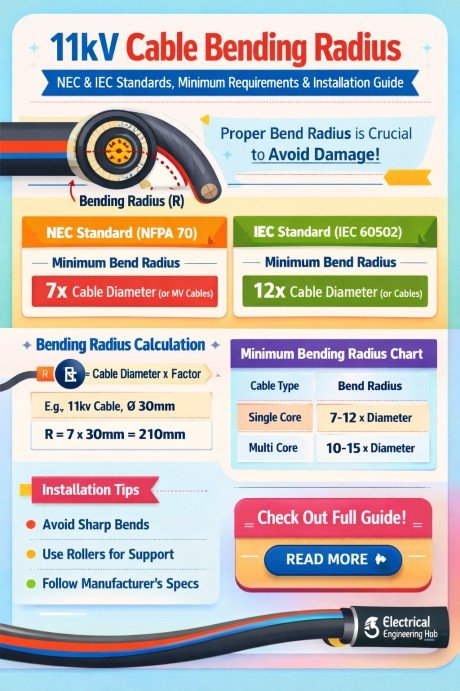
Table of Contents
This guide explains the 11kV Cable Bending Radius requirements according to NEC and IEC standards, calculation methods, practical installation guidelines, and common mistakes to avoid.
Find all about IEEE Standard for Short Circuit Calculation
What Is 11kV Cable Bending Radius?
The 11kV Cable Bending Radius refers to the minimum radius to which a cable can be safely bent without causing damage to its conductor, insulation, metallic screen, or outer sheath.
The bending radius is measured from the centerline of the cable bend. It is usually expressed as a multiple of the cable’s overall outside diameter (OD).
For example, if a cable has an outside diameter of 50 mm and the required bending radius is 15 times the cable diameter:
| Parameter | Value |
|---|---|
| Cable Diameter | 50 mm |
| Bending Factor | 15 × D |
| Minimum Bending Radius | 750 mm |
Any bend tighter than 750 mm may damage the cable structure.
For Accurate and Easy Cable Capacity, use our online tool Cable Trench Fill Calculator
Why Is the Correct Bending Radius Important?
Maintaining the proper 11kV Cable Bending Radius offers several benefits:
- Prevents insulation cracking
- Protects conductor strands from deformation
- Reduces stress on metallic screens
- Prevents sheath damage
- Improves cable lifespan
- Ensures compliance with installation standards
- Minimizes risk of partial discharge
Medium-voltage cables are significantly more sensitive to mechanical stress than low-voltage cables. Therefore, bending limits must be strictly followed during transportation and installation.
Know more about IEEE Standard for Contact Resistance
IEC Standards for 11kV Cable Bending Radius
IEC standards provide guidance for medium-voltage cable installation and handling. The most commonly referenced standards include:
- IEC 60502-2
- IEC 60287
- IEC 60840
- Manufacturer installation guidelines
For detailed international requirements, you can also refer to our comprehensive guide on cable bending radius iec standard which covers bending limits for different cable voltage levels and constructions.
Typical IEC Bending Radius Requirements
| Cable Type | Minimum Bending Radius |
|---|---|
| Single-Core 11kV Cable | 15 × Overall Diameter |
| Three-Core 11kV Cable | 12 × Overall Diameter |
| Armoured Cable | 15 × Overall Diameter |
| Unarmoured Cable | 12 × Overall Diameter |
Manufacturers may specify larger values depending on cable design.
Find all about IEC Standard for Relay Testing
NEC Requirements for Medium Voltage Cable Bending
The National Electrical Code (NEC) does not always prescribe a fixed bending radius for every medium-voltage cable. Instead, NEC generally requires compliance with manufacturer instructions and recognized industry standards.
Relevant NEC references include:
| NEC Article | Description |
|---|---|
| Article 300 | General Wiring Methods |
| Article 311 | Medium Voltage Conductors |
| Article 328 | Medium Voltage Cable Installations |
| Article 110.3(B) | Manufacturer Installation Instructions |
According to NEC requirements, installers must follow the cable manufacturer’s minimum bend radius specifications during installation.
Formula for Calculating 11kV Cable Bending Radius
The calculation is straightforward.
Formula
Minimum Bending Radius = Cable Diameter × Bending Factor
Where:
- Cable diameter = Overall cable outside diameter
- Bending factor = Standard multiplier (typically 12 or 15)
Example 1
Suppose an 11kV XLPE cable has:
- Diameter = 52 mm
- Required factor = 15
Calculation:
52 × 15 = 780 mm
Minimum bending radius = 780 mm
Know more about IEC Standard for MV Cable Testing
Example 2
For a three-core 11kV cable:
- Diameter = 65 mm
- Factor = 12
Calculation:
65 × 12 = 780 mm
Minimum bending radius = 780 mm
Typical Bending Radius Values for Common 11kV Cables
The table below shows approximate values commonly encountered in the field.
| Cable Size | Approx. Diameter | Radius Factor | Minimum Radius |
|---|---|---|---|
| 95 mm² | 42 mm | 15D | 630 mm |
| 120 mm² | 46 mm | 15D | 690 mm |
| 185 mm² | 52 mm | 15D | 780 mm |
| 240 mm² | 58 mm | 15D | 870 mm |
| 300 mm² | 63 mm | 15D | 945 mm |
| 400 mm² | 70 mm | 15D | 1050 mm |
Always verify actual dimensions from the manufacturer’s datasheet before installation.
Explore details on iec standard for underground cable laying
Installation Guidelines for 11kV Cable Bending Radius
Following proper installation practices is just as important as calculating the correct radius.
During Cable Pulling
- Use cable rollers at bends.
- Avoid sudden directional changes.
- Maintain smooth pulling paths.
- Monitor pulling tension continuously.
- Use approved cable lubricants when necessary.
During Cable Termination
- Allow sufficient space around switchgear and transformers.
- Plan cable routing before pulling.
- Maintain recommended bending limits near terminations.
- Avoid twisting the cable while positioning.
During Storage and Transportation
- Keep cables on approved drums.
- Prevent cable flattening during transport.
- Avoid dropping cable drums.
- Follow manufacturer handling recommendations.
Learn more about earthing cable size as per iec
Common Mistakes That Violate Bending Radius Requirements
Many installation failures originate from simple mistakes.
| Mistake | Consequence |
|---|---|
| Tight bends near termination kits | Insulation stress |
| Forcing cable into ducts | Sheath damage |
| Ignoring manufacturer instructions | Reduced service life |
| Using undersized cable trays | Mechanical deformation |
| Sharp trench corners | Conductor stress |
Even if the cable appears undamaged externally, internal insulation defects can develop over time due to excessive bending.
Factors Affecting 11kV Cable Bending Radius
Several factors influence the required bending radius.
Cable Construction
Armoured cables generally require larger bending radii than unarmoured cables.
Conductor Type
Stranded conductors are more flexible than solid conductors.
Findt all about AC Hipot Test Procedure for Cables
Insulation Material
XLPE-insulated cables have specific mechanical limitations that must be respected during installation.
Operating Environment
Cold weather installations may require larger bending radii because cable materials become less flexible at lower temperatures.
Manufacturer Requirements
The manufacturer’s specification always takes precedence over general recommendations.
Best Practices for Long-Term Reliability
To achieve maximum service life from medium-voltage cables:
- Verify cable dimensions before installation.
- Follow IEC and NEC recommendations.
- Maintain proper cable support spacing.
- Use large-radius bends whenever possible.
- Inspect cable routing before energization.
- Train installation personnel on medium-voltage handling procedures.
Find all about High Voltage Cable Testing Standards
A properly installed cable can operate reliably for decades, while an improperly bent cable may develop faults within a few years.
FAQs
What is the minimum 11kV Cable Bending Radius?
The minimum value is typically 12 to 15 times the cable’s overall diameter, depending on cable construction and manufacturer recommendations.
Does NEC specify a fixed bending radius for 11kV cables?
NEC generally requires compliance with manufacturer instructions and recognized industry standards rather than prescribing one fixed value for all medium-voltage cables.
How do I calculate the 11kV Cable Bending Radius?
Multiply the cable outside diameter by the recommended bending factor. For example, a 50 mm cable with a 15D requirement needs a minimum radius of 750 mm.
Can excessive bending damage an 11kV cable?
Yes. Tight bends can damage insulation, metallic screens, and conductors, leading to reduced cable life and potential failures.
Which standard is commonly used for medium-voltage cable bending requirements?
IEC 60502-2 and manufacturer installation manuals are the most commonly referenced sources for medium-voltage cable bending requirements.
Conclusion
The 11kV Cable Bending Radius plays a critical role in ensuring the safe and reliable operation of medium-voltage cable systems. Whether following NEC requirements, IEC recommendations, or manufacturer specifications, maintaining the correct bending radius protects the cable from mechanical damage and insulation stress.
By calculating the proper radius, using suitable installation practices, and avoiding sharp bends, engineers and technicians can significantly improve cable performance, reduce maintenance costs, and extend service life.
Get new guides in your feed. Follow Electrical Insights on LinkedIn for new electrical standards guides, calculators and design tips from Azad Circuit Hub.
#11kVCableBendingRadius,#CableBendingRadius,#11kVCableInstallation,#MediumVoltageCable,#ElectricalEngineering,#PowerDistribution,#NECCode,#IECStandards,#CableInstallation,#ElectricalSafety
