
AC Hipot Test Procedure for Cables: Complete Guide for Safe and Accurate High Voltage Testing
High voltage insulation testing plays a critical role in ensuring the reliability and safety of electrical systems. The AC hipot test procedure for cables is widely used to verify insulation strength, detect defects, and confirm that cables can withstand operating voltages without failure. Whether in power distribution, industrial plants, or infrastructure projects, understanding this procedure helps prevent costly downtime and electrical hazards.
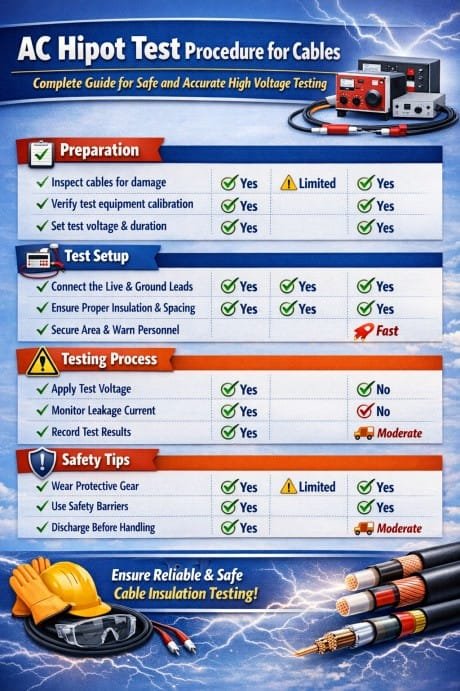
Table of Contents
This guide explains the complete AC hipot test procedure for cables in a clear and practical manner. It covers preparation, test methods, safety practices, and interpretation of results so that technicians and engineers can perform accurate testing with confidence.
Know more about Insulation Resistance Testing: Step-by-Step Process
What is AC Hipot Testing
AC hipot testing, also known as high potential testing, involves applying an alternating current high voltage to a cable to evaluate its insulation integrity. The goal is to ensure that the insulation can withstand higher-than-normal voltage stress without breakdown.
Unlike DC testing, AC testing closely simulates real operating conditions. This makes the AC hipot test procedure for cables more reliable for certain cable types, especially those used in medium and high voltage systems.
Why AC Hipot Testing is Important
Cables are exposed to environmental stress, aging, and mechanical damage. Even minor insulation defects can lead to failures if not detected early.
Key benefits of AC hipot testing include:
- Detection of insulation weaknesses
- Verification of installation quality
- Prevention of unexpected breakdowns
- Compliance with industry standards
- Improved system reliability
By following a proper AC hipot test procedure for cables, you reduce risks and ensure long-term performance.
Know more about Top 12 Electrical Testing Equipment Suppliers in USA
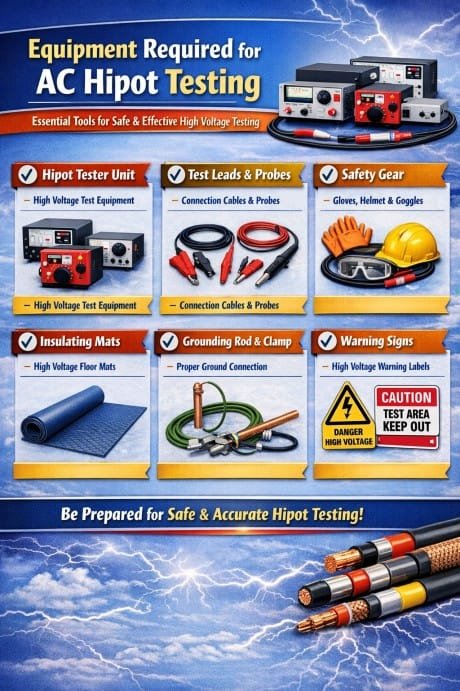
Equipment Required for AC Hipot Testing
Before starting the test, it is important to use the correct equipment. The accuracy of results depends heavily on the setup.
| Equipment | Purpose |
|---|---|
| AC Hipot Tester | Generates high voltage for testing |
| Test Leads and Clamps | Connect tester to cable |
| Insulation Resistance Tester | Pre-check insulation condition |
| Grounding Rod | Ensures safe discharge after test |
| Safety Barriers | Protect personnel during testing |
| Voltage Meter | Monitors applied voltage |
Modern AC hipot systems may also include digital displays, automatic ramp controls, and data logging features for improved accuracy.
Preparation Before Testing
Proper preparation is essential for a successful test. Skipping these steps can lead to incorrect results or safety risks.
Start by isolating the cable from all connected equipment. Ensure that both ends are disconnected and properly identified. Clean the cable terminations to remove dust, moisture, or contamination.
Next, perform an insulation resistance test using a megger. This helps confirm that the cable is in a suitable condition for high voltage testing.
Checklist before starting the AC hipot test procedure for cables:
- Cable is completely de-energized
- All connections are disconnected
- Test area is secured and marked
- Equipment is calibrated
- Personnel are trained and aware
Step-by-Step AC Hipot Test Procedure
The AC hipot test procedure for cables should be followed carefully to ensure both safety and accuracy.
Step 1: Connect the Equipment
Connect the high voltage terminal of the tester to the conductor of the cable. The return path or ground terminal should be connected to the cable shield or earth.
Ensure all connections are tight and properly insulated.
Explore all about vlf testing procedure
Step 2: Set Test Voltage
Determine the appropriate test voltage based on cable rating and standards. Typically, the test voltage is higher than the operating voltage.
| Cable Rating | Typical Test Voltage |
|---|---|
| Low Voltage | 2 to 3 times rated voltage |
| Medium Voltage | As per IEC or IEEE standards |
| High Voltage | Specified by manufacturer |
Step 3: Increase Voltage Gradually
Apply voltage slowly using a controlled ramp. This avoids sudden stress on the insulation and reduces the chance of false failures.
Monitor the leakage current during this stage.
Step 4: Hold Test Voltage
Maintain the test voltage for a specified duration, usually 5 to 15 minutes depending on standards and cable type.
Observe the current behavior. A stable current indicates good insulation, while increasing current may signal a problem.
Step 5: Reduce Voltage and Discharge
Gradually reduce the voltage to zero after the test period. Use a grounding rod to safely discharge any stored energy in the cable.
Never skip the discharge step, as residual charge can be dangerous.
Step 6: Record Results
Document the test voltage, duration, and leakage current readings. Proper records help in future analysis and maintenance planning.
Safety Precautions During Testing
High voltage testing involves serious risks. Following safety guidelines is not optional.
Important safety measures include:
- Use insulated gloves and protective equipment
- Keep unauthorized personnel away
- Install warning signs and barriers
- Ensure proper grounding of equipment
- Never touch the cable during testing
- Always discharge the cable after testing
A disciplined approach to safety ensures that the AC hipot test procedure for cables is performed without incidents.
Know more about HT Motor Tan Delta Testing – Best Guide for High Voltage Motor Insulation Diagnostic & Preventive Maintenance
Common Mistakes to Avoid
Even experienced technicians can make errors if procedures are not followed properly.
Some common mistakes include:
- Applying voltage too quickly
- Incorrect test voltage selection
- Poor grounding connections
- Ignoring environmental conditions like humidity
- Skipping pre-test inspections
Avoiding these issues improves test accuracy and protects equipment.
Interpreting Test Results
Understanding the results is as important as performing the test itself.
| Observation | Interpretation |
|---|---|
| Stable Leakage Current | Insulation is healthy |
| Gradual Increase in Current | Possible insulation degradation |
| Sudden Current Spike | Insulation failure or breakdown |
| No Current Flow | Possible connection issue |
If the cable fails the test, further investigation is required. This may include visual inspection, partial discharge testing, or replacing the cable section.
Find more about Best Megger Insulation Tester for Industrial Motors
Standards and Guidelines
The AC hipot test procedure for cables should follow recognized standards to ensure consistency and reliability.
Common standards include:
- IEC 60502 for power cables
- IEEE 400 for field testing
- VDE standards for insulation testing
Following these standards ensures that test results are accepted across industries.
Advantages of AC Hipot Testing
AC testing offers several advantages compared to other methods.
- Simulates real operating conditions
- Suitable for long cable lengths
- Detects insulation weaknesses effectively
- Provides reliable performance data
These advantages make the AC hipot test procedure for cables a preferred choice in many applications.
Explore all about How to Use Megger BM5200 Insulation Tester 5kV
Final Thoughts
The AC hipot test procedure for cables is a critical part of electrical maintenance and commissioning. When performed correctly, it helps identify insulation issues before they lead to serious failures. From preparation to result interpretation, every step plays an important role in ensuring accuracy and safety.
By using proper equipment, following standard procedures, and maintaining strict safety practices, technicians can carry out high voltage testing with confidence. A well-executed test not only protects equipment but also enhances the overall reliability of the electrical system. Explore all about How to Test a 3 Phase Motor With a Megger
Get new guides in your feed. Follow Electrical Insights on LinkedIn for new electrical standards guides, calculators and design tips from Azad Circuit Hub.
#acHipotTestProcedureForCables, #HipotTesting, #CableTesting, #HighVoltageTesting, #ElectricalTesting, #InsulationTesting, #CableSafety, #ElectricalMaintenance, #PowerCables, #TestingProcedures
