NEC Article 210.20 A Explained: 125% Continuous Load Rule
NEC Article 210.20 A is the rule that sets the minimum size of a branch-circuit breaker or fuse when the circuit feeds a continuous load. Size a 20-amp breaker for a 20-amp continuous heater and you have already missed the requirement. This guide explains how the rule works, walks through worked examples, and points you to the neighbouring rules in Articles 215, 225 and 240 that electricians and inspectors read alongside it.
Table of Contents
Table of Contents
What Does NEC Article 210.20 A Say?
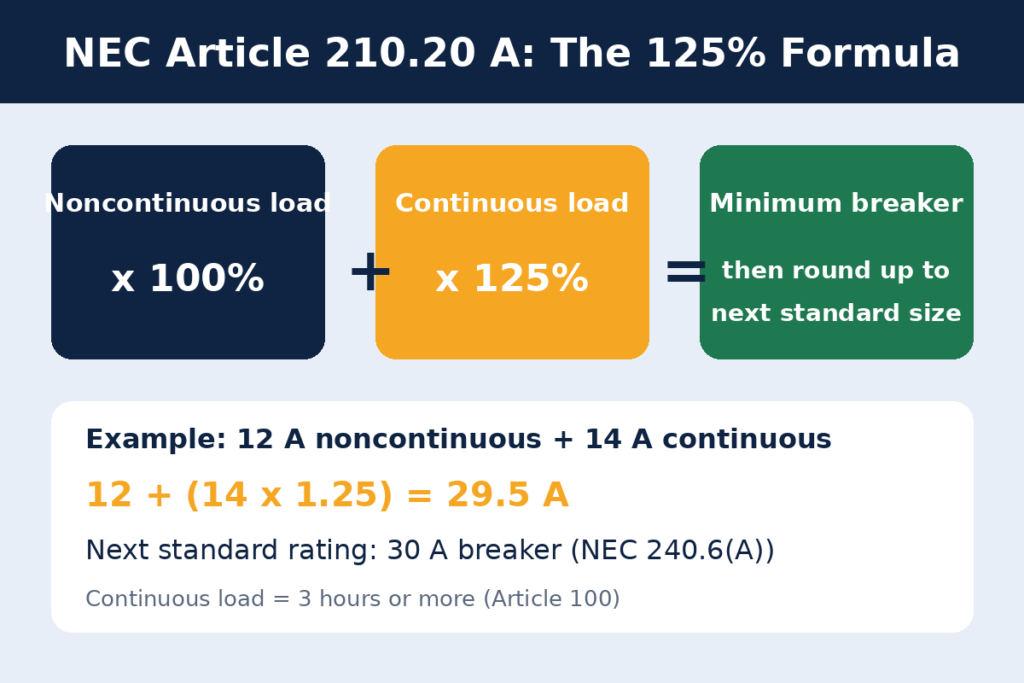
In plain words, NEC Article 210.20 A says that when a branch circuit supplies continuous loads, or a mix of continuous and noncontinuous loads, the overcurrent device must be rated at no less than the noncontinuous load plus 125 percent of the continuous load.
A continuous load is defined in Article 100 as a load where the maximum current is expected to continue for three hours or more. Think of EV chargers, electric heating, store lighting and server equipment.
There is one exception. If the assembly, including the overcurrent device, is listed for operation at 100 percent of its rating, the 125 percent multiplier does not apply. Most standard breakers are not marked this way, so check the label before you rely on it.
Why the 125 Percent Factor Exists
A breaker and its terminals warm up under sustained current. Limiting a continuous load to 80 percent of the device rating (1 divided by 1.25) keeps temperatures in check and prevents nuisance tripping. That is why you will often hear NEC Article 210.20 A called the 80 percent rule.
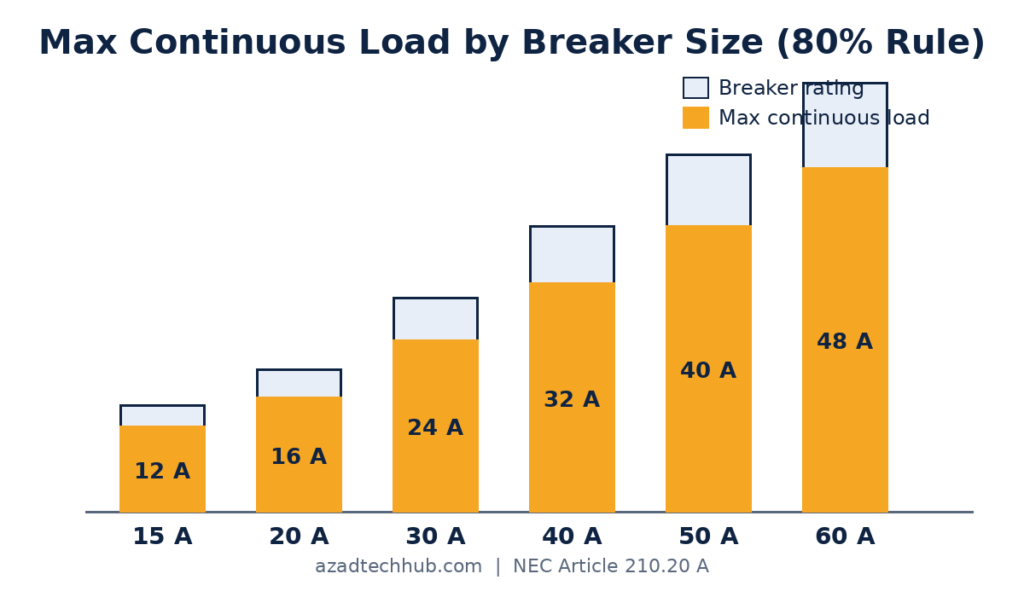
| Breaker size | Maximum continuous load |
|---|---|
| 15 A | 12 A |
| 20 A | 16 A |
| 30 A | 24 A |
| 40 A | 32 A |
| 50 A | 40 A |
| 60 A | 48 A |
Worked Examples of NEC Article 210.20 A
Example 1: continuous load only. A fixed heater draws 16 A for hours at a time. Multiply 16 by 1.25 and you get 20 A, so a 20 A breaker is the minimum.
Example 2: mixed load. A circuit supplies 12 A of noncontinuous load and 14 A of continuous load. Calculate 12 + (14 x 1.25) = 29.5 A. The next standard rating is 30 A, taken from the ratings listed in 240.6(A).
Example 3: EV charger. An EVSE is treated as a continuous load. A 40 A charger needs a 50 A breaker (40 x 1.25). If you are checking whether your panel can take it, run the numbers in our EV charger load calculation tool and see typical Level 2 charger installation cost before you buy. Shopping for a unit? Our top 7 Level 2 EV charger picks compare amperage options, so you can match the charger to the breaker you can legally install.
Remember that the conductor needs the same treatment. Section 210.19(A)(1) requires conductor ampacity of at least the noncontinuous load plus 125 percent of the continuous load, so the breaker and the wire are sized separately. Use the AWG to mm² conversion chart when you compare conductor sizes across standards.
Where NEC Article 210.20 A Fits in Article 210
Article 210 covers branch circuits. Section 210.19 handles conductor ampacity, and 210.20 handles overcurrent protection. Inside 210.20, subsection (A) covers continuous and noncontinuous loads, while (B) through (D) cover conductor protection, equipment and outlet devices. Reading them together stops you from sizing a breaker that protects the wrong thing.
NEC Article 210 PDF and 210.20(A) PDF
Many readers search for an NEC Article 210 PDF or an NEC 210.20(A) PDF. The NEC is copyrighted by NFPA, so a legitimate full copy is not free to redistribute. NFPA does offer free read-only online access to NFPA 70 once you create an account, which is the safest way to read the exact code text.
For a fast reference, download our one-page NEC Article 210.20 A quick reference PDF. It is an original summary with the formula and the breaker table, not the code text.
Related NEC Articles: 215, 225 and 240
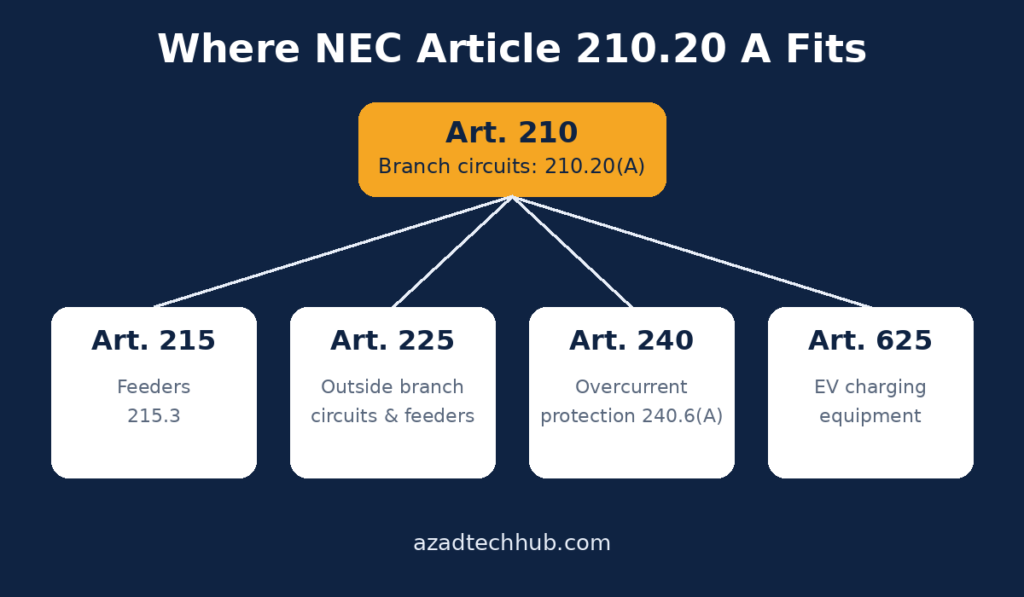
Article 215, feeders. Section 215.3 applies the same 125 percent logic to feeder overcurrent devices, so what you learn here carries over directly.
Article 225, outside branch circuits and feeders. Article 225 covers wiring that runs outdoors between buildings or structures. Those circuits still rely on Article 240 for protection, so the sizing rule stays the same.
Article 240, overcurrent protection. Standard ratings are in 240.6(A), and 240.4(B) explains when you may round up to the next standard size. Read our full guide, NEC Article for Overcurrent Protection: Article 240 Explained, for the rest.
Other guides pair well with NEC Article 210.20 A. The NEC article for conduit fill tells you whether the conductors you just sized will fit, and the NEC code for underground conduit depth covers burial rules for outdoor runs. For protection settings beyond branch circuits, try the overcurrent relay setting calculator and the transformer OCPD sizing chart. Motor circuits follow their own rules, so use the overload relay setting calculator for NEC 430.32 instead.
Continuous Load NEC Article: Quick Reference
If you search for the continuous load NEC article, there is no single one. The definition sits in Article 100, and the 125 percent requirement shows up in 210.19(A)(1) and 210.20(A) for branch circuits, 215.2 and 215.3 for feeders, and Article 625 for EV charging equipment. For more plain-language code guides, browse the electrical standards library.
Tools to Check Your Load
You cannot classify a load as continuous without knowing how long it actually runs. A clamp meter shows real current, and a clamp meter for electricians is the quickest way to confirm a circuit sits below 80 percent of its breaker. A circuit breaker finder like the Klein ET310 helps you trace which breaker feeds which circuit before you change anything.
Common Mistakes with NEC Article 210.20 A
- Sizing the breaker to equal the load, with no 125 percent multiplier.
- Applying the factor to the breaker but not the conductor.
- Treating a load as noncontinuous when it can run three hours or more.
- Assuming a breaker is 100 percent rated without a listing label.
- Ignoring the local edition. Check which NEC edition your jurisdiction has adopted, since adoption varies.
FAQ
Is NEC Article 210.20 A the same as the 80 percent rule?
Yes, it is the same requirement stated from the load side. A breaker must be at least 125 percent of the continuous load, which means the continuous load cannot exceed 80 percent of the breaker rating.
Does it apply to a 20 A receptacle circuit?
It applies whenever the load is continuous. A general-use receptacle circuit with mixed, short-duration loads usually is not, but a dedicated heater or charger on that circuit would be.
Conclusion
NEC Article 210.20 A comes down to one calculation: noncontinuous load plus 125 percent of continuous load. Get that number right, pair it with the conductor rule in 210.19, and check Articles 215 and 240 for feeders and standard ratings. Final designs should be confirmed by a licensed electrician and your local authority having jurisdiction. Browse more tools in the electrical calculators library.
Get new guides in your feed. Follow Electrical Insights on LinkedIn for new electrical standards guides, calculators and design tips from Azad Circuit Hub.