NEC Code for Underground Conduit Depth: 2023 Burial Depth Chart & Rules
As an Amazon Associate I earn from qualifying purchases. If you buy through links on this page, I may earn a commission at no extra cost to you.
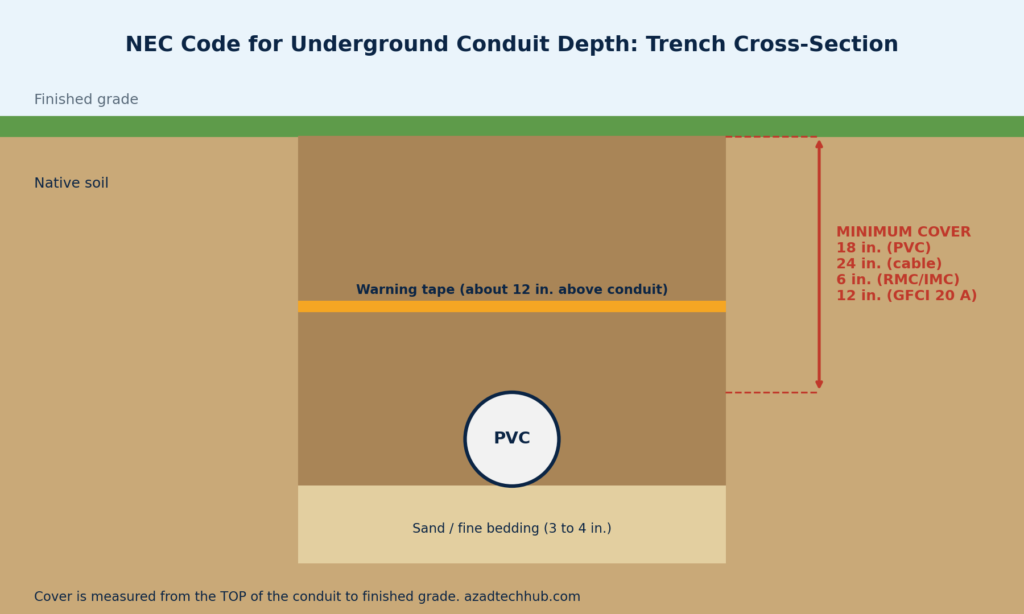
The NEC code for underground conduit depth is set by Table 300.5 in Section 300.5 of the National Electrical Code: 24 inches for direct-buried cable, 18 inches for PVC conduit, 6 inches for rigid metal (RMC) or intermediate metal conduit (IMC), and 12 inches for 20-amp GFCI-protected residential branch circuits. Depth is measured from the top of the raceway to finished grade, not from the bottom of the trench.
In more than 15 years of EPC and site work, trench depth is the mistake I see inspectors flag most often. Crews size the conduit correctly and then dig to the wrong depth, or they bury the wrong wiring method altogether. This guide gives you the full chart, the exceptions, and the answers to the questions US readers search most, so you can pass inspection the first time.
In this guide: the burial depth chart, 2020 vs 2023 vs California, PVC depths, how shallow you can go, Schedule 40 vs 80, Romex underground, 100 amp service conduit size, related NEC sections and a tools checklist.
Quick Answer: Minimum Cover Under the NEC
- Direct-buried cable (UF-B, USE-2): 24 inches
- PVC conduit (Schedule 40 or 80): 18 inches
- RMC or IMC steel conduit: 6 inches
- 120 V, 20 A or less, GFCI-protected residential circuit: 12 inches
- Under roads, alleys and parking lots: 24 inches
- Under a one- or two-family driveway (PVC): 18 inches
- Landscape lighting, 30 V or less: 6 inches
Always confirm with your local authority having jurisdiction (AHJ), because local amendments can be stricter than the NEC.
What Is the NEC Code for Underground Conduit Depth?
Section 300.5, Underground Installations, covers buried cables, conductors and raceways rated 1,000 V or less. Paragraph 300.5(A) points to Table 300.5 for minimum cover, and the table is organized by location (rows) and wiring method (columns).
Three ideas drive the table:
- Cover is measured to the top of the raceway. If your conduit is 2 inches in diameter and you need 18 inches of cover, the trench is at least 20 inches deep plus bedding.
- Stronger wiring methods get less cover. Steel conduit resists crushing, so it needs only 6 inches. PVC and cables rely on soil depth for protection.
- Traffic increases depth. Roads, alleys and parking lots require 24 inches regardless of method, because of vehicle loading.
Underground raceways are also treated as wet locations under 300.5(B), so the conductors inside must be listed for wet use (for example THWN-2). That single rule is the reason Romex is not allowed, which we cover below.
NEC Burial Depth Chart (Table 300.5, 0 to 1,000 V)
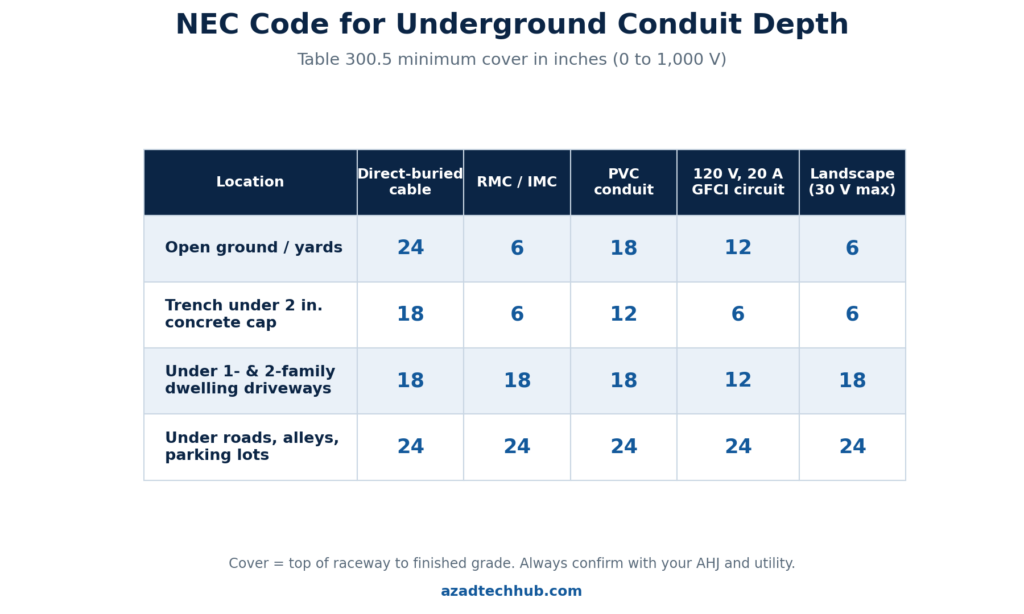
This NEC burial depth chart summarizes the rows contractors use most. Values are minimum cover in inches.
| Location | Direct-buried cable | RMC / IMC | PVC (non-metallic raceway) | 120 V, 20 A, GFCI circuit | Landscape / irrigation, 30 V max |
|---|---|---|---|---|---|
| All locations not specified below (yards, open ground) | 24 | 6 | 18 | 12 | 6 |
| In trench below 2 in. of concrete or equivalent | 18 | 6 | 12 | 6 | 6 |
| Under one- and two-family dwelling driveways and outdoor parking areas | 18 | 18 | 18 | 12 | 18 |
| Under streets, highways, roads, alleys, driveways and parking lots (other than the dwelling case above) | 24 | 24 | 24 | 24 | 24 |
Notes that save you rework:
- If an installation meets more than one column, the table lets you use the shallower value for that column.
- If you cannot reach depth because of rock or utilities, the NEC allows concrete or equivalent cover in some cases, but only where the table row says so. Do not improvise.
- This table is a field summary. The full table contains additional rows (for example airport runways and solid rock) and footnotes, so verify against the edition your AHJ enforces.
If you are still choosing the pipe size for these trenches, run your conductors through our conduit fill calculator first, then come back and set the depth.
NEC Code for Underground Conduit Depth by Edition: 2020, 2023 and “2022”
Readers often search for the NEC code for underground conduit depth 2022, but there is no 2022 edition. The NEC publishes every three years: 2017, 2020, 2023, and the next edition will be 2026. If a page or inspector mentions “2022”, they usually mean the California Electrical Code 2022, which is built on the 2020 NEC.
- 2020 NEC: Table 300.5 gives 24 in. for direct-buried cable, 6 in. for RMC/IMC, 18 in. for PVC and 12 in. for GFCI-protected 20 A residential circuits in open ground.
- 2023 NEC: The common-case numbers above are unchanged, which is why one chart works for both editions. The 2023 code continues to expand GFCI protection for outdoor circuits, so more outdoor circuits qualify for the 12-inch column.
- Which one applies? The NEC is law only when your state or city adopts it. Ask your AHJ which edition and which local amendments are in force before you dig.
For related rules that change with the edition, see our guide to NEC 314.28 pull box sizing and the NEC junction box fill guide.
NEC Code for Underground Conduit Depth in California
California does not enforce the NEC directly. It adopts the California Electrical Code (CEC), published in Title 24, Part 3. The 2022 CEC is based on the 2020 NEC, and newer cycles follow the 2023 NEC, so Table 300.5 minimums for PVC (18 in.), RMC (6 in.) and direct burial (24 in.) match the national table.
Where California differs is local practice:
- Cities and counties add amendments, especially for seismic areas, high-water-table zones and utility trenches.
- Utilities such as PG&E, SCE and SDG&E publish their own service-lateral depths, often deeper than the NEC.
- Many California inspectors expect warning tape and sand or slurry bedding.
Check your city’s building department page and your utility’s service requirements before ordering material.
Burial Depth for PVC Conduit Under the NEC
The most searched version of this question is burial depth for PVC conduit under the NEC, and the answer is simple:
- 18 inches of cover in open ground and under residential driveways.
- 12 inches if the trench has at least 2 inches of concrete above the conduit, or if the circuit is a GFCI-protected 120 V, 20 A residential branch circuit.
- 24 inches under roads, alleys and parking lots.
PVC is a non-metallic raceway, so it needs a separate equipment grounding conductor inside. Sunlight, heat and cold make PVC expand and contract: where a run is fixed at both ends, install expansion fittings per 352.44 (the rule is triggered by about 1/4 inch or more of movement).
How Deep Should Schedule 40 Conduit Be Buried?
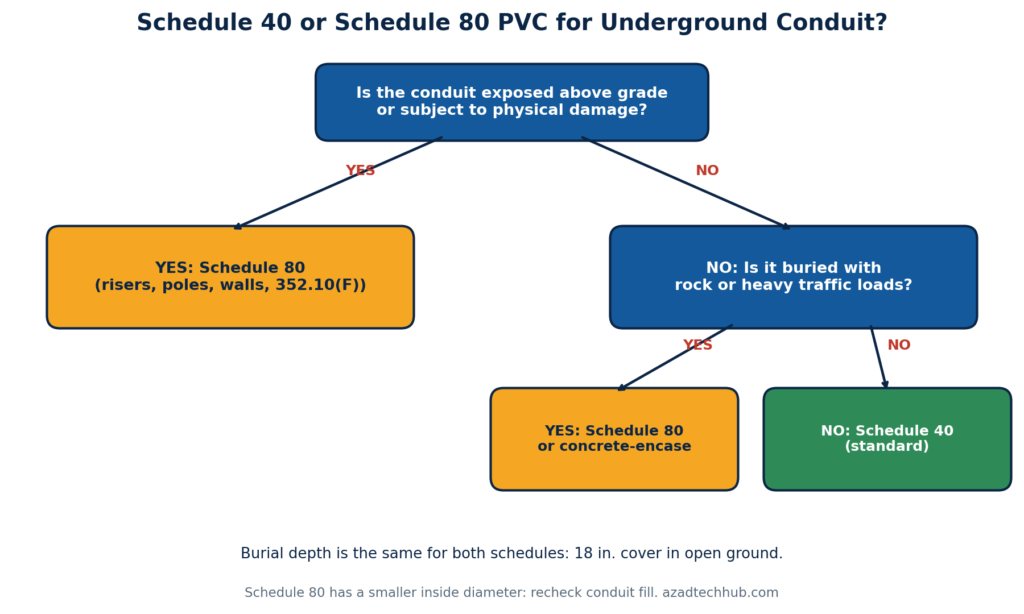
Schedule 40 PVC follows the same rule as any non-metallic raceway: 18 inches in standard ground, 12 inches with a 2-inch concrete cap or on a GFCI-protected 120 V, 20 A residential circuit, and 24 inches under roads and alleys. The schedule does not change the depth. Only the location and circuit type do.
How Shallow Can You Bury Electrical Conduit?
The shallowest legal depths under the table, for 1,000 V or less:
- 6 inches: RMC or IMC in open ground, and landscape lighting circuits at 30 V or less using UF or identified cable.
- 12 inches: PVC on a GFCI-protected 120 V, 20 A residential circuit, or PVC under a concrete cap in the trench.
- Solid rock: very shallow cover is permitted if the table row for rock is followed with concrete cover. Read the row and footnotes first.
Shallow is not always smart. A shovel strike at 6 inches on a PVC run is a hazard even when the inspector signs off. When I design residential runs, I use the table as the floor and add 6 inches where gardens, fence posts or irrigation are expected.
Circuits above 1,000 V follow Table 300.50 instead, with deeper cover requirements, so do not use the chart on this page for medium voltage work.
Should Underground Conduit Be Schedule 40 or 80?
For the buried portion, Schedule 40 PVC is normally enough and costs less. Schedule 80 has a thicker wall and is the right choice when conduit is exposed to physical damage, such as the vertical riser on a pole, a wall or a pedestal, where 352.10(F) requires Schedule 80 or equivalent protection.
| Factor | Schedule 40 | Schedule 80 |
|---|---|---|
| Buried depth requirement | Same as Schedule 80 | Same as Schedule 40 |
| Wall thickness | Standard | Thicker, stronger |
| Where to use it | Below grade, concrete-encased, inside walls | Exposed risers, driveway edges, sleeves, rocky soil |
| Cost | Lower | Higher |
| Internal diameter | Larger (more fill capacity) | Smaller (less fill capacity) |
Because Schedule 80 has a smaller inside diameter, re-check your numbers in the conduit fill calculator if you switch schedules mid-design.
Can Romex Be Buried Underground in Conduit?
No. Type NM cable (Romex) is not permitted to be buried or installed in wet or damp locations, and 334.12(B) lists underground installation as prohibited. Putting Romex inside buried conduit does not fix this, because the conduit is a wet location under 300.5(B) and moisture will condense inside it.
Use one of these instead:
- Individual THWN-2 conductors pulled into PVC or metal conduit. This is the standard method for panels, detached garages and sheds.
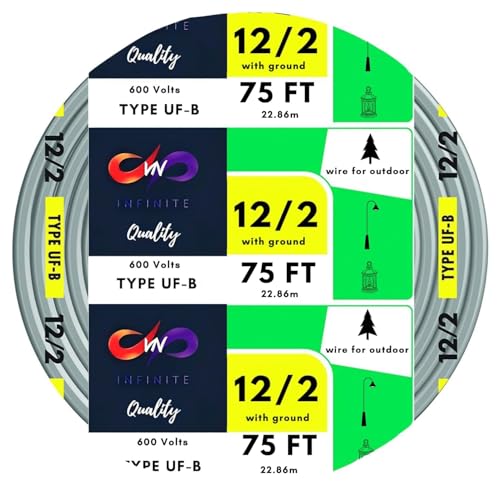
- Type UF-B cable for direct burial at 24 inches (12 inches on a GFCI-protected 20 A residential circuit, or 18 inches under a residential driveway).
- Type MC or other cable identified for direct burial, where the listing allows it.
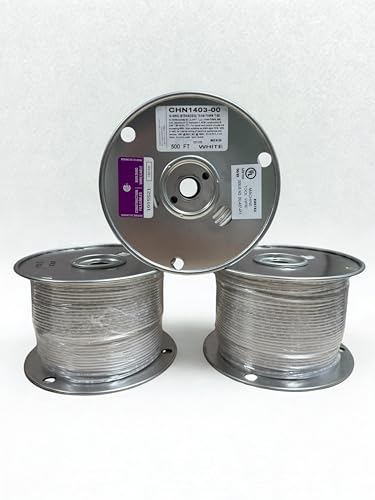
Recommended gear:
What Size Conduit Is Needed for a 100 Amp Underground Service?
A 100 A one-family dwelling service typically uses 4 AWG copper or 2 AWG aluminum conductors under the dwelling-service rule in 310.12, plus a smaller grounding conductor where required. Three current-carrying conductors and a ground fit comfortably in 1-1/4 inch PVC on paper, but 2-inch Schedule 40 PVC is the practical standard for 100 A laterals. It gives pulling room, accommodates an upsize to 200 A later, and matches what most utilities specify.
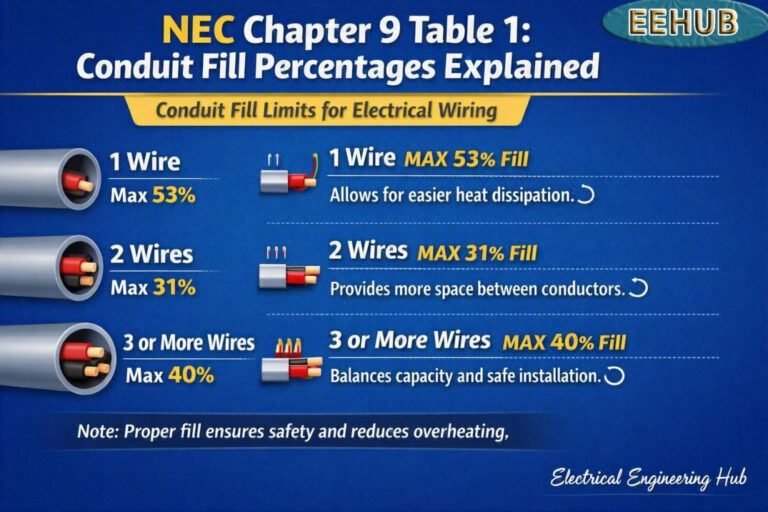
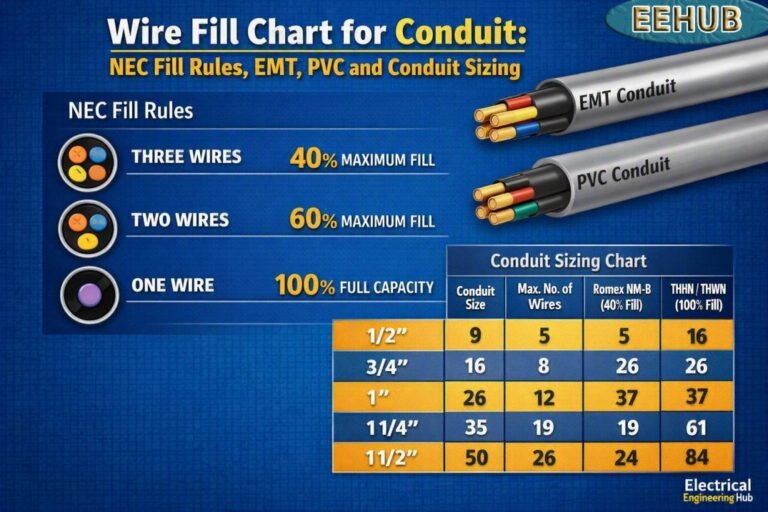
For the exact number, use fill percentages from NEC Chapter 9 (40% for three or more conductors) and verify in the conduit fill calculator. Then check two outside constraints:
- Utility rules: many utilities dictate conduit size, bend radius, sweeps and depth on the service lateral (often 24 to 36 inches).
- Voltage drop: long laterals may need a larger conductor even if fill is fine. Use the cable size calculator or the voltage drop calculator.
An electrical service size guide will help you decide whether 100 A is still the right choice before you trench.
Other NEC Sections That Affect Underground Conduit
Depth is only one part of a compliant trench. These sections show up on almost every inspection:
- 300.5(B): underground raceways are wet locations, so use wet-rated conductors.
- 300.5(D): conductors emerging from grade must be protected, typically to 8 feet above grade, with Schedule 80 PVC or RMC.
- 300.5(F): backfill must not contain large rocks or sharp debris that can damage the raceway, and compaction must not leave voids.
- 300.5(G): seal conduit ends where moisture can travel into a building or enclosure.
- 352.44: use expansion fittings where thermal movement is expected.
- 210.8: GFCI protection for outdoor circuits, which affects whether you qualify for the 12-inch column.
For above-ground portions, review our NEC conduit bending and support guide and the grounding and bonding guide under NEC Article 250, since PVC runs need an equipment grounding conductor.
Trench Planning Checklist
- Call 811 at least a few days before digging to mark utilities.
- Confirm the edition and local amendments with the AHJ.
- Pick the wiring method (conduit with THWN-2, or UF-B).
- Set the depth from the chart: add conduit diameter and 3 to 4 inches of bedding to the cover requirement.
- Lay bedding, install conduit, glue joints and let cement cure.
- Install warning tape about 12 inches above the raceway. Many AHJs and utilities require it.
- Backfill in layers and compact, then restore grade.
- Test insulation and continuity before energizing.
Tools and Materials Worth Buying
| Item | Why you need it | Link |
|---|---|---|
| Schedule 40 PVC conduit, 10 ft sticks | Main raceway for buried runs | PVC conduit |
| Schedule 80 PVC elbows and risers | Above-grade protection at 300.5(D) | Schedule 80 elbows |
| PVC primer and cement | Solvent-weld joints that stay sealed | PVC cement |
| Expansion fittings | Thermal movement per 352.44 | Expansion couplings |
| Underground warning tape | Marks the line, often required | Warning tape |
Before buying, confirm each listing is current and matches your size and listing requirements (UL listed, correct schedule).
Common Mistakes with Underground Conduit Depth
- Measuring from the trench bottom. Cover is measured from the top of the raceway to finished grade.
- Using the 12-inch column on the wrong circuit. It applies only to 120 V circuits with GFCI protection and a maximum 20 A overcurrent device.
- Burying Romex. NM cable is never allowed underground, even in conduit.
- Forgetting the road or alley row. Alleys and parking lots need 24 inches.
- Ignoring local amendments or utility specs. The AHJ and the utility have the final word.
- Skipping the equipment grounding conductor in PVC. Non-metallic conduit does not carry fault current.
FAQ: NEC Code for Underground Conduit Depth
What is the NEC code for underground conduit depth?
Table 300.5 sets the minimum cover: 24 inches for direct burial, 18 inches for PVC, 6 inches for RMC or IMC, and 12 inches for GFCI-protected 120 V, 20 A residential circuits. Roads, alleys and parking lots require 24 inches.
Is there an NEC code for underground conduit depth PDF?
The NEC is copyrighted by NFPA. You can read the current code for free online at NFPA’s website after creating a free account, and buy the PDF or print copy there. Avoid unofficial PDF downloads, since they may be old editions. For a quick field reference, save the chart image on this page.
What is the NEC code for underground conduit depth in 2020 and 2023?
The common values (24, 18, 6 and 12 inches) are the same in both editions. Check which edition your jurisdiction has adopted.
What are the NEC underground conduit requirements besides depth?
Use wet-rated conductors, protect where conductors leave the ground, avoid damaging backfill, seal conduit ends, and install expansion fittings where needed. See the sections listed above.
How deep should Schedule 40 conduit be buried?
18 inches in typical ground, 12 inches with 2 inches of concrete above or on a GFCI-protected 20 A residential circuit, and 24 inches under roads.
Should underground conduit be Schedule 40 or 80?
Schedule 40 is fine below grade. Use Schedule 80 where the conduit is exposed to physical damage, such as risers and above-ground sections.
Can Romex be buried underground in conduit?
No. Use THWN-2 conductors in conduit or UF-B cable.
What size conduit for a 100 amp underground service?
2-inch Schedule 40 PVC is the common choice, though your utility’s specification controls.
Where can I find a code for buried electrical wires PDF?
Use the NEC 300.5 section and Table 300.5 on NFPA’s site. If you want a printable summary, use the burial depth chart image above and always verify against your adopted edition.
Conclusion
The NEC code for underground conduit depth comes down to a few numbers: 24 inches for direct burial, 18 inches for PVC, 6 inches for RMC or IMC, and 12 inches for GFCI-protected 20 A residential circuits, with 24 inches under roads and alleys. Pick the wiring method first, apply Table 300.5, then confirm your edition, your AHJ and your utility.
Next, size the raceway in the conduit fill calculator, check the NEC pull box sizing rules, and bookmark this page as your field reference. If this guide saved you a re-dig, share it with the electrician next to you.
Disclaimer: This article is for educational use and does not replace the NEC, local code amendments or your AHJ. Electrical work should be done by qualified persons.
Get new guides in your feed. Follow Electrical Insights on LinkedIn for new electrical standards guides, calculators and design tips from Azad Circuit Hub.