NEC Article for Conduit Fill: 5 Key Rules and Tables (2026)
The NEC article for conduit fill is not a single article. It is a chain of five NEC references: the general rule in 300.17, the percentage limits in Chapter 9 Table 1, the conduit and conductor areas in Tables 4 and 5, the same-size shortcut in Annex C, and a “number of conductors” section inside each raceway article. This guide shows how those pieces fit together, with a table, a PVC chart and a worked example, so you can size a conduit without hunting through the code book.
Quick answer: For three or more conductors, the NEC limits fill to 40% of the conduit’s internal area (53% for one conductor, 31% for two, 60% for a nipple of 24 in. or less). The limits sit in Chapter 9, Table 1. Conductor areas come from Table 5 and conduit areas from Table 4. To skip the arithmetic, use our conduit fill calculator.
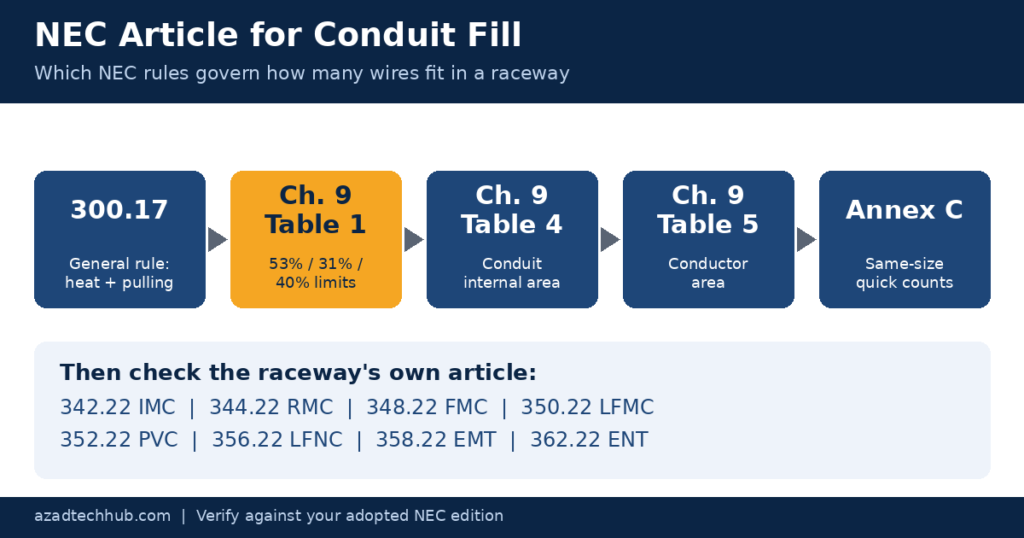
Table of Contents
Table of Contents
Which NEC Article for Conduit Fill Applies to Your Job?
Start with the raceway you are installing, because each raceway has its own article, and each one applies the NEC article for conduit fill logic by sending you back to the same Chapter 9 tables. The map below shows where each rule lives.
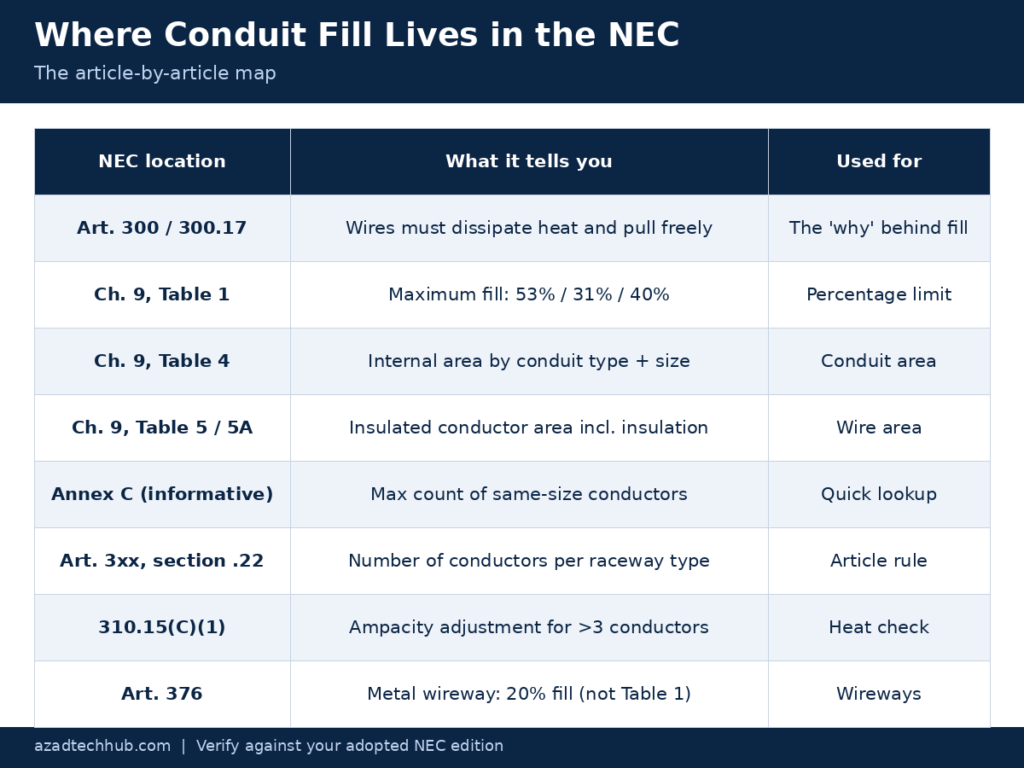
| NEC location | What it covers | Why you need it |
|---|---|---|
| 300.17 | Number and size of conductors in a raceway | The general rule: heat must dissipate and wires must pull without damage |
| Chapter 9, Table 1 | Maximum fill percentages | 53%, 31% or 40% |
| Chapter 9, Table 4 | Internal area by raceway type and trade size | The conduit side of the calculation |
| Chapter 9, Table 5 and 5A | Area of insulated and compact conductors | The wire side of the calculation |
| Annex C (informative) | Maximum same-size conductors per conduit | A quick lookup, not the rule itself |
| Article 3xx, section .22 | Number of conductors for each raceway type | Sends you to Table 1 |
The “section .22” rows are where most people get lost. Each raceway article has a short section titled number of conductors, and it points back to Chapter 9 Table 1 for the percentage:
- Article 342, IMC: section 342.22
- Article 344, RMC: section 344.22
- Article 348, FMC: section 348.22
- Article 350, LFMC: section 350.22
- Article 352, PVC: section 352.22
- Article 356, LFNC: section 356.22
- Article 358, EMT: section 358.22
- Article 362, ENT: section 362.22
Section numbers can move between editions, so confirm them against the edition your jurisdiction has adopted.
NEC Article for Conduit Fill PDF: Where to Read the Code and What to Save
Many electricians search for the NEC article for conduit fill PDF because they want the table on a phone or in a tablet folder. Two practical points help here.
First, the NEC is a copyrighted NFPA publication, so the official text is read through NFPA, which offers free read-only access to the code on its NFPA 70 page. You should not rely on random PDF uploads, because they are often an older edition with outdated numbering.
Second, you do not need the whole book on site. Save the one-page cheat sheet below. It condenses the NEC article for conduit fill into our own words and is built for printing or saving to your phone.
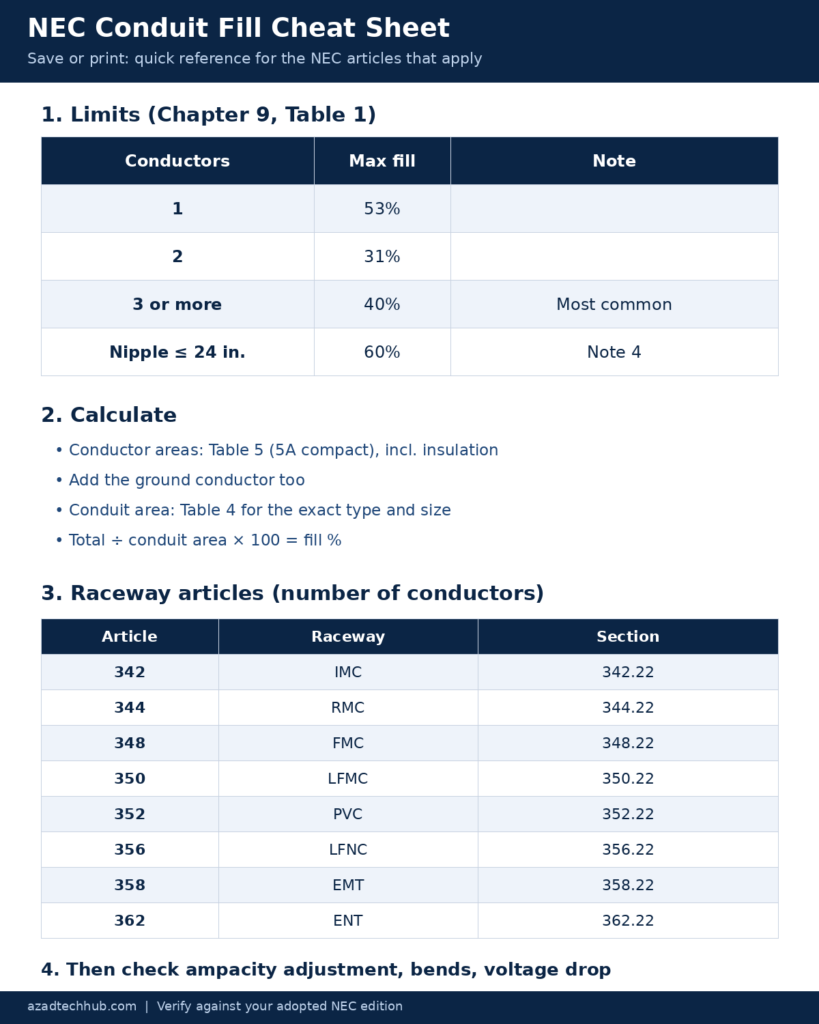
If you work with printed charts, a pocket code companion or a set of laminated reference cards makes a good gift for an apprentice.
NEC Conduit Fill Percentage: The Chapter 9 Table 1 Limits
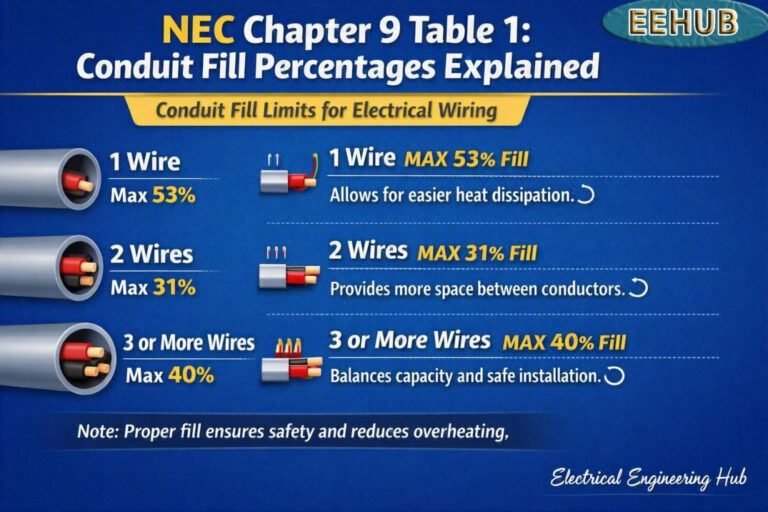
Within the NEC article for conduit fill chain, the fill percentage depends only on how many conductors are in the conduit, as set out in Chapter 9, Table 1:
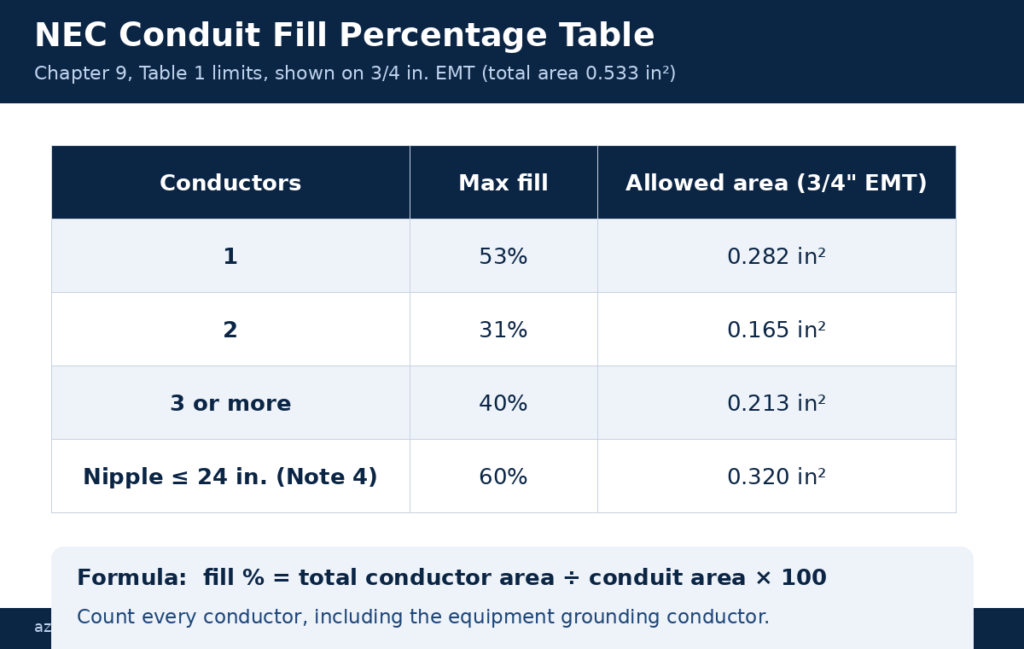
- One conductor: 53%. See the 53% rule explained.
- Two conductors: 31%. See the 31% rule for two conductors.
- Three or more conductors: 40%. See the 40% rule for three or more.
- Short nipples, 24 in. or less: 60%. See the nipple fill rule.
Four notes to the tables change real answers. Equipment grounding conductors count toward fill (Note 3). Table 1 applies to complete conduit systems, not short sections that only protect exposed wiring (Note 2). A calculation that ends in a decimal of 0.8 or more may be rounded up to the next whole conductor (Note 7).
A multiconductor cable counts as one conductor, measured at its major diameter if oval (Note 9). For the full breakdown of the table, read our guide to NEC Chapter 9 Table 1 conduit fill percentages.
NEC Conduit Fill Table: EMT, RMC and PVC Areas
The next table is the conduit half of every NEC article for conduit fill calculation. It shows the 40% fill area for the same trade size in three raceway types. The figures are computed from the total internal areas in Chapter 9 Table 4, so the third decimal can differ slightly from the printed table.
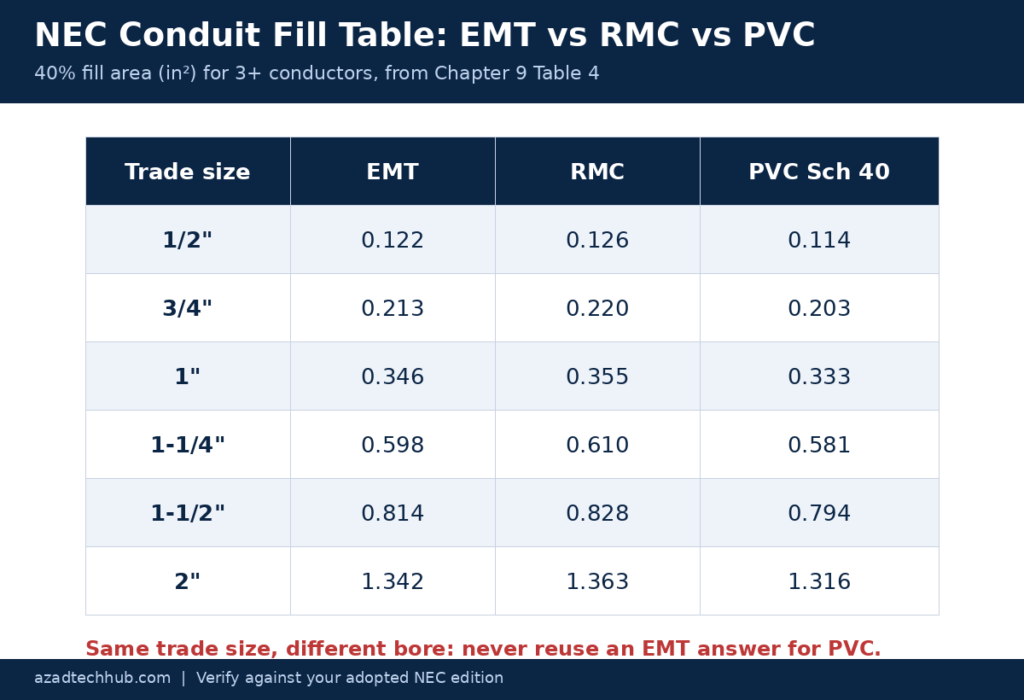
| Trade size | EMT 40% (in²) | RMC 40% (in²) | PVC Sch 40 40% (in²) |
|---|---|---|---|
| 1/2″ | 0.122 | 0.126 | 0.114 |
| 3/4″ | 0.213 | 0.220 | 0.203 |
| 1″ | 0.346 | 0.355 | 0.333 |
| 1-1/4″ | 0.598 | 0.610 | 0.581 |
| 1-1/2″ | 0.814 | 0.828 | 0.794 |
| 2″ | 1.342 | 1.363 | 1.316 |
Notice that the same trade size gives a different answer in each material, because wall thickness changes the bore. That is why a result for EMT must never be reused for PVC. If you need a longer wire-by-wire chart, see our wire fill chart for conduit.
PVC Conduit Fill Chart: Article 352 Rules
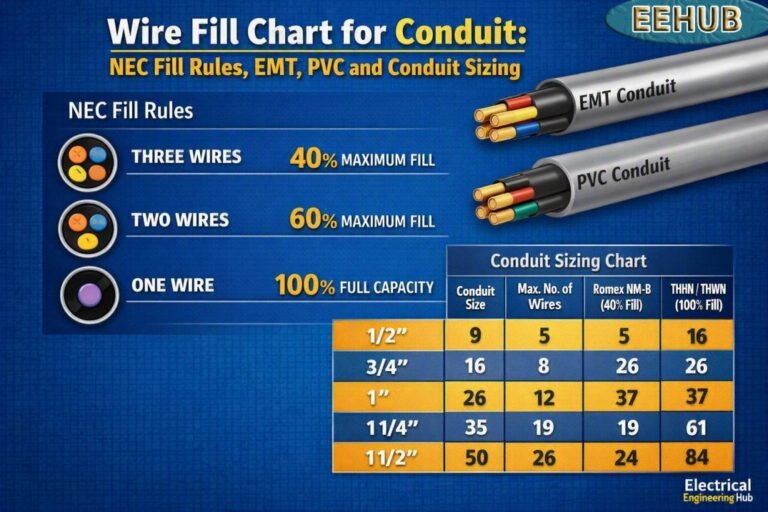
Under the NEC article for conduit fill rules, PVC follows Article 352, and section 352.22 sends you to the same Table 1 percentages. The difference is the internal area. The chart below shows the maximum number of same-size THHN conductors in Schedule 40 PVC at the 40% limit.
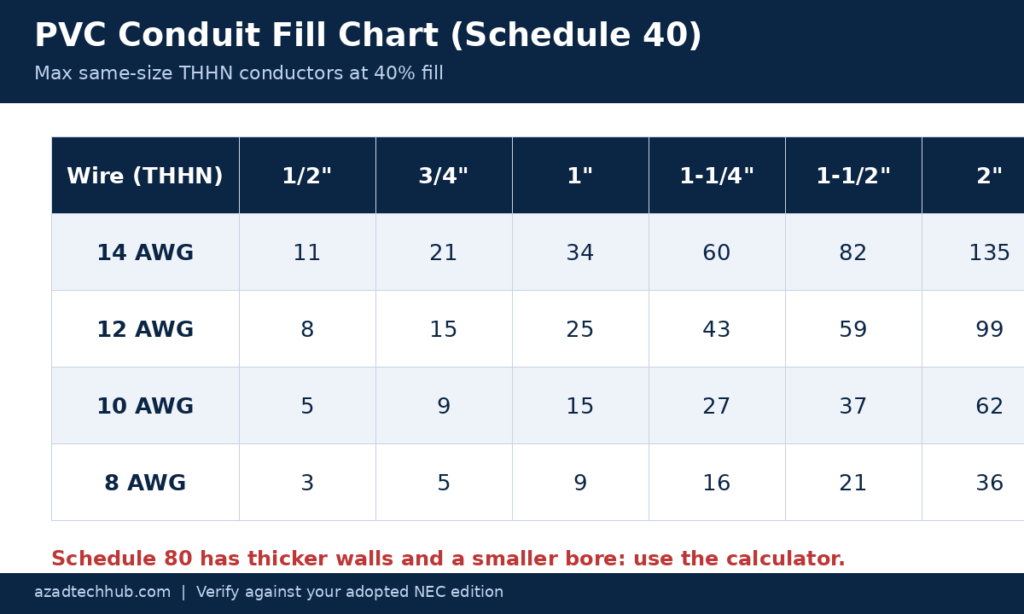
Schedule 80 PVC has thicker walls and a smaller bore, so these counts do not apply to it. For Schedule 80, and for more sizes, use the PVC electrical pipe fill chart or the calculator. Treat the counts here as planning figures and check them against Annex C for your exact conductor.
PVC runs also need expansion fittings and the right solvent cement. A good PVC conduit cutter and a reamer for deburring save time on every joint.


NEC Chapter 9 Conduit Fill: Tables 4, 5 and Annex C
Searches for NEC Chapter 9 conduit fill usually mean one of three tables inside the NEC article for conduit fill chain:
- Table 4 gives the internal area of each raceway type and trade size, plus its 53%, 31%, 40% and 60% values.
- Table 5 gives the area of each insulated conductor, including insulation. Table 5A covers compact aluminum building wire. See compact conductor conduit fill.
- Annex C lists how many same-size conductors fit in each conduit. It is informative, so the percentage rule in Table 1 stays the controlling requirement. For mixed sizes you must add areas yourself, as shown in mixed conductor sizes in conduit fill.
How to Apply the NEC Article for Conduit Fill: A Worked Example
Take a 48 A EV charger on a 60 A circuit, wired with two 6 AWG THHN conductors and one 10 AWG THHN ground. The same example appears in our hub, and it shows every step of the NEC article for conduit fill in action.
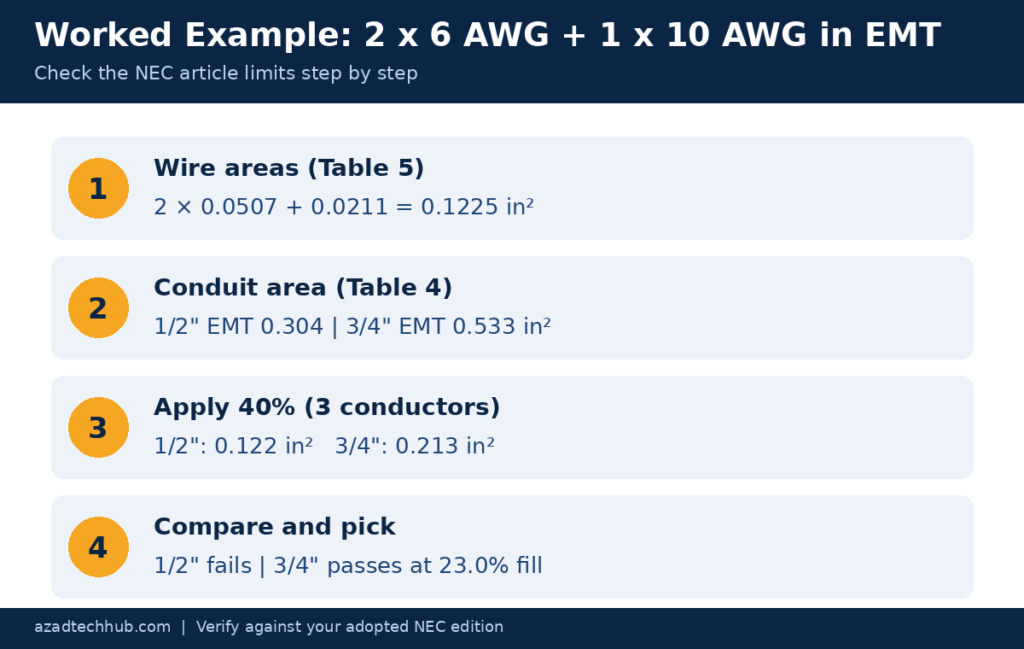
- Wire area (Table 5): 2 × 0.0507 + 0.0211 = 0.1225 in².
- Conduit area (Table 4): 1/2″ EMT is 0.304 in² and 3/4″ EMT is 0.533 in².
- Apply the limit (Table 1): three conductors, so 40%. That gives 0.122 in² for 1/2″ EMT and 0.213 in² for 3/4″ EMT.
- Compare: 0.1225 is above 0.122, so 1/2″ EMT fails by a hair. 3/4″ EMT passes at 23.0% fill.
Size the conductors first with the EV charger cable size calculator, then check the conduit. For a deeper walkthrough, follow how to calculate conduit fill step by step. If you are choosing the charger itself, our guide to the best Level 2 EV charger covers circuit sizing.
Special Raceways: Flex, Liquidtight, Cable and Trays
Not every raceway follows the plain NEC article for conduit fill path:
- Flexible and liquidtight conduit: check sections 348.22, 350.22 and 356.22 and use the correct Table 4 area. See the flexible conduit fill chart and the liquidtight flexible nonmetallic conduit fill chart.
- Romex and other cable: a cable counts as one conductor. See Romex in conduit and, for instrument cable by diameter, the Belden cable conduit fill calculator.
- Metal wireways: Article 376 uses its own 20% limit, not Table 1.
- Cable trays: Article 392 uses a different method. Use the cable tray fill calculator.
Related NEC Sections Beyond Fill
Passing the NEC article for conduit fill check does not finish the job, because fill only says the wires fit. Four other sections complete the picture:
- Ampacity adjustment: more than three current-carrying conductors need derating under 310.15(C)(1) in the 2023 edition (310.15(B)(3)(a) in older editions). Use the conduit fill derating calculator.
- Bends: EMT is limited to the equivalent of four quarter bends between pull points under 358.26. Plan bends with the cable bending radius calculator.
- Pull boxes: long or bent runs may need a box sized under NEC 314.28.
- Grounding conductor size: the equipment grounding conductor you pick from 250.122 also counts toward fill. Size the phase conductors with the AC cable size calculator first.
In Canada the rules differ, so read the Canadian Electrical Code vs NEC differences before reusing an NEC answer.
Check Your Answer With the NEC Conduit Fill Calculator
Once you know which NEC article for conduit fill rule applies, let a tool do the arithmetic. Our NEC conduit fill calculator takes your conductor sizes and quantities, applies the correct percentage for the conductor count, and shows the smallest conduit that passes for EMT, RMC and PVC. Open the conduit fill calculator and enter your wires. It also includes CSA, IEC, BS 7671 and AS/NZS modes for non-US work.
Tools That Make Conduit Work Easier
Once the NEC article for conduit fill check passes, the right tools keep the install clean. As an Amazon Associate I earn from qualifying purchases, at no extra cost to you. See our affiliate disclosure.
- Wire strippers: clean strips on 14 to 6 AWG THHN protect the insulation you just calculated. See our best wire strippers for electricians.


- Conduit benders: see our conduit bender reviews.


- Fish tape and wire-pulling lubricant: a fish tape and lube make a high-fill pull much easier and protect the insulation.
- Splicing: for junction boxes in the run, see whether WAGO lever nuts work on stranded wire.
- Testing after the pull: a clamp meter or multimeter confirms the circuit once it is energized.
Frequently Asked Questions
What is the NEC article for conduit fill?
There is no single article. The general rule is in 300.17, the percentages are in Chapter 9 Table 1, and each raceway article has a number of conductors section, such as 358.22 for EMT.
What is the NEC conduit fill percentage?
It is 53% for one conductor, 31% for two and 40% for three or more. Nipples of 24 in. or less may be filled to 60%.
Is there an NEC conduit fill table PDF I can download?
The official NEC is available to read through NFPA. For a quick reference, use the cheat sheet in this guide, and check it against the edition your jurisdiction has adopted.
What is the PVC conduit fill chart limit?
PVC follows the same NEC article for conduit fill percentages as other raceways, but the internal area of Schedule 40 and Schedule 80 differs, so use the correct Table 4 value.
Where is NEC Chapter 9 conduit fill in the code book?
Chapter 9, Table 1 for the percentages, Table 4 for conduit areas, Table 5 for conductor areas and Annex C for same-size counts.
Does the grounding wire count in conduit fill?
Yes. Equipment grounding and bonding conductors count using their actual dimensions.
Conclusion
The NEC article for conduit fill comes down to a simple path: pick the raceway article, apply the Table 1 percentage, take areas from Tables 4 and 5, and confirm with Annex C. Then check ampacity, bends and pull boxes. Follow that path for every new run. When you want a fast answer, the conduit fill calculator does the whole chain in seconds.
About This Guide
Written by Abdul Wassay, an electrical engineer who publishes standards-based calculators and guides on Azad Circuit Hub. Areas and limits are based on NEC Chapter 9 Tables 1, 4 and 5 and Annex C. This guide is a design aid, not a substitute for the code or a licensed electrician. Always verify against the NEC edition adopted by your jurisdiction and your inspector. Spotted an error? Use our contact page.
Sources: NFPA 70, National Electrical Code (Chapter 9 Tables 1, 4, 5 and 5A, Annex C, Articles 342 to 362, 376, 392, sections 250.122, 300.17, 310.15 and 358.26).
Get new guides in your feed. Follow Electrical Insights on LinkedIn for new electrical standards guides, calculators and design tips from Azad Circuit Hub.