
Conduit Nipple Fill Rule NEC Under 24 Inches: Chapter 9 Note 4 Fill Exception
The conduit nipple fill rule NEC provides a useful exception for short raceway sections installed between electrical boxes, cabinets, gutters, and similar enclosures. Under NEC Chapter 9, Table 1, Note 4, a conduit or tubing nipple with a maximum length of 24 inches can be filled to 60% of its total internal cross-sectional area under the conditions stated by the NEC.
This is different from the normal 40% raceway fill limit commonly used when three or more conductors are installed. Understanding the difference can prevent unnecessary upsizing of short nipples while keeping the installation within the NEC requirements.
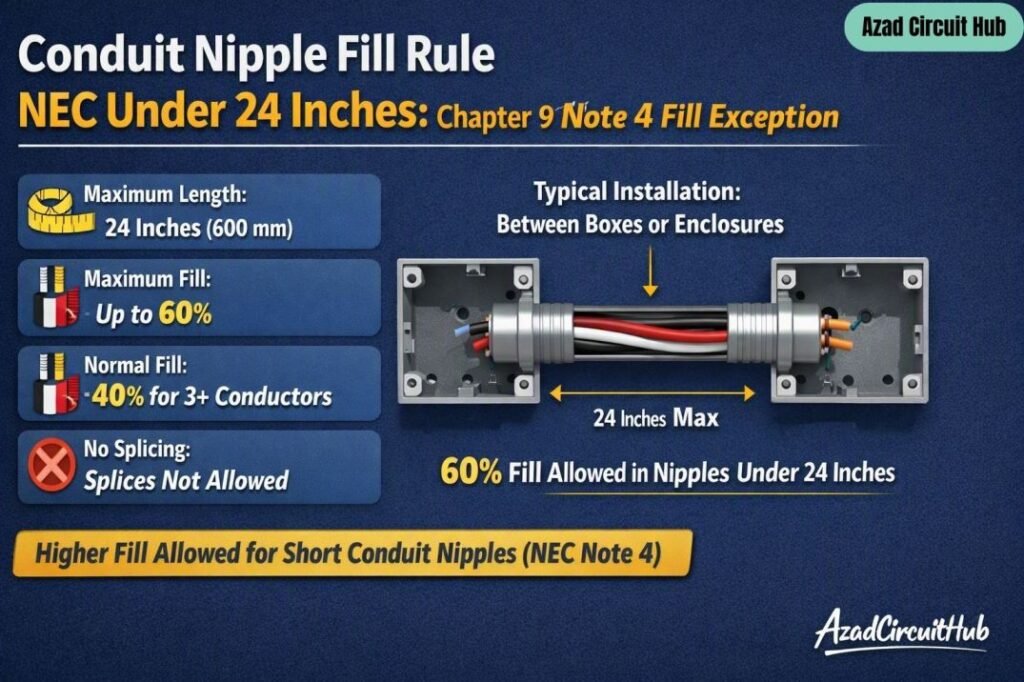
Table of Contents
Table of Contents
Conduit Nipple Fill Rule NEC at a Glance
The following table summarizes the main requirements associated with the conduit nipple fill rule NEC.
| Item | NEC Requirement |
|---|---|
| Maximum nipple length | 24 in. (600 mm) |
| Maximum fill for qualifying nipple | 60% |
| Normal fill for 3 or more conductors | 40% |
| Applicable NEC location | Chapter 9, Table 1, Note 4 |
| Typical installation | Between boxes, cabinets, gutters, and other enclosures |
| Conductors spliced in nipple | Not permitted under the Note 4 condition |
| Raceway type | Conduit or tubing covered by the applicable NEC provisions |
| Purpose | Allows higher fill in short raceway nipples |
The 60% allowance is an exception for qualifying short nipples. It should not be applied automatically to every piece of conduit shorter than 24 inches.
What Is the 24-Inch Conduit Nipple Exception?
A conduit nipple is generally a short section of raceway used to connect two enclosures. A common example is a short piece of EMT connecting a junction box to a panelboard.
NEC Chapter 9, Table 1, Note 4 permits a nipple not exceeding 24 inches in length to have a fill of up to 60% of its total cross-sectional area, subject to the conditions in the note.
This is important because the standard conductor-fill calculation normally uses a lower percentage when multiple conductors are installed in a raceway.
| Installation | Common Fill Percentage |
|---|---|
| One conductor | 53% |
| Two conductors | 31% |
| Three or more conductors | 40% |
| Qualifying nipple under 24 in. | 60% |
The percentages above come from NEC Chapter 9, Table 1. The 60% nipple provision is therefore a specific exception rather than a replacement for the normal raceway-fill rules.
How the 60% Nipple Fill Works
The calculation is straightforward. First, determine the internal cross-sectional area of the conduit from the applicable NEC tables. Then multiply that area by 60%.
For example, suppose a short nipple has an internal area of 0.533 square inches.
The permitted conductor area is:
0.533 × 0.60 = 0.320 in²
The combined conductor area must therefore be no greater than approximately 0.320 square inches.
| Conduit Internal Area | 60% Maximum Fill |
|---|---|
| 0.200 in² | 0.120 in² |
| 0.300 in² | 0.180 in² |
| 0.400 in² | 0.240 in² |
| 0.500 in² | 0.300 in² |
| 0.600 in² | 0.360 in² |
| 0.800 in² | 0.480 in² |
| 1.000 in² | 0.600 in² |
This calculation only establishes the available raceway area. You still need the actual conductor dimensions or the conductor area values specified by the applicable NEC tables.
For larger projects, an electrical conduit size calculator can simplify the comparison between conductor count, conductor size, and available raceway area.
Example: Three Conductors in a Short Nipple
Consider a short metallic conduit nipple connecting a junction box to a panel. Assume the raceway’s internal area is 0.533 in².
Under the normal 40% rule:
0.533 × 0.40 = 0.2132 in²
Under the 60% nipple exception:
0.533 × 0.60 = 0.3198 in²
That gives the qualifying nipple substantially more usable conductor area.
| Calculation | Maximum Conductor Area |
|---|---|
| 40% standard fill | 0.213 in² |
| 60% nipple fill | 0.320 in² |
| Additional available area | 0.107 in² |
The difference can matter when a panel connection contains several relatively large conductors.
However, the raceway must meet the conditions for the exception. A nipple that exceeds 24 inches cannot simply use the 60% calculation because it is convenient.
What Happens If the Nipple Is Longer Than 24 Inches?
The 24-inch maximum is an important part of the exception.
If a raceway section exceeds 24 inches, the special 60% nipple provision in Chapter 9, Table 1, Note 4 does not apply. The normal raceway-fill provisions must then be considered.
For example:
| Nipple Length | 60% Exception? |
|---|---|
| 6 in. | Yes, if other conditions are met |
| 12 in. | Yes, if other conditions are met |
| 18 in. | Yes, if other conditions are met |
| 24 in. | Yes, if other conditions are met |
| 24.1 in. | No |
| 30 in. | No |
| 36 in. | No |
The 24-inch measurement should therefore be treated as a maximum, not a general guideline.
When working with metric drawings or international projects, a conduit size calculator australia can also help with metric raceway sizing, but the applicable Australian requirements should not be substituted for NEC rules on a U.S. installation.
Conductor Splices and Taps in the Nipple
Another important point is conductor splicing and tapping.
The Chapter 9, Table 1, Note 4 exception includes a condition concerning splices and taps within the nipple. The increased fill allowance is not intended to create a convenient location for making electrical connections.
Keep splices and taps in an enclosure approved for that purpose. The short raceway section should function as a connection between enclosures rather than as a hidden splice location.
This is especially important in crowded panel installations where a short nipple can appear to provide additional space.
Nipple Fill vs. Standard Raceway Fill
The difference between the normal 40% calculation and the special 60% allowance is worth remembering.
| Factor | Standard Raceway Fill | Short Nipple Exception |
|---|---|---|
| Typical maximum for 3+ conductors | 40% | 60% |
| Maximum length condition | Not based on 24 in. nipple exception | 24 in. maximum |
| Purpose | General raceway installations | Short connection between enclosures |
| Splices/taps inside nipple | Governed by applicable NEC requirements | Must satisfy Note 4 conditions |
| Calculation basis | Chapter 9, Table 1 | Chapter 9, Table 1, Note 4 |
For projects involving many conduit sizes, a conduit size calculator can help check the required raceway area before installation.
Practical Installation Checks
Before applying the 60% allowance, check these points:
- Measure the actual nipple length.
- Confirm that it does not exceed 24 inches.
- Identify the raceway type and trade size.
- Obtain the correct internal area from the applicable NEC table.
- Determine the total conductor area.
- Confirm that the conductors meet the conditions of the nipple exception.
- Check conductor ampacity separately.
- Consider conductor bending space at the enclosure.
- Verify termination requirements.
- Check any local amendments adopted by the authority having jurisdiction.
Raceway fill and conductor ampacity are separate calculations. A conduit can have enough physical space for the conductors while the conductor installation still requires a different ampacity or adjustment calculation.
Frequently Asked Questions
What is the NEC conduit nipple fill rule?
The conduit nipple fill rule NEC allows a qualifying conduit or tubing nipple no longer than 24 inches to be filled to 60% of its total cross-sectional area, subject to the conditions in NEC Chapter 9, Table 1, Note 4.
Can a 24-inch nipple be filled to 60%?
Yes. A nipple with a maximum length of 24 inches can qualify for the 60% fill allowance when the other requirements of Chapter 9, Table 1, Note 4 are satisfied.
Does the 60% rule apply to all short conduits?
No. The exception applies to qualifying nipples installed between boxes, cabinets, auxiliary gutters, and other enclosures and is subject to the conditions specified by NEC Chapter 9, Table 1, Note 4.
What happens if a conduit nipple is more than 24 inches?
The special 60% nipple allowance does not apply once the nipple exceeds 24 inches. The applicable standard raceway-fill requirements must then be used.
Can I put a splice inside a conduit nipple?
The Chapter 9, Table 1, Note 4 exception includes a condition that the conductors are not spliced or tapped within the nipple. Splices and taps should be made in an enclosure permitted for that purpose.
Final Takeaway
The conduit nipple fill rule NEC provides a useful 60% fill exception for qualifying nipples with a maximum length of 24 inches. The rule is found in NEC Chapter 9, Table 1, Note 4 and is particularly useful when connecting adjacent panels, junction boxes, cabinets, and other enclosures.
The key points are simple: verify the nipple length, use the correct raceway internal area, calculate the 60% limit, and confirm that the installation meets every condition of the NEC exception. Do not use the 60% value simply because a conduit section is short.
Always check the edition of the NEC adopted by the local authority and any applicable amendments before final installation.
Get new guides in your feed. Follow Electrical Insights on LinkedIn for new electrical standards guides, calculators and design tips from Azad Circuit Hub.
#ConduitNippleFill, #NECConduitFill, #ConduitFillRule, #NECChapter9, #Chapter9Note4, #NEC2023, #ElectricalCode, #ConduitSizing, #ElectricalWiring, #Electricians
