NEC 314.28 Pull Box Sizing Requirements: Complete Guide
NEC 314.28 defines the requirements for sizing pull boxes, junction boxes, and conduit bodies when conductors are 4 AWG or larger. Correct box dimensions are essential to protect conductors during installation and prevent excessive bending stress. This guide explains the complete nec pull box sizing requirements, including straight pulls, angle pulls, U-pulls, spacing rules, common mistakes, and practical sizing methods used by electrical professionals.
The National Electrical Code provides specific rules because large conductors require more room for pulling and bending compared with smaller wires. Understanding these requirements helps engineers, electricians, and contractors select compliant enclosures for commercial and industrial installations.
If you want to avoid manual calculations, skip the math further down and use our calculator that applies NEC rules automatically.
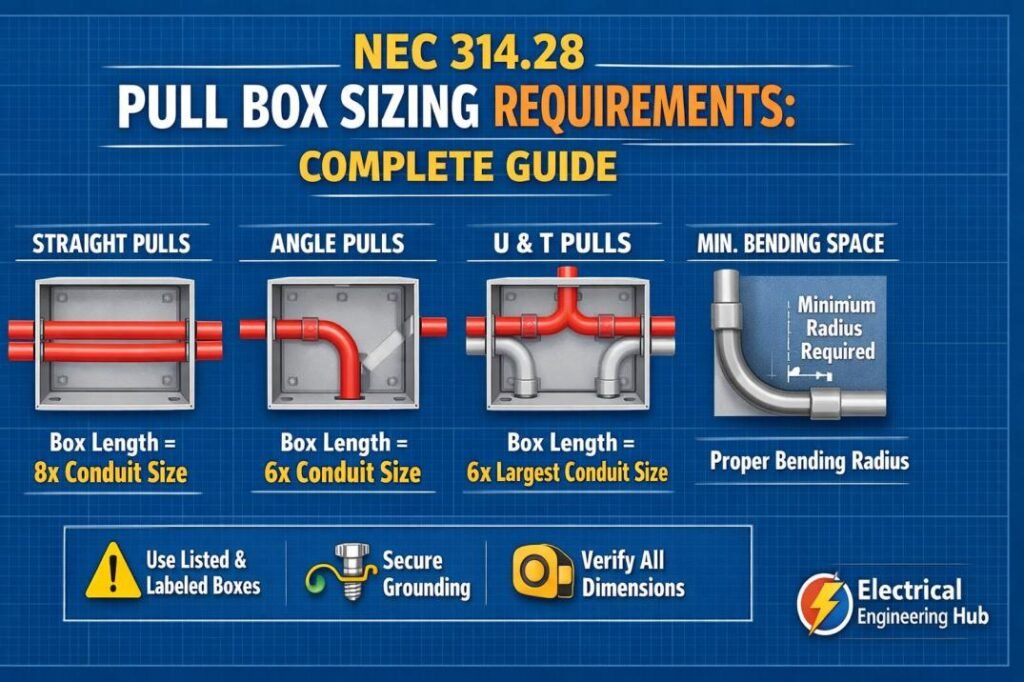
Table of Contents
Table of Contents
What Is NEC 314.28?
NEC 314.28 covers the sizing of pull boxes, junction boxes, and conduit bodies used with conductors rated 4 AWG or larger. These rules apply when the enclosure is used for pulling, splicing, or changing the direction of conductors inside a raceway system.
The purpose of the rule is to provide enough space for safe conductor installation without damaging cable insulation or exceeding the minimum bending radius. Large power conductors are stiff and require additional room when pulled through raceways.
The nec pull box sizing rules do not apply to boxes containing only smaller conductors. If a box contains conductors smaller than 4 AWG and does not fall under the large conductor requirements, sizing is generally based on NEC 314.16 box fill calculations.
When Is a Pull Box Required?
A pull box is installed when conductors cannot be easily pulled through a raceway system because of distance, bends, or installation complexity. Large conductors create higher pulling tension, so additional access points may be required to make installation safer and easier.
Common situations where a pull box may be required include:
- Long underground conduit runs where pulling tension becomes excessive.
- Raceway systems containing multiple bends that make conductor installation difficult.
- Electrical feeders requiring a splice or transition point.
- Large commercial or industrial power distribution systems.
- Changes in conduit direction that require additional conductor bending space.
- Projects where cable pulling equipment cannot safely complete the installation in one section.
Following nec pull box sizing requirements during the design stage helps avoid installation delays and costly field modifications.
The Three Pull Configurations NEC 314.28 Covers
NEC 314.28 identifies different pulling arrangements because conductor movement inside a box changes depending on the direction of the raceway entries. Each configuration requires a different approach to determine the minimum enclosure dimensions.
The three main arrangements are straight pulls, angle pulls, and U-pulls. The goal in each case is to provide enough room for conductors to enter, exit, and bend without exceeding allowable limits.
When multiple raceway sizes enter the same box, the largest raceway becomes the primary reference point. The box sizing nec requirements also consider additional raceway entries depending on the pulling configuration.
Straight Pulls (314.28(A)(1))
A straight pull occurs when conductors enter and leave the enclosure through raceway openings located on opposite walls. The conductors travel in a straight path through the box without changing direction.
For this arrangement, NEC requires the minimum distance between raceway entries to be based on the trade diameter of the largest raceway connected to the box. The enclosure must provide enough straight-line space for conductors to move freely during pulling.
The rule uses a multiplier of the largest raceway diameter to establish the minimum internal length. This prevents conductors from being forced into tight bends while being pulled.
A proper nec pull box sizing calculation automatically identifies the largest conduit size and applies the straight pull requirement.
Angle Pulls (314.28(A)(2))
An angle pull occurs when conductors enter and leave the box through raceways installed at different angles. A common example is a conduit entering from one wall and leaving through an adjacent wall.
The minimum enclosure distance depends on the largest raceway on the pulling path and also considers other raceway entries located on the same wall. These additional entries increase the space required because conductors must bend around them.
The rule is designed to maintain proper conductor bending space during installation. Instead of measuring only one raceway opening, the complete arrangement inside the box must be considered.
A box sizing calculator nec approach simplifies this process by applying the correct angle pull logic automatically.
U-Pulls (Same Wall Entry/Exit)
A U-pull occurs when conductors enter and leave through raceway openings on the same wall or through similar directional arrangements that require the conductor to make a U-shaped bend inside the enclosure.
U-pulls follow the same general sizing principle as angle pulls because conductors must change direction within the box. This is a common area of confusion during field installations.
Many installers incorrectly apply straight pull dimensions to U-pulls. However, the conductor path requires additional space, so the angle pull requirements are typically used.
Using a nec pull box sizing calculator helps prevent incorrect assumptions and ensures the enclosure meets NEC requirements.
Minimum Distance Between Raceway Entries
NEC 314.28 also considers the spacing between raceway entries that contain the same conductors. Proper spacing prevents conductors from being forced into sharp bends and helps maintain the required bending radius.
When raceways are installed too close together, conductors may become damaged during pulling or termination. Adequate separation also provides room for locknuts, fittings, and installation tools.
The required distance depends on the raceway arrangement and conductor size. Designers should consider the complete installation layout instead of only the conduit diameter.
NEC 314.28 Pull Box Sizing Chart (Quick Reference)
The following nec pull box sizing chart provides a simplified reference for common conduit sizes. Actual installations should always be verified using the complete NEC requirements because raceway arrangement and multiple entries can affect final dimensions. See in detail Straight Pull vs. Angle Pull Box Sizing (NEC 314.28)
| Conduit Trade Size | Straight Pull Minimum | Angle/U-Pull Minimum |
|---|---|---|
| 1 inch | Based on 8× raceway diameter | Based on 6× raceway diameter plus additional entries |
| 2 inch | Based on 8× raceway diameter | Based on 6× raceway diameter plus additional entries |
| 3 inch | Based on 8× raceway diameter | Based on 6× raceway diameter plus additional entries |
| 4 inch | Based on 8× raceway diameter | Based on 6× raceway diameter plus additional entries |
| 6 inch | Based on 8× raceway diameter | Based on 6× raceway diameter plus additional entries |
This quick table is useful during planning, but engineers should confirm final dimensions with a detailed nec box sizing calculation.
Common Mistakes When Sizing Pull Boxes to Code
Incorrect pull box selection is one of the common causes of failed inspections and difficult cable installation. The following mistakes should be avoided:
- Forgetting to include additional raceway entries on the same wall during angle pulls.
- Using nominal conduit size instead of actual trade diameter requirements.
- Applying straight pull rules to angle or U-pull configurations.
- Ignoring locknut, fitting, and termination space inside the enclosure.
- Selecting box dimensions based only on one conduit when multiple raceway sizes are connected.
- Not checking conductor bending radius requirements for large cables.
- Assuming a standard junction box fill calculation is enough for large conductors.
Proper box sizing nec practices require evaluating the complete raceway arrangement before selecting an enclosure.
Skip the Manual Calculations – Use Our NEC-Compliant Calculator
Manual calculations can become time-consuming when a pull box has multiple conduit entries or complex pulling arrangements. Our Pull Box Sizing Calculator simplifies the process by applying NEC 314.28 requirements automatically.
The tool evaluates straight pulls, angle pulls, and U-pulls while considering raceway dimensions and configuration rules. Instead of manually reviewing every requirement, engineers and electricians can quickly determine a compliant box size.
FAQs
Does NEC 314.28 apply to junction boxes too?
Yes. NEC 314.28 applies to junction boxes, pull boxes, and conduit bodies when they are used with conductors 4 AWG or larger. The rule ensures enough space for pulling, splicing, and conductor bending.
What size wire triggers NEC 314.28 pull box sizing?
NEC 314.28 applies when conductors are 4 AWG or larger. Smaller conductors are generally evaluated using NEC 314.16 box fill requirements unless another code section applies.
What’s the minimum size for a straight pull box?
For a straight pull, the minimum enclosure dimension is based on eight times the trade diameter of the largest raceway entering the box. A proper nec pull box sizing calculation should be used for exact dimensions.
Is the angle pull rule different from the U-pull rule?
Angle pulls and U-pulls use similar sizing principles because both require conductor direction changes inside the enclosure. Both require additional space compared with straight pulls.
Do trade diameter and nominal conduit size mean the same thing?
Yes, in NEC terminology, conduit trade size refers to the standard commercial size designation used for raceways. The calculation uses the trade diameter, not a measured outside dimension.
Understanding nec pull box sizing is important for safe and code-compliant electrical installations. NEC 314.28 provides clear guidelines for large conductor applications, helping professionals select enclosures that allow proper pulling, bending, and termination.
Related Guides & Tools
Get new guides in your feed. Follow Electrical Insights on LinkedIn for new electrical standards guides, calculators and design tips from Azad Circuit Hub.
NEC31428, #PullBoxSizing, #ElectricalEngineering, #ElectricalCode, #NECStandards, #ElectricalInstallation, #ConduitSizing, #ElectricalDesign, #PowerSystems, #ElectriciansGuide