
Pull Box Sizing Calculator (NEC 314.28)
Installing a pull box with the correct dimensions is essential for safe cable pulling, future maintenance, and compliance with the National Electrical Code (NEC). This Pull Box Sizing Calculator helps electricians, engineers, contractors, and designers estimate the minimum pull box dimensions required under NEC 314.28.
Whether you are working with straight pulls, angle pulls, or U-pulls, using the correct electrical pull box sizing method reduces cable stress and prevents costly installation errors. This guide explains how pull box sizing works, summarizes NEC requirements, provides quick reference charts, and links to detailed resources for advanced calculations and special installation conditions.
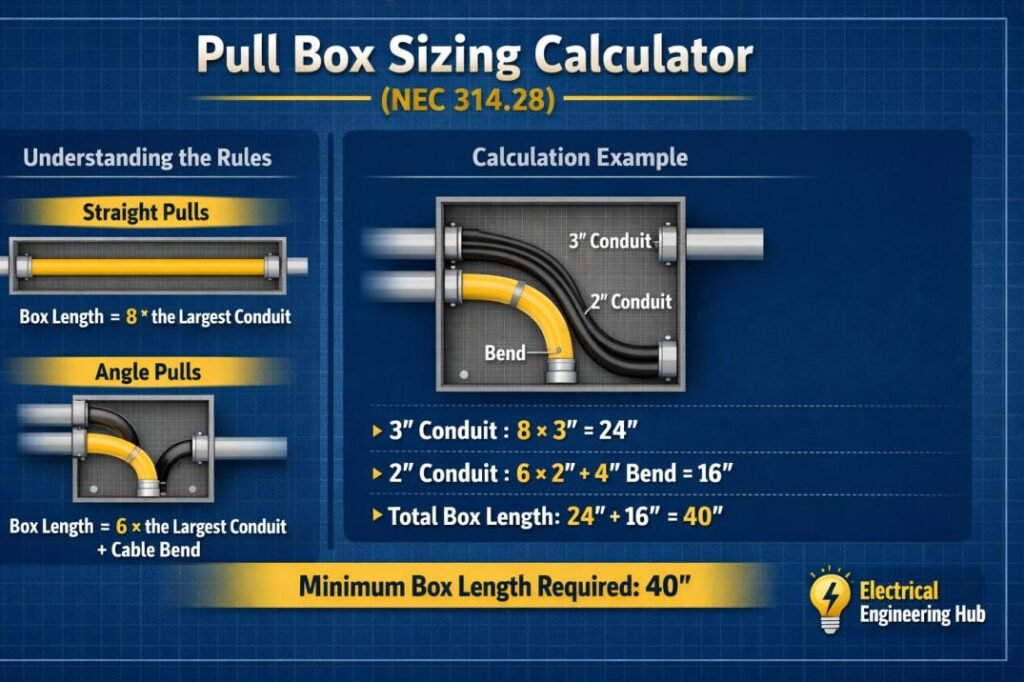
Table of Contents
Table of Contents
Pull Box Sizing Calculator
Pull Box Sizing Calculator
Minimum enclosure dimensions for straight, angle, and U-pulls containing conductors 4 AWG and larger.
Raceways Entering This Wall
List every raceway entering the wall for this straight pull. Only the largest trade size governs the result.
| Trade Size | Custom (in) |
|---|
Raceways Entering the Same Wall / Row
Add every raceway that enters through the same wall and encloses the same conductors, in physical entry order.
| Trade Size | Custom (in) |
|---|
How to Use
- Choose the pull type: Straight Pull if conductors enter and exit through opposite walls in a straight line, or Angle / U-Pull if conductors change direction or enter and exit the same wall.
- Add a row for every raceway entering the relevant wall using “Add Raceway,” selecting the trade size from the dropdown, or choosing “Custom” to type an exact size.
- For Angle / U-Pull, enter raceways in their actual physical order along the wall so entry-to-entry spacing is calculated correctly.
- Select “Calculate” to view the minimum enclosure dimension required for that pull.
- Repeat for each wall or pull condition in the box, then use the largest resulting dimensions to set the enclosure size, allowing extra room for locknuts, bushings, and gutter space.
Technical Notes
This calculator applies to pull and junction boxes and conduit bodies used with conductors 4 AWG and larger, as covered by NEC 314.28(A). Boxes and conduit bodies for conductors smaller than 4 AWG are sized under the general fill provisions of NEC 314.16 instead.
- A straight pull is one where the raceway enters one wall and the conductors leave through the opposite wall without a change in direction.
- An angle pull or U-pull occurs where the conductors enter and leave in a way that requires the conductor to bend inside the enclosure, including entries and exits on the same wall.
- Where a row contains raceways of different trade sizes, the largest raceway in that row governs the primary dimension, while the remaining raceways in the same row still add to the required space.
- Entry-to-entry spacing applies between raceways that enclose the same conductors, to preserve adequate bending room for each conductor as it is pulled through the box.
- Results shown are code-minimum values only. Manufacturer instructions, locknut and bushing clearance, gutter space, and conductor bending space may require a larger enclosure than the code minimum.
- Always verify final dimensions against the current adopted edition of the NEC and the authority having jurisdiction before installation.
How to Use Pull Box Sizing Calculator
Using the Pull Box Sizing Calculator requires only a few inputs.
- Select the pull configuration.
- Enter the largest conduit trade size.
- Enter the number of raceways entering each wall.
- Specify whether conduits are on opposite walls or adjacent walls.
- Click Calculate.
- Review the minimum pull box dimensions displayed.
For the most accurate results:
- Verify conduit sizes before entering values.
- Include every raceway entering the box.
- Select the correct pull configuration.
- Use actual conduit trade sizes instead of cable diameters.
- Confirm the final installation complies with local electrical regulations.
Although the calculator automates electrical box size calculation, field conditions such as conductor bending radius, cable type, and maintenance access should also be considered during installation.
What Is a Pull Box?
A pull box is an electrical enclosure installed in conduit systems to provide access for pulling, installing, replacing, or maintaining conductors. Unlike splice boxes or junction boxes, pull boxes typically do not contain wire splices or electrical devices.
Their primary purpose is to reduce pulling tension over long conduit runs while providing an accessible location for routing conductors through bends and direction changes.
The table below highlights the differences.
| Feature | Pull Box | Junction Box |
|---|---|---|
| Cable pulling | Yes | Sometimes |
| Wire splicing | Normally No | Yes |
| Device mounting | No | Often |
| NEC sizing rules | NEC 314.28 | NEC 314.16 or applicable sections |
| Main application | Long conduit runs | Circuit connections |
Understanding this distinction helps avoid selecting the wrong enclosure when sizing electrical pull boxes.
How to Size a Pull Box
Many users looking for a Pull Box Sizing Calculator also want to understand how to size a pull box manually. The process follows NEC 314.28, where the required box dimensions depend on the raceway layout, conduit size, and whether the installation is a straight pull, angle pull, or U-pull.
For straight pulls, the minimum box length is eight times the largest conduit trade size. Angle and U-pulls require additional spacing based on the largest conduit and the number of raceways on the same wall. For a complete step-by-step explanation with worked examples, see our detailed guide on How to Size a Pull Box.
NEC 314.28 Requirements at a Glance
NEC 314.28 establishes minimum dimensions for pull boxes, conduit bodies, and junction boxes used with conductors 4 AWG and larger. Minimum distances vary depending on whether it’s a straight pull or angle pull, see how each is calculated.
Key requirements include:
- Straight pulls require box length based on conduit size.
- Angle pulls have different sizing requirements.
- U-pulls require additional spacing.
- Conductor damage must be avoided during pulling.
- Raceways on adjacent walls require additional calculations.
- Larger conduit systems usually require larger pull boxes.
- Minimum dimensions depend on conduit arrangement rather than conductor size alone.
- Local authority requirements may exceed NEC minimum values.
For detailed formulas and code explanations, see our complete guide on NEC 314.28 Pull Box Sizing Requirements.
Straight Pulls vs. Angle Pulls vs. U-Pulls
Different conduit layouts require different sizing methods. Choosing the wrong method may result in an undersized enclosure even if the conduit count appears correct.
| Pull Type | Description | Basic NEC Requirement |
|---|---|---|
| Straight Pull | Conduits enter opposite walls | Based on largest raceway |
| Angle Pull | Conduits turn 90° | Based on conduit sizes plus spacing |
| U-Pull | Conductors reverse direction | Similar to angle pull rules |
When using a pullbox calculator, always select the correct pull type before performing the calculation. See the full breakdown of straight vs. angle pull sizing.
Pull Box Sizing Chart
The following condensed chart provides a quick reference for common straight pull installations. Always verify calculations before installation.
| Largest Raceway | Minimum Straight Pull Length |
|---|---|
| 1 inch | 8 inches |
| 1¼ inch | 10 inches |
| 1½ inch | 12 inches |
| 2 inch | 16 inches |
| 2½ inch | 20 inches |
| 3 inch | 24 inches |
| 3½ inch | 28 inches |
| 4 inch | 32 inches |
| 5 inch | 40 inches |
| 6 inch | 48 inches |
This table is intended as a quick reference only.
For a complete pull box sizing chart covering straight pulls, angle pulls, U-pulls, multiple conduits, and conduit spacing, visit our dedicated sizing chart guide.
Underground Pull Box Sizing
Underground pull box sizing often requires additional planning beyond NEC minimum dimensions. Soil conditions, drainage, cable weight, utility access, maintenance requirements, and future expansion should all be considered when selecting underground enclosures.
Read our complete guide on Underground Pull Box Sizing and Electrical Vault Design for detailed recommendations.
Why Proper Pull Box Sizing Matters
Selecting the correct pull box size improves both installation quality and long-term system reliability.
Proper sizing offers several benefits.
| Benefit | Why It Matters |
|---|---|
| Easier cable pulling | Reduces installation effort |
| Lower conductor stress | Protects insulation |
| Better maintenance access | Simplifies future repairs |
| Code compliance | Meets NEC requirements |
| Reduced installation damage | Minimizes cable abrasion |
| Future expansion | Provides additional working space |
Electrical pull box dimensions should never be selected solely based on available enclosure sizes. Instead, they should satisfy code requirements while allowing practical conductor installation.
Factors That Affect Pull Box Sizing
Several design variables influence pull box calculation.
| Design Factor | Impact |
|---|---|
| Largest conduit size | Major sizing parameter |
| Number of conduits | Increases required dimensions |
| Pull direction | Straight, angle, or U-pull |
| Conduit spacing | Affects wall dimensions |
| Future expansion | May require larger enclosure |
| Cable type | Large power cables require more working room |
| Installation location | Indoor or underground installations |
Considering these variables early in the design stage helps avoid expensive field modifications.
Common Mistakes During Pull Box Sizing
Many installation problems result from incorrect box selection rather than incorrect conduit installation.
Avoid these common mistakes.
- Using cable diameter instead of conduit trade size.
- Ignoring adjacent raceways.
- Selecting the wrong pull configuration.
- Assuming all junction boxes follow the same sizing rules.
- Forgetting future conduit additions.
- Choosing the smallest available enclosure without verifying NEC requirements.
- Ignoring underground installation requirements.
Using an electrical pull box size calculator significantly reduces these errors while improving design accuracy.
Pull Box vs Junction Box
Although both enclosures protect electrical conductors, they serve different purposes.
| Pull Box | Junction Box |
|---|---|
| Used for conductor pulling | Used for conductor splicing |
| Usually contains no electrical devices | Frequently contains wire connections |
| Sized using NEC 314.28 | Sized under different NEC rules |
| Common in feeders and large conduit systems | Common in branch circuits |
Understanding this difference improves electrical box sizing decisions during project planning. Follow the complete guide on the major differences between pull box and junction box here.
Applications of Pull Boxes
Pull boxes are widely used across industrial and commercial electrical systems.
Typical applications include:
- Industrial facilities
- Commercial buildings
- Manufacturing plants
- Renewable energy projects
- Utility distribution systems
- Data centers
- Water treatment facilities
- Underground electrical networks
- Parking structures
- Infrastructure projects
In each application, proper pull box sizing improves installation efficiency and reduces maintenance costs.
Frequently Asked Questions
How do I calculate pull box size?
Identify the pull type, determine the largest conduit entering the box, count the raceways on each wall, and apply the minimum sizing rules in NEC 314.28. A Pull Box Sizing Calculator performs these calculations automatically.
What’s the minimum size for a straight pull?
For a straight pull, NEC 314.28 requires the minimum box length to be at least eight times the trade size of the largest raceway entering the box from opposite walls.
Is a junction box the same as a pull box?
No. A pull box is primarily used for pulling conductors through conduit systems, while a junction box is intended for wire splices, circuit connections, or device mounting. Their sizing requirements also differ under the NEC.
Related Guides
Continue learning with these detailed resources covering every aspect of pull box sizing and NEC compliance.
- NEC 314.28 Pull Box Sizing Requirements
- Straight Pull vs. Angle Pull Box Sizing (NEC 314.28)
- How to Size a Pull Box
- Pull Box Sizing Chart
- Underground Pull Box Sizing
These resources complement the Pull Box Sizing Calculator and provide detailed guidance for every common installation scenario, helping electricians, engineers, and designers confidently calculate pull box size, select compliant electrical pull box dimensions, and meet NEC 314.28 requirements for commercial, industrial, and underground electrical systems.
Get new guides in your feed. Follow Electrical Insights on LinkedIn for new electrical standards guides, calculators and design tips from Azad Circuit Hub.
#PullBoxSizingCalculator, #NEC31428, #ElectricalEngineering, #ElectricalDesign, #PullBoxSizing, #ElectricalCode, #ConduitDesign, #ElectricalCalculator, #PowerDistribution, #Electricians
Pull Box Sizing Calculator (NEC 314.28)
Pull Box Sizing Calculator helps you determine the minimum pull box dimensions required by NEC 314.28. Calculate electrical pull box sizing accurately for straight, angle, and U-pulls with practical examples.
Price Currency: USD
Operating System: Web Browser
Application Category: UtilitiesApplication
