
Pull Box Sizing Chart: Standard Dimensions Reference
A pull box sizing chart helps electricians, engineers, and contractors quickly determine the minimum enclosure dimensions required for common conduit installations under NEC 314.28. This reference provides standard pull box dimensions for typical straight pulls and angle/U-pulls using common conduit trade sizes.
The values are based on NEC multiplier rules and are intended for simple single-raceway, single-size applications. For installations with multiple conduits, mixed raceway sizes, or complex routing, use the Pull Box Sizing Calculator to get an accurate result based on your exact configuration.
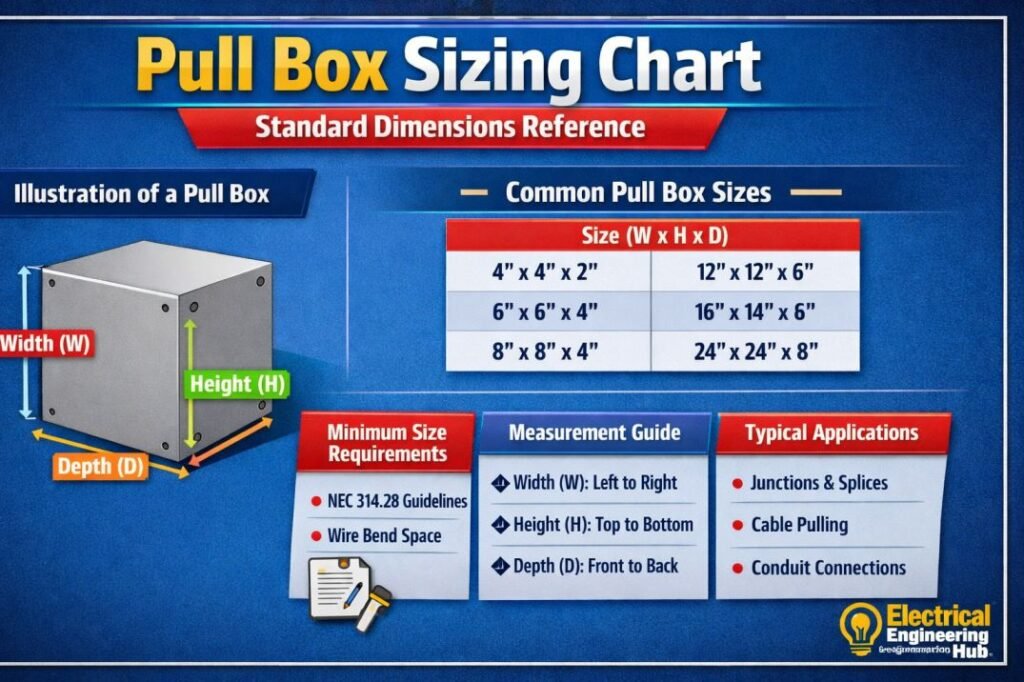
Table of Contents
Table of Contents
How to Read This Chart
The pull box sizing chart below has two main columns: straight pull minimum and angle/U-pull minimum. A straight pull occurs when conductors enter and leave the box from opposite sides, while an angle pull changes direction inside the enclosure.
The straight pull calculation generally uses an 8× multiplier of the largest raceway trade diameter. The angle/U-pull calculation uses a 6× multiplier when only one raceway enters a wall and additional calculations apply when multiple raceways are installed on the same side. For a detailed explanation, see our guide on NEC 314.28 Pull Box Sizing Requirements.
Pull Box Sizing Chart (by Trade Size)
The following pull box sizing chart provides common minimum dimensions for standard conduit trade sizes. These values represent typical NEC 314.28 calculations using approximate trade diameters. Always verify the actual conduit outside diameter from NEC Chapter 9 tables or manufacturer data before final installation.
| Conduit Trade Size | Straight Pull Minimum (inches) | Angle/U-Pull Minimum (inches) |
|---|---|---|
| 1/2 inch | 4 | 3 |
| 3/4 inch | 6 | 4.5 |
| 1 inch | 8 | 6 |
| 1-1/4 inch | 10 | 7.5 |
| 1-1/2 inch | 12 | 9 |
| 2 inch | 16 | 12 |
| 2-1/2 inch | 20 | 15 |
| 3 inch | 24 | 18 |
| 3-1/2 inch | 28 | 21 |
| 4 inch | 32 | 24 |
This electrical pull box size chart is designed as a quick reference for common field installations. The actual enclosure size may need to increase depending on conduit arrangement, conductor size, bending radius requirements, and the number of raceways entering the box.
For example, a 2-inch conduit requires a minimum straight pull dimension of approximately 16 inches based on the 8× rule. However, if multiple conduits enter the same side of the enclosure, the required pull box dimensions can increase significantly.
For projects with non-standard layouts, the Pull Box Sizing Calculator provides a faster way to determine the required dimensions while considering raceway arrangement and NEC requirements.
What This Chart Doesn’t Cover
While a pull box sizing chart is useful for common installations, it does not cover every possible field condition. Electrical installations often involve multiple raceways, different conduit sizes, and complex conductor routing that require additional calculations.
The chart above does not include:
- Multiple raceways entering the same wall, where NEC 314.28 angle pull calculations require adding conduit dimensions and spacing requirements.
- Mixed conduit sizes installed in the same pull box, where the largest raceway and additional entry arrangements affect the final dimensions.
- Underground pull boxes, handholes, and vault installations that may have separate depth, drainage, accessibility, and utility requirements.
- Conductor bending space requirements beyond the minimum pull distance calculations.
- Large conductor installations where conductor bending radius becomes the limiting factor.
- Pull box requirements for special applications involving power feeders, parallel conductors, or high-voltage systems.
For example, an electrical pull box dimensions calculation for three different conduit sizes entering multiple sides cannot be completed using a basic chart alone. These situations require a detailed calculation based on the NEC 314.28 rules.
Understanding these limitations helps prevent undersized enclosures that can create installation difficulties, damage conductors, or fail inspection requirements.
For a complete comparison of the two methods, review our guide on Straight Pull vs. Angle Pull to understand why different pull arrangements require different box sizes.
Get an Exact Size for Your Configuration
The pull box sizing chart above works well for standard single-raceway applications, but real-world electrical projects often involve more complicated layouts. Multiple conduit entries, different raceway sizes, and large conductors can change the required enclosure dimensions.
The Box Sizing Calculator allows you to enter your conduit size, pull type, and installation arrangement to calculate the required box dimensions quickly. Instead of manually applying NEC formulas, the calculator provides a practical solution for engineers, electricians, and contractors who need accurate sizing for actual installations.
Use the calculator whenever your project goes beyond the standard pull box sizes chart shown above.
Related Guides & Tools
Frequently Asked Questions
What is the minimum size for a 2-inch pull box?
For a standard straight pull, a 2-inch conduit requires a minimum pull box dimension of approximately 16 inches based on the NEC 314.28 8× trade diameter rule. For an angle pull, the minimum is typically around 12 inches when only one raceway enters that wall.
Do angle pulls need a smaller box than straight pulls?
Yes, angle pulls generally require smaller dimensions than straight pulls because NEC 314.28 uses a 6× multiplier instead of the 8× multiplier used for straight pulls. However, multiple raceways entering the same wall can increase the required pull box dimensions.
Where do pull box dimension rules come from?
The rules for electrical pull box dimensions come from NEC Article 314.28. This section defines minimum sizing requirements for pull and junction boxes based on conduit trade size, pull type, and raceway arrangement.
Is this chart valid for both EMT and rigid conduit?
The general NEC sizing method applies to EMT, rigid metal conduit, and other raceway types, but actual conduit outside diameters may vary. Always confirm the conduit dimensions using NEC Chapter 9 tables or manufacturer specifications before selecting a final box size.
Why are pull box sizes important in electrical installations?
Correct pull box sizing provides enough space for safe conductor installation, reduces pulling tension, prevents insulation damage, and ensures compliance with electrical codes. An undersized box can make conductor pulling difficult and may create inspection issues.
Can I use this pull box sizing chart for commercial projects?
Yes, the chart can be used as a quick reference during planning and estimation. However, commercial and industrial projects often involve larger feeders, multiple conduits, and complex routing, so a detailed calculation is recommended before final design approval.
What is the difference between conduit size and pull box size?
Conduit size refers to the raceway diameter used to contain conductors, while pull box size refers to the enclosure dimensions needed to safely install and pull those conductors. The required pull box dimensions depend on conduit size, pull direction, and the number of raceways entering the box.
Final Thoughts on Pull Box Sizing
A pull box sizing chart is a valuable field reference for quickly checking minimum enclosure dimensions based on NEC 314.28 requirements. It helps electrical professionals estimate standard pull box sizes during design and installation.
However, standard charts only cover basic single-raceway situations. Modern electrical systems often include multiple conduits, different raceway sizes, and complex cable routing. In these cases, using a dedicated Pull Box Sizing ensures the selected enclosure meets code requirements and provides enough working space for safe conductor installation.
By understanding both the chart values and NEC calculation methods, engineers and electricians can select the correct electrical pull box dimensions for reliable and code-compliant installations.
Get new guides in your feed. Follow Electrical Insights on LinkedIn for new electrical standards guides, calculators and design tips from Azad Circuit Hub.
StraightPullBox, #AnglePullBox, #PullBoxSizing, #NEC31428, #ElectricalBoxSizing, #ElectricalCode, #ConduitInstallation, #ElectricalDesign, #ElectricianGuide, #NECStandards
