
Straight Pull vs. Angle Pull Box Sizing (NEC 314.28)
Pull boxes are an essential part of electrical raceway systems because they provide space for conductor pulling, routing, and maintenance access. However, one of the most common mistakes during installation is treating every pull box the same way. The required dimensions change depending on whether the conductors make a straight pull, an angle pull, or a U-pull inside the enclosure. Understanding straight pull vs. angle pull box sizing helps electricians, engineers, and contractors select the correct enclosure dimensions.
The NEC 314.28 requirements separate these configurations because each pulling arrangement creates different bending and mechanical stresses on conductors. Using the wrong method can result in an undersized box, difficult conductor installation, or failed inspection. A Pull Box Sizing Calculator can simplify this process by quickly determining the correct size for different pull configurations.
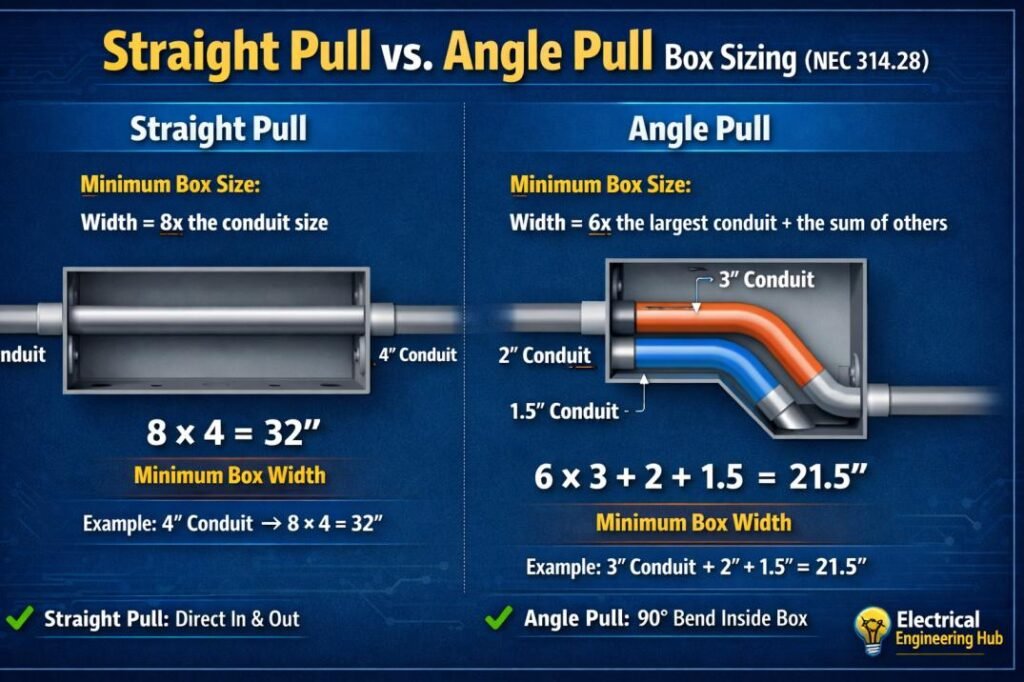
Table of Contents
Table of Contents
Why the Pull Type Matters for Sizing
The pull configuration directly affects the amount of space required inside a pull box. The purpose of NEC pull box sizing rules is to protect conductors from excessive bending stress and prevent damage during cable pulling.
A straight pull requires less internal space because conductors travel through the box without changing direction. When conductors turn inside the box, additional room is needed to maintain proper bending radius and reduce pulling tension.
This is why straight pull box sizing vs. angle pull box sizing uses different requirements. Angle pulls and U-pulls need additional space because the conductors must change direction while entering or leaving the raceway.
Correct pull box sizing ensures easier installation, reduces conductor damage, and keeps the electrical system compliant with NEC 314.28 requirements.
What Is a Straight Pull?
A straight pull occurs when conductors enter one side of a pull box and leave through the opposite side without changing direction. The raceways are aligned directly across from each other, allowing cables or wires to move in a straight path through the enclosure.
Typical examples include long conduit runs where a pull box is installed between two straight sections of raceway. These installations are common in commercial buildings, industrial facilities, and large electrical distribution systems.
For straight pull box sizing, NEC 314.28 provides a simpler requirement because there is no conductor direction change inside the box. The minimum distance between the raceway entries must be eight times the trade diameter of the largest raceway in that row.
The largest conduit size controls the calculation when multiple raceways are installed. A common installation mistake is measuring the smallest conduit instead of the largest one, which can create an undersized enclosure.
When performing pull box calculation for straight pulls, installers should always verify raceway trade size, conductor type, and available enclosure dimensions before installation.
What Is an Angle Pull?
An angle pull occurs when conductors enter through one wall of a pull box and leave through another wall that is not directly opposite. The conductors must change direction inside the enclosure, usually at a 90-degree corner.
Examples include conduit systems where raceways turn around building corners or where distribution routes change direction inside an electrical room. These configurations require more space than straight pulls because the conductors need enough room to bend smoothly.
In NEC pull box sizing, angle pulls follow a different approach from straight pulls. The required distance is based on six times the trade diameter of the largest raceway, plus the total of the raceway diameters entering the same wall.
The additional space accounts for the conductor path through the turn. Without enough room, pulling tension increases and insulation damage can occur during installation.
Understanding the difference between straight pull box sizing vs. angle pull box sizing is especially important in industrial projects where large conductors and multiple raceways are common.
What Is a U-Pull?
A U-pull is a pull configuration where conductors enter and leave the same wall of the pull box. Instead of passing straight through or turning to an adjacent wall, the conductors make a U-shaped path inside the enclosure.
U-pulls are often confused with straight pulls because both raceway openings may appear on the same side of the box. However, the conductor movement inside the enclosure is completely different.
For u-pull box sizing, NEC 314.28 applies the same general sizing concept used for angle pulls. The enclosure must provide enough space for the conductors to reverse direction without creating excessive stress.
Many field errors occur when installers treat U-pulls as straight pulls and use the smaller straight pull requirement. This mistake can lead to failed inspections because the box does not provide adequate bending space.
Calling out U-pulls separately during design reviews and installation planning helps avoid one of the most common pull box sizing errors.
Straight Pull vs. Angle Pull Box Sizing vs. U-Pull Comparison
The table below highlights the main differences between common pull configurations and the sizing approach required by NEC 314.28.
| Pull Type | Direction Change | Minimum Sizing Rule | Common Mistake |
|---|---|---|---|
| Straight Pull | None | 8× trade diameter | Ignoring largest raceway when sizes differ |
| Angle Pull | 90° or more | 6× trade diameter plus adjacent entries | Forgetting to add same-wall entries |
| U-Pull | Enter and exit same wall | Same as angle pull | Mistaking it for a straight pull |
Real-World Example: Same Box, Different Rules
Consider an electrical installation using a 2-inch conduit system connected through a pull box. The physical box location remains the same, but the required size changes depending on how the conductors travel through the enclosure.
If the conduit arrangement creates a straight pull, the conductors move directly across the box. Because there is no change in direction, the required dimension is smaller.
Now consider the same 2-inch conduit installation configured as an angle pull. The conductors must turn inside the box, so additional space is required to maintain the proper bend radius. The enclosure must provide more room than the straight pull arrangement.
If the same conduit enters and exits from the same wall, the configuration becomes a U-pull. Although the raceway openings may look similar to other arrangements, the conductor path requires the larger angle-pull type spacing.
This example shows why straight pull box sizing vs. angle pull box sizing cannot be treated as a single calculation. The conduit size alone does not determine the final box dimension. The pulling arrangement is equally important.
Using a Pull Box Sizing Calculator helps eliminate these configuration-based errors by applying the correct NEC 314.28 rule automatically.
How to Avoid Sizing Mistakes on Mixed Pull Configurations
Many real-world electrical installations contain more than one pull type in the same enclosure. A pull box may include a straight pull on one side, an angle pull on another side, and multiple conduit sizes entering different walls.
These mixed configurations require careful evaluation because each pull condition may have different spacing requirements. Common mistakes include applying the straight pull rule to the entire box, ignoring the largest raceway size, or forgetting to include additional raceway entries on the same wall.
To avoid pull box sizing errors:
- Identify every raceway entering and leaving the enclosure before selecting the box size.
- Determine whether each conductor path creates a straight pull, angle pull, or U-pull.
- Use the largest raceway trade diameter for each applicable calculation.
- Check same-wall raceway entries when calculating angle and U-pull dimensions.
- Verify the final dimensions against NEC 314.28 requirements.
For complex installations, manually tracking each condition can become time-consuming. A Pull Box Sizing Calculator can simplify mixed configurations by applying the correct sizing method for each pull arrangement.
Size Any Pull Configuration Instantly
Selecting the correct enclosure size becomes easier when the pull type and conduit arrangement are evaluated together. The Pull Box Sizing Calculator provides a quick way to determine the required dimensions for straight pulls, angle pulls, and U-pulls based on NEC 314.28 guidelines.
Instead of manually reviewing multiple raceway combinations, electricians and engineers can enter the conduit details and configuration to receive accurate sizing guidance. This reduces calculation mistakes, speeds up design work, and helps ensure installations pass inspection.
For a complete calculation process, use the Pull Box Sizing Calculator and review the detailed NEC requirements in our guide on NEC 314.28 Pull Box Sizing Requirements.
Frequently Asked Questions
What is the difference between an angle pull and a U-pull?
An angle pull occurs when conductors enter one wall and exit through another wall, creating a directional change. A U-pull occurs when conductors enter and exit from the same wall, requiring the conductors to reverse direction inside the box.
Does a U-pull need more room than a straight pull?
Yes. A U-pull requires more space because the conductors change direction inside the enclosure. It follows the same general sizing approach as an angle pull rather than a straight pull.
Can one pull box have both straight and angle pulls?
Yes. A single pull box can contain multiple pull configurations. Each conductor path must be evaluated separately to determine the correct enclosure dimensions according to NEC 314.28.
What happens if I size a pull box using the wrong rule?
Using the wrong sizing method can result in an undersized box that creates excessive conductor bending stress, increases pulling difficulty, and may fail electrical inspection. Correct pull box calculation is necessary for code compliance and safe installation.
Final Thoughts on Straight Pull vs. Angle Pull Box Sizing
Understanding the difference between straight pull box sizing vs. angle pull box sizing is essential for accurate electrical design and installation. Although the conduit size may remain the same, the required enclosure dimensions can change significantly depending on the conductor path.
Straight pulls require less space because conductors move directly through the box. Angle pulls and U-pulls need additional room because the conductors must change direction while maintaining proper bending conditions.
Following NEC 314.28 guidelines helps prevent undersized pull boxes, installation delays, and conductor damage. For quick and reliable results, use a Box Sizing Calculator when working with different raceway layouts.
For additional guidance, explore the complete NEC 314.28 Pull Box Sizing Requirements article and check the upcoming Pull Box Sizing Chart for quick reference values during design and field installation.
Related Guides & Tools
Get new guides in your feed. Follow Electrical Insights on LinkedIn for new electrical standards guides, calculators and design tips from Azad Circuit Hub.
StraightPullBox, #AnglePullBox, #PullBoxSizing, #NEC31428, #ElectricalBoxSizing, #ElectricalCode, #ConduitInstallation, #ElectricalDesign, #ElectricianGuide, #NECStandards
