NEC Code for Island Receptacles: 2020, 2023 and 2026 Rules
The NEC code for island receptacles has changed more in the last three editions than almost any other kitchen rule. A kitchen island used to need at least one outlet. Today, depending on the edition your jurisdiction enforces, the outlet may be optional, may need a future provision, and may not be allowed on the side of the cabinet. This guide explains section 210.52(C) edition by edition, where an island or peninsula outlet can go, and what the 2026 NEC adds.
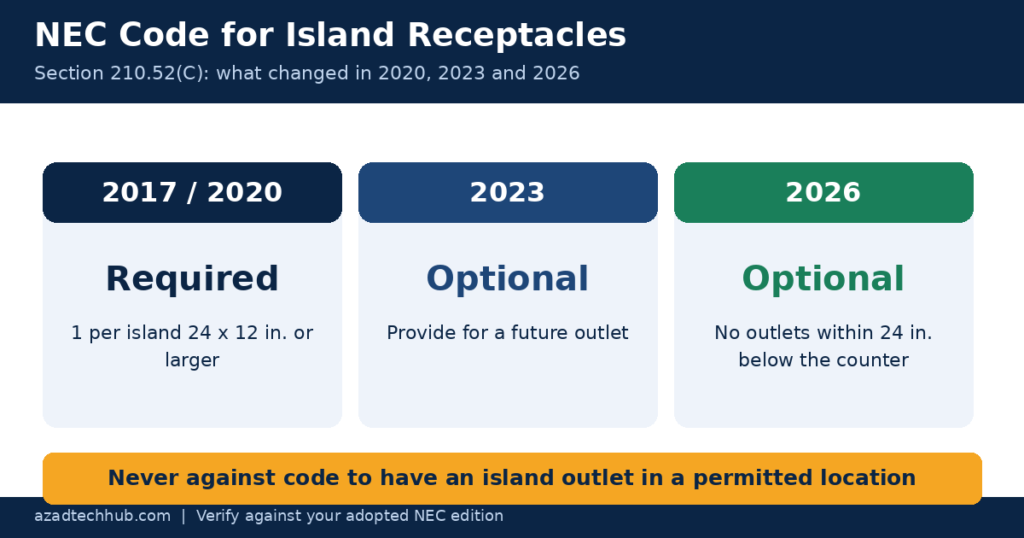
Quick answer: In the 2020 NEC, an island needs at least one receptacle if its countertop is 24 in. by 12 in. or larger. The 2023 NEC made it optional, but requires a provision for adding one later. The 2026 NEC keeps that and bans receptacles within 24 in. below the countertop, except in a drawer. It is never against code to have an outlet on an island, as long as it is in a permitted location.
What Is the NEC Code for Island Receptacles?
The NEC code for island receptacles is in section 210.52(C), which covers countertop spaces in dwelling unit kitchens. Part (C)(1) covers wall countertops, (C)(2) covers islands and peninsulas, and (C)(3) says where the receptacle may be installed. The 2026 edition adds (C)(4) for prohibited locations. This rule applies to dwelling units. If you are asking what is the code for electrical outlets on an island, the short answer depends on the edition, so the table below is the one to use.
Is It Against Code to Have an Outlet on an Island?
No. Having an outlet on an island is allowed in every edition. In the 2017 and 2020 editions it was required. In the 2023 edition it became optional. The location is what the code controls. A receptacle serving the island countertop has to be on or above the counter, in the countertop with a listed assembly, or (in the 2020 edition only) below it within limits.
NEC Code for Island Receptacles by Edition
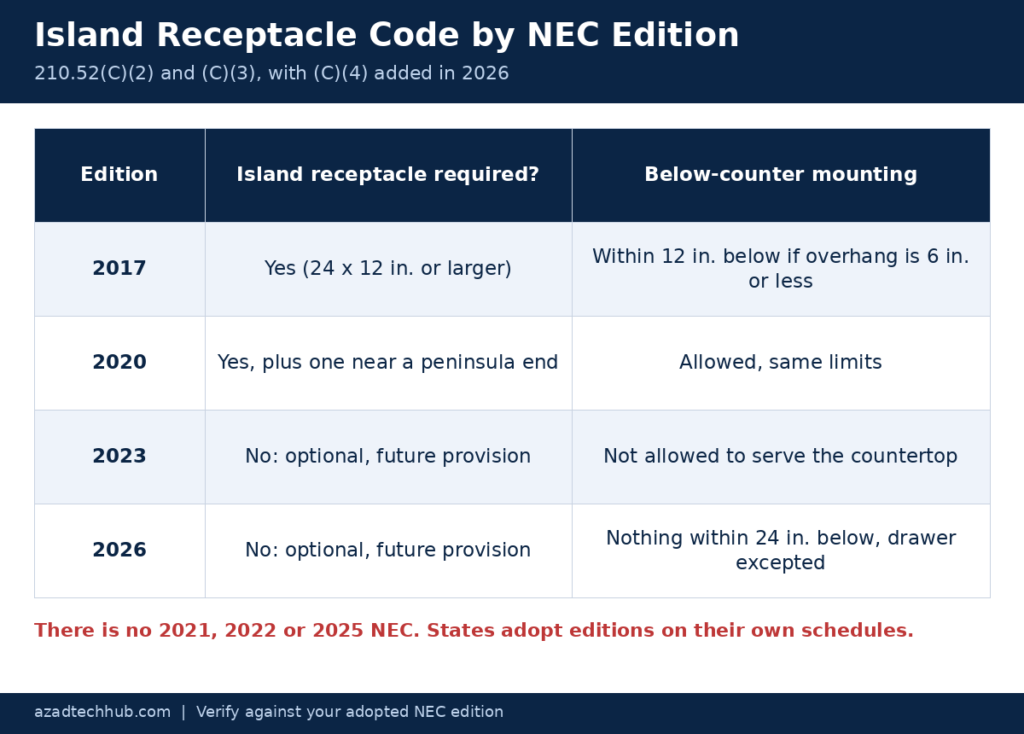
There is no 2021 or 2022 NEC, and no 2025 edition. The editions are 2017, 2020, 2023 and 2026. Searches for the NEC code for island receptacles 2021 or kitchen island outlet code 2025 usually mean the 2020 or 2023 edition, which states adopt on their own schedules.
| Edition | Is an island receptacle required? | Below-counter mounting |
|---|---|---|
| 2017 | Yes, at each island or peninsula of 24 in. by 12 in. or more | Allowed within 12 in. below, if the counter overhangs its base by 6 in. or less |
| 2020 | Yes, same size trigger. At least one near the outer end of a peninsula | Allowed, same limits |
| 2023 | No. Optional, but provide for a future receptacle if none is installed | Not allowed to serve the countertop |
| 2026 | No. Same as 2023, wording tightened | Nothing within 24 in. below the countertop, except in a drawer |
The 2020 NEC code for island receptacles is in 210.52(C)(2) and (C)(3). One receptacle was required at each island countertop at least 24 in. in the long dimension and 12 in. in the short dimension, and a peninsula needed one within 2 ft of its outer end. The NEC 2020 210.52 C 2 text sent you to (C)(3) for location.
What Are the New NEC Rules Regarding Island Outlets?
Two changes matter:
- 2023: the required receptacle was removed. If you do not install one, the 2023 text calls for provisions at the island for adding a receptacle later, such as a box and conduit. A receptacle serving the countertop can no longer sit below it.
- 2026: the wording moves from “if installed” to “if provided”. A new section, 210.52(C)(4), prohibits receptacle outlets within 24 in. below the countertop, including on adjacent walls extending from base cabinets. A receptacle in a drawer is allowed, but it does not count as the island receptacle.
Summaries of the 2026 text vary in the details, so read 210.52 on NFPA’s free access page before you design to it.
Where Can a Kitchen Island Outlet Go?
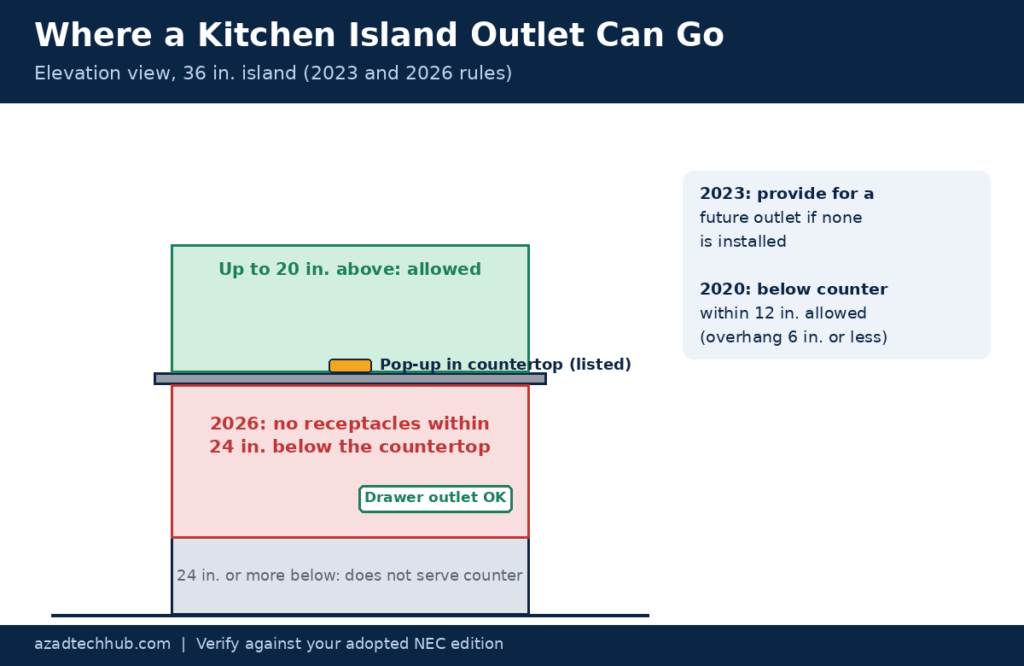
Under the NEC code for island receptacles, 210.52(C)(3) in the 2023 edition allows an island receptacle that serves the countertop to go:
- On or above the counter, no more than 20 in. above it, such as on a raised bar or ledge.
- In the countertop, using a receptacle assembly listed for the application, such as a pop-up unit.
Face-up receptacles in a countertop must be listed for it. See our guide to the NEC code for outlet orientation for the face-up rules. Under the 2020 edition there was a third location, below the countertop within 12 in., and the 2026 edition now bans anything within 24 in. below it, except in a drawer.
NEC Code for Island Receptacles in California
California adopts the NEC through the California Electrical Code (CEC). The 2022 CEC is based on the 2020 NEC, and the 2025 CEC, effective 1 January 2026, is based on the 2023 NEC. Local amendments vary, so confirm with your building department before you choose a location. A kitchen island outlet code check for California should name the CEC edition, not the NEC edition.
Peninsular Countertop Outlet Requirements
Peninsular countertop outlet requirements follow the NEC code for island receptacles closely. A peninsula is a countertop attached to a wall at one end. The NEC measures the peninsular countertop from the connected perpendicular wall. In the 2020 edition, at least one receptacle was required within 2 ft of the outer end. In the 2023 and 2026 editions, the same optional rule and future provision apply as on an island. Peninsula receptacles follow the same location rules, so the receptacle cannot be on the side of the cabinet to serve the counter.
Kitchen Island Outlet Placement: Practical Options
| Option | Edition | Notes |
|---|---|---|
| Pop-up receptacle in the countertop | 2023, 2026 | Needs a countertop-listed assembly |
| Outlet on a raised bar or ledge | 2023, 2026 | Up to 20 in. above the counter |
| Box and conduit only | 2023, 2026 | The provision for a future outlet |
| Side-of-cabinet outlet | 2020 only | Banned within 24 in. below the counter in 2026 |
| Drawer outlet | 2026 | Allowed, but does not count as the island receptacle |
Circuits and Other Rules for Island Receptacles
A few related rules apply whenever you follow the NEC code for island receptacles:
- Circuit: countertop receptacles belong on the 20 amp small-appliance branch circuits, not a general lighting circuit.
- GFCI: the 2023 edition requires GFCI protection for kitchen receptacles. See our guide to NEC article 210.8 A.
- Tamper resistance: kitchen receptacles need to be tamper-resistant.
- Circuit loading: see how many outlets fit on one circuit in our NEC code for how many receptacles on one circuit guide.
- Wall spacing: the other counters follow the 24-inch spacing rule, covered in our home electrical wiring NEC code guide.
Rough-In for an Island: Box, Conduit and Wire
Even where the NEC code for island receptacles only requires a provision, the rough-in matters. An island sits on the floor, so the rough-in is a run through the slab or floor, usually in conduit. Check the conductor count in the conduit with our conduit fill calculator and the NEC article for conduit fill. Check the box with the NEC article for box fill, and size the circuit with our AC cable size calculator.
Tools and Parts for Island Outlets
Once you know the NEC code for island receptacles for your edition, pick listed parts. As an Amazon Associate I earn from qualifying purchases, at no extra cost to you. See our affiliate disclosure.
- Pop-up countertop outlets: buy a unit listed for countertops.
- Tamper-resistant GFCI receptacles: for kitchens.
- Receptacle tester: confirms wiring and GFCI trip.
- Fish tape and conduit tools: for the floor run to the island. See our conduit bender reviews.
- Voltage tester: see our voltage tester reviews.
Frequently Asked Questions
What is the NEC code for island receptacles?
NEC 210.52(C)(2) and (C)(3), with a new (C)(4) in the 2026 edition.
Do kitchen islands need an outlet?
Not under the 2023 and 2026 NEC, but they need a provision for one. The 2020 NEC required one.
What is the 2020 NEC code for island receptacles?
At least one receptacle at each island of 24 in. by 12 in. or more, located under 210.52(C)(3).
Conclusion
The NEC code for island receptacles depends on the edition: required in 2017 and 2020, optional with a future provision in 2023 and 2026, with new below-counter limits in 2026. Confirm which edition your jurisdiction enforces, plan the location under 210.52(C)(3), and rough in the island with the right box and conduit.
About This Guide
Written by Abdul Wassay, an electrical engineer who publishes standards-based calculators and guides on Azad Circuit Hub. This guide is educational, not a substitute for the NEC or a licensed electrician. Verify against the edition and local amendments your AHJ enforces. Spotted an error? Use our contact page.
Sources: NFPA 70, National Electrical Code (210.52(C), 210.8, 210.11, 406.12).
Get new guides in your feed. Follow Electrical Insights on LinkedIn for new electrical standards guides, calculators and design tips from Azad Circuit Hub.