Compact Conductor Conduit Fill: NEC Chapter 9 Note 1 Explained
Compact conductor conduit fill is an important detail when calculating how many conductors can be installed inside a raceway. NEC Chapter 9, Table 1 provides general conduit fill percentages, while Note 1 explains how the dimensions of compact conductors affect the calculation.
This matters when using compact-stranded or compressed conductors. Their physical dimensions can differ from standard conductors with the same nominal cross-sectional area. Using the correct conductor dimensions helps avoid an undersized raceway and makes conduit fill calculations more accurate.
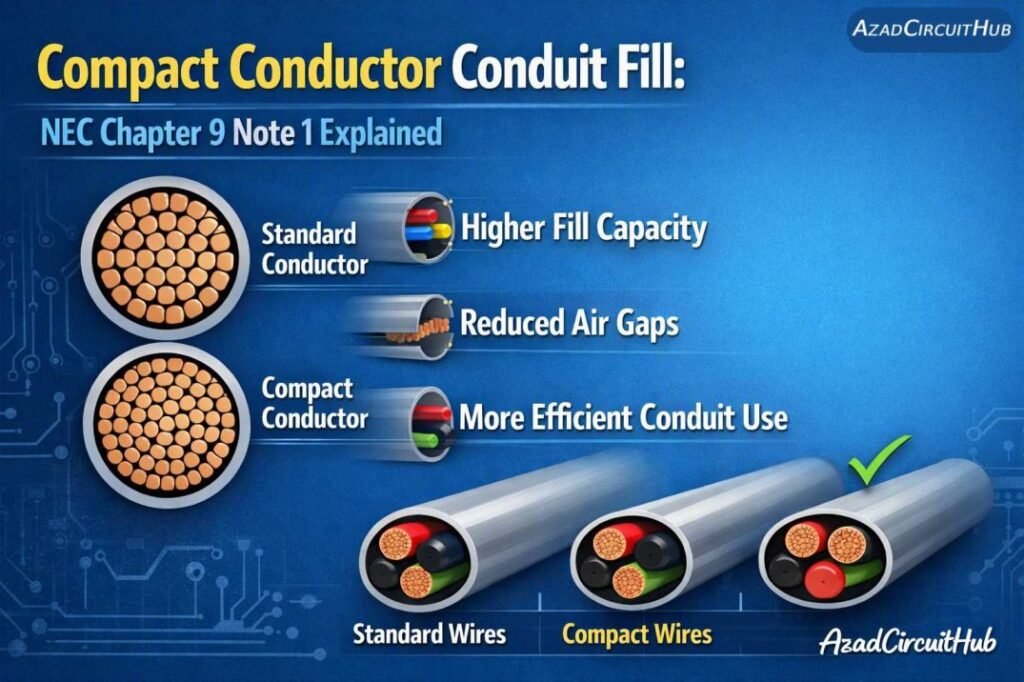
Table of Contents
Table of Contents
| NEC Conduit Fill Rule | Maximum Fill |
|---|---|
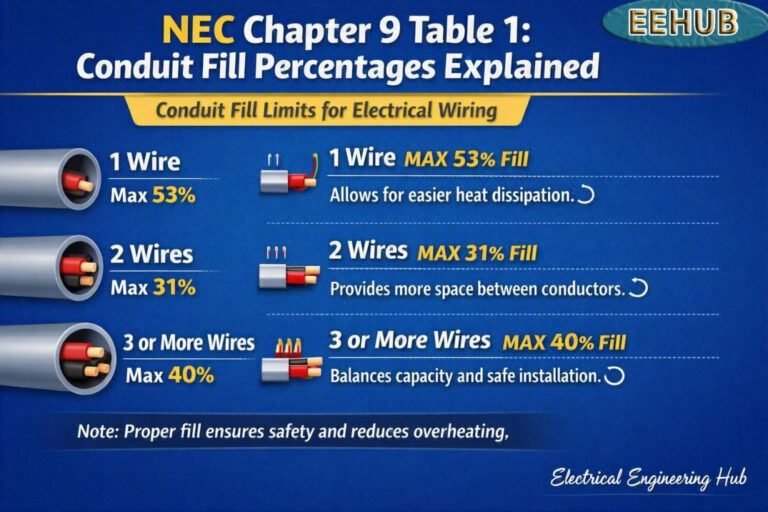
| 1 conductor | 53% |
| 2 conductors | 31% |
| More than 2 conductors | 40% |
| Compact conductors | Apply NEC Chapter 9 Note 1 where applicable |
| Conduit fill reference | NEC Chapter 9, Table 1 |
What Is Compact Conductor Conduit Fill?
Compact conductor conduit fill refers to the amount of raceway space occupied by conductors that have a compacted construction. Compact conductors are manufactured so that individual strands are compressed or arranged more tightly than conventional stranded conductors.
The result is a conductor with a smaller outside diameter for a similar conductive cross-sectional area.
This difference becomes important because conduit fill is based on physical area inside the raceway. The calculation does not simply use the nominal electrical size of the conductor.
For example, two conductors may both have the same copper cross-sectional area but different outside diameters because of their construction. The conductor with the smaller finished diameter occupies less physical space.
What Does NEC Chapter 9 Note 1 Say?
NEC Chapter 9 Note 1 addresses the dimensions of conductors, cables, and raceways used in the tables. For compact conductors, the note provides a method for determining the approximate diameter based on the conductor area.
The key concept is that a compact conductor should not automatically be treated as though its physical dimensions are identical to a standard conductor.
When performing a conduit fill calculation, use the conductor dimensions required by the NEC tables or the manufacturer’s listed dimensions, as applicable.
| Calculation Item | What to Check |
|---|---|
| Conductor type | Solid, stranded, compact or compressed |
| Conductor area | AWG or kcmil size |
| Outside diameter | Manufacturer or applicable NEC data |
| Number of conductors | Current-carrying and non-current-carrying conductors as applicable |
| Raceway type | EMT, PVC, RMC, IMC, etc. |
| Fill limit | 53%, 31%, or 40% under the applicable rule |
For an installation with many conductors, a small difference in individual conductor diameter can have a noticeable effect on total occupied area.
How Compact Conductors Affect Conduit Fill
The practical advantage of compact construction is reduced outside diameter. This can allow more conductor area to be installed within a given raceway compared with conventional conductors.
However, compact construction does not mean that an installer can ignore the actual conductor dimensions.
A typical conduit fill calculation uses:
Total conductor area ≤ Allowable raceway fill area
For more than two conductors, the general NEC limit is 40% of the internal cross-sectional area of the raceway.
| Number of Conductors | General Maximum Raceway Fill |
|---|---|
| 1 | 53% |
| 2 | 31% |
| 3 or more | 40% |
The actual NEC requirements should always be checked for the specific installation because other provisions can affect the calculation.
Compact Conductor Example
Consider a raceway containing several large compact copper conductors. The first step is to determine the applicable conductor dimensions.
Assume a manufacturer provides an outside diameter of 0.600 inches for one conductor.
The area of one round conductor is:
A = π × d² / 4
Therefore:
A = 3.1416 × (0.600)² / 4
A ≈ 0.283 in²
If the raceway contains three identical conductors:
Total conductor area = 3 × 0.283
Total area ≈ 0.849 in²
The raceway must then provide enough internal area so that the applicable NEC fill percentage is not exceeded.
This example demonstrates why conductor diameter is important. The nominal conductor size alone does not provide the complete physical information needed for a precise conduit fill calculation.
For faster sizing, use an electrical conduit size calculator to check raceway requirements after entering the relevant conductor information.
Compact vs Standard Conductors
Compact and standard conductors can have different outside dimensions even when they have the same nominal electrical size.
| Feature | Standard Stranded Conductor | Compact Conductor |
|---|---|---|
| Strand arrangement | Conventional | More tightly arranged |
| Outside diameter | Generally larger | Generally smaller |
| Conductor area | Based on nominal size | Based on nominal size |
| Raceway space | Can require more | Can require less |
| Termination | Depends on listed equipment | Must be compatible with termination |
| Fill calculation | Use applicable dimensions | Use applicable compact dimensions |
The smaller outside diameter can be useful in feeders, service conductors, industrial distribution systems, and large raceways where space is limited.
However, conduit fill is only one part of conductor selection. Ampacity, temperature correction, adjustment factors, voltage drop, termination ratings, and short-circuit requirements also need consideration.
How to Calculate Conduit Fill
A practical conduit fill calculation can be completed in several steps.
Step 1: Identify the Raceway
Determine the raceway type and trade size. The internal dimensions vary between EMT, PVC, RMC, IMC, and other raceway systems.
Step 2: Identify Every Conductor
Record conductor size, insulation type, construction, and outside diameter.
Step 3: Calculate Individual Conductor Area
For a round conductor:
Area = πd² / 4
Use the actual listed outside diameter where available.
Step 4: Add the Conductor Areas
Multiply the area of each conductor by the number of conductors and add the results.
Step 5: Compare With the Allowable Fill
For more than two conductors, compare the total conductor area with 40% of the raceway’s internal area, subject to the applicable NEC requirements.
For projects involving metric cable specifications or international installations, an conduit size calculator australia can also be useful as a separate reference, but the governing installation standard must be used for the project.
Why Manufacturer Data Matters
Manufacturer data can be especially useful for compact conductors because actual outside diameter depends on conductor construction.
Two cables with the same conductor material and nominal electrical size can have different overall diameters because of:
- Strand count
- Compaction
- Insulation thickness
- Insulation material
- Voltage rating
- Shielding
- Cable construction
For conduit fill, the relevant physical dimensions should come from the applicable NEC tables or reliable manufacturer documentation.
A conduit size calculator can simplify the arithmetic, but it should not replace verification of conductor dimensions and the governing code requirements.
Common Mistakes in Compact Conductor Fill
Several errors appear regularly in conduit fill calculations.
Using nominal area as physical area: Electrical cross-sectional area and finished outside diameter are not the same measurement.
Ignoring conductor construction: Compact conductors may occupy less space than standard conductors.
Using the wrong fill percentage: The permitted percentage depends on the number of conductors and applicable NEC provisions.
Forgetting insulation dimensions: The insulation contributes to the physical outside diameter.
Selecting the raceway before checking fill: Raceway size should be verified after considering all conductors and applicable requirements.
Treating a calculator as the code: Calculation tools assist with arithmetic. The NEC and applicable project requirements determine compliance.
Frequently Asked Questions
What is compact conductor conduit fill?
It is the calculation of the physical space occupied by compact conductors inside a raceway. Compact conductors have tightly arranged strands and may have a smaller outside diameter than conventional conductors of the same nominal size.
What is NEC Chapter 9 Note 1?
NEC Chapter 9 Note 1 provides guidance related to the dimensions used with the Chapter 9 tables, including how compact conductors are treated for dimensional purposes. The current NEC edition should be consulted for the exact wording and application.
What is the maximum conduit fill for three conductors?
Under the general NEC Chapter 9, Table 1 rule, a raceway containing more than two conductors is limited to 40% fill. Other NEC provisions may affect how a particular installation is evaluated.
Do compact conductors allow more wires in conduit?
Their smaller outside diameter can reduce the physical space occupied by each conductor. This may allow more conductors to fit within a raceway while remaining within the applicable fill limit. The actual manufacturer dimensions must still be checked.
Is conduit fill based on conductor area or diameter?
Conduit fill is ultimately an area calculation. The conductor’s outside diameter is used to determine its physical cross-sectional area, including the relevant insulation or cable construction when required.
Final Takeaway
Compact conductor conduit fill requires attention to both conductor construction and raceway dimensions. NEC Chapter 9 provides the tables and notes used for many raceway calculations, while the actual conductor outside diameter can be critical when compact conductors are involved.
For a reliable calculation, identify the raceway, conductor count, conductor construction, outside dimensions, and applicable NEC fill percentage. Then verify the result against the current NEC edition, manufacturer information, and project requirements before installation.
Get new guides in your feed. Follow Electrical Insights on LinkedIn for new electrical standards guides, calculators and design tips from Azad Circuit Hub.
#CompactConductor, #ConduitFill, #NECChapter9, #ConduitFillCalculation, #NECCode, #ElectricalEngineering, #ElectricalWiring, #ConduitSizing, #WireSizing, #NECStandards