
Conduit Fill for 2 Conductors: The 31% Rule Explained
When sizing electrical conduit, the number of conductors inside the raceway directly affects the maximum allowable fill. For two conductors, the National Electrical Code (NEC) allows a higher fill percentage than it does when three or more conductors are installed. This is commonly called the 31% rule.
Understanding conduit fill for 2 conductors helps electricians select the correct raceway size without creating installation problems. The calculation depends on the conductor insulation type, wire size, and internal area of the conduit.
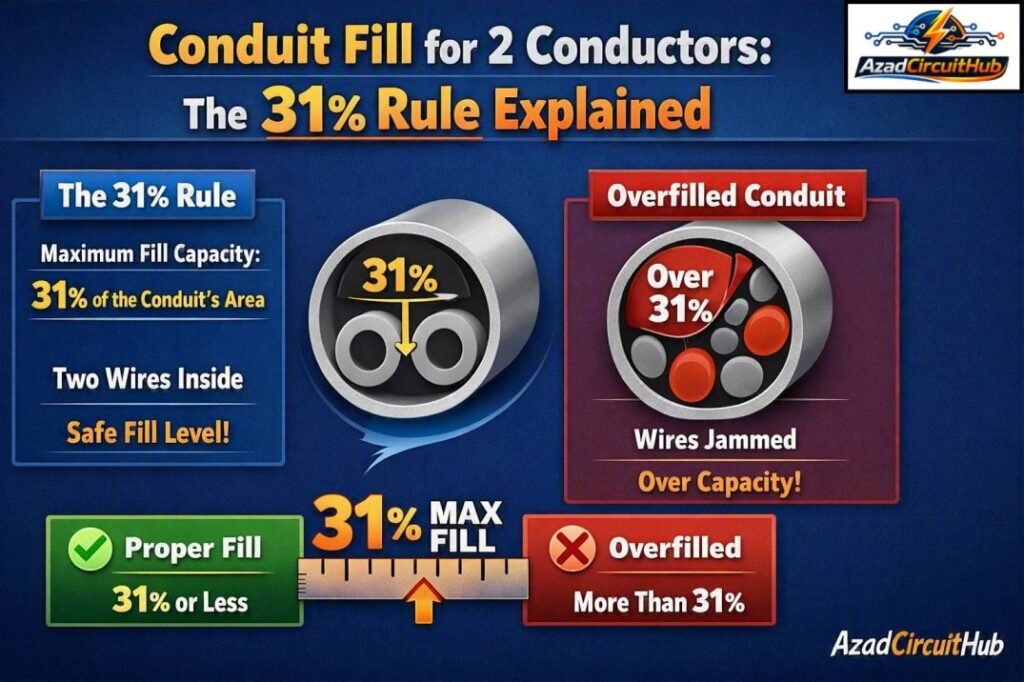
Table of Contents
Table of Contents
Quick Conduit Fill Chart for 2 Conductors
The following table gives a simple overview of the NEC conduit fill percentages that are commonly used when determining raceway capacity.
| Number of Conductors | Maximum Conduit Fill | NEC Rule |
|---|---|---|
| 1 conductor | 53% | Table 1 |
| 2 conductors | 31% | Table 1 |
| 3 or more conductors | 40% | Table 1 |
| Grounding conductor | Counted under applicable fill requirements | NEC rules apply |
| Nipples 24 inches or less | Special fill rules may apply | NEC 358.22 / 344.22 and related rules |
For a raceway containing two conductors, the total cross-sectional area of both wires must not exceed 31% of the raceway’s available internal area. This rule applies to the conductor arrangement, not simply to the wire’s ampacity.
What Is the 31% Conduit Fill Rule?
The 31% rule means that two conductors can occupy up to 31% of the usable interior area of a conduit. The remaining 69% provides space for pulling and installing the conductors.
For example, if a conduit has an allowable interior area of 0.500 square inches at the 31% limit, the combined area of the two conductors cannot exceed 0.500 square inches.
The basic calculation is:
Maximum conductor area = Internal conduit area × 31%
If you know the area of the two conductors, you can also determine the minimum raceway area required:
Required conduit area = Total conductor area ÷ 0.31
This is why simply counting wires is not enough. Two large conductors can require more conduit space than several smaller wires.
Why Is Conduit Fill for 2 Conductors Limited to 31%?
The NEC limits raceway fill to provide enough room for conductor installation and future maintenance. A conduit packed too tightly can make pulling wires difficult and may damage the insulation.
The 31% limit for two conductors provides a practical balance between using conduit efficiently and maintaining adequate installation space.
Conduit fill also becomes important when conductors are large, stiff, heavily insulated, or installed over long distances. Even when the calculated fill is technically acceptable, the actual installation may require additional consideration for pulling tension, bends, and conductor damage.
Conduit Fill Calculation Example
Suppose you need to install two insulated conductors in a raceway. Each conductor has a total cross-sectional area of 0.120 square inches.
First, add the conductor areas:
0.120 + 0.120 = 0.240 square inches
Next, divide the total area by the permitted 31% fill:
0.240 ÷ 0.31 = 0.774 square inches
Therefore, the raceway must have at least 0.774 square inches of usable internal area.
The next step is to check the appropriate NEC conduit table and select a raceway with an allowable area equal to or greater than this value.
| Calculation Step | Result |
|---|---|
| Conductor 1 area | 0.120 in² |
| Conductor 2 area | 0.120 in² |
| Total conductor area | 0.240 in² |
| Maximum fill | 31% |
| Minimum internal area | 0.774 in² |
Always use the actual conductor dimensions or the conductor area listed in the applicable NEC tables. Nominal wire size alone does not provide enough information for an accurate fill calculation.
How to Calculate Conduit Fill for 2 Conductors
A simple four-step process can be used for most basic installations.
Step 1: Identify the Conductors
Determine the conductor size, insulation type, and whether the wires are individual conductors or cables. Different insulation systems can have different outside diameters.
Step 2: Find the Conductor Area
Use the applicable NEC Chapter 9 tables or manufacturer data to determine the conductor’s cross-sectional area.
Step 3: Add Both Conductor Areas
Multiply the area by two when both conductors are identical.
For different-size conductors, calculate each conductor separately and then add the values.
Step 4: Compare With 31% of the Raceway Area
Multiply the raceway’s total internal area by 0.31. The combined conductor area must be equal to or less than this permitted value.
For larger projects, using an electrical conduit size calculator can make the process faster and reduce the chance of selecting an undersized raceway.
Conduit Fill for 2 Conductors: Common Wire and Conduit Combinations
The actual raceway size depends on conductor construction and insulation. The table below is a general planning reference rather than a substitute for the applicable NEC tables.
| Conductor Size | Typical Application | Common Conduit Sizes to Check |
|---|---|---|
| 12 AWG | Branch circuits | 1/2 in., 3/4 in. |
| 10 AWG | Branch circuits | 1/2 in., 3/4 in. |
| 8 AWG | Larger branch circuits | 3/4 in., 1 in. |
| 6 AWG | Feeders | 3/4 in., 1 in. |
| 4 AWG | Feeders | 1 in., 1-1/4 in. |
| 2 AWG | Larger feeders | 1 in., 1-1/4 in., 1-1/2 in. |
| 1/0 AWG | Service/feeders | 1-1/4 in., 1-1/2 in., 2 in. |
These sizes are only starting points. Conduit type, conductor insulation, conductor diameter, and installation conditions can change the required raceway size.
Does the Ground Wire Count as a Third Conductor?
This is one of the most common questions about raceway fill. The answer depends on how the conductors are arranged and which NEC requirements apply.
Equipment grounding conductors are included in conduit fill calculations, but they are handled differently from current-carrying conductors when applying the raceway fill tables. When more than one equipment grounding conductor is present, specific NEC rules determine how their areas are counted.
For example, a circuit with two current-carrying conductors and one equipment grounding conductor does not simply mean that the installation automatically uses the 40% rule. The applicable NEC provisions must be checked based on the actual raceway and conductor arrangement.
For accurate installations, use the conductor area tables and the raceway-specific requirements rather than relying on a simple wire count.
Conduit Fill vs Ampacity
Conduit fill and conductor ampacity are separate calculations.
Conduit fill determines whether the physical conductors can fit inside the raceway. Ampacity determines how much current the conductor can safely carry under the applicable conditions.
A conductor may have sufficient ampacity for a circuit but still require a larger conduit because of its physical diameter.
| Calculation | What It Determines |
|---|---|
| Conduit fill | Physical space inside the raceway |
| Ampacity | Safe current-carrying capacity |
| Voltage drop | Voltage loss along the circuit |
| Conductor derating | Reduced ampacity under certain conditions |
| Raceway sizing | Appropriate conduit dimensions |
Never use a conduit fill calculation as a replacement for wire ampacity, overcurrent protection, or voltage-drop calculations.
Conduit Fill for Different Raceways
The 31% concept is used with the NEC raceway fill rules, but the exact available area depends on the raceway type.
Rigid metal conduit (RMC), intermediate metal conduit (IMC), electrical metallic tubing (EMT), PVC conduit, and other raceways have different internal dimensions. Therefore, the same two conductors may require different conduit sizes depending on the raceway selected.
For this reason, always select the correct NEC Chapter 9 table for the raceway type before completing the calculation.
If you are sizing a complete circuit rather than checking one simple combination, an electrical conduit size calculator can help compare conductor sizes and raceway options more efficiently.
Factors That Can Increase the Required Conduit Size
The 31% calculation is only one part of practical raceway selection. Consider these factors before choosing the final conduit size:
- Long conduit runs
- Multiple bends
- Large conductor sizes
- Thick conductor insulation
- High pulling tension
- Difficult installation locations
- Future circuit expansion
- Pulling equipment and installation method
- Raceway temperature and environmental conditions
- Applicable NEC raceway-specific requirements
A slightly larger conduit can sometimes make installation much easier, even when a smaller raceway technically satisfies the fill calculation.
Common Mistakes When Applying the 31% Rule
Several mistakes occur when calculating raceway capacity.
Using Wire Gauge Instead of Actual Area
AWG identifies conductor size, but the physical outside diameter varies with insulation and construction. Use the applicable conductor area rather than estimating from AWG alone.
Applying the 40% Rule to Two Conductors
The 40% maximum generally applies when there are three or more conductors in the raceway. Two conductors use the 31% limit under the standard raceway fill calculation.
Ignoring Conduit Type
A 3/4-inch EMT and a 3/4-inch PVC raceway do not necessarily have identical internal areas. Always use the correct raceway dimensions.
Forgetting Grounding Conductors
Grounding conductors can affect the fill calculation. Do not assume they can always be ignored.
Confusing Fill With Ampacity
A conduit can pass the fill calculation while the circuit still fails an ampacity or voltage-drop requirement. These checks must be completed separately.
When Should You Use a Larger Conduit?
A larger raceway is often worthwhile when the installation has long runs, several bends, or large conductors. It can reduce pulling difficulty and provide more working space.
For example, an electrician may select a larger conduit than the minimum calculated size when a feeder contains large copper or aluminum conductors. The additional space can make pulling and terminating the conductors easier.
Before finalizing the raceway, verify the installation against the latest applicable NEC requirements and local electrical code amendments.
FAQs About Conduit Fill for 2 Conductors
What is the maximum conduit fill for two conductors?
Under the standard NEC raceway fill rule, two conductors can occupy up to 31% of the raceway’s internal area. The conductor areas must be calculated using the applicable NEC tables.
Why is conduit fill 31% for two wires?
The 31% limit provides space around the conductors for practical installation and pulling. It prevents raceways from becoming excessively crowded.
Does a ground wire change the 31% rule?
A grounding conductor is considered in conduit fill calculations under the applicable NEC provisions, but its treatment differs from current-carrying conductors. The complete installation should be checked using the appropriate NEC requirements.
Can two large wires use 40% conduit fill?
No. Simply having two conductors does not allow the 40% fill limit. The standard maximum for two conductors is 31%; the 40% limit generally applies when three or more conductors are installed.
How do I find the correct conduit size for two wires?
Find the cross-sectional area of both conductors, add the areas together, and divide the result by 0.31 to determine the minimum required internal raceway area. Then compare that value with the applicable NEC raceway table.
Related Guides
- NEC Chapter 9 Table 1
- Conduit Fill for 1 Conductor
- Romex in Conduit Fill Chart
- Conduit Fill Derating Calculator
Final Takeaway
The 31% rule is an important part of raceway sizing when only two conductors are installed. To calculate the required size, determine the actual area of both conductors, add them together, and make sure their combined area does not exceed 31% of the raceway’s internal area.
Remember that conduit fill is only one part of electrical design. Conductor ampacity, voltage drop, grounding, bend limitations, pulling conditions, and local code requirements should also be reviewed before installation.
For faster calculations across different conductor sizes and raceway types, use an electrical conduit size calculator to compare suitable conduit options before making the final selection.
Get new guides in your feed. Follow Electrical Insights on LinkedIn for new electrical standards guides, calculators and design tips from Azad Circuit Hub.
#ConduitFill, #ElectricalWiring, #NECCode, #ConduitSizing, #ElectricalEngineering, #WireSizing, #ElectricianTips, #NEC314, #ElectricalCalculations, #ConduitFillCalculator
