Conduit Fill for 1 Conductor: The 53% Rule Explained
When only one conductor is installed in a raceway, the National Electrical Code (NEC) allows a much larger portion of the conduit’s internal area to be occupied than it does when several conductors share the same raceway. This is where the 53% rule becomes important.
The basic rule is simple: under NEC Chapter 9, Table 1, a single conductor can occupy up to 53% of the available internal area of a raceway or conduit. However, the calculation still depends on the actual inside area of the raceway and the conductor’s dimensions.
Understanding this rule helps electricians select the correct conduit size without unnecessarily using oversized raceways. It also makes conduit fill calculation faster when working with large single conductors, grounding conductors, or other installations where only one conductor is present.
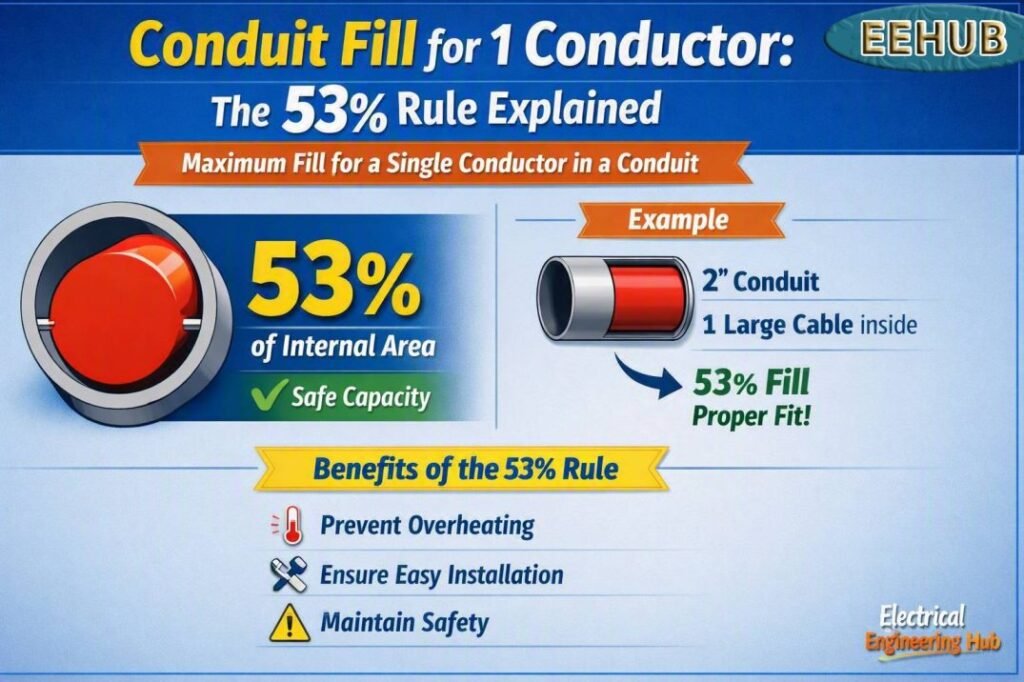
Table of Contents
Table of Contents
Quick Answer: 53% Conduit Fill Rule
| Item | NEC Conduit Fill Limit |
|---|---|
| 1 conductor | 53% |
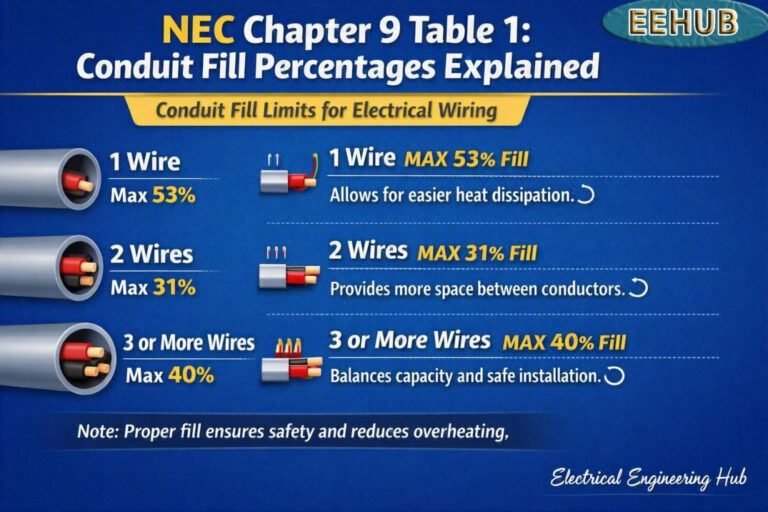
| 2 conductors | 31% |
| More than 2 conductors | 40% |
| Primary reference | NEC Chapter 9, Table 1 |
| Basic calculation | Conductor area ÷ Raceway area × 100 |
| Maximum for 1 conductor | 53% of raceway internal area |
The key point is that the 53% allowance applies when there is only one conductor in the raceway. It should not be confused with the 31% limit for two conductors or the 40% limit normally used when more than two conductors are installed.
For a broader guide covering raceway dimensions, conductor areas, and different fill conditions, see our detailed conduit fill calculation guide before sizing a raceway.
What Does Conduit Fill for 1 Conductor Mean?
Conduit Fill for 1 Conductor refers to the maximum percentage of a raceway’s internal cross-sectional area that may be occupied by one conductor. NEC Chapter 9, Table 1 establishes a 53% maximum fill for a single conductor.
For example, if a conduit has an internal cross-sectional area of 1.00 square inch, the maximum permitted area for one conductor is:
1.00 × 53% = 0.53 square inch
Therefore, a conductor with an area of 0.50 square inch would fit under the fill requirement, while a conductor with an area of 0.55 square inch would exceed it.
The calculation uses the conductor’s actual cross-sectional area, not its ampacity. This distinction is important because wire size tables such as NEC Chapter 9, Table 5 provide conductor dimensions that can be used for raceway fill calculations.
How the 53% Rule Is Calculated
The standard formula is:
Maximum conductor area = Raceway internal area × 0.53
To check an existing installation, use:
Fill percentage = Conductor area ÷ Raceway internal area × 100
For example, assume a raceway has an internal area of 0.832 square inches and the conductor occupies 0.350 square inches.
0.350 ÷ 0.832 × 100 = 42.1%
Because 42.1% is below 53%, the conductor complies with the raceway fill limit for a single conductor.
Simple One-Conductor Fill Example
| Calculation | Value |
|---|---|
| Raceway internal area | 0.832 in² |
| 53% allowable area | 0.441 in² |
| Conductor area | 0.350 in² |
| Actual fill | 42.1% |
| Result | Compliant |
Always use the actual raceway dimensions and conductor area applicable to the installation. Different conduit types and trade sizes have different internal areas.
Conduit Fill for 1 Conductor: Actual Raceway Examples
The following examples use internal areas from NEC Chapter 9, Table 4 for common raceway types. The exact raceway type should be checked before using a value for a design or installation.
| Raceway | Trade Size | Approx. Internal Area | 53% Fill Area |
|---|---|---|---|
| EMT | 1/2 in. | 0.304 in² | 0.161 in² |
| EMT | 3/4 in. | 0.533 in² | 0.283 in² |
| EMT | 1 in. | 0.832 in² | 0.441 in² |
| EMT | 1-1/4 in. | 1.453 in² | 0.770 in² |
| EMT | 1-1/2 in. | 2.036 in² | 1.079 in² |
| EMT | 2 in. | 3.356 in² | 1.778 in² |
| RMC | 1 in. | 0.832 in² | 0.441 in² |
| RMC | 1-1/2 in. | 1.647 in² | 0.874 in² |
| RMC | 2 in. | 2.598 in² | 1.377 in² |
Values should be verified against the applicable NEC edition and raceway table before final installation. Raceway dimensions can vary by raceway type.
Why Is the Limit 53% for One Conductor?
The higher percentage is possible because one conductor does not create the same arrangement and pulling concerns as multiple conductors packed inside the raceway.
When several conductors are installed together, more empty space is needed around them. The NEC therefore reduces the allowable raceway fill to 31% for two conductors and 40% for more than two conductors.
This creates three important fill limits:
- 53% for one conductor
- 31% for two conductors
- 40% for more than two conductors
These percentages are not recommendations to fill the conduit as tightly as physically possible. They are maximum permitted fill percentages under the applicable NEC raceway fill rules.
How to Find Conductor Area
Conductor dimensions are commonly obtained from NEC Chapter 9, Table 5. The table provides approximate dimensions and areas for individual insulated conductors.
For a raceway fill calculation, you need the conductor’s cross-sectional area rather than simply its AWG number.
For example, a conductor may be identified as 4 AWG, but the area used for raceway fill depends on the conductor construction and insulation type. Different insulated conductor types can have different outside dimensions.
A practical calculation therefore follows this sequence:
- Identify the conductor type and size.
- Find its applicable area in NEC Chapter 9, Table 5.
- Identify the raceway type and trade size.
- Find the raceway internal area in Chapter 9, Table 4.
- Multiply the raceway area by 53%.
- Compare the conductor area with the permitted area.
If you regularly work with multiple raceway sizes, our conduit fill calculation resource can make these calculations easier by putting the major formulas and reference values in one place.
Example: Selecting a Conduit for One Large Conductor
Suppose a single conductor has an outside cross-sectional area of 0.40 square inch.
You are considering a 1-inch EMT raceway with an internal area of approximately 0.832 square inch.
Maximum permitted area:
0.832 × 0.53 = 0.441 square inch
The conductor area is 0.40 square inch.
Actual fill:
0.40 ÷ 0.832 × 100 = 48.1%
Since 48.1% is less than 53%, the raceway satisfies the one-conductor fill limit.
However, conduit selection should not stop at fill. The installation must also satisfy conductor ampacity, temperature limitations, bending space, pulling requirements, grounding and bonding rules, and other applicable NEC requirements.
53% Rule vs. 40% Rule
One of the most common mistakes is using the 40% rule for every conduit calculation.
The correct percentage depends on the number of conductors in the raceway.
| Number of Conductors | Maximum Fill |
|---|---|
| 1 | 53% |
| 2 | 31% |
| More than 2 | 40% |
For instance, if you have a raceway containing three insulated conductors, you cannot use the 53% allowance simply because one conductor is large. The 40% rule applies to the raceway fill calculation when more than two conductors are present.
Likewise, adding a second conductor changes the applicable fill percentage from 53% to 31%.
Does the 53% Rule Apply to Grounding Conductors?
The answer depends on what conductors are actually installed and how the raceway fill calculation applies to the particular installation.
A common misconception is that every conductor associated with a circuit can be ignored for raceway fill. That is not generally correct. Equipment grounding conductors and other conductors may need to be included according to the applicable NEC rules.
The raceway fill calculation should therefore be based on the actual conductors present, rather than assuming that a conductor does not count because it is used for grounding.
For complicated installations, check NEC Article 300 and the applicable raceway fill provisions in Chapter 9.
Common Mistakes When Using the 53% Rule
Using the 53% limit for multiple conductors
This is the most frequent error. The 53% allowance is for one conductor, not a group of conductors.
Using nominal conduit size
A 1-inch conduit does not necessarily have exactly 1 square inch of internal area. Always use the applicable internal area from the relevant NEC raceway table.
Ignoring insulation dimensions
Two conductors with the same AWG size may have different outside dimensions because of their insulation and construction.
Confusing ampacity with conductor area
Ampacity determines how much current a conductor can safely carry under applicable conditions. Raceway fill uses physical conductor dimensions.
Treating 53% as a target
The 53% value is a maximum fill limit, not a recommendation that the raceway should always be filled to 53%.
Conduit Fill for 1 Conductor Calculation Formula
For quick reference, use these formulas:
Maximum allowable conductor area = Raceway area × 0.53
Actual fill percentage = Conductor area ÷ Raceway area × 100
For example:
- Raceway area = 1.453 in²
- Maximum fill = 1.453 × 0.53
- Maximum conductor area = 0.770 in²
If the conductor area is 0.650 in²:
0.650 ÷ 1.453 × 100 = 44.7%
The result is below the 53% limit.
Remember that these calculations address raceway fill only. They do not replace conductor ampacity, voltage drop, derating, or other electrical design checks.
Practical Conduit Fill Reference
| Item | Value |
|---|---|
| One-conductor NEC fill limit | 53% |
| Two-conductor fill limit | 31% |
| More-than-two-conductor limit | 40% |
| One-conductor formula | Raceway area × 0.53 |
| Fill percentage formula | Conductor area ÷ Raceway area × 100 |
| Main NEC reference | Chapter 9, Table 1 |
| Raceway area reference | Chapter 9, Table 4 |
| Conductor area reference | Chapter 9, Table 5 |
Use the applicable NEC edition adopted by the authority having jurisdiction. Local amendments can also affect electrical installations.
Frequently Asked Questions
What is the 53% conduit fill rule?
The 53% rule allows one conductor to occupy up to 53% of the raceway’s internal cross-sectional area under the NEC raceway fill provisions. The actual conductor and raceway areas must be used for the calculation.
Why is conduit fill 53% for one conductor?
A single conductor requires less space for arranging and pulling conductors than multiple conductors. NEC Chapter 9, Table 1 therefore permits a higher fill percentage for one conductor.
What is the conduit fill for two conductors?
For two conductors, the NEC allows a maximum raceway fill of 31% under Chapter 9, Table 1. The 53% allowance does not apply once a second conductor is present.
What is the conduit fill for three or more conductors?
For more than two conductors, the normal maximum fill is 40%. The calculation uses the total cross-sectional area of the conductors compared with the raceway’s internal area.
Where can I find conductor areas for conduit fill?
NEC Chapter 9, Table 5 provides dimensions and areas for many commonly used conductors. Raceway internal areas are found in Chapter 9, Table 4. Always verify the applicable conductor type, insulation, raceway type, and NEC edition.
Related Guides
- NEC Chapter 9 Table 1
- Conduit Fill for 2 Conductors
- Romex in Conduit Fill Chart
- Conduit Fill Derating Calculator
Final Takeaway
Conduit Fill for 1 Conductor is based on a straightforward 53% maximum fill allowance. The key is to use the correct physical area for both the conductor and raceway rather than relying on nominal conduit size alone.
The basic process is to find the raceway’s internal area, multiply it by 0.53, and compare that result with the conductor’s actual cross-sectional area. If the conductor area is equal to or below the permitted value, the raceway meets the fill limit for a single conductor.
For real installations, however, raceway fill is only one part of conduit sizing. Conductor ampacity, voltage drop, bending space, temperature correction, adjustment factors, grounding, and local code requirements should also be reviewed before finalizing the installation.
For a complete reference covering different conductor counts, raceway types, and fill percentages, use our conduit fill calculation guide to continue the sizing process.
Get new guides in your feed. Follow Electrical Insights on LinkedIn for new electrical standards guides, calculators and design tips from Azad Circuit Hub.
ConduitFill, #ConduitFillCalculator, #ElectricalConduit, #NECChapter9, #NECStandards, #ElectricalWiring, #ElectricianGuide, #ConduitSizing, #ElectricalEngineering, #53PercentRule