Mixed Conductor Sizes in Conduit Fill: Rounding Rules Explained
Mixed Conductor Sizes in Conduit Fill is common in control panels, branch circuits, feeders, and industrial installations. A raceway may contain several large power conductors together with smaller control, grounding, or neutral conductors.
The calculation is not based on simply counting wires. Each conductor contributes its own cross-sectional area, so different conductor sizes must be calculated separately and then added together. The final total is compared with the permitted conduit fill area.
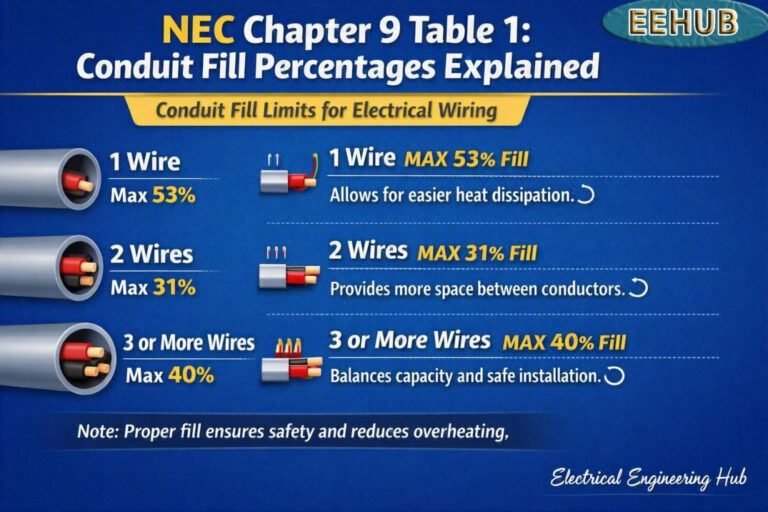
| Conductor Arrangement | Typical NEC Chapter 9 Fill Limit | Basic Calculation |
|---|---|---|
| 1 conductor | 53% | Conductor area ÷ raceway area |
| 2 conductors | 31% | Total conductor area ÷ raceway area |
| More than 2 conductors | 40% | Total conductor area ÷ raceway area |
| Short nipple, 24 in. or less | 60% | Special allowance under NEC rules |
These percentages come from NEC Chapter 9, Table 1. Always check the edition of the NEC adopted for the project and any applicable local requirements.
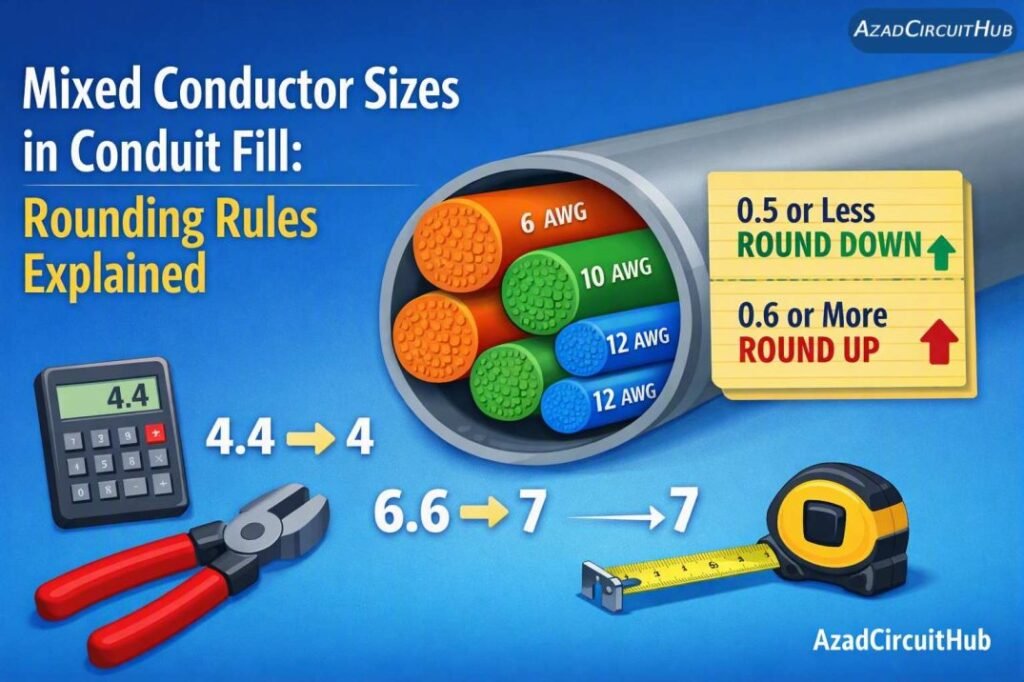
Table of Contents
Table of Contents
How Mixed Conductor Sizes Are Calculated
When different conductor sizes share a conduit, calculate the area of every conductor rather than using the area of only the largest wire.
For example, consider a raceway containing:
- Three 6 AWG conductors
- Two 10 AWG conductors
- One 12 AWG conductor
The approximate conductor areas are:
| Conductor | Area per Conductor | Quantity | Total Area |
|---|---|---|---|
| 6 AWG | 0.0507 in² | 3 | 0.1521 in² |
| 10 AWG | 0.0211 in² | 2 | 0.0422 in² |
| 12 AWG | 0.0133 in² | 1 | 0.0133 in² |
| Total | 6 | 0.2076 in² |
The next step is to compare 0.2076 in² with the permitted 40% fill area of the selected raceway.
This is the key principle for Mixed Conductor Sizes in Conduit Fill: calculate each conductor’s actual area, multiply by its quantity, and add the results before comparing the total with the permitted raceway area.
Do You Round Conductor Areas?
Rounding is one of the most common sources of error in manual conduit fill calculations.
Do not round each conductor area aggressively before multiplying it by the number of conductors. A small difference may become significant when a raceway contains many wires.
For example, if a conductor has an actual area of 0.0211 in², replacing it with 0.02 in² before completing the calculation changes the final result.
A practical calculation sequence is:
- Identify every conductor size.
- Obtain its conductor area from the applicable NEC Chapter 9 table.
- Multiply the area by the number of conductors.
- Add all conductor areas.
- Determine the permitted raceway fill area.
- Compare the total conductor area with that limit.
- Round the displayed final result only as needed.
The calculation should not be made to pass a conduit-fill requirement simply by rounding down intermediate values.
Conduit Fill Example With Different Wire Sizes
Suppose a conduit contains four 8 AWG, three 12 AWG, and two 14 AWG conductors.
| Wire Size | Approx. Area | Quantity | Combined Area |
|---|---|---|---|
| 8 AWG | 0.0366 in² | 4 | 0.1464 in² |
| 12 AWG | 0.0133 in² | 3 | 0.0399 in² |
| 14 AWG | 0.0097 in² | 2 | 0.0194 in² |
| Total | 9 | 0.2057 in² |
There are more than two conductors, so the normal maximum fill percentage for the raceway is 40%.
If the raceway has an internal cross-sectional area of 0.60 in², its 40% permitted fill is:
0.60 × 0.40 = 0.24 in²
The calculated conductor area is 0.2057 in², which is below 0.24 in².
For projects with several conductor combinations, an electrical conduit size calculator can reduce repetitive manual calculations and make it easier to test different raceway sizes.
Why Mixed Sizes Should Not Be Averaged
A common mistake is to average conductor sizes and then use that average for conduit fill. This method is not appropriate.
For example, 6 AWG and 14 AWG conductors have very different cross-sectional areas. Their contribution to conduit occupancy must be calculated individually.
| Incorrect Approach | Correct Approach |
|---|---|
| Average the wire gauges | Calculate each wire size separately |
| Use the largest wire for every conductor | Use the actual area of each conductor |
| Round every value early | Preserve useful precision |
| Compare wire count only | Compare total conductor area |
| Estimate conduit size | Verify against permitted fill area |
Gauge numbers also cannot be averaged meaningfully because AWG is a logarithmic sizing system.
NEC Tables Used for Conduit Fill
NEC Chapter 9 contains several tables that are important when calculating raceway fill.
| NEC Reference | Purpose |
|---|---|
| Chapter 9, Table 1 | Maximum percentage of conduit and tubing fill |
| Chapter 9, Table 4 | Dimensions and total area of conduit and tubing |
| Chapter 9, Table 5 | Dimensions of insulated conductors and fixture wires |
| Chapter 9, Table 5A | Approximate conductor dimensions |
| Chapter 9, Table 8 | Conductor properties |
| Chapter 9, Table 9 | AC resistance and reactance information |
The actual conductor dimensions can vary by insulation type and construction. Therefore, using the appropriate table for the specific conductor is important.
When working on installations outside the United States, the governing standard may use different fill methods. Australian projects, for example, should be checked against the applicable requirements of AS/NZS 3000 and related standards. A conduit size calculator australia can be useful for preliminary sizing, but the final design should follow the applicable Australian requirements.
Rounding the Final Conduit Fill Percentage
Suppose the calculated conductor area is 0.2378 in² and the raceway has an internal area of 0.60 in².
The fill percentage is:
(0.2378 ÷ 0.60) × 100 = 39.63%
It may be displayed as 39.6% or 40.0%, depending on the desired precision. However, calculations should retain sufficient precision before the final comparison.
This becomes important when the actual result is close to the maximum permitted fill. A result of 39.63% should not be treated as exactly 40% during intermediate calculations.
For a quick check of alternative raceway sizes and conductor combinations, use a conduit size calculator before finalizing the installation.
Practical Tips for Mixed Conductor Sizes in Conduit Fill Calculations
Keep these points in mind when checking a conduit schedule:
- Count every conductor that is subject to the applicable fill calculation.
- Use the actual conductor size and construction.
- Calculate different wire sizes separately.
- Do not average AWG numbers.
- Avoid excessive rounding during intermediate calculations.
- Use the correct raceway internal area.
- Apply the correct fill percentage.
- Check special rules for nipples and other raceway arrangements.
- Verify grounding and bonding conductor treatment under the applicable NEC requirements.
- Confirm local code adoption before construction.
Conduit fill is only one part of electrical raceway design. Ampacity, derating, voltage drop, bending space, pulling tension, conductor insulation, and termination requirements may also affect the final installation.
Frequently Asked Questions
How do you calculate conduit fill with different wire sizes?
Calculate the cross-sectional area of each conductor size, multiply by the quantity of that conductor, and add all the areas together. Compare the resulting total with the permitted percentage of the raceway’s internal area.
Can you mix different wire sizes in the same conduit?
Yes, different conductor sizes can be installed in the same raceway when the installation complies with the applicable electrical code. Ampacity, conductor grouping, insulation ratings, circuit requirements, and raceway fill must all be considered.
Do you round conduit fill calculations?
Avoid unnecessary rounding during intermediate calculations. Keep adequate precision when adding conductor areas and calculating the final fill percentage. The displayed final value can then be rounded for reporting.
What percentage of conduit can be filled with wires?
Under NEC Chapter 9, Table 1, the general limits are 53% for one conductor, 31% for two conductors, and 40% for more than two conductors. Special raceway conditions can have different requirements.
Does wire size affect conduit fill?
Yes. Larger conductors occupy more cross-sectional area and therefore consume more of the available raceway space. When several sizes are mixed, each conductor contributes its own area to the total fill calculation.
Final Check
Mixed Conductor Sizes in Conduit Fill requires an area-based calculation rather than a simple wire-count method. The safest approach is to identify every conductor, use the appropriate dimensional data, multiply each area by its quantity, and add the results without unnecessary early rounding.
When the calculated total is close to the permitted limit, use the unrounded values for the final comparison. This avoids a borderline result being changed by premature rounding and provides a more reliable conduit sizing decision.
Get new guides in your feed. Follow Electrical Insights on LinkedIn for new electrical standards guides, calculators and design tips from Azad Circuit Hub.
#MixedConductorSizes, #ConduitFill, #ConduitFillCalculation, #NECChapter9, #NECCode, #ElectricalEngineering, #ElectricalWiring, #ConduitSizing, #WireSizing, #ElectricalCode