NEC 314.16 Junction Box Fill Requirements Explained
Choosing the correct electrical box is not only about fitting the wires physically. The National Electrical Code (NEC) sets clear limits on how many conductors, devices, and fittings can safely occupy a box. NEC 314.16 Junction Box Fill explains these requirements by matching the internal cubic-inch volume of a box with the components installed inside it. Following these rules helps prevent overheating, damaged insulation, and difficult maintenance.
These requirements apply to standard junction and device boxes, not pull boxes that fall under NEC 314.28. If you are looking for pull box rules, see our Junction Box vs. Pull Box guide and the NEC 314.28 Pull Box Sizing Requirements article. Once you understand the basics, our Electrical Junction Box Calculator provides the fastest way to verify compliance.
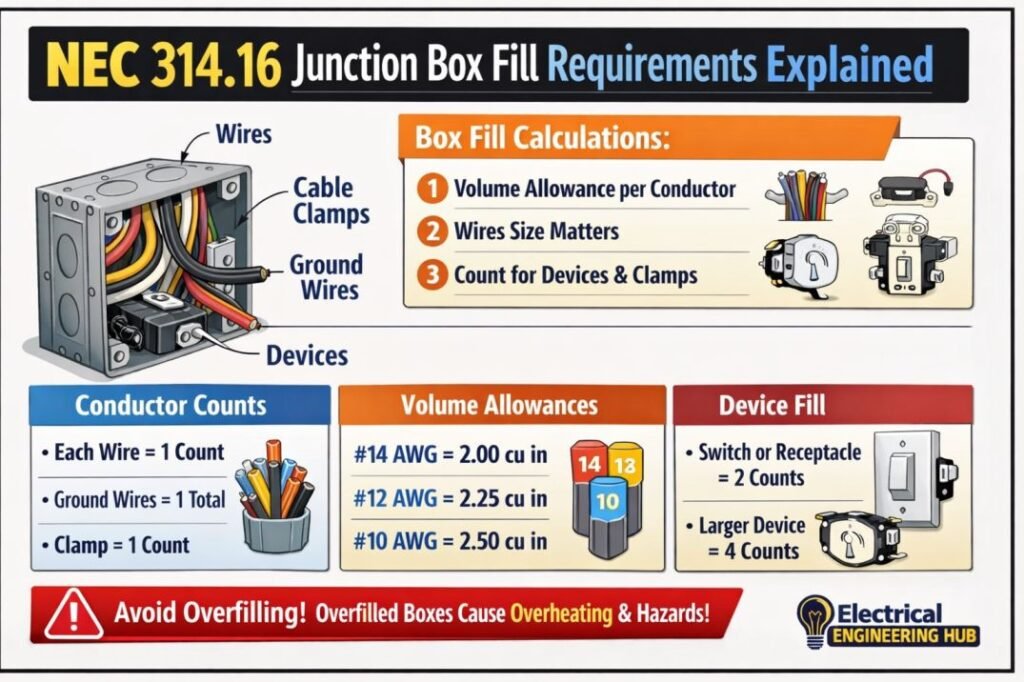
Table of Contents
Table of Contents
What Is NEC 314.16?
NEC 314.16 is the section of the National Electrical Code that defines Junction box fill requirements for electrical boxes containing conductors sized 6 AWG and smaller. It applies to both metallic and nonmetallic boxes used for splicing, terminating, or mounting electrical devices such as switches and receptacles.
Unlike NEC 314.28, which determines pull box dimensions for larger conductors and raceway installations, NEC 314.16 focuses on the available internal volume of standard electrical boxes. Every conductor and approved fitting occupies part of the box volume, and the total cannot exceed the manufacturer’s rated capacity.
If your installation involves larger conductors or straight pulls, refer to the NEC 314.28 Pull Box Sizing Requirements guide instead of applying box fill rules.
| NEC Section | Purpose | Applies To |
|---|---|---|
| NEC 314.16 | Box fill based on cubic-inch volume | Junction boxes, device boxes, conductor sizes 6 AWG and smaller |
| NEC 314.28 | Pull box sizing based on dimensions | Pull boxes, junction boxes with larger conductors and raceways |
How Box Fill Volume Works
Every approved electrical box has a manufacturer-rated internal volume expressed in cubic inches. Think of this volume as a fixed storage budget. Every conductor, wiring device, clamp, and approved fitting uses part of that available space. Once the available volume is fully allocated, no additional conductors or components can be installed.
The purpose of these limits is safety rather than convenience. Overfilled boxes create excessive wire compression, increase insulation damage during installation, and make future maintenance difficult. Crowded conductors can also reduce heat dissipation, making long-term reliability a concern.
Instead of estimating available space visually, NEC assigns standardized volume allowances based on conductor size and installed components. Electricians compare the required volume against the box’s stamped cubic-inch capacity to determine compliance.
Many professionals simplify this process by using a junction box sizing calculator or electrical junction box size calculator, which performs the required counting automatically while reducing the chance of errors.
What Counts Toward Box Fill?
When calculating NEC 314.16 Junction Box Fill, every qualifying component inside the box must be counted correctly. Missing even one item can result in a code violation.
The following items contribute toward box fill:
- Every insulated conductor entering the box counts toward the required volume.
- Conductors that are spliced inside the box are included.
- Conductors terminated on switches, receptacles, or similar devices are counted.
- Each yoke-mounted device, including switches and receptacles, counts as two conductor volume allowances.
- Internal cable clamps supplied inside the box count toward box fill.
- Internal support fittings that occupy wiring space must be included.
- Equipment grounding conductors count as a single conductor volume allowance regardless of how many grounding conductors are present.
- Pigtails that originate and terminate within the same box generally do not increase conductor count because they do not leave the box.
The easiest way to avoid counting mistakes is to review every item inside the enclosure before performing calculations. An accurate junction box size calculator can also help you understand NEC 314.16 Junction Box Fill requirements.
| Component | Counts Toward Box Fill? |
|---|---|
| Insulated conductor entering box | Yes |
| Switch or receptacle | Yes (two conductor allowances) |
| Internal clamp | Yes |
| Equipment grounding conductors | Yes (counted once collectively) |
| Internal support fitting | Yes |
| Internal pigtail only | Generally No |
Conductor Size Affects Required Volume
Wire gauge has a direct impact on required box volume. Larger conductors occupy more space than smaller conductors, so NEC assigns greater volume allowances as conductor size increases.
For example, a box containing twelve 14 AWG conductors requires less internal volume than a box containing the same number of 10 AWG conductors. Even though the conductor count is identical, the larger wire size demands more space.
This is why both conductor quantity and conductor gauge must be considered during junction box sizing. Ignoring wire size can easily lead to an undersized box even when the conductor count appears acceptable.
Common Box Fill Mistakes
Many box fill violations occur because installers overlook one or more required components during the calculation. These mistakes are common in both residential and commercial projects.
Common errors include:
- Forgetting to count equipment grounding conductors.
- Counting a switch or receptacle as one conductor instead of two conductor allowances.
- Ignoring internal cable clamps supplied with the box.
- Forgetting internal support fittings that occupy wiring space.
- Assuming the manufacturer’s stamped volume automatically accounts for every installed fitting.
- Selecting a larger-looking box without verifying its actual cubic-inch rating.
- Mixing conductor sizes without considering that each gauge has different volume requirements.
- Estimating capacity by eye instead of following NEC requirements.
- Using pull box sizing rules where standard box fill requirements should apply.
Using a reliable j box size calculator significantly reduces these mistakes because it evaluates every required component before displaying the final result.
NEC 314.16 vs. IEC Junction Box Sizing
Although both NEC and IEC aim to improve electrical safety, they approach junction box sizing differently.
NEC 314.16 Junction Box Fill uses standardized conductor volume allowances based on conductor size, devices, clamps, and fittings. Compliance depends on ensuring the total required volume does not exceed the manufacturer’s rated box capacity.
IEC standards, on the other hand, generally focus on enclosure design, installation practices, environmental protection, cable entry methods, and manufacturer recommendations rather than using the same box fill calculation method.
If you work on international projects, read our IEC Standard for Junction Box guide for IEC-based practices. You can also compare both approaches in our upcoming NEC vs. IEC Junction Box Sizing guide to understand when each standard applies.
Skip the Manual Count — Use Our Calculator
Manual calculations are accurate when performed carefully, but they take time and are easy to miscount on busy projects. Our Electrical Junction Box Calculator simplifies the process by guiding you through conductor count, conductor size, devices, grounding conductors, and fittings before checking compliance automatically.
Whether you need a quick junction box sizing calculator for residential work or an electrical junction box size calculator for commercial installations, the tool reduces calculation time while improving accuracy. It also supports both NEC and IEC workflows, making it useful for engineers, electricians, contractors, inspectors, and students.
Frequently Asked Questions
How many wires can go in a junction box?
There is no fixed number. The allowable quantity depends on the box’s cubic-inch capacity, conductor size, devices, internal clamps, and other components counted under NEC 314.16 Junction Box Fill.
Does a switch or outlet count as one conductor or two?
A switch or receptacle mounted on a yoke counts as two conductor volume allowances when calculating box fill under NEC 314.16.
Do grounding conductors count toward box fill?
Yes. All equipment grounding conductors together count as one conductor volume allowance regardless of how many grounding conductors are inside the box.
What’s the difference between box fill (314.16) and pull box sizing (314.28)?
NEC 314.16 determines whether a standard junction or device box has enough internal volume for conductors and devices. NEC 314.28 applies to pull boxes and larger conductors, where minimum box dimensions are determined by raceway layout and conductor size rather than cubic-inch volume.
Get new guides in your feed. Follow Electrical Insights on LinkedIn for new electrical standards guides, calculators and design tips from Azad Circuit Hub.
NEC31416, #JunctionBoxFill, #BoxFillCalculator, #ElectricalCode, #NECCode, #ElectricalEngineering, #ElectricianLife, #ElectricalSafety, #WiringStandards, #CodeCompliance