NEC vs. IEC Junction Box Sizing: Important Differences
Choosing the correct junction box is not only about dimensions or available space. It also depends on the electrical standard that governs your project. Engineers, electricians, and contractors often work with imported equipment, international clients, or multinational projects where both NEC and IEC requirements may appear in the same specification.
This creates confusion because the sizing methods are not interchangeable. NEC vs. IEC Junction Box Sizing follows two different approaches. NEC primarily determines box size through conductor fill allowances, while IEC focuses on enclosure capacity, cable entries, terminals, and manufacturer ratings under the applicable standard series.
Applying the wrong method can lead to failed inspections, code violations, unnecessary redesign, or safety concerns. Understanding the differences helps you select the correct enclosure from the beginning.
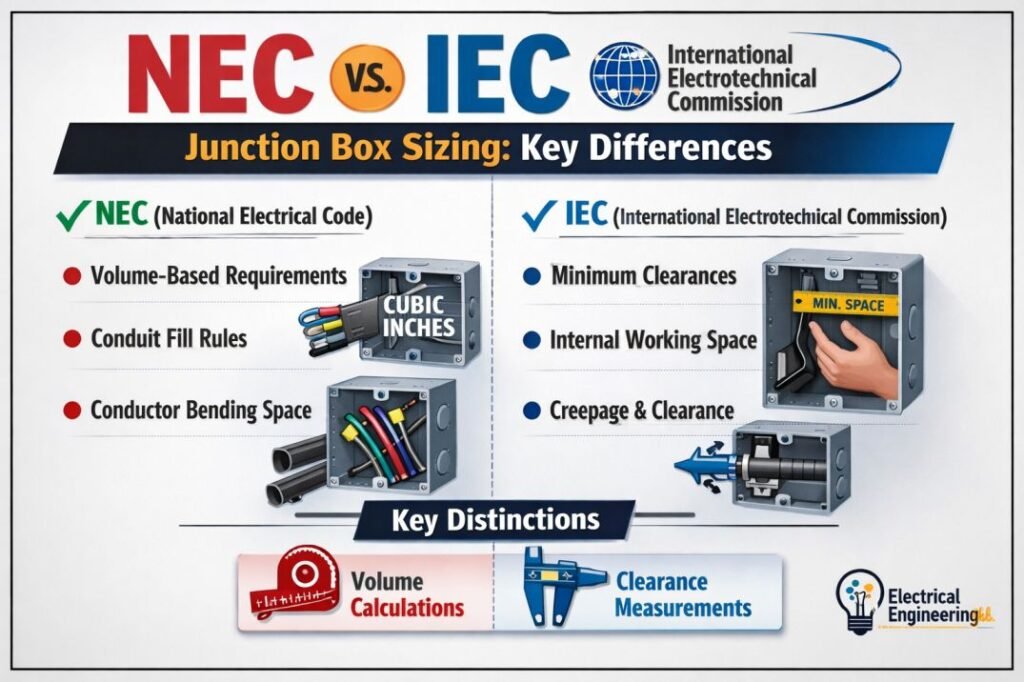
Table of Contents
Table of Contents
The Core Difference: Fill-Based vs. Entry/Volume-Based Logic
The biggest difference between NEC vs. IEC Junction Box Sizing is the philosophy behind each standard. The National Electrical Code (NEC) uses a conductor fill method defined in Article 314.16. Every conductor inside the box contributes to the required internal volume. Devices, grounding conductors, clamps, and fittings also affect the calculation. The goal is to prevent overcrowding, protect conductor insulation, and maintain safe working space.
IEC standards approach the problem differently. Instead of assigning a fixed volume allowance for every conductor, the focus is placed on the enclosure’s overall usable capacity, cable entries, terminal arrangement, bending space, and the manufacturer’s tested ratings. The selected junction box must accommodate all installed components without exceeding its intended design limits.
Both systems aim to improve electrical safety and installation reliability, but they use different sizing logic. This is why engineers should never assume that a junction box sized under one standard automatically complies with the other.
For projects requiring accurate calculations, use the Electrical Junction Box Calculator to select the proper sizing method before beginning your installation.
Side-by-Side Comparison
| Feature | NEC | IEC |
|---|---|---|
| Governing Logic | Cubic-inch volume divided by per-conductor allowance | Box volume based on conductor entries, terminals, and manufacturer-rated capacity |
| Device Counting | Each device counts as two conductor volumes | Determined by manufacturer instructions and applicable IEC series |
| Grounding Conductors | Counted once regardless of quantity | Evaluated according to applicable IEC requirements |
| Common Standard Series | NEC Article 314.16 | IEC 60670 series |
| Typical Region | United States | Europe, Asia, Middle East, Africa, and many international markets |
| Primary Focus | Conductor fill calculation | Enclosure capacity and equipment arrangement |
| Compliance Authority | NEC adopted by local AHJ | National adoption of IEC standards and local regulations |
| Manufacturer Influence | Limited to approved box listing | Strong emphasis on tested enclosure ratings |
If your project follows NEC requirements, review the NEC 314.16 Junction Box Fill Requirements guide for detailed box fill calculations.
For projects designed under international standards, see the IEC Standard for Junction Box guide to understand IEC enclosure requirements.
Why NEC vs. IEC Junction Box Sizing on Real Jobs
Understanding NEC vs. IEC Junction Box Sizing becomes especially important on projects involving equipment from multiple countries. Many industrial facilities purchase switchgear, PLC panels, control stations, and automation equipment from European manufacturers while installing them in North America. Likewise, engineering consultants in the Middle East frequently prepare designs that include equipment certified to both standards.
Consider a contractor installing an imported IEC control panel inside a facility that follows NEC. The enclosure itself may be IEC-certified, but the field wiring must still satisfy the local electrical code. Similarly, an engineering company preparing drawings for an overseas client cannot simply apply NEC conductor fill rules if the project specifications require IEC compliance.
Inspection authorities also review installations based on the adopted electrical code in their jurisdiction. Even if the equipment is technically safe, using the wrong sizing method can delay project approval and require expensive modifications.
Early identification of the governing standard reduces design changes, simplifies procurement, and avoids installation errors. During project planning, using the Electrical Junction Box Calculator ensures that the selected sizing method matches the project’s code requirements.
Can You Use NEC Sizing on an IEC-Rated Box (or Vice Versa)?
The simple answer is no.
A junction box should always be sized according to the standard under which it is designed, tested, and certified. An IEC-rated enclosure is evaluated using IEC requirements, while an NEC installation must satisfy NEC box fill rules where applicable. Mixing calculation methods does not provide code compliance and may result in inspection failures.
Manufacturers test their products according to specific standards, and those ratings determine how the enclosure should be installed. Even if two boxes have similar external dimensions, their approved installation methods may differ significantly.
Always verify:
- The governing electrical code
- The manufacturer’s certification
- Project specifications
- Local inspection requirements
- Authority Having Jurisdiction (AHJ) guidance
Following the correct standard protects both safety and regulatory compliance.
Which Standard Applies to Your Project?
Before selecting a junction box, answer these questions:
- Which electrical code has been adopted in your country or project location?
- What standard is specified by the client or engineering consultant?
- Is the enclosure rated under NEC or IEC requirements?
- Does the local Authority Having Jurisdiction (AHJ) require one specific standard?
- Are you working with imported equipment that includes manufacturer installation instructions?
- Are conductor sizing rules directing you toward a junction box or a pull box? If so, review the Junction Box vs. Pull Box guide before finalizing your design.
When uncertainty exists, confirm the applicable requirements with the AHJ before purchasing or installing equipment.
Size Correctly Under Either Standard
Manually comparing two different electrical standards can be time-consuming, especially on projects involving multiple enclosure types. The Electrical Junction Box Calculator simplifies this process by allowing you to select the applicable NEC or IEC sizing method based on your project requirements.
Instead of manually reviewing tables and manufacturer documentation, the calculator helps you determine the appropriate junction box size quickly and consistently. Whether you are working on residential, commercial, or industrial installations, using the correct calculation method reduces errors and improves compliance from the start.
Frequently Asked Questions
Is IEC junction box sizing stricter than NEC?
Not necessarily. The two standards use different sizing methods rather than one being universally stricter. NEC focuses on conductor fill allowances, while IEC emphasizes enclosure capacity, cable entries, terminals, and manufacturer-tested ratings.
Can I use an IEC-rated box on a US job?
An IEC-rated enclosure may be acceptable if it meets all applicable listing, certification, and local code requirements. However, the installation must still comply with the electrical code adopted by the local Authority Having Jurisdiction (AHJ).
What IEC standard covers junction box sizing?
Junction boxes are generally covered under the IEC 60670 series, together with applicable manufacturer instructions and national implementations of IEC requirements. Always verify the exact standard referenced in your project specifications.
Does box fill mean the same thing under NEC and IEC?
No. Under NEC, box fill is based on conductor volume allowances defined in Article 314.16. Under IEC, enclosure selection is generally based on the manufacturer’s rated capacity, cable entries, terminal arrangement, and applicable IEC standards rather than the NEC conductor volume calculation alone.
Get new guides in your feed. Follow Electrical Insights on LinkedIn for new electrical standards guides, calculators and design tips from Azad Circuit Hub.
NECvsIECJunctionBoxSizing, #JunctionBoxSizing, #NECStandards, #IECStandards, #ElectricalEngineering, #ElectricalDesign, #ElectricalCode, #IndustrialAutomation, #ElectricalSafety, #EngineeringGuide