
Electrical Service Size Calculator: Best Tool
Understanding and calculating the electrical service size for a building is a crucial part of electrical planning, whether for residential, commercial, or industrial setups. An electrical service size calculator simplifies this process by helping you determine the appropriate service size based on load requirements. Accurate calculations ensure safety, efficiency, and compliance with electrical codes like the National Electrical Code (NEC).
In this article, we’ll explore the importance of an electrical service calculator, how to use one effectively, and its benefits in ensuring proper electrical system design. Along the way, we’ll also provide insights into related concepts like load calculation, generator sizing, and more.
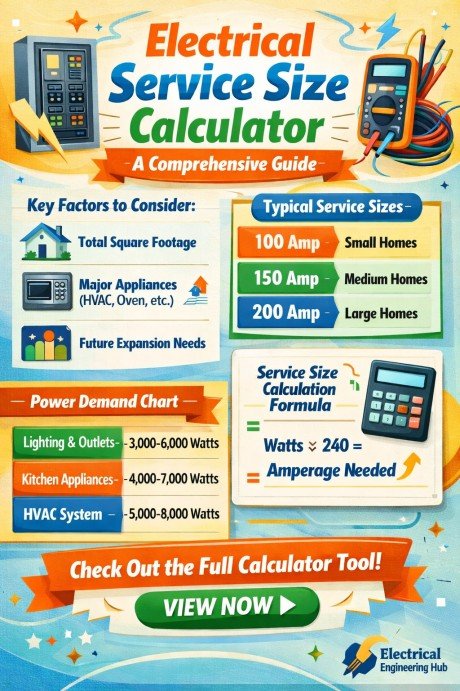
Table of Contents
Table of Contents
What Is an Electrical Service Calculator?
An electrical service calculator is a tool designed to help electricians, contractors, and homeowners estimate the size of electrical service needed for a building. The service size refers to the main electrical panel’s capacity to handle the building’s load requirements, typically measured in amperes (amps).
For example, a typical single-family home may require a 100-amp or 200-amp service depending on its size, number of appliances, and other factors. A proper calculation helps avoid overloading circuits, reduces the risk of electrical fires, and ensures compliance with codes.
If you’re looking to delve deeper into the principles of calculating electrical service size, check out Calculating Electrical Service Size for a detailed walkthrough.
Electrical Service Size Calculator
NEC Article 220 — Standard Method
Electrical Service Size Calculator
Work out the minimum electrical service size for a single dwelling unit from its floor area, fixed appliances, and heating or cooling load, then check it against an existing or planned panel.
Calculated Load Current
0A
Load breakdown
How to use this calculator
- Step 1
Enter the dwelling’s living area and confirm the number of small-appliance and laundry circuits, which are nearly always 2 and 1 respectively.
- Step 2
Fill in the nameplate VA for each fixed appliance you have. Leave a field at 0 if the appliance is not installed.
- Step 3
Enter the range and dryer nameplate ratings, then the heating and cooling equipment loads.
- Step 4
Choose the service voltage, and optionally select an existing or planned panel size to check its headroom.
- Step 5
Select Calculate. The panel on the right updates with total amperage, minimum recommended breaker size, and a full load breakdown.
- Step 6
Use the utilization gauge to see how close the calculated load sits to your chosen panel size, and adjust inputs to test different scenarios.
Technical reference notes
General lighting and receptacle load
Based on the dwelling’s living area, this covers general-purpose lighting and receptacle circuits throughout the home.
Small-appliance and laundry circuits
Kitchen, dining, and laundry receptacle circuits are counted at a fixed allowance per circuit, separate from general lighting.
Demand factor on general loads
Combined lighting, small-appliance, and laundry load is not counted at full value. A reduced portion above the first block of load reflects the fact that not every circuit draws its full rating at the same time.
Fixed appliance demand
Dishwasher, disposal, water heater, and similar fixed appliances are counted at full nameplate value individually, but when four or more are present, the group is reduced by a standard demand factor.
Range and dryer allowance
Electric ranges and clothes dryers use their own listed demand allowances rather than full nameplate value, since a single range or dryer element is not on continuously.
Heating and cooling
Heating and air conditioning are treated as non-coincident loads. Only the larger of the two is added to the total, since a dwelling is not normally heating and cooling at the same time.
Why Is Electrical Service size Calculation Important?
- Safety: Correctly sizing the electrical service ensures that circuits are not overloaded, reducing the risk of overheating and fires.
- Efficiency: Properly sized services optimize the performance of electrical appliances.
- Compliance: NEC and local electrical codes mandate specific standards for service sizing to maintain safety and reliability.
- Future Expansion: A correctly calculated service allows room for additional loads, such as new appliances or extensions.
Key Factors in Electrical Service Calculation
To use an electrical service size calculator effectively, you’ll need to consider several factors:
1. Square Footage of the Building
The NEC requires a baseline wattage of 3 watts per square foot for general lighting and receptacle outlets. For instance, a 2,000-square-foot home would need at least 6,000 watts for basic lighting and outlets.
2. Major Appliances
Large appliances like HVAC systems, electric stoves, dryers, and water heaters consume significant power. Their wattage ratings should be included in the calculation.
3. Lighting Loads
General lighting contributes to the overall load. Modern LED lights may reduce this significantly compared to older incandescent bulbs.
4. Special Loads
Pools, hot tubs, and electric vehicle chargers are examples of special loads that must be considered.
5. Continuous Loads
Continuous loads, such as commercial refrigeration, must account for 125% of their rated load per NEC guidelines.
For a step-by-step guide to load calculation, refer to Electrical Load Calculator and Electrical Load Calculation for more details.
Steps to Calculate Electrical Service Size
Follow these steps when using an electrical service size calculator:
Step 1: List All Electrical Loads
Create a list of all electrical devices in the building, including:
- Lighting
- Receptacles
- Appliances
- HVAC equipment
- Special loads (e.g., pool pumps)
Know more about nec article 220
Step 2: Convert Wattage to Amperes
Use the formula:
Amperes (A) = Watts (W) ÷ Voltage (V)
For example, if a water heater consumes 4,500 watts on a 240-volt circuit:
Amperes = 4,500 ÷ 240 = 18.75 A
Step 3: Apply NEC Demand Factors
NEC Article 220 provides demand factors that reduce the total load calculation, accounting for the fact that not all devices run simultaneously. Read about NEC 220 in detail here.
Click Here to Explore NEC Article 220
Step 4: Select the Main Service Size
Add up all calculated loads, apply the demand factors, and choose a service size that meets or exceeds the total. Common residential sizes are 100 amps, 150 amps, and 200 amps.
For a more detailed guide, refer to Electrical Load Calculation Table, which provides an easy reference for standard loads and their demand factors.
Benefits of Using an Electrical Service size Calculator
- Time-Saving: Automates complex calculations, reducing manual errors.
- Accuracy: Ensures precise load estimations, avoiding oversized or undersized services.
- Compliance: Assists in adhering to NEC and local code requirements.
- Ease of Planning: Helps design electrical systems for new builds or upgrades effectively.
Generator Sizing and Load Calculations
When sizing a generator, load calculations are equally crucial. Generators must handle both running and startup loads of connected equipment. A properly sized generator ensures uninterrupted power during outages without overloading the system.
To calculate generator size:
- Add up the wattage of all connected loads.
- Account for startup surges of inductive loads (e.g., motors).
- Select a generator with at least 20% extra capacity.
For more information on this topic, explore Generator Sizing for a comprehensive guide.
Common Mistakes to Avoid
- Ignoring Future Needs: Failing to account for future expansions can lead to undersized services.
- Overestimating Loads: Oversized services are costly and inefficient.
- Neglecting Special Loads: Forgetting to include items like electric car chargers can lead to inaccurate calculations.
Tools for Electrical Load and Service Calculations
In addition to manual methods, there are several online and offline tools available for load and service calculations, including:
- Load calculation spreadsheets.
- NEC-compliant software.
- Dedicated electrical service size calculators available online.
For a quick and easy way to calculate residential load in kW, visit Electricity Load Calculator in kW for Home.
Final Thoughts
An electrical service size calculator is an indispensable tool for ensuring that your building’s electrical system is safe, efficient, and compliant with code requirements. By accurately estimating service size, you can prevent costly mistakes and design systems that meet current and future needs.
Whether you’re a professional electrician, contractor, or homeowner, understanding the basics of electrical load calculation is essential. For more insights, explore related topics like Electrical Load Calculator and Electrical Load Calculation to enhance your knowledge and planning.
By integrating these best practices and using reliable tools, you can ensure a seamless electrical system design that stands the test of time.
Follow Us on Social:
Subscribe our Newsletter on Electrical Insights for latest updates from Electrical Engineering Hub
#ElectricalServiceCalculator, #ElectricalCalculator, #ServiceCalculator, #ElectricalServices, #ElectricalLoad, #PowerCalculator, #HomeElectricity, #ElectricLoadCalculator, #ElectricalTools, #EnergyCalculator, #ElectricalPlanning, #LoadEstimation, #SmartElectricity, #WiringCalculator, #PowerManagement
Electrical Service Size Calculator: Best Tool
Use our Electrical Service Size Calculator to accurately calculate electrical load demand, panel capacity, and service entrance size for residential and commercial installations. Fast, reliable, and easy-to-use online tool.
Price Currency: USD
Operating System: Web Browser
Application Category: UtilitiesApplication
