
Level 2 EV Charger Installation Cost: Complete Home Charging Guide
The Level 2 EV Charger Installation Cost for a typical home can range from about $500 to $2,500, including the charger and electrical work. A simple installation near an existing electrical panel may cost much less, while a detached garage, long cable run, panel upgrade, trenching, or difficult access can push the project well above $3,000.
A Level 2 charger normally operates at 208–240 volts and can add roughly 20–40 miles of driving range per hour, depending on the charger’s power output and the vehicle. For many homeowners, the biggest cost is not the charging unit itself but the electrical work needed to install it safely.
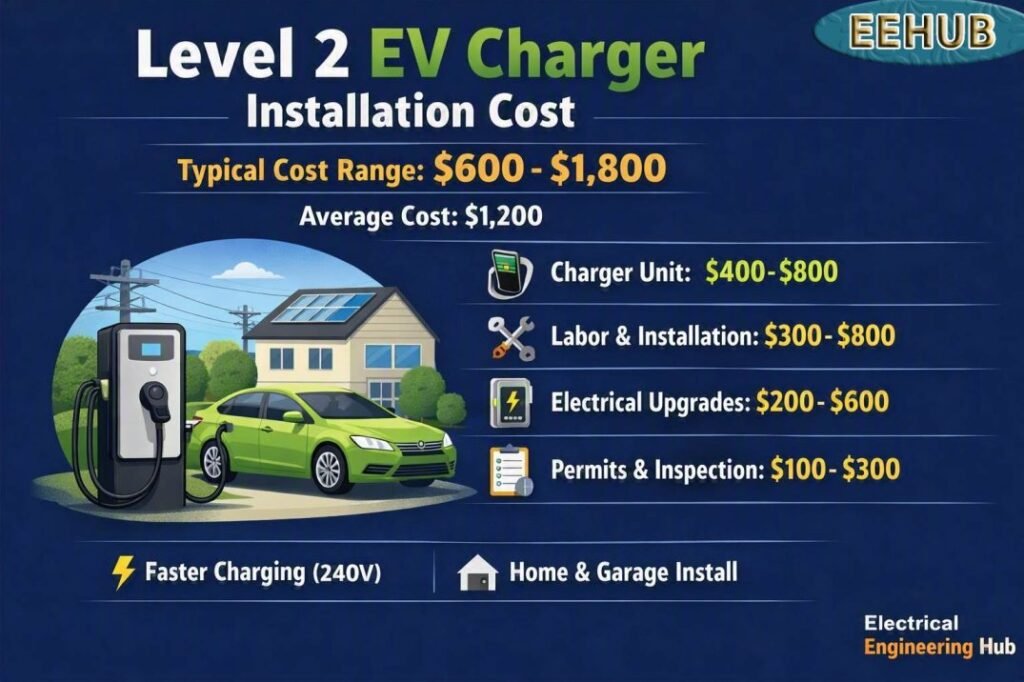
Table of Contents
Table of Contents
Level 2 EV Charger Installation Cost at a Glance
| Installation Type | Typical Cost Range |
|---|---|
| Charger only | $300–$1,000+ |
| Basic plug-in installation | $500–$1,200 |
| Basic hardwired installation | $700–$1,500 |
| Typical home installation | $800–$2,000 |
| Long-distance wiring | $1,200–$2,500+ |
| Panel upgrade required | $2,000–$5,000+ |
| Trenching or detached garage | $1,500–$4,000+ |
| Premium/custom installation | $3,000+ |
These are planning ranges rather than fixed quotes. Local labor rates, permits, electrical-panel capacity, wire length, charger rating, and site conditions can change the final price substantially.
What Is the Average Cost to Install a Level 2 Charger at Home?
For many single-family homes, the cost to install a Level 2 charger at home falls around $800 to $2,000 when the existing electrical system has adequate capacity and the charger is installed reasonably close to the panel.
The cost usually contains three major components: the EV charger, electrical materials, and electrician labor.
| Cost Component | Typical Range |
|---|---|
| Level 2 charger | $300–$1,000+ |
| Breaker | $20–$100+ |
| Copper/aluminum conductors | $100–$500+ |
| Conduit and fittings | $50–$300+ |
| Labor | $300–$1,000+ |
| Permit/inspection | $50–$300+ |
| Panel modifications | $0–$1,500+ |
| Trenching | $500–$2,000+ |
A straightforward installation can therefore be quite affordable, while a complex electrical project can become expensive quickly.
How Much Does a Hardwired Level 2 EV Charger Cost Installed?
A hardwired Level 2 charger typically costs about $700 to $1,500 installed when the electrical panel is suitable and the charger is located close to it.
Hardwired equipment is connected directly to a dedicated circuit rather than plugged into a receptacle. This arrangement is common for higher-power chargers and outdoor installations because it eliminates the need for a large outlet and plug.
The final cost depends on the circuit rating, wire size, conduit route, charger location, and local electrical requirements.
For example, a 48-amp charger may require a 60-amp circuit under common continuous-load sizing practices. A 40-amp charger may require a 50-amp circuit. The exact requirements should be confirmed against the charger’s installation instructions and the applicable electrical code.
EV Charger Home Installation Cost by Charger Power
Not every Level 2 charging station delivers the same power. A higher-power unit can require a larger circuit and sometimes more expensive electrical work.
| Charger Output | Approx. Circuit | Typical Charging Power | Approx. Range Added per Hour* |
|---|---|---|---|
| 16A | 20A | 3.8 kW | 10–15 miles |
| 24A | 30A | 5.8 kW | 15–25 miles |
| 32A | 40A | 7.7 kW | 20–30 miles |
| 40A | 50A | 9.6 kW | 25–35 miles |
| 48A | 60A | 11.5 kW | 30–40 miles |
| 60A | 75A | 14.4 kW | 35–50 miles |
*Actual vehicle range varies with battery size, efficiency, temperature, charging losses, and other conditions.
A higher amperage does not automatically mean faster charging if the vehicle’s onboard AC charger cannot accept the additional power.
What Determines the Cost to Install Level 2 EV Charger at Home?
Several factors determine the final level 2 charging installation cost.
Distance From the Electrical Panel
The shortest practical cable route is usually the least expensive. If the garage is directly beside the electrical panel, an electrician may need only a short run of cable and conduit.
A detached garage or charger installed on the opposite side of the house can require much more wiring, conduit, drilling, or trenching.
Electrical Panel Capacity
The existing service must have sufficient capacity for the new EV charging circuit. If the panel is already heavily loaded, an electrician may need to perform a load calculation.
Possible solutions include:
- Installing a lower-power charger
- Managing charging loads with an approved energy-management system
- Reconfiguring circuits where permitted
- Upgrading the electrical panel
- Upgrading the home’s service
A panel upgrade can add thousands of dollars to the project, so it is important to check this before purchasing equipment.
Charger Location
Indoor garage installations are often simpler than outdoor installations. Outdoor equipment may require weather-rated equipment, appropriate conduit, additional protection, and more complicated routing.
Wiring and Conduit
Copper conductors can represent a significant part of the cost. Long runs require more cable, while larger circuits require larger conductors.
Conduit type and installation method also affect material and labor costs.
Qmerit Average EV Charger Installation Cost
Qmerit is a major EV charging installation marketplace that provides installation services through its network of electricians. Its published installation pricing and estimates have commonly been used as a reference point for understanding residential EV charger installation expenses.
However, a Qmerit EV charger installation cost typical for one homeowner should not be treated as a universal national price. Qmerit quotes can vary according to location, electrical requirements, charger type, wiring distance, permits, and the condition of the existing electrical system.
For an actual project, the useful number is the site-specific quote rather than a national average.
| Project Condition | Likely Effect on Quote |
|---|---|
| Panel beside garage | Lower |
| Short conduit run | Lower |
| Existing suitable circuit | Potentially lower |
| Long cable run | Higher |
| Detached garage | Higher |
| Trenching required | Much higher |
| Panel upgrade | Much higher |
| Service upgrade | Highest potential increase |
Tesla Level 2 Charger Installation Cost
The Tesla Level 2 charger installation cost depends mainly on the electrical work rather than simply the Tesla Wall Connector price.
A Tesla Wall Connector can be installed on a suitable dedicated circuit, with the electrician configuring the installation according to the available electrical capacity and Tesla’s installation requirements.
The Tesla Level 2 charger cost itself is only one part of the project. Homeowners should also budget for the breaker, conductors, conduit, labor, permit, and possible panel modifications.
The same principle applies when comparing the cost of a Level 2 charger from Tesla with other brands. The installation requirements can have a greater effect on the total project price than modest differences between charger prices.
If you are comparing charging equipment before installation, see our guide to the Best Level 2 EV Charger for a look at charger features, power ratings, smart functions, and home-use considerations.
Level 2 EV Charger Installation Cost by Project Type
| Installation Scenario | Approximate Total |
|---|---|
| Charger near panel | $500–$1,200 |
| Standard garage installation | $800–$2,000 |
| Outdoor wall installation | $900–$2,200 |
| Long cable run | $1,200–$2,500+ |
| Detached garage | $1,500–$4,000+ |
| Trenching required | $1,500–$4,000+ |
| Panel upgrade | $2,000–$5,000+ |
| Service upgrade | $3,000–$8,000+ |
Local pricing can be significantly different. For example, a Level 2 EV charger installation cost CT may be higher or lower than a similar project in another state because electrician rates, permits, building practices, and local electrical conditions differ.
Likewise, a level 2 charger installation cost Frisco quote should be based on the actual property rather than applying a national average to every home.
How Much Does a Level 2 Charging Station Cost?
The equipment price for a Level 2 charging station commonly falls between $300 and $1,000 or more. Premium models can cost more because of features such as Wi-Fi, load management, energy monitoring, scheduling, mobile applications, adjustable current settings, and integrated cable management.
| Feature | Basic Unit | Premium Unit |
|---|---|---|
| Level 2 AC charging | Yes | Yes |
| Adjustable current | Sometimes | Usually |
| Wi-Fi | Sometimes | Usually |
| Mobile app | Sometimes | Usually |
| Energy monitoring | Limited | Often |
| Load management | Limited | Available on some models |
| Outdoor rating | Model dependent | Common |
| Price | Lower | Higher |
Buying a more expensive charger does not necessarily reduce installation costs. The electrical circuit still needs to be correctly sized for the selected charging current.
How Much Does Level 2 Charging Cost?
The ongoing level 2 charging cost depends on electricity rates and the amount of energy transferred to the vehicle.
The basic calculation is:
Charging cost = Energy consumed in kWh × Electricity price per kWh
For example, if an EV uses 30 kWh and electricity costs $0.20/kWh:
30 × $0.20 = $6.00
Charging losses mean electricity drawn from the home can be somewhat higher than the energy ultimately stored in the battery.
Level 2 Charger Cost Per Hour
The level 2 charger cost per hour depends on its power draw and the local electricity rate.
| Charger Power | Electricity Rate | Approx. Cost per Hour |
|---|---|---|
| 7.2 kW | $0.15/kWh | $1.08 |
| 7.2 kW | $0.20/kWh | $1.44 |
| 9.6 kW | $0.15/kWh | $1.44 |
| 9.6 kW | $0.20/kWh | $1.92 |
| 11.5 kW | $0.15/kWh | $1.73 |
| 11.5 kW | $0.20/kWh | $2.30 |
These calculations exclude charging losses and assume the charger operates continuously at the stated power.
Ways to Reduce the Cost of Installing a Level 2 Charger
Homeowners can often reduce project costs by planning the installation before purchasing the charger.
- Install the charger close to the electrical panel where practical.
- Ask an electrician to perform a load calculation before buying a high-power unit.
- Compare plug-in and hardwired installation options.
- Choose a charging current that matches the vehicle and home’s electrical capacity.
- Obtain multiple itemized installation quotes.
- Check whether local utility rebates or EV charging incentives are available.
- Avoid unnecessarily long cable and conduit routes.
- Confirm permit requirements before work begins.
A lower-power Level 2 charger may provide enough overnight charging without requiring an expensive electrical upgrade.
What Should Be Included in an Installation Quote?
A good quote should clearly identify the charger, circuit rating, wire type and size, conduit, breaker, labor, permit, inspection, and any panel work.
| Quote Item | Should Be Specified? |
|---|---|
| Charger model | Yes |
| Circuit amperage | Yes |
| Wire/conductor type | Yes |
| Conduit | Yes |
| Breaker | Yes |
| Labor | Yes |
| Permit | Yes |
| Panel modifications | If applicable |
| Trenching | If applicable |
| Inspection | If applicable |
This makes it easier to compare two electrician quotes that may initially appear to have very different prices.
EV Charging Station Depreciation Life
EV charging equipment is generally treated as a long-term electrical asset, but its useful life depends on usage, environment, maintenance, and technology changes. For homeowners, understanding EV Charging Station Depreciation Life can also help when comparing the overall Level 2 EV Charger Installation Cost.
| Component | Typical Useful Life |
|---|---|
| Level 2 charger | 8–12 years |
| Cable and connector | 5–10 years |
| Mounting hardware | 10+ years |
| Electrical protection | 10–20 years |
Heavy daily charging may shorten equipment life, while indoor installation and proper maintenance can extend it. For detailed cost planning, see our guide to EV charger depreciation and useful life.
7kW EV Charger Cost: What to Budget
A 7kW home EV charger is a practical Level 2 option for many drivers, but the total price depends on the charger, cable run, protection devices, and electrician’s labor. The table below gives a quick planning range.
| Cost Component | Typical Range |
|---|---|
| 7kW charger | $400–$900 |
| Installation | $500–$1,500 |
| Electrical upgrades | $0–$1,000+ |
| Estimated total | $900–$3,400+ |
When comparing Level 2 EV Charger Installation Cost, remember that a longer circuit run or panel upgrade can significantly increase the final bill. For a detailed breakdown, see our guide to 7kW EV Charger Cost and installation requirements.
For homeowners still choosing the charging equipment, our Best Level 2 EV Charger guide can help compare suitable models before you request installation quotes.
How Much Does a Wallbox Cost?
If you are wondering how much does a wallbox cost, the charger itself is only part of the total expense. A typical home Wallbox Level 2 charger may cost around $400–$800, while installation can add several hundred dollars depending on wiring distance, panel capacity, and labor.
| Cost Item | Typical Range |
|---|---|
| Wallbox charger | $400–$800 |
| Installation | $300–$1,000+ |
| Total project | $700–$1,800+ |
The final price should therefore be compared with the complete Level 2 EV Charger Installation Cost, not just the equipment price. For a detailed breakdown, see our guide to Wallbox pricing and installation costs.
Home EV Charging Station Installation
Home EV charging station installation usually involves more than mounting the charger. An electrician should check the main panel capacity, available breaker space, wire size, grounding, and the distance to the parking location. A dedicated 240V circuit is commonly required for Level 2 charging.
| Installation item | Typical consideration |
|---|---|
| Circuit | Dedicated 240V circuit |
| Protection | Correctly sized breaker and GFCI where required |
| Wiring | Sized for charger current and installation method |
| Panel | Adequate capacity and breaker space |
| Inspection | Local electrical-code requirements |
Because wiring distance, panel upgrades, and labor can change the total price, review the Level 2 EV Charger Installation Cost before budgeting. For a detailed breakdown, see our guide to home EV charging station installation, including equipment, electrical work, and installation factors.
Frequently Asked Questions
1. How much does it cost to install a Level 2 charger at home?
The typical cost to install a Level 2 charger at home is roughly $800 to $2,000 for a straightforward installation. Short wiring runs and an adequate electrical panel can keep the price lower, while panel upgrades, trenching, or long cable runs can increase the total substantially.
2. How much does it cost to install a Level 2 charger?
The cost to install a Level 2 charger commonly ranges from about $500 to $2,500 or more, depending on the charger, circuit size, wiring distance, labor, permits, and electrical-panel capacity. A site-specific electrician quote is more reliable than a general average.
3. How much does a Level 2 charger cost?
A Level 2 charger itself commonly costs around $300 to $1,000 or more. Smart charging features, higher output, energy monitoring, load management, and premium hardware can increase the equipment price.
4. How much to get a Level 2 charger at home?
For many homes, budgeting $800 to $2,000 for the charger and a standard installation is a reasonable starting point. Homes requiring a panel or service upgrade can have significantly higher project costs.
5. How much does Level 2 charging cost?
Level 2 charging cost depends on the vehicle’s energy consumption and the local electricity rate. Multiply the electricity used in kWh by the utility’s price per kWh, then account for normal charging losses for a closer estimate.
Related Guides
Get new guides in your feed. Follow Electrical Insights on LinkedIn for new electrical standards guides, calculators and design tips from Azad Circuit Hub.
#Level2EVCharger, #EVChargerInstallation, #EVChargingCost, #HomeEVCharging, #ElectricVehicle, #EVChargerCost, #EVChargingStation, #EVHomeCharger, #EVChargingGuide, #ElectricCar
