DEWALT EV Charger Review: Models, Features, Installation & Buying Guide
Choosing an EV charger is not only about maximum charging speed. The circuit rating, connector, cable length, installation method, protection features, and daily charging needs all matter. In this DEWALT EV Charger Review, I am looking at the current DEWALT portable Level 2 charger range and how the different output ratings compare.
As an electrical engineer with more than 15 years of field experience in electrical panels, industrial automation, PLCs, SCADA systems, and electrical troubleshooting, I pay particular attention to the electrical side of EV charging. A charger must match the vehicle, branch circuit, receptacle, and installation conditions rather than simply being selected by its advertised amperage.
DEWALT EV Charger Review: Models Compared
The DEWALT range includes several output levels, making it possible to select a charger according to the available circuit capacity and required charging speed.
| Model | Max Current | Approx. Power at 240V | Best For |
|---|---|---|---|
| DEWALT DXPAEV048 | 48A | 11.5 kW | Dedicated high-output home charging |
| DEWALT DXPAEV040 | 40A | 9.6 kW | Faster residential charging |
| DEWALT DXPAEV032 | 32A | 7.7 kW | Moderate daily charging |
| DEWALT DXPAEV016 | 16A | 3.8 kW | Apartments and lower-capacity circuits |
Actual charging power depends on the vehicle's onboard charger, supply voltage, temperature, circuit installation, and charging settings.
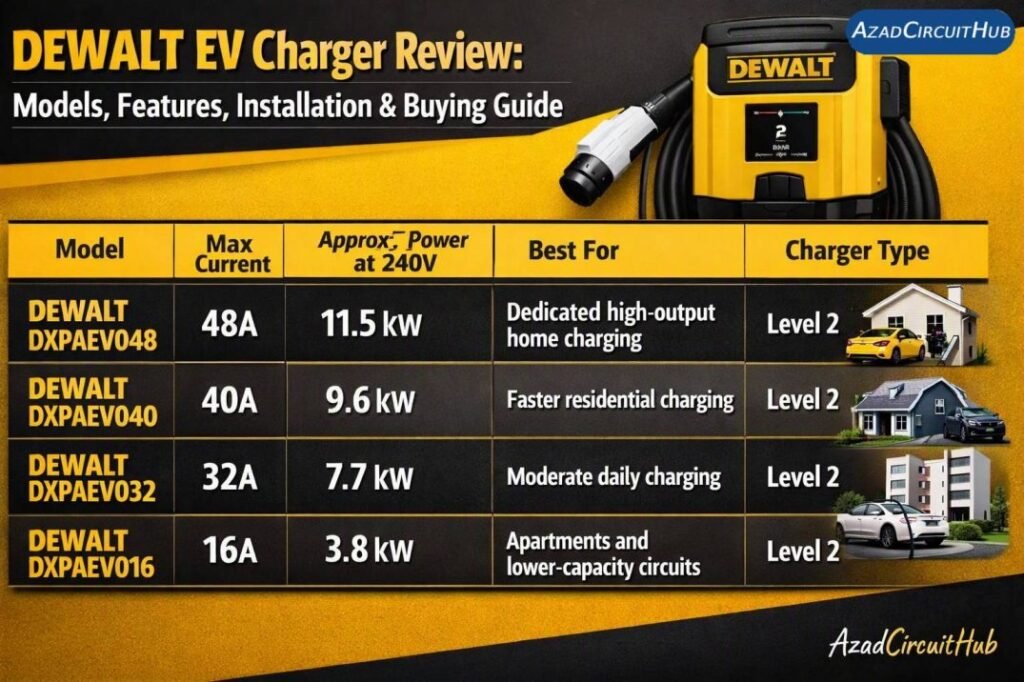
Table of Contents
Table of Contents
Which DEWALT EV Charger Should You Buy?
For a dedicated 60A circuit, the DXPAEV048 is the model to investigate if your EV can accept its full output. The DXPAEV040 can make more sense where a 50A circuit is available. The DXPAEV032 suits many residential applications where a 40A circuit is already installed.
The DXPAEV016 is different because its lower current demand can make it easier to integrate into locations where a high-amperage circuit is not practical.
Before buying, check the vehicle's maximum AC charging rate and have the branch circuit evaluated by a qualified electrician.
Check DEWALT DXPAEV048 on Amazon if you need a high-output Level 2 charging option.
DEWALT DXPAEV048 Review
The DEWALT DXPAEV048 is the high-output option in this lineup. At 48 amps and 240 volts, its theoretical maximum output is approximately 11.5 kW.
That makes it suitable for EV owners who want to reduce charging time and have a properly sized residential electrical installation. A 48A continuous EV load is significant, so the circuit must be designed accordingly.
For a 48A continuous load, the commonly applied 125% sizing principle results in a 60A branch-circuit requirement under NEC continuous-load rules. Local code, installation method, conductor temperature ratings, and equipment requirements still need to be checked. Read complete DEWALT 48A Level 2 EV Charger Review here.
This model is most interesting for homeowners with a dedicated charging location and an EV capable of accepting high AC charging power.
DEWALT DXPAEV040 Review
The DEWALT DXPAEV040 provides up to 40A of charging current, equivalent to about 9.6 kW at 240V.
It sits between the high-output DXPAEV048 and the lower-current models. For many homes, this can be a useful balance between charging speed and electrical infrastructure.
A 40A continuous load generally points toward a 50A circuit when applying the 125% continuous-load calculation. However, the exact installation must follow the applicable electrical code and equipment instructions.
Read Complete DEWALT 40A Level 2 EV Charger Review here.
If your EV is charged overnight and does not need the maximum available AC rate, the DXPAEV040 may provide more charging capacity than necessary while avoiding the larger circuit associated with a 48A charger.
Check DEWALT DXPAEV040 on Amazon before choosing a circuit and connector arrangement.
DEWALT DXPAEV032 Review
The DEWALT DXPAEV032 is rated at 32A, giving approximately 7.7 kW at 240V.
This output is enough for many daily-driving situations. A vehicle adding roughly 7.7 kWh per hour of charging can recover a substantial amount of energy during an overnight charging session, although real-world results vary.
From an electrical installation perspective, a 32A continuous load typically leads to a 40A circuit under the 125% sizing principle. This makes the model interesting for homes where a 40A branch circuit is more practical than a larger 50A or 60A circuit.
See DEWALT DXPAEV032 on Amazon if your priority is a practical Level 2 charging rate without moving to the highest current option.
DEWALT DXPAEV016 Review
The DEWALT DXPAEV016 operates at 16A, producing approximately 3.8 kW at 240V.
Its lower output is not automatically a disadvantage. For apartment parking, secondary vehicles, workplace charging, or locations with limited electrical capacity, a lower-current charger can be easier to accommodate.
A 16A continuous load corresponds to a 20A circuit when the 125% continuous-load calculation is applicable.
The main trade-off is charging time. Drivers who cover high daily mileage may prefer one of the higher-current DEWALT models.
Check DEWALT DXPAEV016 on Amazon if you need a lower-current charging solution.
DEWALT EV Charger Installation and Electrical Requirements
Installation deserves as much attention as the charger itself. EV charging is a continuous load, so the circuit should not be treated like an ordinary intermittent receptacle load.
| Charger Current | Approx. 240V Load | Typical 125% Circuit Calculation |
|---|---|---|
| 16A | 3.8 kW | 20A |
| 32A | 7.7 kW | 40A |
| 40A | 9.6 kW | 50A |
| 48A | 11.5 kW | 60A |
These figures are planning values, not a substitute for the equipment instructions or local electrical code.
The electrician should verify conductor size, breaker rating, grounding, voltage drop, termination torque, enclosure suitability, receptacle rating where applicable, and any required GFCI protection.
For a deeper comparison of residential charging options, see our guide to the best level 2 ev charger options.
DEWALT vs WOLFBOX EV Charger
DEWALT and WOLFBOX approach the EV charging market from different brand backgrounds. DEWALT is widely associated with professional power tools and electrical equipment, while WOLFBOX focuses heavily on EV charging products and accessories.
When comparing them, look beyond brand recognition. Compare maximum amperage, cable length, connector type, display or controls, weather protection, portability, warranty terms, app functionality, and the electrical requirements of the installation.
A useful comparison should also consider whether your vehicle can actually use the charger's maximum output. Buying a higher-rated charger does not automatically make an EV charge faster if its onboard AC charger has a lower limit.
DEWALT vs EVIQO EV Charger
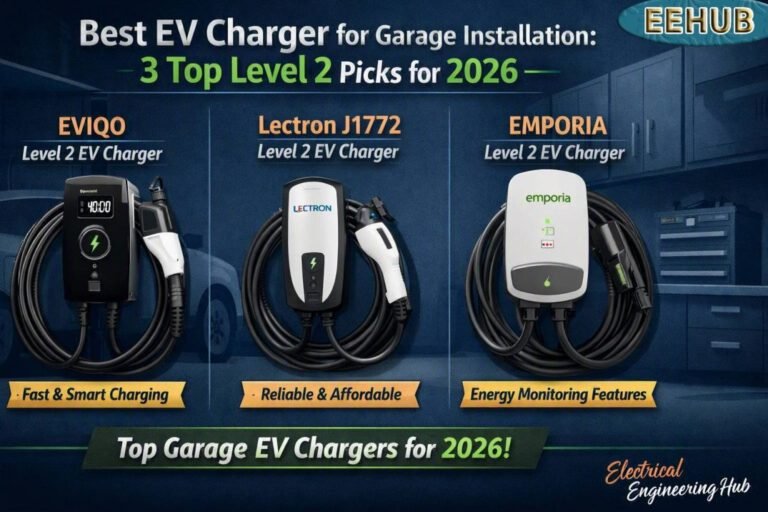
EVIQO has become another name worth considering in the home Level 2 charger market. A DEWALT versus EVIQO comparison should focus on specifications rather than simply comparing advertised charging speeds.
Look at continuous output, installation options, safety certifications, cable management, connector design, warranty coverage, smart charging features, and current pricing.
The right choice also depends on whether you want a portable charger or a more permanent home charging setup.
If you are comparing several residential products, our broader best ev charger level 2 guide can help you review the alternatives by charging speed and application.
Is the DEWALT EV Charger Any Good?
The answer depends on the model, vehicle, and installation. The DEWALT range covers several current levels, from 16A through 48A, so there is no single specification that describes every charger in the lineup.
The main advantage of having multiple current ratings is flexibility. Buyers can select a charger that better matches their available electrical capacity instead of automatically installing the largest unit.
For an electrical engineer, the key question is not simply whether the charger can deliver 48A. It is whether the vehicle, branch circuit, breaker, conductors, connections, and installation environment are all suitable for that continuous load.
Best DEWALT EV Charger for Apartment Parking
Apartment charging introduces different constraints. Parking spaces may not have a dedicated high-amperage circuit, and tenants may have restrictions on electrical modifications.
The DXPAEV016 is therefore worth considering where lower charging current is preferred. A 16A Level 2 charger can provide useful overnight charging without requiring the same circuit capacity as a 40A or 48A unit.
However, apartment residents should obtain permission where required and confirm that the electrical supply and parking arrangement support EV charging.
For faster charging requirements, compare this option with our guide to the fastest level 2 charger options.
DEWALT EV Charger Buying Checklist
Before placing an order, check these points:
- Confirm your EV's maximum AC charging rate.
- Check the available voltage at the charging location.
- Determine the required branch-circuit capacity.
- Verify the connector used by your vehicle.
- Check cable length and parking layout.
- Review outdoor installation requirements.
- Confirm protection and certification information.
- Consider whether portable or fixed charging is more practical.
- Compare warranty and return terms.
- Check the latest Amazon price and model availability.
For readers looking at established charging brands and popular configurations, our famous level 2 ev charger guide provides another useful comparison point.
DEWALT EV Charger Charging Time
Charging time depends heavily on battery capacity and the vehicle's onboard AC charger. A simple estimate is:
Charging time ≈ Energy required ÷ Charging power
For example, adding 40 kWh at an effective 7.7 kW rate would theoretically take about 5.2 hours. Real charging sessions can take longer because of charging losses, battery temperature, charging curves, and vehicle power management.
| Approx. Charger Output | Typical Use |
|---|---|
| 3.8 kW | Lower daily mileage |
| 7.7 kW | Regular overnight charging |
| 9.6 kW | Faster home charging |
| 11.5 kW | High-output residential charging |
Frequently Asked Questions
Is DEWALT making EV chargers?
DEWALT offers EV charging products under its brand, including the DXPAEV048, DXPAEV040, DXPAEV032, and DXPAEV016 models discussed in this guide. Availability can vary by market and retailer.
What size breaker does a DEWALT EV charger need?
It depends on the charger output and installation requirements. Using the common 125% continuous-load calculation, 16A, 32A, 40A, and 48A loads correspond to 20A, 40A, 50A, and 60A circuit ratings respectively. Local code and manufacturer instructions must be followed.
How fast does a DEWALT Level 2 charger charge?
Charging speed depends on the specific model and vehicle. The four models discussed here range from approximately 3.8 kW to 11.5 kW at 240V, while the vehicle's onboard charger can limit the actual rate.
Can I use a DEWALT EV charger outdoors?
Outdoor suitability depends on the exact model, installation method, enclosure protection, and manufacturer's instructions. Always confirm the product's environmental rating before installing it outdoors.
Which DEWALT EV charger should I choose?
Match the charger to your EV's AC charging capability and the electrical capacity available at the installation point. The DXPAEV048 targets high-output charging, while the DXPAEV016 is designed around a much lower current level.
Final Buying Considerations
This DEWALT EV Charger Review shows why charger selection should start with the electrical installation rather than the advertised maximum output. The DXPAEV048 targets drivers who can support a 48A charging load, while the DXPAEV040 and DXPAEV032 offer lower current options. The DXPAEV016 is particularly relevant where a lower-power Level 2 setup is preferred.
As an electrical engineer, I would always verify the complete charging circuit before choosing the largest available model. A properly matched 32A or 40A charger can be more practical than installing a 48A unit that the vehicle or electrical system cannot fully use.
Check the current Amazon listing, model specifications, warranty information, and installation requirements before purchasing because product availability and configurations can change.
Related Guides & Tools
- Emporia EV Charger Review
- Emporia Pro Level 2 EV Charger Review
- EVIQO vs ChargePoint Home Flex vs Emporia
- Emporia Level 2 EV Charger vs ChargePoint Home Flex
- EV Charger Cable Size Calculator
Get new guides in your feed. Follow Electrical Insights on LinkedIn for new electrical standards guides, calculators and design tips from Azad Circuit Hub.
#DEWALTEVCharger, #DEWALTEVChargerReview, #EVCharger, #Level2EVCharger, #ElectricVehicleCharging, #EVChargingStation, #HomeEVCharger, #EVChargerInstallation, #DEWALTTools, #EVChargingGuide