
Emporia EV Charger Review: Best Budget Option?
If you want a fast home EV charger without paying premium prices, the Emporia Level 2 EV Charger is one of the models worth considering. It combines 240V charging, up to 48 amps of output, Wi-Fi connectivity, and energy monitoring in a compact package. For EV owners who want smart features without moving into the $500+ price range, it offers a strong balance of performance and cost.
In this emporia ev charger review, we look at its charging speed, installation requirements, smart features, build quality, app experience, safety, pros and cons, and overall value. We will also compare its features with what most homeowners should expect from a Level 2 EV charger.
Emporia EV Charger Review: Quick Overview
| Feature | Emporia Level 2 EV Charger |
|---|---|
| Charger type | Level 2 EV charger |
| Maximum output | Up to 48A |
| Maximum power | Up to 11.5 kW |
| Input | 240V AC |
| Connector | J1772 |
| Cable length | About 24 ft |
| Wi-Fi | Yes |
| Mobile app | Emporia Energy app |
| Energy monitoring | Yes |
| Installation | Hardwired or NEMA 14-50 configuration, depending on model/setup |
| Recommended circuit | Up to 60A for 48A charging |
| Outdoor use | Yes, when properly installed |
| Best for | Home EV charging and energy-conscious homeowners |
| Smart charging | Yes |
| Main advantage | Strong features at a competitive price |
| Amazon | Check Emporia Level 2 on Amazon |
Always verify the current Amazon listing, included hardware, plug configuration, and electrical requirements before purchasing.
What Is the Emporia Level 2 EV Charger?
The Emporia Level 2 is a residential EV charging station designed for drivers who want substantially faster charging than a standard 120V Level 1 charger.
A Level 1 charger typically operates from a household 120V outlet and can add only a limited number of miles per hour. A 240V Level 2 charger can deliver much more energy during the same charging period.
The Emporia can provide up to 48 amps and approximately 11.5 kW when installed on an appropriately sized circuit. That makes it suitable for many modern EVs and plug-in hybrids that support Level 2 charging.
One of its biggest selling points is its connection with the Emporia Energy ecosystem. The charger can work with the company's energy monitoring platform, giving homeowners more visibility into electricity consumption and charging behavior.
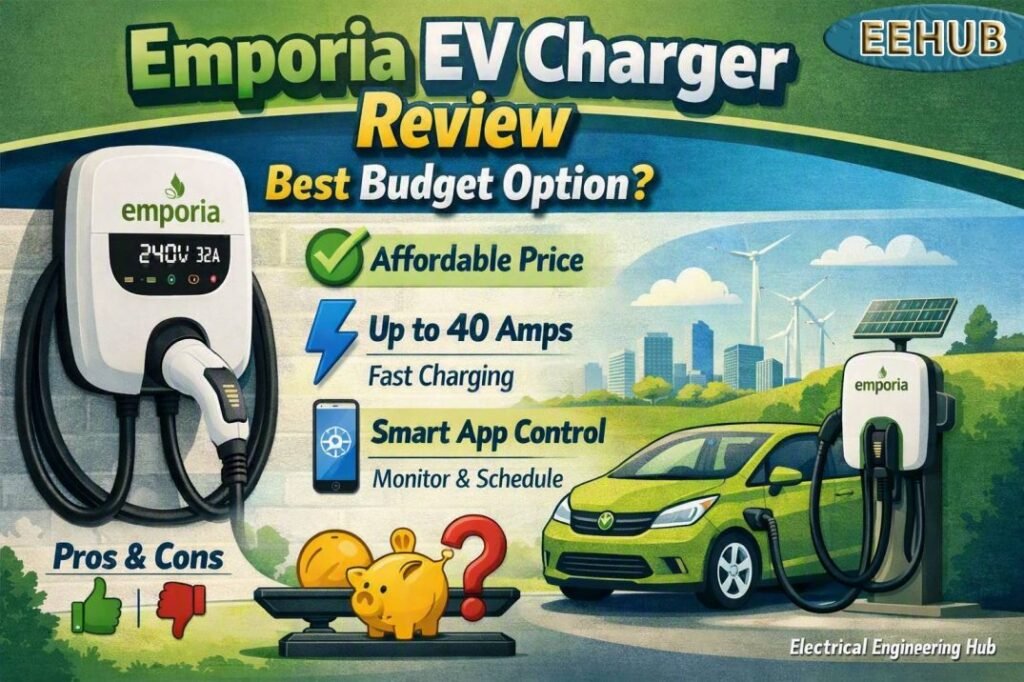
Table of Contents
Table of Contents
Emporia EV Charger Review
Charging Speed and Performance
Charging speed is one of the most important factors when buying an EV charger.
At its maximum 48A output, the Emporia can deliver up to about 11.5 kW. Actual charging speed depends on the vehicle's onboard AC charger, battery state, temperature, charging settings, and other factors.
For example, an EV capable of accepting 11.5 kW from an AC charger can take full advantage of the Emporia's maximum output. Another vehicle limited to 7.2 kW will charge at the vehicle's lower limit.
This is important because buying a 48A charger does not automatically mean your EV will charge at 48A.
For overnight charging, however, a Level 2 charger can be a major upgrade. Many drivers can recover a large portion of their daily driving range while the vehicle is parked at home.
Smart Features and Energy Monitoring
The smart features are where Emporia separates itself from many basic budget EV chargers.
The Emporia Energy app allows users to monitor charging activity and manage charging sessions from a smartphone. Depending on the setup and compatible Emporia equipment, homeowners can also integrate EV charging into a broader home energy monitoring system.
This can be useful for people who want to understand how much electricity their EV consumes.
The charger also supports scheduled charging, which can help users take advantage of lower electricity rates where time-of-use pricing is available.
For homeowners with solar panels, smart energy management can be particularly attractive. The ability to monitor energy flows and coordinate charging with household consumption can make an EV charger more useful as part of a complete home energy system.
Installation and Electrical Requirements
Installation is one area where buyers should pay close attention.
A 48A continuous EV charging load generally requires a properly sized 60A circuit under the applicable electrical code and installation conditions. The exact requirements can vary depending on the installation method, local code, wiring method, breaker configuration, and charger settings.
For a typical 48A installation, a dedicated circuit is required. The charger should not share its circuit with another major load.
A licensed electrician should verify:
- Electrical panel capacity
- Breaker rating
- Wire size
- Grounding and bonding
- Disconnect requirements
- GFCI requirements where applicable
- Local electrical code
- Charger configuration
- Receptacle suitability if using a plug-in installation
Do not select the wire size based only on the charger's advertised amperage. EV charging is treated as a continuous load, so conductor ampacity and installation conditions matter.
If your electrical panel is already heavily loaded, an electrician may recommend load management or a panel upgrade.
Build Quality and Outdoor Installation
The Emporia charger is designed for residential use and can be installed in locations where the equipment is exposed to outdoor conditions, provided the installation follows the manufacturer's instructions and local electrical requirements.
The charging cable is long enough for many residential garages and driveways, although the ideal cable length depends on where the charger is mounted relative to the vehicle's charge port.
A wall-mounted Level 2 charger also keeps the charging equipment organized compared with repeatedly handling a portable charging cable.
For outdoor installations, proper mounting, weather protection, cable management, and electrical connections are important. An outdoor EV charger should never be installed using an unsuitable extension cord or makeshift electrical connection.
Is Emporia Good for Solar EV Charging?
The Emporia system can be particularly interesting for homeowners with solar PV.
Solar production changes throughout the day, while EV charging can represent a significant electrical load. Smart monitoring can help homeowners understand when their vehicle is consuming energy and how that consumption relates to household electricity use.
However, buyers should distinguish between energy monitoring and fully automated solar-surplus charging. The exact functionality depends on the Emporia equipment, software configuration, utility setup, and vehicle.
If solar charging is your primary goal, check the current manufacturer's documentation before purchasing to confirm that the specific charging mode you want is supported.
Emporia Level 2 vs Basic EV Chargers
| Feature | Emporia Level 2 | Basic Level 2 Charger |
|---|---|---|
| Maximum charging | Up to 48A | Often 32A–40A |
| 240V charging | Yes | Yes |
| Wi-Fi | Yes | May vary |
| Mobile app | Yes | May vary |
| Energy monitoring | Yes | Usually limited |
| Scheduled charging | Yes | May vary |
| Solar-energy ecosystem | Strong integration potential | Usually limited |
| Home energy management | Excellent | Basic |
| Best feature | Smart energy control | Low purchase cost |
The comparison shows why the Emporia is more than just a simple EV charging cable. Its smart functionality can justify the additional cost for homeowners who actually plan to use the app and energy-management features.
Emporia EV Charger Review: Pros and Cons
Pros
- Up to 48A charging capability
- Approximately 11.5 kW maximum output
- Wi-Fi connectivity
- Smartphone app
- Energy monitoring
- Scheduled charging
- Useful for solar-equipped homes
- Competitive pricing compared with many premium chargers
- Suitable for daily home charging
- Strong option for energy-conscious homeowners
Cons
- Maximum charging speed depends on the vehicle
- 48A operation requires a properly sized electrical circuit
- Installation can add significant cost
- Smart features may be unnecessary for users who only want basic charging
- App-based features depend on connectivity
- Buyers need to check the exact Amazon package and installation configuration
Who Should Buy the Emporia Level 2?
The Emporia is a good fit for EV owners who want more than basic charging.
It makes particular sense for homeowners who already use Emporia energy monitoring products or want better visibility into household electricity consumption.
It is also attractive for solar homeowners who want to monitor EV charging alongside their home's energy use.
If you simply need a charger that starts charging whenever you plug in your vehicle, some less expensive Level 2 models may be enough. But if smart controls, Wi-Fi, energy monitoring, and scheduled charging matter to you, the Emporia offers more value.
Looking for alternatives before you decide? Compare other options in our best level 2 ev charger for home guide to find a charger that matches your vehicle, electrical panel, and budget.
Is Emporia the Best Budget EV Charger?
The word "budget" can be misleading when comparing EV chargers.
The cheapest charger is not necessarily the best value. A lower-priced unit may lack Wi-Fi, energy monitoring, scheduling, or a strong software platform.
Emporia takes a different approach by offering a relatively affordable charger while including smart-energy features. That combination is the main reason it stands out.
For homeowners who want a high-output Level 2 charger with smart functionality, the Emporia can be a compelling value.
For basic charging without smart features, a simpler charger may save money.
How Much Does an Emporia EV Charger Cost?
The retail price can change based on promotions, configuration, and seller. Amazon pricing can also fluctuate throughout the year.
Before buying, compare the current price with installation costs. A charger that appears inexpensive can become considerably more expensive after adding a 240V circuit, wiring, conduit, breaker, labor, or electrical panel upgrades.
For the latest price and availability, check the current Amazon listing here:
Always confirm whether the listing includes the exact plug or hardwired configuration you need.
Installation Cost to Consider
The charger itself is only part of the total project cost.
If your garage already has a suitable 240V circuit near the installation point, installation may be relatively straightforward. If a new circuit must be run from the electrical panel, labor and materials can increase the total cost.
Typical project costs may include:
| Installation Item | Possible Cost Range |
|---|---|
| Basic EV charger installation | $300–$800+ |
| New 240V circuit | $400–$1,200+ |
| Long wire/conduit run | $500–$1,500+ |
| Panel upgrade | $1,500–$4,000+ |
| Load-management equipment | Varies |
These are planning ranges rather than fixed prices. Local labor rates, distance from the panel, wall construction, conduit requirements, permits, and panel capacity can significantly change the final price.
Final Verdict
The Emporia Level 2 is a strong choice for EV owners who want fast home charging and useful smart-energy features without moving straight into the premium charger market.
In this emporia ev charger review, the biggest strengths are its 48A maximum output, 11.5 kW charging capability, Wi-Fi connectivity, energy monitoring, scheduling, and integration with the wider Emporia ecosystem.
It is especially appealing for homeowners with solar panels or an interest in tracking household energy consumption.
The main limitation is that getting the full 48A output requires an appropriate electrical installation, and not every EV can accept the charger's maximum power.
Overall, if smart controls and energy monitoring matter to you, the Emporia deserves a place on your shortlist.
Want to compare it with other high-quality home charging stations? Explore our best level 2 ev charger for home guide before making your final purchase.
Frequently Asked Questions
Is Emporia a good EV charger?
Yes. The Emporia Level 2 is a good option for homeowners who want fast AC charging, Wi-Fi connectivity, energy monitoring, and smart charging features. Its value is strongest for users who will actually use those smart features.
How many amps does the Emporia EV charger use?
The Emporia Level 2 can provide up to 48 amps when configured and installed for maximum output. A 48A continuous EV charging load generally requires a properly sized 60A circuit, subject to the applicable electrical code and installation requirements.
Does Emporia EV charger work with Tesla?
The charger uses the J1772 connector, so compatibility with a Tesla depends on the vehicle and adapter arrangement. Tesla vehicles that support J1772 AC charging can generally use a compatible J1772-to-Tesla adapter.
Can Emporia charge an EV with solar power?
It can be used as part of a solar-equipped home's energy-management setup, particularly when combined with compatible Emporia energy-monitoring equipment. However, the exact solar charging capabilities depend on the current hardware and software configuration.
Is Emporia better than a cheap Level 2 charger?
For users who want Wi-Fi, energy monitoring, scheduled charging, and smart energy management, Emporia can provide better overall value than a basic charger. If you only need simple plug-in charging, a cheaper Level 2 model may be sufficient.
Related Guides
- EVIQO Level 2 EV Charger Review
- Emporia Classic vs Emporia Pro
- Grizzl E Level 2 EV Charger Review
- Hardwired vs Plug In EV Charger
- Best Commercial Level 2 EV Charger
- Best EVSE Level 2 Charger
- Best EV Charger Under $300
Get new guides in your feed. Follow Electrical Insights on LinkedIn for new electrical standards guides, calculators and design tips from Azad Circuit Hub.
EmporiaEVCharger, #EmporiaEVChargerReview, #EVCharger, #Level2EVCharger, #HomeEVCharger, #EVCharging, #ElectricVehicle, #SmartEVCharger, #EVChargerReview, #EVChargingStation
