
Emporia Classic vs Emporia Pro: Which Level 2 EV Charger Should You Buy?
Choosing between two EV chargers from the same brand can be harder than comparing completely different products. The Emporia Classic and Emporia Pro are both designed for home Level 2 charging, but their feature sets and use cases are not exactly the same.
In this Emporia Classic vs Emporia Pro comparison, I will focus on the practical differences that matter during installation and daily charging. As an electrical engineer with hands-on experience in electrical panels, protection systems, and load management, I pay particular attention to circuit requirements, charging current, cable size, connectivity, and how a charger behaves as part of a residential electrical system.
Emporia Classic vs Emporia Pro: Quick Comparison
| Feature | Emporia Classic | Emporia Pro |
|---|---|---|
| Charger type | Level 2 AC EV charger | Level 2 AC EV charger |
| Supply | 208–240V AC | 208–240V AC |
| Maximum charging power | Up to 11.5 kW | Up to 11.5 kW |
| Maximum output | Up to 48A | Up to 48A |
| Typical full-power circuit | 60A circuit | 60A circuit |
| Connectivity | Wi-Fi | Wi-Fi |
| Energy monitoring | Yes | Yes |
| Mobile app | Emporia app | Emporia app |
| Installation | Hardwired / compatible configurations vary by model | Hardwired / compatible configurations vary by model |
| Charging cable | Long integrated cable | Long integrated cable |
| Home energy ecosystem | Emporia energy management | Emporia energy management |
| Best suited for | Straightforward home EV charging | Users wanting deeper integration and energy-management features |
| Amazon availability | Check current listing | Check current listing |
The table gives the basic picture, but the important differences become clearer when you look at how each charger fits into a real home's electrical system.
Recommended Charger: Emporia Pro
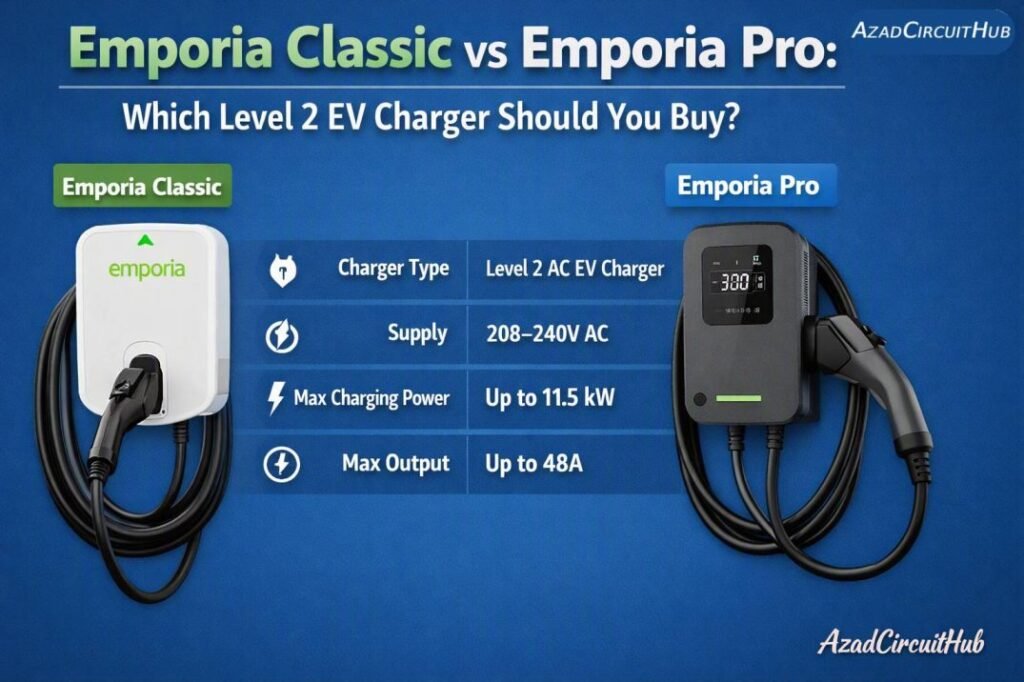
Table of Contents
Table of Contents
What Is the Difference Between Emporia Classic and Pro?
The main distinction is not simply charging speed. Both models are designed around high-power Level 2 charging, so a properly installed 240V supply can provide substantially faster charging than a standard 120V household outlet.
The more important consideration is the feature set and how much control you want over your home's energy consumption.
The Classic makes sense for homeowners who primarily want a connected Level 2 EV charger with app-based monitoring. It provides the core features required for convenient overnight charging without necessarily requiring an advanced energy-management setup.
The Pro is aimed more toward homeowners who want their EV charger to work as part of a broader energy-management system. This can be particularly useful where the home has solar panels, other large electrical loads, or a desire to monitor electricity consumption more closely.
If your priority is simply reliable home charging, compare the current Amazon package carefully before paying extra for features you may not use.
Check the Emporia Level 2 EV Charger on Amazon
Charging Power and Electrical Requirements
One of the first things I check with any 48A EV charger is the branch-circuit requirement.
At 240V and 48A, the theoretical charging output is:
240V × 48A = 11,520W
That equals approximately 11.5 kW.
EV charging is generally treated as a continuous load. Under the commonly applied 125% continuous-load calculation, a 48A charging load requires:
48A × 125% = 60A
That is why a full-power 48A installation typically calls for a properly sized 60A branch circuit, subject to the equipment instructions, applicable electrical code, conductor ampacity, terminal ratings, installation method, and local requirements.
| Charging current | Approx. power at 240V | Typical continuous-load circuit calculation |
|---|---|---|
| 16A | 3.84 kW | 20A |
| 24A | 5.76 kW | 30A |
| 32A | 7.68 kW | 40A |
| 40A | 9.60 kW | 50A |
| 48A | 11.52 kW | 60A |
Do not select wire size from amperage alone. Conductor material, insulation temperature rating, ambient conditions, conduit fill, terminal ratings, installation method, voltage drop, and local code requirements can all affect the final design.
For homeowners who are unsure whether their panel can support a 48A EV charger, an electrician should assess the service capacity and existing loads before installation.
Emporia Classic vs Emporia Pro for Homeowners
For most buyers, the choice comes down to how much they value energy monitoring and integration.
The Classic is easier to justify when the EV charger has one primary job: charge the vehicle. If you plug in after work and normally charge overnight, advanced energy-management functions may not provide enough additional value to justify a more expensive model.
The Pro becomes more interesting when your electrical system is more complex.
For example, a homeowner may have:
- Solar PV with a grid-tied inverter
- An electric heat pump
- Electric water heating
- A second EV
- Large workshop equipment
- A battery energy storage system
- Time-of-use electricity rates
- A strong interest in household energy monitoring
In these situations, the ability to see and manage electrical consumption can become much more useful.
If you are still comparing other charging options, our guide to the best level 2 ev charger can help you compare Emporia with competing home EV charging stations.
Smart Features and Energy Monitoring
Emporia has built much of its product identity around energy monitoring. Its ecosystem can provide useful information about electricity consumption through the company's app and compatible monitoring equipment.
This matters because an EV can become one of the largest individual electrical loads in a home.
A charger operating at 48A for several hours can consume considerably more electricity than many conventional household appliances. Being able to understand when and how much energy the vehicle uses can therefore help homeowners manage charging costs.
The Pro is particularly worth examining if energy monitoring is one of your main reasons for choosing Emporia.
Before purchasing, check the current Amazon listing for the exact model number and included accessories because package contents and availability can change.
Buy the Emporia Pro Level 2 EV Charger on Amazon
Installation: What an Electrician Should Check
A Level 2 EV charger should not be treated like a simple appliance that can always be added to an existing outlet.
Before installation, check:
- Available panel capacity
The main service must have adequate capacity for the additional continuous load. - Breaker rating
A 48A continuous charging load generally requires a 60A circuit when operated at the full rating under the 125% calculation. - Conductor sizing
Select conductors according to the applicable electrical code and actual installation conditions. - Grounding and protection
Follow the manufacturer's requirements and local electrical regulations for grounding and required protection. - Installation location
Consider cable reach, vehicle parking position, weather exposure, and physical protection. - Voltage drop
Long cable runs may require additional consideration for conductor size and voltage drop. - Future loads
Leave enough service capacity if another EV, heat pump, solar battery, or other major load may be added later.
The manufacturer's installation instructions should always take priority for product-specific requirements.
For a deeper look at the standard Emporia unit, see our Emporia Level 2 EV Charger Review before making your final purchase.
Emporia Classic vs Emporia Pro: Which One Fits Your Setup?
The right choice depends on the electrical and energy-management requirements of the home rather than the name printed on the enclosure.
Choose the Classic if you mainly need:
- Fast overnight EV charging
- Wi-Fi connectivity
- App-based charging information
- A straightforward home charging setup
- A Level 2 charger without an unnecessarily complex system
Consider the Pro if you want:
- More emphasis on energy monitoring
- Integration with a broader Emporia energy ecosystem
- Better visibility of household electricity use
- A charger that fits into a more energy-conscious home
- Greater interest in solar and load-management applications
If you are specifically interested in the higher-feature model, our Emporia Pro Level 2 EV Charger Review covers its features and installation considerations in greater detail.
Which Emporia Charger Is Better for Solar Homes?
Solar owners should look beyond the charger itself.
The key question is whether the charging system can help you make better use of available solar energy while respecting the home's electrical limits. A solar-equipped house can have several competing loads, and EV charging can quickly become one of the largest.
For example, a 48A charger at 240V can draw around 11.5 kW when operating at full output. A typical residential solar system may produce much less than that at certain times of the day.
This does not mean the charger cannot be used with solar. It means the homeowner should understand how solar generation, household demand, grid import, and EV charging interact.
For solar installations, I would also check whether the selected Emporia equipment supports the exact monitoring and energy-management configuration you intend to use.
Buying Guide: What to Check Before Ordering
Amazon listings can change, so confirm the exact model before placing an order.
| Buying factor | What to verify |
|---|---|
| Model | Confirm Classic or Pro model |
| Maximum current | Verify the listed charging amperage |
| Voltage | Confirm compatibility with your electrical supply |
| Installation | Check hardwired and/or plug-in configuration |
| Cable length | Make sure it reaches the vehicle comfortably |
| Wi-Fi | Check your home's Wi-Fi coverage |
| Energy monitoring | Confirm which monitoring features are included |
| Electrical circuit | Have an electrician verify requirements |
| Warranty | Review the current manufacturer's warranty |
| Accessories | Confirm what is included in the Amazon package |
A long cable is useful, but cable management also matters. Avoid placing the charging cable where it can become a trip hazard or be repeatedly driven over.
Frequently Asked Questions
Is Emporia Classic the same as Emporia Pro?
No. They are related Emporia Level 2 charging products, but their feature sets and intended use cases can differ. Check the current model specifications before purchasing because product configurations may change.
Can an Emporia charger deliver 48 amps?
Compatible Emporia Level 2 configurations can provide up to 48A, or about 11.5 kW at 240V. The vehicle must also support the required AC charging rate.
What size breaker does a 48A EV charger need?
A 48A EV charging load is normally calculated as a continuous load. Using the 125% calculation gives 60A, so a full-power installation commonly uses a 60A circuit, subject to the manufacturer's instructions and applicable electrical code.
Is Emporia suitable for solar EV charging?
Emporia equipment can be attractive for homes where solar generation and electricity monitoring are important. However, the exact solar-energy-management capability depends on the equipment configuration, so check the current product documentation before buying.
Should I buy Emporia Classic or Emporia Pro?
Look at your actual requirements. If you mainly need connected Level 2 charging, the Classic may provide the functions you need. If energy monitoring and broader Emporia ecosystem integration are important, the Pro may be worth considering. Compare the current specifications, price, and included equipment before ordering.
Final Thoughts
The most useful way to compare these two chargers is to look beyond charging speed. Both can provide the high-power Level 2 charging that most EV owners want, but the value of each model depends on how you plan to use it.
For a straightforward home EV installation, focus on charging current, circuit capacity, cable reach, connectivity, and installation requirements. For a home with solar or several large electrical loads, energy monitoring and system integration deserve more attention.
As an electrical engineer, I would also recommend treating the charger as a significant continuous electrical load rather than simply another household appliance. Proper service-load assessment and installation are just as important as the charger brand.
Before ordering, compare the current Amazon specifications for both models, verify the exact accessories included, and have the proposed circuit checked by a qualified electrician.
Related Guides & Tools
- Emporia EV Charger Review
- Emporia Pro Level 2 EV Charger Review
- EVIQO vs ChargePoint Home Flex vs Emporia
- Emporia Level 2 EV Charger vs ChargePoint Home Flex
- EV Charger Cable Size Calculator
Get new guides in your feed. Follow Electrical Insights on LinkedIn for new electrical standards guides, calculators and design tips from Azad Circuit Hub.
#EmporiaClassic, #EmporiaPro, #EVCharger, #Level2EVCharger, #ElectricVehicle, #EVCharging, #HomeEVCharger, #SmartEVCharger, #EmporiaEVCharger, #EVChargerComparison
