
Emporia Level 2 EV Charger vs ChargePoint Home Flex
Choosing the right home EV charger has become more important than ever as electric vehicle adoption continues to grow in 2026. Two of the most popular options available today are the Emporia Level 2 EV Charger and the ChargePoint Home Flex. Both chargers offer fast charging speeds, smart features, and compatibility with most electric vehicles. However, they differ in pricing, software experience, installation flexibility, and overall value.
If you are comparing Emporia Level 2 EV Charger vs ChargePoint, this detailed guide will help you understand the strengths and weaknesses of each option so you can make the best decision for your home charging needs.
Emporia Level 2 EV Charger vs ChargePoint : Comparison Table
| Feature | Emporia Level 2 EV Charger | ChargePoint Home Flex |
|---|---|---|
| Maximum Output | Up to 48A | Up to 50A |
| Voltage | 240V | 240V |
| Wi-Fi Connectivity | Yes | Yes |
| Smart App | Emporia App | ChargePoint App |
| Energy Monitoring | Advanced | Good |
| Cable Length | 24 Feet | 23 Feet |
| Indoor/Outdoor Use | Yes | Yes |
| Hardwired Option | Yes | Yes |
| Plug-In Option | Yes | Yes |
| Smart Scheduling | Yes | Yes |
| Price Range (2026) | Lower Cost | Higher Cost |
| Warranty | 3 Years | 3 Years |
Recommended Charger: ChargePoint Home Flex
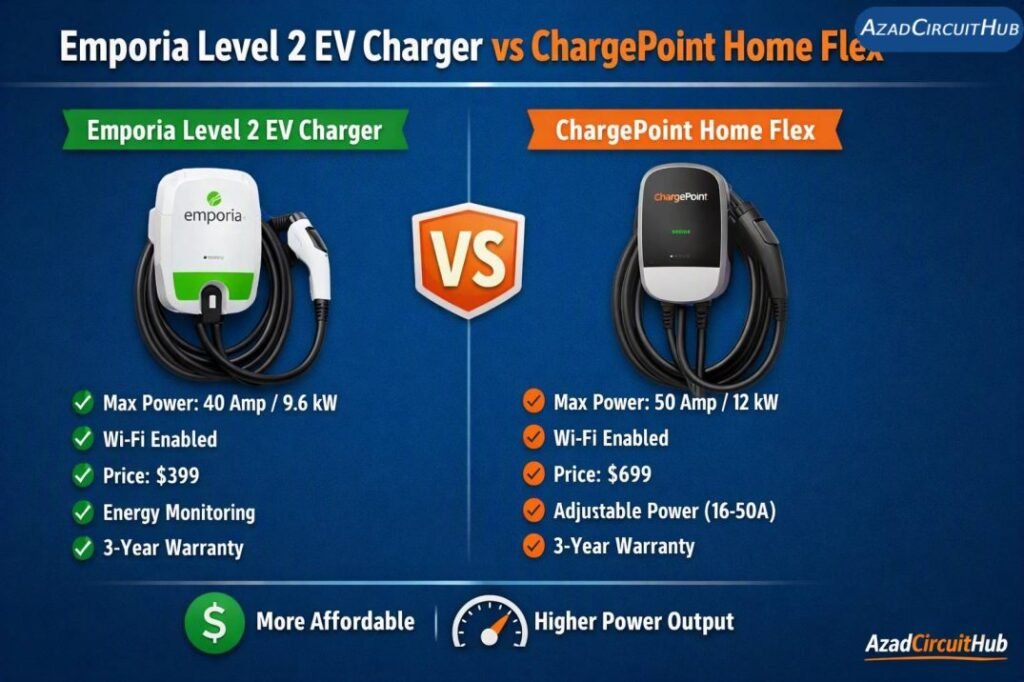
Table of Contents
Table of Contents
Overview of the Emporia Level 2 EV Charger
The Emporia Level 2 EV Charger has gained popularity because it combines smart charging capabilities with an affordable price point. It is designed for homeowners who want reliable charging performance without spending a premium amount.
One of its biggest strengths is energy monitoring. The charger integrates with Emporia's energy management ecosystem, allowing users to track electricity usage in real time.
Key Features of Emporia Charger
- Up to 48 amps charging capacity
- Wi-Fi connectivity
- Real-time energy monitoring
- Smart charging schedules
- Utility rate integration
- Indoor and outdoor installation support
- Compatible with most EV models
The charger is especially attractive for users who want detailed electricity consumption data and cost tracking.
Read our complete Emporia EV Charger Review here.
Overview of ChargePoint Home Flex
ChargePoint is one of the most recognized names in EV charging. The ChargePoint Home Flex is designed to deliver premium charging performance along with a polished mobile app experience.
The company also operates one of the largest public charging networks, which allows users to manage both home and public charging through a single platform.
Key Features of ChargePoint Home Flex
- Up to 50 amps charging capability
- Smart charging controls
- Voice assistant support
- Detailed charging history
- Flexible amperage settings
- Public and home charging integration
- Strong brand reputation
ChargePoint focuses heavily on user experience and software reliability, making it a preferred choice for many EV owners.
Read our complete ChargePoint Home Flex Review here.
Why Level 2 EV Chargers Are Important
A Level 2 EV charger operates on a 240V electrical circuit and delivers significantly faster charging than a standard Level 1 charger.
Benefits of Level 2 charging include:
- Faster charging times
- Improved convenience for daily driving
- Better energy management
- Smart scheduling features
- Reduced charging downtime
Most EV owners consider a Level 2 charger essential for efficient home charging.
Emporia Level 2 EV Charger vs ChargePoint: Charging Performance
Performance is often the first factor buyers consider when selecting a home EV charger.
Both chargers provide fast Level 2 charging and can add substantial driving range overnight.
| Performance Factor | Emporia | ChargePoint |
|---|---|---|
| Maximum Current | 48A | 50A |
| Charging Speed | Excellent | Excellent |
| EV Compatibility | Wide | Wide |
| Smart Load Management | Available | Available |
| Reliability | High | High |
In real-world use, the difference between 48A and 50A charging is minimal. Most EV owners will not notice a significant difference in charging time.
For daily charging, both chargers deliver excellent performance.
Smart Features Comparison
Smart charging features have become a major selling point for modern EV chargers.
Emporia Smart Features
The Emporia platform focuses heavily on energy management.
Users can:
- Monitor energy consumption
- Track charging costs
- Schedule charging during off-peak hours
- Analyze household energy usage
- Integrate with smart home energy systems
ChargePoint Smart Features
ChargePoint emphasizes convenience and user experience.
Users can:
- Schedule charging sessions
- Receive charging notifications
- Access charging history
- Control charging remotely
- Integrate public charging accounts
For homeowners interested in detailed energy insights, Emporia often has an advantage. For those who prefer a mature charging ecosystem, ChargePoint performs exceptionally well.
Installation and Setup
Installation flexibility is another important factor when comparing EV chargers.
Both products support:
- Hardwired installation
- NEMA 14-50 plug installation
- Indoor installation
- Outdoor installation
Installation Comparison
| Installation Feature | Emporia | ChargePoint |
|---|---|---|
| Plug-In Version | Yes | Yes |
| Hardwired Version | Yes | Yes |
| Outdoor Rated | Yes | Yes |
| Professional Installation Recommended | Yes | Yes |
| DIY Friendly Setup | Good | Good |
The installation process is relatively similar for both units. However, many users report that Emporia's setup process is straightforward and beginner-friendly.
Mobile App Experience
The mobile application often determines how enjoyable an EV charger is to use on a daily basis.
Emporia App
The Emporia app offers:
- Real-time power monitoring
- Charging analytics
- Cost calculations
- Energy consumption reports
- Scheduling controls
The app is particularly useful for users who want detailed electricity insights.
ChargePoint App
The ChargePoint app provides:
- Home charger management
- Public charging station access
- Charging reminders
- Cost estimates
- Charging history
Because ChargePoint operates a large charging network, its app delivers additional value beyond home charging.
Price Comparison in 2026
Pricing remains one of the most important differences between these chargers.
| Pricing Factor | Emporia | ChargePoint |
|---|---|---|
| Average Retail Price | Lower | Higher |
| Value for Money | Excellent | Good |
| Smart Features Included | Yes | Yes |
| Energy Monitoring | Advanced | Standard |
Emporia typically costs noticeably less than ChargePoint while still offering many premium features.
For budget-conscious buyers, this price difference can be a deciding factor.
Energy Monitoring and Efficiency
Energy monitoring has become increasingly important as electricity costs continue to rise.
Emporia stands out in this category because of its detailed reporting capabilities. Users can track:
- Daily charging usage
- Monthly energy consumption
- Charging costs
- Peak demand periods
- Household energy trends
ChargePoint provides useful charging data but focuses more on charging sessions rather than complete home energy management.
Homeowners interested in reducing electricity expenses often prefer Emporia for this reason.
Reliability and Customer Support
Both companies have established strong reputations in the EV charging market.
Emporia
Advantages include:
- Reliable hardware
- Frequent software updates
- Helpful customer support
- Strong user satisfaction ratings
ChargePoint
Advantages include:
- Industry-leading brand recognition
- Extensive charging experience
- Proven reliability
- Large support infrastructure
Neither charger has major reliability concerns, making both safe long-term investments.
Which Charger Is Best for Different Users?
Choose Emporia If:
- You want the best value for money
- Energy monitoring is important
- You want detailed electricity analytics
- You prefer a lower purchase cost
- You are building a smart energy management system
Choose ChargePoint If:
- You value brand reputation
- You frequently use public ChargePoint stations
- You want a highly polished mobile app
- You prefer ecosystem integration
- You are comfortable paying a premium price
Tesla vs ChargePoint vs Emporia: Key Differences
For buyers comparing Tesla, ChargePoint, and Emporia, the main differences are charging speed, circuit requirements, connectivity, and energy monitoring. The table below provides a quick technical comparison. Values such as the 80% continuous-load limit follow NEC Article 625 and NEC 210.20(A) principles.
| Feature | Tesla Wall Connector | ChargePoint Home Flex | Emporia EV Charger |
|---|---|---|---|
| Max charging power | Up to 11.5 kW* | Up to 12 kW* | Up to 11.5 kW* |
| Max current | 48A* | 50A* | 48A* |
| Typical 240V circuit | 60A | 60A–70A | 60A |
| NEC continuous-load basis | 48A on 60A | 40A on 50A / 48A on 60A | 48A on 60A |
| Wi-Fi/app control | Yes | Yes | Yes |
| Energy monitoring | Yes | Yes | Yes |
*Actual output depends on the vehicle, installation, and configured amperage. For Emporia vs ChargePoint Home Flex, Emporia's energy-monitoring ecosystem can be particularly useful for homeowners who want detailed consumption data, while ChargePoint emphasizes broad vehicle compatibility and charging controls.
Tesla's Wall Connector is closely integrated with Tesla vehicles and is also compatible with many other EVs using the appropriate connector/adapter.
Buying tip: Check your panel capacity, wire size, breaker rating, and EV's maximum AC charging rate before choosing between these three chargers.
Final Verdict
When evaluating Emporia Level 2 EV Charger vs ChargePoint, both products deliver excellent charging performance, smart functionality, and long-term reliability. The right choice depends on your priorities.
Emporia offers outstanding value, advanced energy monitoring, and a lower purchase price. It is an excellent option for homeowners who want maximum features without overspending.
ChargePoint Home Flex provides a refined user experience, strong software support, and integration with one of the largest public charging networks in North America. It is ideal for users who prioritize ecosystem convenience and brand recognition.
For most homeowners in 2026, Emporia provides the better overall value. However, ChargePoint remains a premium option for users who want seamless public and home charging integration.
Frequently Asked Questions
Is Emporia Level 2 EV Charger better than ChargePoint?
Emporia offers better value and more advanced energy monitoring features, while ChargePoint provides a more mature charging ecosystem and broader public charging integration.
Which charger is faster, Emporia or ChargePoint?
ChargePoint supports up to 50 amps, while Emporia supports up to 48 amps. In real-world charging scenarios, the speed difference is minimal.
Does Emporia work with all electric vehicles?
Yes. The Emporia Level 2 EV Charger is compatible with most EVs sold in North America that use the J1772 connector or an approved adapter.
Can ChargePoint Home Flex be installed outdoors?
Yes. ChargePoint Home Flex is designed for both indoor and outdoor installations and is weather-resistant.
Which charger offers better value in 2026?
For most homeowners, Emporia offers better value due to its lower price, excellent charging performance, and advanced energy monitoring capabilities.
Related Guides
- EVIQO vs ChargePoint Home Flex vs Emporia
- Emporia EV Charger Review
- Emporia Pro Level 2 EV Charger Review
- Emporia Classic vs Emporia Pro
- Emporia Pro vs ChargePoint Home Flex
- EV Charger Cable Size Calculator
Get new guides in your feed. Follow Electrical Insights on LinkedIn for new electrical standards guides, calculators and design tips from Azad Circuit Hub.
#emporialevel2evchargervschargepoint,#EVChargerComparison,#HomeEVCharging,#ChargePointCharger,#EmporiaEVCharger,#ElectricVehicleCharging,#EVChargingStation,#SmartEVCharger,#EVChargingGuide,#BestEVCharger
