Emporia Pro vs ChargePoint Home Flex: Which Level 2 EV Charger Should You Buy?
When comparing the emporia pro vs chargepoint home flex, I would not choose based on charging amperage alone. Both are smart Level 2 EV chargers designed for home use, but they take different approaches to energy monitoring, controls, installation, and overall ownership.
I have spent more than 15 years working as an electrical engineer around power systems, electrical panels, industrial controls, and automation. When I evaluate an EV charger, I look at the complete installation: circuit capacity, continuous charging load, vehicle compatibility, energy monitoring, cable management, and how useful the smart features are after installation.
For this comparison, I am looking at the Emporia Pro Level 2 EV Charger and ChargePoint Home Flex as two serious residential charging options.
Emporia Pro vs ChargePoint Home Flex at a Glance
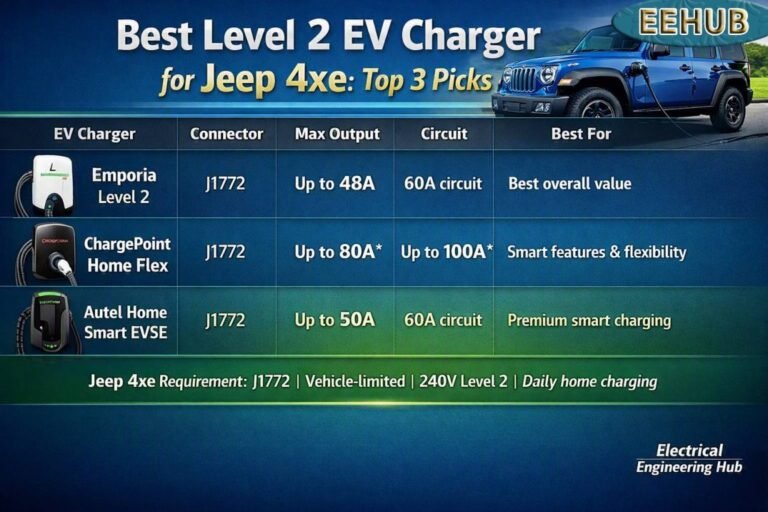
| Feature | Emporia Pro | ChargePoint Home Flex |
|---|---|---|
| Charger type | Level 2 smart EV charger | Level 2 smart EV charger |
| Maximum current | Up to 48A | Up to 80A, configuration dependent |
| Maximum power | Up to about 11.5 kW at 48A/240V | Up to 19.2 kW at 80A/240V |
| Installation | Hardwired | Plug-in or hardwired, depending on configuration |
| Connector | J1772 | J1772 |
| Smart controls | Yes | Yes |
| Energy monitoring | Strong energy-management focus | Charging-session monitoring |
| Wi-Fi connectivity | Yes | Yes |
| Scheduling | Yes | Yes |
| Mobile app | Emporia Energy | ChargePoint |
| Best suited for | Energy-conscious homeowners | Flexible, feature-rich home charging |
Actual charging output depends on the vehicle's onboard AC charger, electrical installation, and configuration.
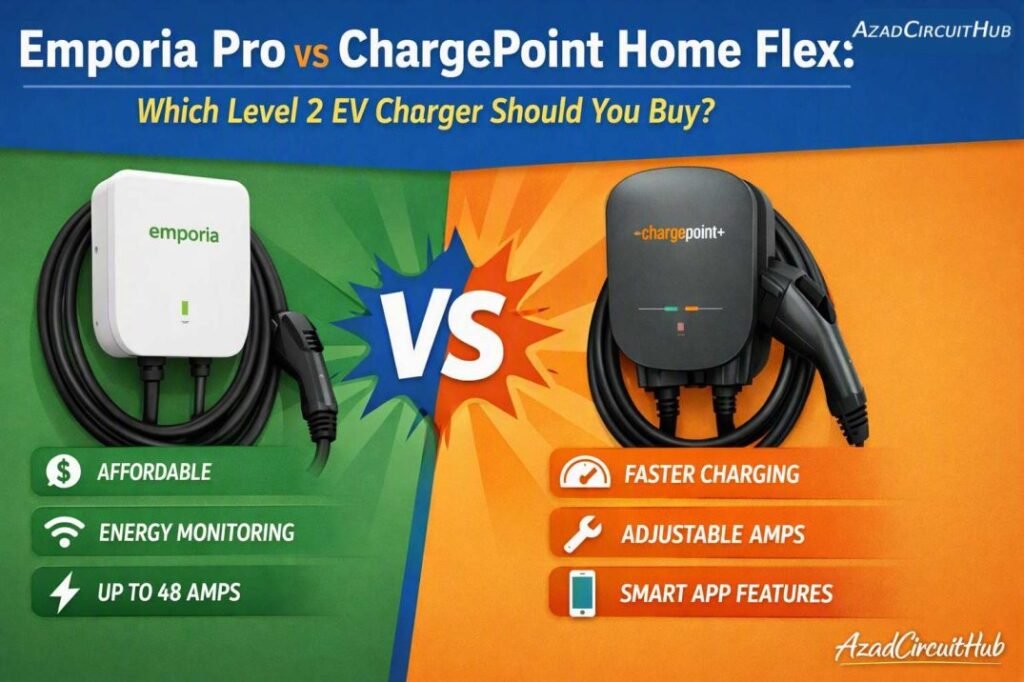
Table of Contents
Table of Contents
Emporia Pro: Energy Monitoring and Smart Charging
The Emporia Pro is particularly interesting for homeowners who want EV charging to be part of a broader energy-management system.
Its main strength is the way Emporia approaches energy monitoring. The company has built a product ecosystem around measuring household electricity consumption, solar generation, and individual circuits. This can make the charger more useful for homeowners who want to understand when and how their EV is consuming electricity.
At up to 48A, the charger can deliver approximately 11.5 kW at 240V. That is enough for many daily-driving situations and is well matched to a typical residential Level 2 installation.
Amazon buying option: Check Emporia Pro Level 2 EV Charger price on Amazon
If you want to compare Emporia's two main approaches to home EV charging, see Emporia Classic vs Emporia Pro before choosing your model.
ChargePoint Home Flex: Flexible Charging Current
ChargePoint Home Flex takes a different approach. Its major attraction is charging-current flexibility. Depending on the electrical installation and configuration, Home Flex can support substantially higher current than the Emporia Pro.
That does not automatically mean faster charging for every EV. Your vehicle's onboard AC charger determines how much power it can actually accept.
For example, an EV limited to 11.5 kW AC charging will not charge faster simply because an 80A-capable EVSE is installed. The higher capacity becomes more useful when the vehicle can accept higher AC power and the home's electrical service can support the load.
For a closer look at the charger itself, see my ChargePoint Home Flex Review.
Charging Speed Comparison
Charging power is one of the easiest specifications to compare, but it needs context.
| Charging Level | Approx. Power at 240V | Typical Use |
|---|---|---|
| 32A | 7.7 kW | Moderate daily driving |
| 40A | 9.6 kW | Faster overnight charging |
| 48A | 11.5 kW | High-power home charging |
| 60A | 14.4 kW | Higher-capacity EVs |
| 80A | 19.2 kW | Compatible high-power EVs |
The Emporia Pro's 48A maximum is already sufficient for many homes. ChargePoint Home Flex provides more headroom where the vehicle and electrical system support higher current.
From an electrical engineering standpoint, I would first check the EV's maximum AC charging rate before paying extra for a higher-current EVSE.
Smart Features and Energy Management
The emporia pro vs chargepoint home flex comparison becomes more interesting when you move beyond amperage.
Emporia focuses heavily on energy visibility. Its ecosystem can be useful when you want to monitor household loads and understand electricity consumption. This can help homeowners decide when to charge an EV and how charging affects total household demand.
ChargePoint has a mature EV charging platform and a strong focus on charging management through its app. Scheduling and charging history can make everyday EV ownership easier.
For homeowners who already use Emporia energy-monitoring equipment, the Pro can be especially attractive because the charger fits naturally into that ecosystem.
Amazon buying option: Shop Emporia Pro Level 2 EV Charger on Amazon
Installation: Emporia Pro vs ChargePoint Home Flex
Installation requirements deserve as much attention as the charger specifications.
The Emporia Pro's 48A output generally requires a properly sized branch circuit. Because EV charging is a continuous load, the circuit cannot simply be sized to the nameplate current without considering applicable electrical requirements.
ChargePoint Home Flex offers more configuration flexibility, but higher-current operation can require a larger circuit and more electrical-service capacity.
Before installation, check:
- Electrical service capacity
- Available breaker space
- Branch-circuit rating
- Conductor size
- Charger configuration
- Vehicle charging capacity
- Outdoor installation requirements
- Local electrical code
A qualified electrician should verify the installation before the charger is operated at its maximum current.
Which Charger Has Better Energy Monitoring?
This is one area where the Emporia Pro has a distinct focus.
Emporia's broader product ecosystem is built around energy measurement. For homeowners interested in solar generation, household electricity consumption, load monitoring, and EV charging, this approach can provide more useful information than a charger that only records charging sessions.
ChargePoint's app is more centered on the EV charging experience. It provides useful information about charging sessions and charger operation without making whole-home energy monitoring the central feature.
If your main objective is energy management, the Emporia ecosystem deserves serious consideration.
For readers who are still comparing other charging systems, my guide to the best level 2 ev charger covers additional residential options.
Which One Should You Buy?
The answer depends on your priorities.
The Emporia Pro is a strong fit if you want 48A Level 2 charging combined with detailed energy-management capabilities. It is particularly interesting for homeowners who have solar panels or already use Emporia monitoring equipment.
ChargePoint Home Flex is worth considering when charging-current flexibility and the ChargePoint ecosystem are more important. Its higher potential current can also provide additional headroom for compatible EVs and electrical systems.
Neither charger should be selected purely because one has a higher maximum amperage. The EV's onboard charger and your home's electrical infrastructure determine how much of that capacity you can use.
Emporia Pro vs ChargePoint Home Flex: My Electrical Engineering Take
After looking at these chargers from an electrical-system perspective, I would start with three questions: How much AC power can the EV accept? What charging speed do I actually need overnight? And how much spare electrical capacity does the house have?
For a typical homeowner who wants smart 48A charging and detailed energy monitoring, the Emporia Pro offers a compelling combination.
For someone who values charging-current flexibility and the ChargePoint platform, Home Flex can make more sense.
The right Level 2 EV charger is the one that fits the vehicle, electrical service, installation, and daily charging pattern rather than simply having the largest specification sheet.
Ready to compare more models? See my Emporia Pro Level 2 EV Charger Review for a closer look at its features, installation, charging performance, and smart-energy capabilities.
Frequently Asked Questions
Is Emporia Pro better than ChargePoint Home Flex?
The two chargers have different strengths. Emporia Pro emphasizes energy monitoring and a broader energy-management ecosystem, while ChargePoint Home Flex emphasizes charging flexibility and the ChargePoint platform. Your vehicle and electrical installation should guide the final choice.
Can Emporia Pro charge at 48 amps?
Yes. The Emporia Pro can provide up to 48A under the appropriate electrical installation conditions. At 240V, that represents approximately 11.5 kW of charging power.
Can ChargePoint Home Flex charge faster than Emporia Pro?
It can support higher charging current in configurations that allow it, but actual charging speed depends on the EV's onboard AC charger and the home's electrical circuit. A vehicle with a lower AC charging limit will not use the full capacity.
Does Emporia Pro work with solar power?
Emporia's energy-management ecosystem is designed to provide visibility into household energy use and solar generation. This makes the Pro particularly interesting for homeowners who want to coordinate EV charging with their wider energy system.
Do I need an electrician to install either charger?
For a hardwired or high-current EV charger installation, professional electrical installation is strongly recommended. The electrician should verify the service capacity, branch circuit, conductors, breaker, grounding, and applicable local requirements.
Final Verdict
The emporia pro vs chargepoint home flex comparison comes down to charging requirements and smart-energy priorities.
Emporia Pro stands out for homeowners who want 48A charging combined with detailed energy monitoring. ChargePoint Home Flex provides greater current flexibility and a well-developed EV charging ecosystem.
Before purchasing, confirm the EV's AC charging limit, select the appropriate connector and installation method, and have the electrical circuit assessed for continuous EV charging.
If you are comparing several home charging stations, these two models are a useful starting point, but the best choice should always match your actual vehicle and electrical system.
Get new guides in your feed. Follow Electrical Insights on LinkedIn for new electrical standards guides, calculators and design tips from Azad Circuit Hub.