Kill A Watt vs Smart Plug Energy Monitor: Which Is Better?
When comparing kill a watt vs smart plug energy monitor options, the main question is whether you need accurate appliance measurements or automatic energy tracking. Both can help identify power-hungry devices, but they work differently. A Kill A Watt meter provides direct readings at the outlet, while a smart plug with energy monitoring can track consumption through an app.
As an electrical engineer with hands-on experience in electrical testing, power measurements, and troubleshooting, I prefer to measure an appliance before deciding whether it wastes energy. Looking at watts, kilowatt-hours (kWh), and operating time gives a clearer picture than relying on estimated electricity costs alone.
Kill A Watt vs Smart Plug Energy Monitor: Quick Comparison
| Feature | Kill A Watt P4400 | Smart Plug Energy Monitor |
|---|---|---|
| Power measurement | Yes | Yes, model dependent |
| Energy consumption (kWh) | Yes | Yes, model dependent |
| Live watt readings | Yes | Supported models |
| Mobile app | No | Usually |
| Remote switching | No | Usually |
| Automation | No | Supported models |
| Internet required | No | Often |
| Best use | Direct appliance testing | Ongoing monitoring |
| Typical connection | Plug-in meter | Plug-in smart outlet |

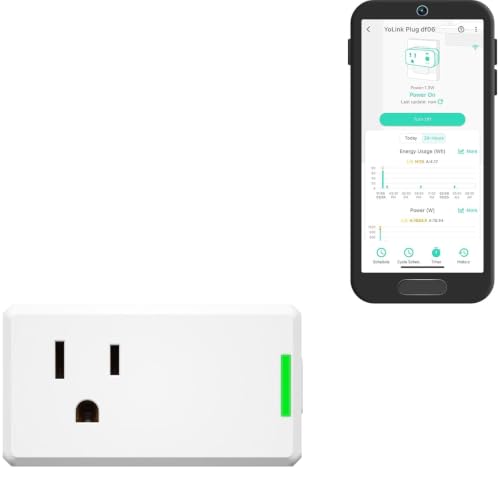
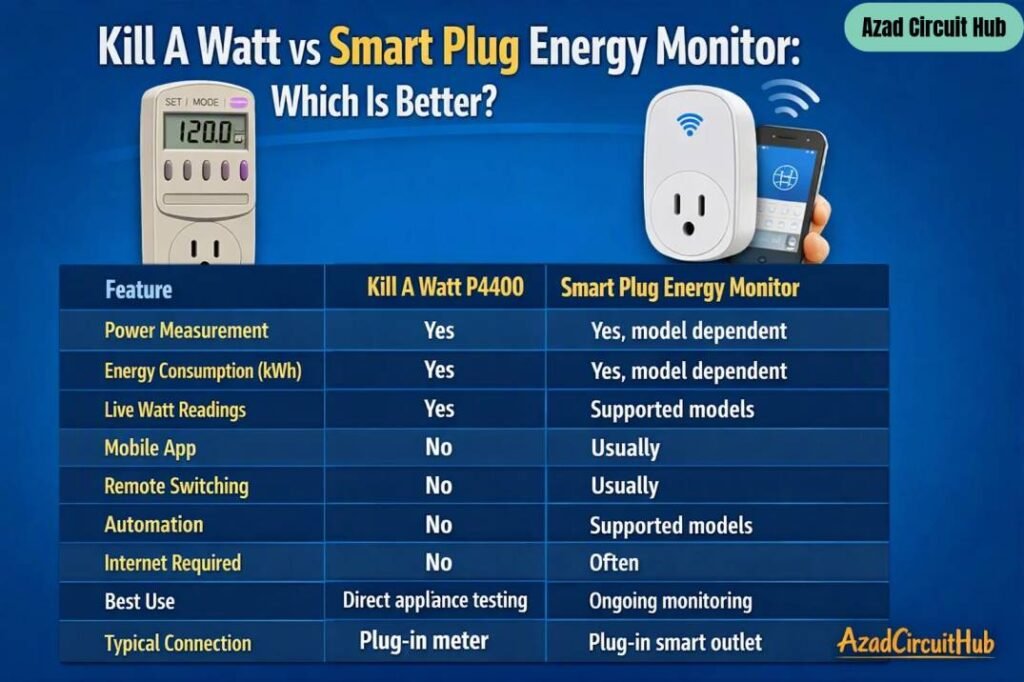
Table of Contents
Table of Contents
What Does a Kill A Watt Meter Do?
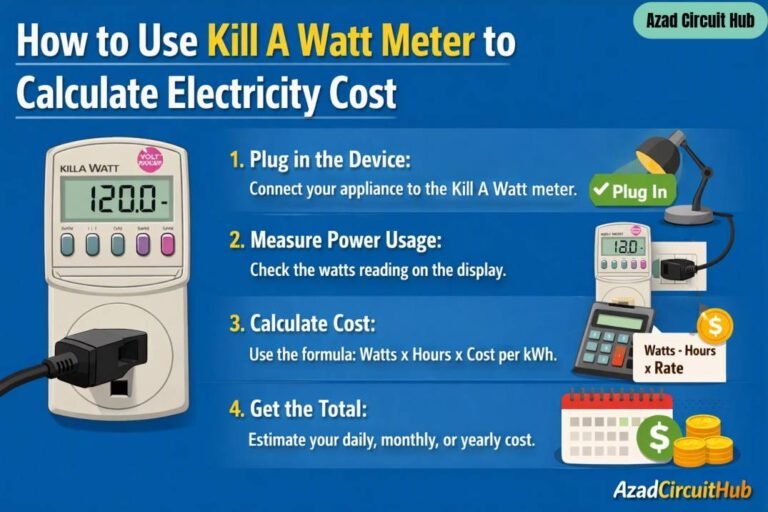
The Kill A Watt P3 P4400 is a plug-in electricity usage monitor that measures the electrical consumption of connected appliances. It can display readings such as watts, voltage, current, frequency, power factor, and accumulated energy.
To use it, plug the meter into a suitable wall outlet, connect the appliance, and read the displayed values. For energy measurements, leave the appliance connected for a representative period.
For example, a refrigerator may draw different amounts of power as its compressor starts and stops. A short reading will not reveal its full daily consumption. Monitoring over 24 hours gives a more useful estimate.
Check the current price: Buy Kill A Watt P3 P4400 Electricity Usage Monitor on Amazon
Smart Plug With Energy Monitoring: How It Works
A power monitoring smart plug combines an outlet, a switching function, and an energy measurement system. Depending on the model, it can report real-time power, accumulated kWh, voltage, current, and estimated electricity costs through a smartphone app.
Some models also support schedules and automation. You could, for example, switch off a compatible desk lamp at night or receive consumption data for a home office appliance.
However, not every smart plug measures energy. Check the specifications before buying, and confirm that its voltage and current ratings suit your appliance.
A smart plug is especially useful when you want to monitor consumption for several days without checking a physical display.
Kill A Watt vs Smart Plug Energy Monitor Cost
The purchase price is only part of the comparison. Consider how many appliances you need to test, whether you need remote access, and whether you want long-term data.
| Cost Factor | Kill A Watt P4400 | Energy-Monitoring Smart Plug |
|---|---|---|
| Initial purchase | Usually a one-time cost | Usually a one-time cost |
| App or cloud service | Not required | Depends on brand |
| Multiple appliances | Move the meter between devices | May require several plugs |
| Long-term tracking | Manual readings | Often automatic |
| Energy-saving automation | Not available | Available on supported models |
Affiliate buying tip: Check the latest price of the Kill A Watt P4400 on Amazon before purchasing. If you need a simple tool for measuring several appliances, one meter may be enough. If you want continuous monitoring and remote switching, compare smart plugs with energy reporting.
Which Is the Best Energy Monitoring Plug?
The best energy monitoring plug depends on your preferred smart home platform, electrical load, and reporting needs. Look for accurate power readings, accumulated kWh, historical data, overload protection, and a clear app interface.
For Home Assistant users, compatibility deserves special attention. Some plugs work locally, while others rely on cloud services. Check the exact model and integration requirements before buying.
Third Reality smart plugs are worth comparing if you want to build a connected home monitoring setup. However, verify that the specific Third Reality plug supports energy monitoring; not every smart plug model offers the same measurement features.
A good power monitoring smart plug should make it easy to review appliance consumption without requiring manual readings every day.
Third Reality Plugs With Power Monitoring
Third Reality smart plugs may suit users who want to connect appliance control with home automation. Before choosing one, confirm whether the exact model measures watts and kWh, and whether it works with your preferred hub or Home Assistant setup.
For a smart plug with energy monitoring home assistant users should check the supported integration, communication protocol, local-control options, and reporting interval. These details can affect how reliably energy data appears in dashboards.
Do not assume that a plug supports energy monitoring simply because it supports automation. Read the model-specific specifications and reviews before purchasing.
Which Is Better for Refrigerator Energy Testing?
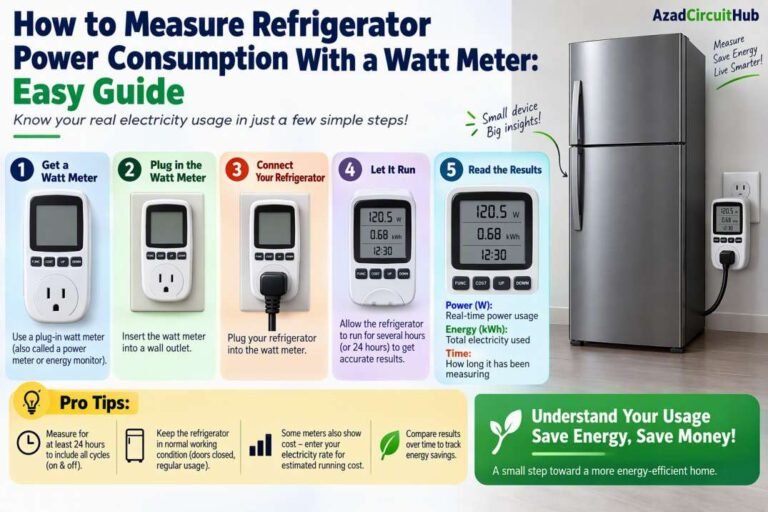
For refrigerator testing, the Kill A Watt P4400 is a useful choice because you can leave it connected and observe energy use over a full day. Record the accumulated kWh after 24 hours, then multiply it by the number of days in your billing period.
For example, if a refrigerator uses 1.5 kWh per day, its estimated 30-day consumption is 45 kWh. Multiply that figure by your electricity rate to estimate the energy charge.
For more detailed instructions, read How to Measure Refrigerator Power Consumption With a Watt Meter.
A smart plug may also provide useful data, but check its continuous current rating and suitability for motor-driven appliances. Refrigerator compressors can have a higher starting current than their normal running current.
Can Smart Plugs Actually Save Energy?
Smart plugs do not automatically reduce an appliance’s energy consumption. They help you identify usage patterns and control compatible devices.
For example, you may discover that an entertainment system draws standby power overnight. A schedule could switch it off when it is not needed. However, switching off equipment can be unsuitable for devices that need continuous power, such as refrigerators, network equipment, or certain medical devices.
For whole-house electricity monitoring, a plug-in meter is not enough. Consider a dedicated system designed to monitor the home’s electrical circuits. See Best Energy Monitor for Whole House for options beyond individual appliances.
Frequently Asked Questions
1. Which smart plug has the best energy monitoring features?
Choose a model that reports live watts, accumulated kWh, historical usage, and estimated costs. Home Assistant users should also confirm integration support and whether local control is available.
2. What are some alternatives to IotaWatt?
Alternatives include Emporia energy monitors, Shelly energy-monitoring devices, and other compatible circuit-level monitoring systems. Compare the number of circuits monitored, installation method, local regulations, and software support.
3. What is the difference between a wattmeter and an energy meter?
A wattmeter measures instantaneous power in watts. An energy meter records consumption over time, usually in watt-hours or kilowatt-hours. Some devices, including the Kill A Watt P4400, provide both types of readings.
4. Do smart plugs actually save energy?
They can help reduce waste when you use their measurements to change habits or automate suitable appliances. Savings are not guaranteed, and standby consumption may be small for some devices.
5. What is the best smart plug for 2026?
There is no single best choice for every home. Compare energy measurement, rated load, safety certification, app support, Home Assistant compatibility, and data history. Verify current model specifications before purchasing.
Final Verdict
In the kill a watt vs smart plug energy monitor comparison, the Kill A Watt P4400 is a strong choice for direct appliance testing without apps or network connections. A smart plug is more convenient for continuous tracking, remote control, and automation.
For basic electrical measurements, I would start with the Kill A Watt P4400. For a connected home where you want consumption data available in an app, a suitable energy-monitoring smart plug may be the better fit.
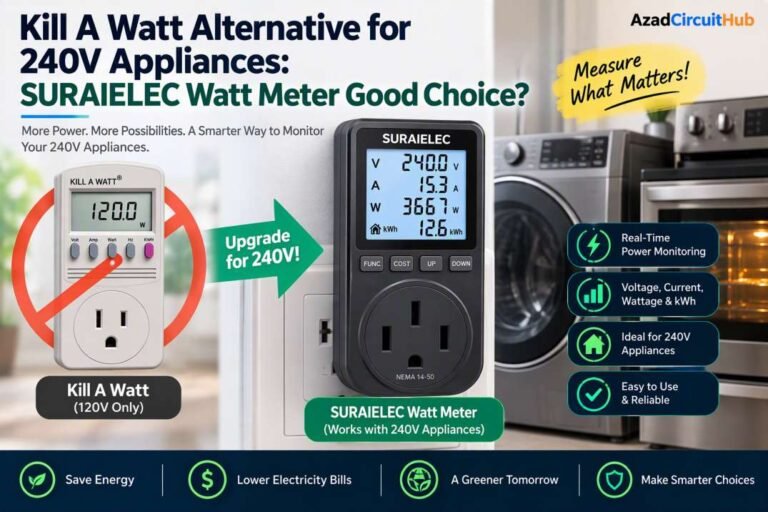
If you need a different plug-in meter for higher-voltage equipment, read Kill A Watt Alternative for 240V Appliances and Kill A Watt P4400 vs P4460 before selecting your device.
Get new guides in your feed. Follow Electrical Insights on LinkedIn for new electrical standards guides, calculators and design tips from Azad Circuit Hub.