Comparison of IEC Standards with UK, EU, and US Electrical Codes: Best Overview
Electrical standards can look similar on paper, but the practical requirements can differ significantly between regions. A proper Comparison of IEC Standards with UK, EU, and US electrical codes helps engineers, contractors, and equipment manufacturers understand where requirements align and where they do not.
IEC standards are widely used as a technical reference for electrical installations, equipment, testing, and safety. The UK uses BS and BS 7671 requirements, Europe combines harmonized EN standards with national rules, while the US relies heavily on the National Electrical Code (NEC) and product standards such as UL standards.
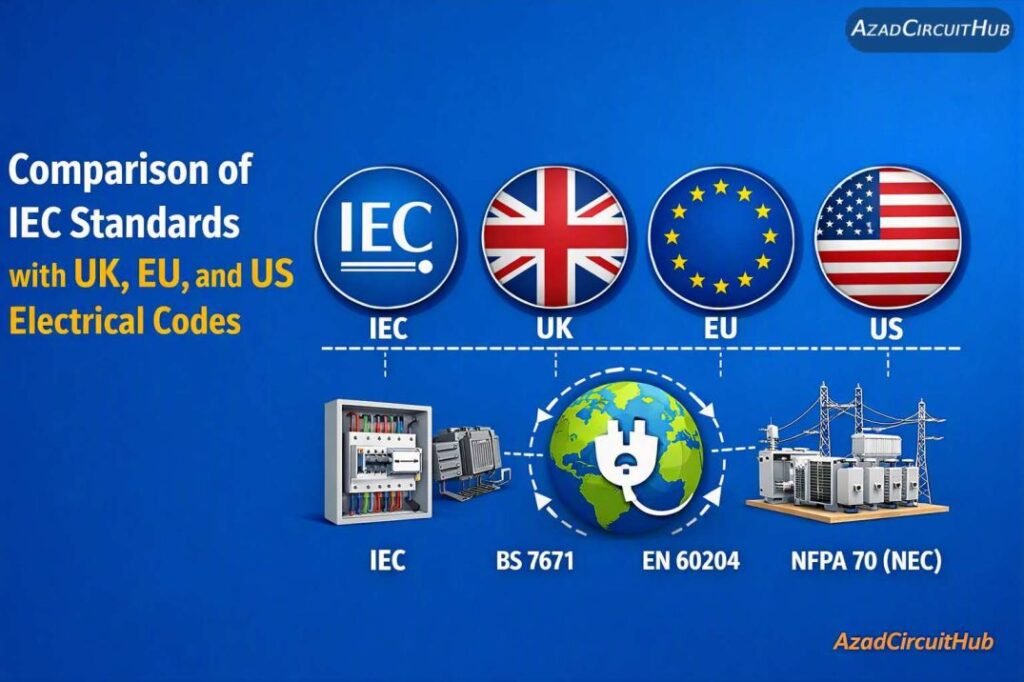
Table of Contents
Table of Contents
Comparison of IEC Standards with UK, EU, and US Electrical Codes
| Region | Main Electrical Framework | Common Installation Standard | Typical Focus |
|---|---|---|---|
| International | IEC | IEC 60364 series | Electrical installations and safety |
| UK | British Standards | BS 7671 | Low-voltage installations |
| EU | EN standards + national rules | HD 60364 / national adaptations | Harmonized electrical requirements |
| USA | NEC + NFPA | NFPA 70 (NEC) | Electrical installation safety |
| Product Certification | IEC / regional standards | IEC, EN, UL, CSA | Equipment safety and compliance |
IEC Standards: The International Reference
The International Electrotechnical Commission (IEC) develops international standards covering electrical and electronic technologies. IEC standards are used extensively for equipment design, testing, protection, wiring systems, switchgear, motors, transformers, and electrical installations.
One of the most important installation families is IEC 60364, which provides requirements for low-voltage electrical installations.
A key point in any Comparison of IEC Standards is that IEC publications are not automatically electrical law in every country. A country may adopt an IEC standard directly, modify it, or develop national requirements based on it.
| IEC Standard | Main Application |
|---|---|
| IEC 60364 | Low-voltage electrical installations |
| IEC 61439 | Low-voltage switchgear and controlgear assemblies |
| IEC 60947 | Low-voltage switchgear and controlgear |
| IEC 60204-1 | Safety of machinery electrical equipment |
| IEC 60529 | IP enclosure ratings |
| IEC 60076 | Power transformers |
| IEC 62305 | Lightning protection |
For engineers working on international projects, understanding the difference between an international standard and a legally adopted national code is essential.
UK Electrical Codes and BS 7671
The UK electrical installation framework is strongly influenced by IEC principles, but it has its own national requirements. BS 7671, commonly called the IET Wiring Regulations, is the primary reference for many low-voltage electrical installations.
BS 7671 incorporates concepts that are familiar to engineers using IEC 60364, including:
- Protective devices
- Automatic disconnection of supply
- Earthing arrangements
- Cable selection
- Voltage drop
- Fault current
- Residual current protection
- Equipotential bonding
- Electrical inspection and testing
However, UK designers should not assume that an IEC-based design can simply be transferred to a British project without checking BS 7671.
| Design Area | IEC Approach | UK Approach |
|---|---|---|
| Wiring systems | IEC 60364 principles | BS 7671 requirements |
| Earthing | TN, TT, IT systems | TN-S, TN-C-S, TT and related arrangements |
| Cable sizing | Current-carrying capacity and correction factors | BS 7671 tables and correction factors |
| RCD protection | Application depends on installation | Detailed BS 7671 requirements |
| Verification | Testing and inspection | BS 7671 inspection and testing |
| Consumer installations | General IEC framework | UK-specific requirements may apply |
This is one of the most important areas in a Comparison of IEC Standards because similar terminology does not always mean identical design rules.
European Electrical Standards and EN Requirements
European electrical requirements are more complex because the European Union does not operate under one single electrical installation code equivalent to the NEC.
Many European standards are published as EN standards. CENELEC develops European electrotechnical standards, and national standards bodies adopt them into their national systems.
The HD 60364 series is particularly important because it is closely related to the IEC 60364 family.
A European project may therefore involve:
- IEC standards
- EN standards
- Nationally adopted standards
- National installation regulations
- Product directives or regulations
- Manufacturer certification requirements
| European Requirement | Purpose |
|---|---|
| EN standards | Harmonized technical requirements |
| HD 60364 | Electrical installation requirements |
| National standards | Country-specific implementation |
| EU legislation | Legal product and safety framework |
| CE marking | Product conformity process where applicable |
IEC vs EN Standards
IEC and EN standards often share substantial technical content. An IEC document may be adopted as a European standard with modifications or additional requirements.
For manufacturers, this distinction matters because CE marking is not simply a statement that a product complies with an IEC publication. The applicable EU legal requirements and harmonized standards must also be considered.
If you are comparing international testing requirements, the related topic IEC vs AS/NZS Testing Standards provides another useful reference for understanding how IEC requirements are adapted by national standards systems.
US Electrical Codes and the NEC
The US approach differs considerably from the IEC-based system. The National Electrical Code, or NFPA 70, is the primary electrical installation code used throughout the United States.
The NEC is developed by the National Fire Protection Association and is adopted into law by jurisdictions. Local adoption can include amendments, so engineers must verify the applicable edition and local requirements.
US electrical design commonly uses:
- NEC Article requirements
- UL product standards
- NEMA standards
- NFPA standards
- Local electrical codes
- Authority Having Jurisdiction requirements
| Topic | IEC-Based Approach | US Approach |
|---|---|---|
| Installation code | IEC 60364 or national adoption | NEC / NFPA 70 |
| Conductor sizing | IEC current-carrying tables | NEC ampacity tables |
| Voltage system | Commonly 230/400 V in many regions | Common 120/208 V and 120/240 V systems |
| Protection | IEC device coordination | NEC requirements and listed equipment |
| Enclosures | IP ratings | NEMA enclosure types plus other requirements |
| Product approval | IEC/EN certification routes | UL and other recognized certification |
IEC vs NEC: Important Technical Differences
One of the biggest mistakes in international electrical design is assuming that cable sizing under IEC rules will produce the same result under NEC requirements.
Both systems consider conductor ampacity, installation conditions, ambient temperature, grouping, and insulation characteristics. However, the tables, correction factors, terminology, and calculation methods can differ.
For example, IEC installations commonly use conductor cross-sectional area in mm², while US electrical practice frequently identifies conductors by AWG or kcmil.
| Parameter | IEC Practice | US Practice |
|---|---|---|
| Conductor size | mm² | AWG / kcmil |
| Voltage designation | V | V |
| Frequency | 50 Hz common internationally | 60 Hz common |
| Protective device | MCB, MCCB, fuse | Breaker, fuse |
| Grounding terminology | Protective conductor / PE | Equipment grounding conductor |
| Enclosure rating | IP code | NEMA type |
These differences make engineering judgment important when equipment is transferred between markets.
Earthing and Grounding Differences
Earthing and grounding are closely related concepts, but terminology varies between standards.
IEC systems commonly identify TN, TT, and IT earthing arrangements. These classifications describe the relationship between the source, exposed conductive parts, and earth.
The NEC uses terms such as grounded conductor and equipment grounding conductor. The US system also has detailed requirements covering grounding electrode systems and bonding.
| System | IEC Terminology | Typical US Equivalent Concept |
|---|---|---|
| TN-S | Separate neutral and PE | Grounded system with separate equipment grounding |
| TN-C | Combined PEN conductor | Limited conceptual comparison |
| TN-C-S | Combined then separated PEN | Related grounding/bonding arrangement |
| TT | Local installation earth electrode | Grounding electrode arrangement with different system rules |
| IT | Isolated or impedance-earthed source | Specialized system |
Because the technical definitions are not perfectly interchangeable, designers should always refer to the applicable local standard rather than translating terminology directly.
Product Standards and Certification
Installation codes and product standards are two different areas of compliance.
A circuit breaker may be designed according to IEC 60947-2, while a US installation may require equipment listed or recognized under applicable UL standards.
Similarly, an electrical enclosure can have an IP rating under IEC 60529 and a NEMA enclosure classification for the US market. These ratings should not automatically be treated as exact equivalents.
| Product | IEC Example | US Example |
|---|---|---|
| Circuit breaker | IEC 60947-2 | UL standards / NEC requirements |
| Enclosure | IEC 60529 | NEMA enclosure type |
| Motor | IEC motor standards | NEMA motor standards |
| Switchgear | IEC 61439 / IEC 60947 | UL / ANSI / NEC framework |
| Industrial control | IEC standards | UL / NFPA / NEC framework |
For equipment manufacturers, selecting the correct certification route early can prevent redesign and testing delays.
Which Standard Should Engineers Use?
The correct standard depends primarily on the project location, contract requirements, authority having jurisdiction, and equipment certification requirements.
| Project Location | Primary Starting Point |
|---|---|
| UK | BS 7671 and applicable UK requirements |
| Germany | Applicable DIN/VDE and EN requirements |
| France | Applicable NF/EN requirements |
| EU project | Relevant EN and national requirements |
| USA | NEC plus local amendments |
| International project | Contract-specified IEC and local requirements |
The best approach is not to decide that one standard is universally better. Instead, determine which code has legal or contractual authority for the project.
For engineers working across borders, IEC vs AS/NZS Testing Standards is also useful when equipment or test procedures need to move between IEC-based and Australian/New Zealand requirements.
Practical Selection Checklist
Before starting an international electrical design, verify:
- Applicable national electrical code
- Current edition of the standard
- Local amendments
- Authority Having Jurisdiction requirements
- Supply voltage and frequency
- Earthing arrangement
- Cable sizing method
- Short-circuit rating
- Protective device requirements
- RCD/GFCI requirements
- Equipment certification
- Enclosure classification
- Inspection and testing requirements
This checklist reduces the risk of applying a familiar IEC design method to a project governed by different national rules.
Frequently Asked Questions
Is IEC the same as the electrical code?
No. IEC publishes international technical standards, while individual countries or jurisdictions decide how those standards are adopted and enforced. Local regulations may add requirements that are not present in the original IEC document.
Is BS 7671 based on IEC standards?
Yes. BS 7671 has strong technical links to the IEC 60364 family and European harmonized standards, but it contains UK-specific requirements and amendments. UK projects should therefore be designed against the applicable BS 7671 requirements rather than IEC documents alone.
Is NEC equivalent to IEC 60364?
Not exactly. Both provide extensive electrical installation requirements, but their structures, terminology, conductor sizing methods, protection rules, and national application differ. NEC is the primary US installation code, while IEC 60364 is an international installation standard.
Can IEC-certified equipment be used in the USA?
Not automatically. Equipment intended for the US market may need to satisfy applicable US product standards, listing or certification requirements, and NEC installation provisions. The exact requirement depends on the equipment and its intended application.
What is the main difference between IEC and NEC?
The main difference is the regulatory and technical framework. IEC provides international standards that countries can adopt or modify, while the NEC is a detailed US electrical installation code that is adopted by jurisdictions and supplemented by local requirements.
Final Thoughts
A detailed Comparison of IEC Standards shows that the major electrical systems share many safety principles, but their implementation can be quite different. IEC 60364, BS 7671, European EN standards, and the US NEC all address electrical safety, protection, wiring, grounding, and verification, but they use different technical frameworks.
For international engineering projects, the safest approach is to identify the governing local code first and then use IEC or other international standards as applicable technical references. This is especially important for cable sizing, protective devices, earthing, equipment certification, and inspection.
When projects involve multiple international standards, engineers should document the applicable design basis instead of mixing requirements from different codes. For related testing and compliance differences, IEC vs AS/NZS Testing Standards can help extend the comparison to another major IEC-based standards framework.
Get new guides in your feed. Follow Electrical Insights on LinkedIn for new electrical standards guides, calculators and design tips from Azad Circuit Hub.
#IECStandards, #ElectricalCodes, #IECvsNEC, #ElectricalEngineering, #UKElectricalStandards, #EUElectricalStandards, #USElectricalCodes, #ElectricalSafety, #ElectricalStandards, #EngineeringCodes