NEC Article 110.26 A: Working Space Clearances Explained (2023 NEC)
NEC Article 110.26 A sets the clear working space you must keep around panelboards, switchboards, disconnects and motor control centers rated 1000 volts or less. It is one of the rules inspectors fail most often, and it exists so an electrician can work safely and escape quickly if an arc flash happens.
This guide explains the dimensions, the three conditions, the exceptions and how 110.26(B) to (E) fit around the rule. Download the free one-page PDF cheat sheet at the end of this article.
What Does NEC Article 110.26 A Require?
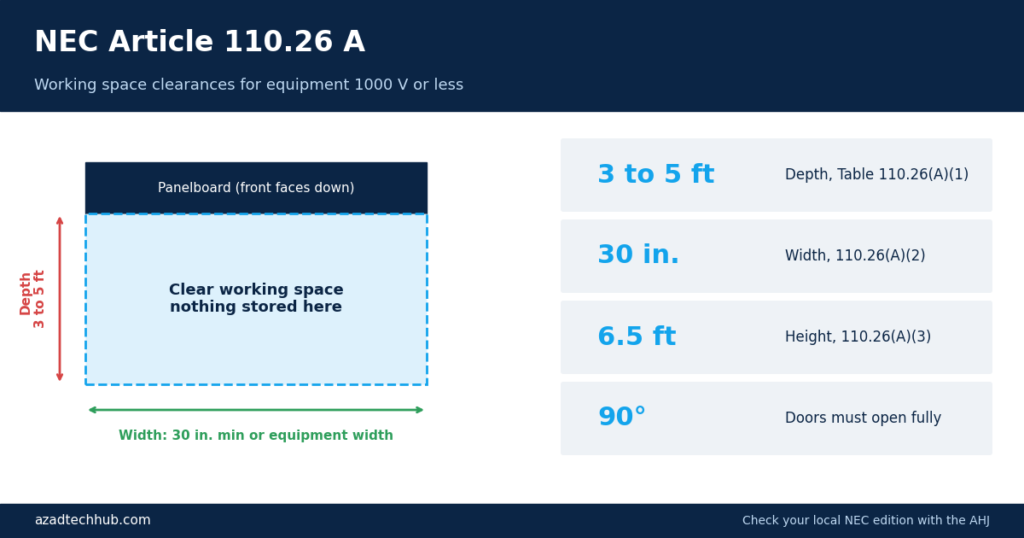
Article 110 is the general rulebook of the NEC, and Part II covers installations of 1000 volts or less. Within it, NEC Article 110.26 A requires working space around equipment that is likely to need examination, adjustment, servicing or maintenance while energized. The space has four parts:
- Depth, (A)(1): measured from the equipment front, per Table 110.26(A)(1).
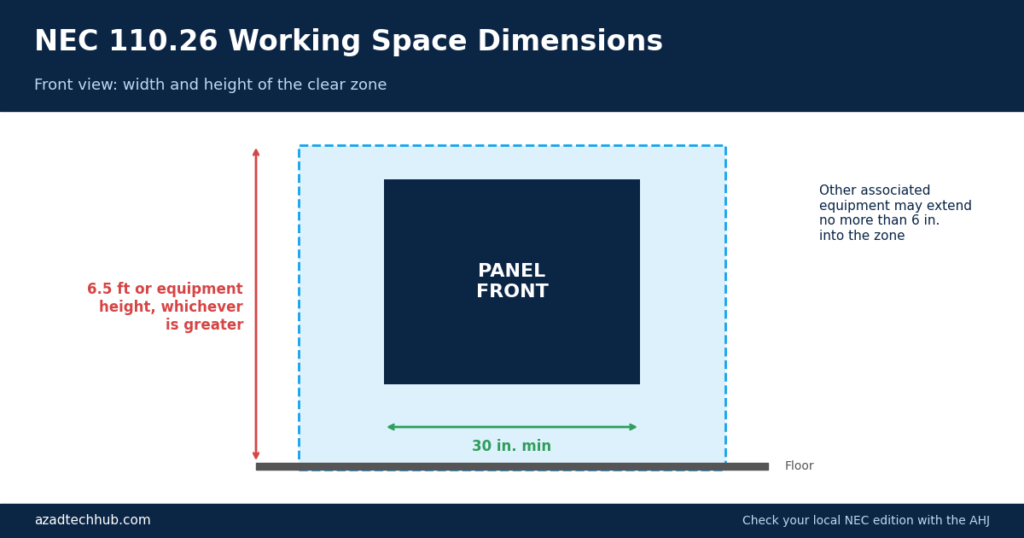
- Width, (A)(2): 30 in. or the equipment width, whichever is greater, with doors able to open 90 degrees.
- Height, (A)(3): 6½ ft or the equipment height, whichever is greater. Associated equipment may extend no more than 6 in. into the space.
- Limited access, (A)(4): extra conditions for equipment above a suspended ceiling or in a crawl space.
Design rules such as those in our NEC Article for Overcurrent Protection guide assume this space is already in your layout.
NEC 110.26 Conditions and Depth Table
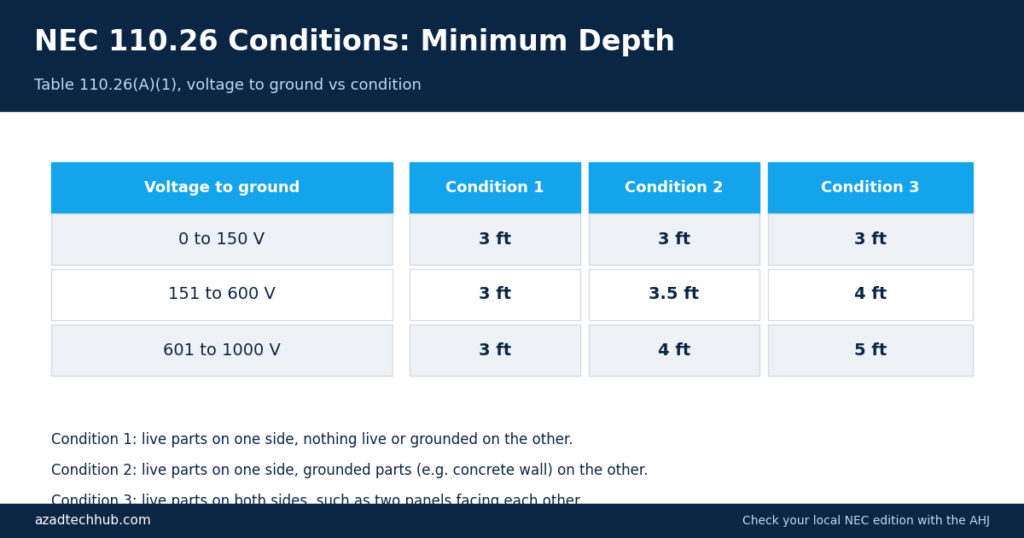
NEC 110.26 conditions describe what sits across the aisle from the equipment. Depth grows with voltage to ground and with the condition.
| Voltage to ground | Condition 1 | Condition 2 | Condition 3 |
|---|---|---|---|
| 0 to 150 V | 3 ft | 3 ft | 3 ft |
| 151 to 600 V | 3 ft | 3½ ft | 4 ft |
| 601 to 1000 V | 3 ft | 4 ft | 5 ft |
Table: NEC Article 110.26 A minimum depth by condition (Table 110.26(A)(1)).
- Condition 1: live parts on one side, nothing live or grounded on the other.
- Condition 2: live parts on one side, grounded parts such as a concrete wall on the other.
- Condition 3: live parts on both sides, such as two panels facing each other.
Example: a 120/208 V panel needs 3 ft, but two 480Y/277 V panels facing each other (Condition 3) need 4 ft. Outline the zone with floor marking tape (affiliate: floor marking tape, Pretty Link) so nobody parks a cart there.
NEC 110.26 Exceptions
Exceptions to NEC Article 110.26 A are narrow, so apply them carefully:
- Dead-front equipment: no space is needed at the back or sides if all connections and adjustable parts are reachable from the front.
- Low voltage: by special permission, smaller spaces where all uninsulated parts are 30 V rms, 42 V peak or 60 V dc or less.
- Existing buildings: Condition 2 spacing is allowed across an aisle when replacing dead-front equipment, if written procedures prevent both sides being open at once.
- Headroom: service equipment or panelboards up to 200 A in existing dwelling units may have less than 6½ ft.
NEC 110.26 B: Keep the Space Clear
NEC 110.26 b says the working space can never be used for storage. If live parts are exposed in a passageway or open area, they must be guarded. The neighboring rules finish the job: 110.26(C) requires safe entrance and egress, (D) requires lighting in equipment rooms, and (E) reserves dedicated space from the floor to 6 ft above the equipment, where no pipes or ducts foreign to the electrical installation may run.
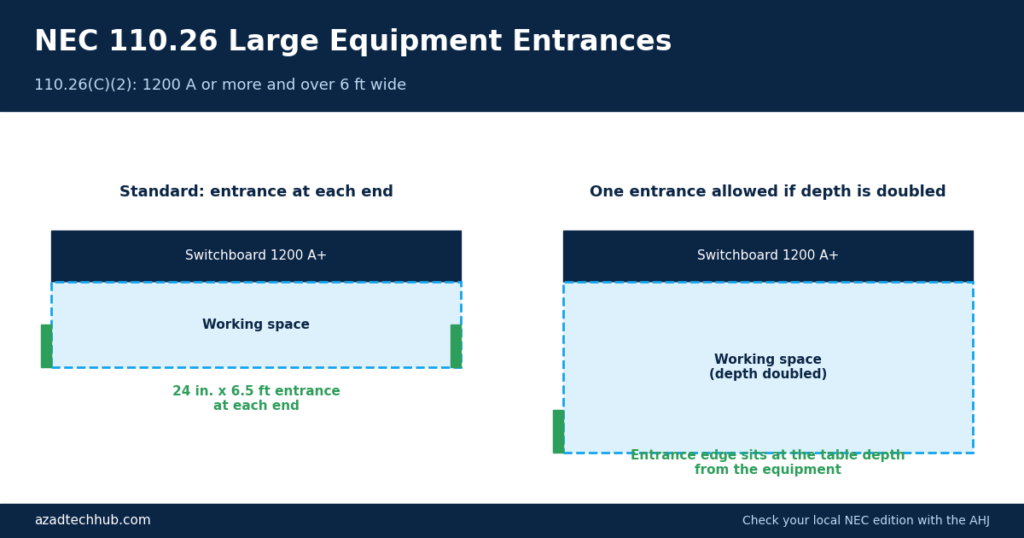
For equipment rated 1200 A or more and over 6 ft wide, 110.26(C)(2) calls for an entrance at each end, at least 24 in. wide and 6½ ft high. One entrance is enough if the exit is unobstructed, or if the depth required by 110.26(A)(1) is doubled.
Check these before routing raceways into the room. Our Conduit Fill Calculator and NEC Article for Conduit Fill guide help size the runs, and Junction Box vs Pull Box helps you pick enclosures that stay out of the space. Feeders to outdoor gear also need the right cover, see NEC Code for Underground Conduit Depth.
NEC Article 110.26 A in the 2020, 2023 and 2026 Editions
There is no 2022 NEC. The Code is revised every three years, so people searching “2022” usually need the 2020 or 2023 edition. The depth table and the 30 in. width are the same in both, and the 2026 edition tightens the egress wording around equipment doors. NEC Article 110.26 A is enforced by whichever edition your state or city has adopted, so confirm it with your authority having jurisdiction.
Practical Tools for NEC Article 110.26 A Inspections
Before opening any panel during a clearance walk-through, prove it is dead or know what is live. A non-contact voltage tester gives a quick first check, and a good electrician’s multimeter confirms it. The Klein ET310 circuit breaker finder speeds up labeling, and the FLIR ONE Pro thermal camera can reveal warm connections. Adding an EV charger? Run the EV Charger Load Calculation Tool first, then check the Level 2 charger installation cost guide. As an Amazon Associate I earn from qualifying purchases. See the affiliate disclosure.
Free NEC Article 110.26 A PDF Cheat Sheet
Download the NEC Article 110.26 A cheat sheet (PDF) for the depth table, conditions and exceptions on one page.
The full NEC is copyrighted, so an Article 110 PDF is not something to download from random sites. NFPA offers free read-only access online at nfpa.org/70 with a free account. For markups on the job, a printed NEC Handbook is easier to flag than a screen.
NEC Article 110.26 A FAQs
What does electrical code 110.26 require?
Access and working space around energized-serviceable equipment: depth per Table 110.26(A)(1), at least 30 in. wide, and 6½ ft high.
What is permitted if the space specified by 110.26(A)(1) is doubled?
For large equipment, a single entrance is enough when the working space depth is doubled.
Does NEC 110.26 apply to disconnects?
Yes. Disconnects, panelboards, switchboards and meter sockets all need the same working space.
What is Article 110 in the NEC?
The general requirements article: equipment examination, workmanship, arc-flash labels, and spaces around equipment.
What is the 6 foot 12 foot rule?
It is not in 110.26. It is the dwelling receptacle rule in 210.52(A): no point along a wall more than 6 ft from an outlet, so outlets sit 12 ft apart at most.
How can I read the NEC for free?
Create a free NFPA account and open NFPA 70 at nfpa.org/70 in read-only mode.
Conclusion
NEC Article 110.26 A comes down to three numbers: 3 to 5 ft deep, 30 in. wide and 6½ ft high. Keep it clear, light it, give people a way out, and confirm your local edition. For more code guides and calculators, browse the Electrical Standards library and the full calculator list.
Get new guides in your feed. Follow Electrical Insights on LinkedIn for new electrical standards guides, calculators and design tips from Azad Circuit Hub.