Copper vs Aluminum Busbar: Which Should You Choose?
Choosing the right busbar material affects electrical performance, installation cost, heat management, and long-term reliability. Copper and aluminum are the two most common choices for low-voltage switchboards, distribution panels, MCCs, power distribution systems, and industrial electrical equipment.
The copper vs aluminum busbar decision is not simply about which metal has better conductivity. Copper offers higher conductivity and excellent mechanical strength, while aluminum provides a lower-cost and lighter alternative. The best option depends on current rating, available space, temperature rise, fault levels, installation conditions, and budget.
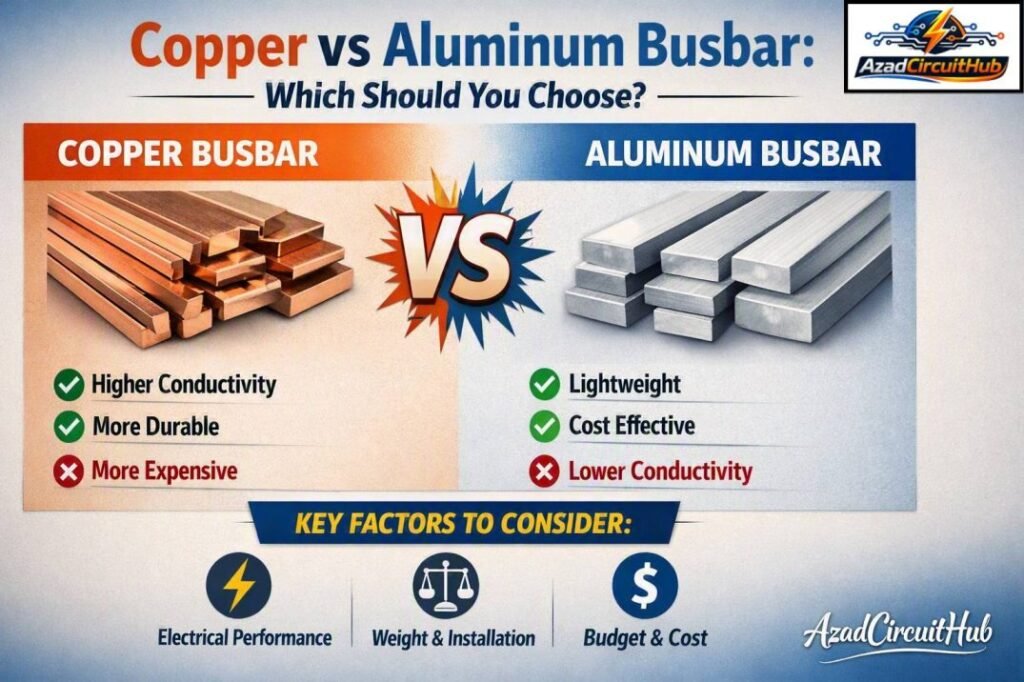
Table of Contents
Table of Contents
Copper vs Aluminum Busbar: Quick Comparison
| Feature | Copper Busbar | Aluminum Busbar |
|---|---|---|
| Electrical conductivity | Higher | Lower |
| Weight | Higher | Lower |
| Material cost | Higher | Lower |
| Required cross-section | Smaller | Larger |
| Mechanical strength | Higher | Lower |
| Corrosion resistance | Very good | Good with proper treatment |
| Thermal performance | Excellent | Good |
| Installation handling | Heavier | Easier |
| Short-circuit performance | Excellent | Good when correctly sized |
| Common applications | Compact panels, high-current systems | Large distribution systems, cost-sensitive projects |
For many projects, the copper vs aluminum busbar choice comes down to whether compactness and conductivity are more important than weight and material cost.
What Is a Busbar?
A busbar is a conductive metal strip, bar, or tube used to distribute electrical power within switchgear, panelboards, distribution boards, control panels, and other electrical equipment.
Instead of using multiple cables for high-current distribution, a busbar provides a rigid and efficient current path. Busbars can be manufactured from copper or aluminum and are available in different widths, thicknesses, and configurations.
The required busbar size depends on current capacity, allowable temperature rise, installation arrangement, ambient temperature, enclosure conditions, and applicable electrical standards.
If you are selecting a conductor size for a new panel or distribution system, use our bus bar size calculator to estimate a suitable busbar dimension based on the design requirements.
Copper Busbar: Advantages and Disadvantages
Copper has been widely used for electrical busbars because of its high electrical conductivity and strong mechanical properties.
Advantages of Copper Busbars
Copper has significantly higher conductivity than aluminum. This allows a copper busbar to carry the same current with a smaller cross-sectional area under comparable design conditions.
Copper also has excellent mechanical strength. It is less likely to deform during installation and can withstand mechanical forces associated with high short-circuit currents.
Another benefit is its relatively stable contact performance. Copper surfaces can be properly prepared and plated to provide reliable connections in switchgear and distribution equipment.
Copper is especially useful where panel space is limited. A smaller conductor can make it easier to design compact switchboards and electrical enclosures.
Disadvantages of Copper Busbars
The biggest disadvantage is cost. Copper is generally more expensive than aluminum, and large busbar systems can require a substantial amount of copper.
Copper is also much heavier. This can increase transportation, handling, and structural support requirements, particularly in large switchboards.
For projects with very high current ratings, the material cost and weight of copper can become significant design considerations.
Aluminum Busbar: Advantages and Disadvantages
Aluminum is widely used in electrical distribution because it provides good conductivity at a lower weight and lower material cost.
Advantages of Aluminum Busbars
The primary advantage of aluminum is its low weight. Aluminum weighs roughly one-third as much as copper by volume, which makes large conductors easier to transport and handle.
Material cost is another important benefit. Aluminum can reduce the initial cost of large electrical distribution systems when properly engineered.
Although aluminum has lower conductivity than copper, its larger required cross-sectional area can often be accommodated in switchboards and bus ducts.
Aluminum is therefore attractive for large power distribution systems where physical space is available and reducing material cost is important.
Disadvantages of Aluminum Busbars
Aluminum has lower electrical conductivity than copper. Therefore, a larger cross-sectional area is normally required to carry the same current under similar conditions.
Aluminum also forms an oxide layer on its surface. This oxide has poor electrical conductivity, so proper joint preparation, compatible connectors, and suitable termination practices are essential.
Thermal expansion is another consideration. Aluminum expands and contracts more with temperature changes than copper, which makes proper joint design and connection torque important.
Copper vs Aluminum Busbar for Current Capacity
Current carrying capacity is one of the most important factors when comparing the two materials.
For the same cross-sectional area, copper generally carries more current than aluminum. However, simply comparing conductivity is not enough for a final busbar design.
| Design Factor | Copper | Aluminum |
|---|---|---|
| Conductivity | Higher | Lower |
| Typical required area | Smaller | Larger |
| Heat generation | Lower for equal area | Higher for equal area |
| Space requirement | Lower | Higher |
| Cooling considerations | Usually favorable | May require larger surface area |
Actual ampacity should be determined using the applicable standard, manufacturer data, enclosure conditions, temperature rise limits, and installation arrangement.
For a quick preliminary calculation, a bus bar size calculator can help compare approximate copper and aluminum dimensions before final engineering verification.
Copper vs Aluminum Busbar: Cost Comparison
Cost is often the deciding factor for large electrical installations.
Copper typically costs more per kilogram and has a higher material cost. Aluminum can offer considerable savings, particularly in large busbar systems where several meters of conductor are required.
However, the total project cost should include more than the metal price. Aluminum may require a larger busbar cross-section, different connection hardware, careful surface preparation, and compatible terminals.
A good comparison should therefore consider material, fabrication, installation, supports, joints, accessories, and maintenance.
Copper vs Aluminum Busbar for Heat Dissipation
Busbar temperature affects insulation life, joint reliability, and overall equipment performance.
Copper’s higher conductivity reduces resistance for a given cross-sectional area. Lower resistance generally means lower I²R losses and less heat generation.
Aluminum can also provide reliable thermal performance when correctly sized. Its larger cross-sectional area can provide additional surface area for heat dissipation.
The enclosure design, ventilation, busbar spacing, orientation, ambient temperature, and number of loaded conductors can have a major effect on the final temperature rise.
Copper vs Aluminum Busbar for Short-Circuit Current
Short-circuit performance is another critical design consideration.
During a fault, very high current can create substantial electromagnetic forces between busbars. The busbar supports, spacing, bracing, joints, and material strength must all be suitable for the prospective fault current.
Copper’s greater mechanical strength can provide an advantage in demanding high-fault-current applications. However, properly designed aluminum busbar systems can also meet required short-circuit ratings.
The final design should always be checked against the switchgear manufacturer’s short-circuit rating and the relevant electrical standard.
Which Busbar Is Better for Industrial Panels?
Copper is often preferred for compact industrial panels, high-current switchboards, MCCs, and applications where space is limited.
Aluminum can be a strong choice for large distribution boards, bus ducts, utility systems, and projects where reducing material cost and weight is important.
There is no universal winner. The correct material depends on the complete electrical and mechanical design.
Choose Copper When:
- Panel space is limited.
- High conductivity is important.
- Mechanical strength is a major concern.
- High fault currents are expected.
- Weight is less important than compactness.
- Premium connections and compact switchgear are required.
Choose Aluminum When:
- Project cost is a major concern.
- Low weight is valuable.
- Adequate space is available for a larger busbar.
- The system uses compatible aluminum-rated connections.
- Large power distribution conductors are required.
Copper vs Aluminum Busbar: Connection and Maintenance
Connections deserve special attention when using either material.
For aluminum, oxide removal, joint compound where specified, correct connector selection, and manufacturer-recommended torque are particularly important. Aluminum-rated lugs and terminals should be used where required.
Copper connections also require proper preparation and tightening. Over-tightening can damage components, while under-tightening can increase contact resistance and create hot spots.
Thermal imaging can be useful during maintenance to identify abnormal heating at busbar joints, terminals, and connection points.
If you are working on a distribution board and need to determine a preliminary conductor dimension, check our bus bar size calculator before selecting the final busbar specification.
Standards and Design Considerations
Busbar systems should be designed according to the standards applicable to the equipment and installation.
Common references include:
| Standard | Application |
|---|---|
| IEC 61439 | Low-voltage switchgear and controlgear assemblies |
| IEC 60865-1 | Calculation of short-circuit effects |
| UL 891 | Switchboards in applicable North American installations |
| NFPA 70 | National Electrical Code requirements |
| IEEE standards | Various power system and equipment design considerations |
The exact standard depends on the country, equipment type, voltage level, and installation.
Copper vs Aluminum Busbar: Final Verdict
The copper vs aluminum busbar decision should be based on electrical performance, physical dimensions, cost, weight, fault withstand capability, connection requirements, and installation conditions.
Copper is usually the better choice when space is limited, high conductivity is needed, or mechanical strength is a priority. Aluminum is often more attractive for large distribution systems where lower cost and reduced weight provide significant benefits.
Neither material should be selected using ampacity alone. Always verify the final busbar dimensions, temperature rise, short-circuit withstand, joint design, and applicable standards before construction.
For a faster preliminary sizing check, use a bus bar size calculator to compare conductor dimensions and current requirements before finalizing your electrical design.
Frequently Asked Questions
Is copper busbar better than aluminum?
Copper offers higher conductivity and mechanical strength, so it can be advantageous where space, high current, and fault withstand requirements are important. Aluminum can be a better economic choice for larger distribution systems.
Why is aluminum busbar cheaper than copper?
Aluminum generally has a lower material cost and much lower weight. Although a larger cross-section may be needed for the same current, the overall conductor cost can still be lower.
Does aluminum busbar need to be larger than copper?
Generally, yes. Because aluminum has lower electrical conductivity, a larger cross-sectional area is normally required to achieve comparable current-carrying performance.
Can copper and aluminum busbars be connected together?
They can be connected when the connection system is specifically designed and rated for both metals. Suitable bimetallic connectors, terminals, surface preparation, and installation procedures may be required to prevent connection problems.
Which busbar is best for high current?
Copper is often preferred for high-current applications because of its high conductivity and mechanical strength. However, properly sized aluminum can also be used for high-current distribution when space and connection requirements are suitable.
Get new guides in your feed. Follow Electrical Insights on LinkedIn for new electrical standards guides, calculators and design tips from Azad Circuit Hub.
#CopperVsAluminumBusbar, #Busbar, #CopperBusbar, #AluminumBusbar, #ElectricalEngineering, #BusbarSizing, #ElectricalSystems, #PowerDistribution, #ElectricalDesign, #ElectricalSafety