
Flat vs Tubular vs Rectangular Busbar: Sizing Differences, Current Capacity & Selection Guide
Choosing the right busbar shape affects current capacity, temperature rise, voltage drop, mechanical strength, and the overall size of an electrical panel. The three common options are flat, tubular, and rectangular busbars, and each has different electrical and mechanical characteristics.
This guide explains Flat vs Tubular vs Rectangular Busbar sizing differences, including current carrying capacity, surface area, cooling, short-circuit strength, and practical applications. It also explains how busbar shapes sizing changes the required conductor dimensions for low-voltage switchboards, distribution panels, MCCs, and industrial power systems.
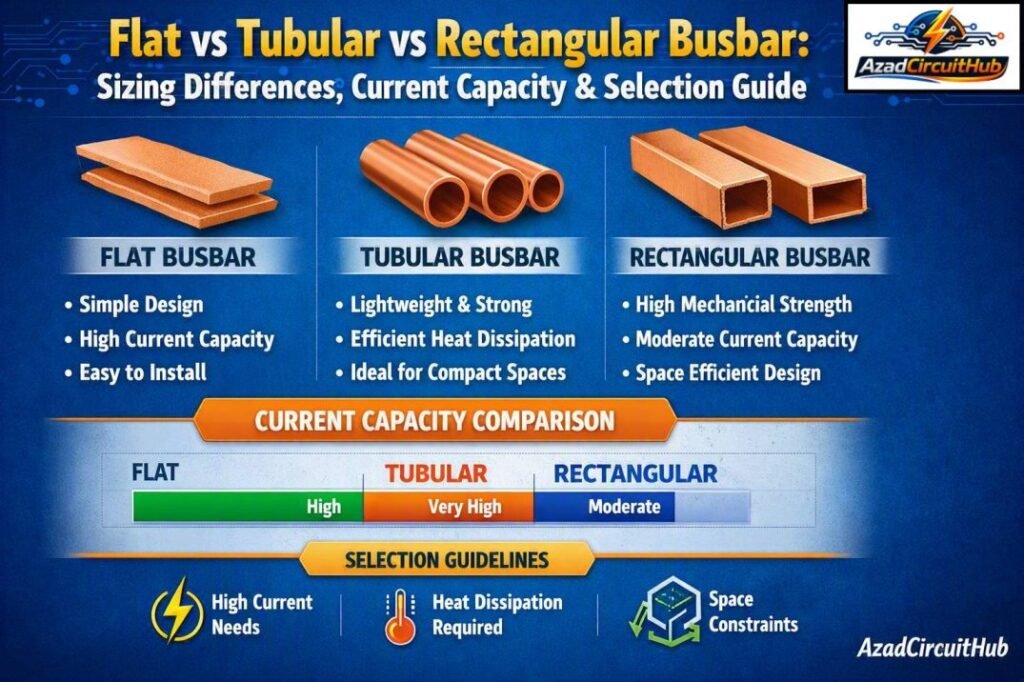
Table of Contents
Table of Contents
Flat vs Tubular vs Rectangular Busbar
| Busbar Type | Typical Shape | Main Advantage | Cooling | Common Application |
|---|---|---|---|---|
| Flat busbar | Thin, wide strip | Easy installation and connections | Good | Distribution panels |
| Rectangular busbar | Wide rectangular section | High current capacity | Very good | LV switchboards |
| Tubular busbar | Hollow round or rectangular tube | Excellent strength-to-weight ratio | Excellent | High-current systems |
For quick preliminary sizing, use our bus bar size calculator to estimate the required busbar dimensions based on current and conductor material before checking the applicable standard and manufacturer data.
What Is a Busbar?
A busbar is a rigid electrical conductor used to distribute power between incoming feeders, circuit breakers, transformers, switchgear, and outgoing circuits. Copper and aluminum are the most common materials.
Unlike flexible cables, busbars are normally installed as solid or hollow conductors. Their shape determines how much conductor material is required and how effectively heat can move away from the conductor.
Important busbar design factors include:
- Rated current
- Conductor material
- Cross-sectional area
- Ambient temperature
- Installation method
- Permitted temperature rise
- Surface area
- Short-circuit current
- Frequency and proximity effects
- Insulation and enclosure conditions
- Mechanical support
- Ventilation
The cross-sectional area is important, but it is not the only factor that determines busbar ampacity.
Flat vs Tubular vs Rectangular Busbar: Basic Difference
Flat busbars are generally narrow in thickness and much wider than they are thick. They are simple to fabricate and provide a large exposed surface area for their cross-sectional area.
Rectangular busbars have a defined width and thickness and are widely used in switchboards and power distribution equipment. They provide a compact arrangement with good heat dissipation.
Tubular busbars use a hollow cross section. The tube can provide excellent mechanical strength while reducing conductor weight compared with an equivalent solid section.
| Feature | Flat Busbar | Rectangular Busbar | Tubular Busbar |
|---|---|---|---|
| Cross section | Flat strip | Solid rectangle | Hollow tube |
| Weight efficiency | Moderate | Moderate | Excellent |
| Heat dissipation | Good | Good to very good | Very good |
| Mechanical rigidity | Moderate | High | Very high |
| Connection method | Very easy | Easy | Requires suitable fittings |
| Panel applications | Common | Very common | Less common |
| High-current applications | Good | Excellent | Excellent |
| Space efficiency | Good | Excellent | Good |
How Busbar Shapes Sizing Affects Current Capacity
The current carrying capacity of a busbar depends on its material, cross-sectional area, surface area, operating temperature, and installation environment.
For a simple rectangular busbar, the cross-sectional area can be calculated as:
A = W × T
Where:
- A = cross-sectional area
- W = busbar width
- T = busbar thickness
For example, a copper busbar measuring 50 mm × 10 mm has a cross-sectional area of:
50 × 10 = 500 mm²
However, this does not mean every 500 mm² busbar shape will have exactly the same ampacity.
A tubular conductor may have the same metal cross-sectional area while offering a different surface area and thermal performance. Therefore, busbar shapes sizing should always consider the complete thermal design rather than area alone.
Flat Busbar Sizing
Flat copper and aluminum busbars are popular because they are easy to cut, drill, bend, and connect. They are especially useful inside distribution boards and low-voltage switchgear.
A flat busbar can provide a large cooling surface compared with a compact square section. This can be useful where natural convection is available.
Typical flat busbar dimensions include:
| Width | Thickness | Cross-Sectional Area |
|---|---|---|
| 20 mm | 3 mm | 60 mm² |
| 25 mm | 5 mm | 125 mm² |
| 30 mm | 5 mm | 150 mm² |
| 40 mm | 5 mm | 200 mm² |
| 50 mm | 5 mm | 250 mm² |
| 50 mm | 10 mm | 500 mm² |
| 60 mm | 10 mm | 600 mm² |
| 80 mm | 10 mm | 800 mm² |
| 100 mm | 10 mm | 1,000 mm² |
Actual allowable current must be verified using the applicable busbar standard, manufacturer tables, temperature-rise limits, and enclosure conditions.
Rectangular Busbar Sizing
Rectangular busbars are one of the most common choices for LV electrical distribution. Their width and thickness can be selected to provide the required ampacity while maintaining practical mechanical dimensions.
For example, a 100 mm × 10 mm rectangular copper busbar has:
A = 100 × 10 = 1,000 mm²
Increasing the width generally increases the available surface area. However, making the busbar extremely wide can create mechanical and installation challenges.
For high-current systems, multiple bars may be installed in parallel.
For example:
- 2 × 50 mm × 10 mm
- 2 × 80 mm × 10 mm
- 3 × 100 mm × 10 mm
Parallel busbars must have suitable spacing, equal current paths, secure supports, and proper termination arrangements.
Before selecting parallel conductors, use a bus bar size calculator for an initial comparison of conductor area and then verify the final arrangement against the applicable design standard.
Tubular Busbar Sizing
Tubular busbars are usually selected where mechanical strength, weight reduction, and thermal performance are important.
A hollow conductor can provide high rigidity without requiring the same amount of metal as a solid conductor of similar external dimensions. Tubular conductors can also offer a large external surface for cooling.
For a round tube, the metal cross-sectional area is approximately:
A = π/4 × (D² − d²)
Where:
- D = outside diameter
- d = inside diameter
For rectangular hollow sections, the calculation is based on the outer and inner dimensions.
Tubular designs are particularly useful in high-current electrical installations, substations, and specialized busbar systems. They are less convenient than flat or rectangular bars when many bolted branch connections are required.
Flat vs Tubular vs Rectangular Busbar: Thermal Performance
Heat is one of the most important factors in busbar sizing. Electrical resistance produces heat according to:
P = I²R
As current increases, heat generation rises rapidly. The busbar must transfer this heat to its surroundings without exceeding the permitted conductor temperature.
A busbar with a large exposed surface can generally release heat more effectively. This is one reason busbar geometry matters even when two conductors have similar metal cross-sectional areas.
| Design Factor | Flat | Rectangular | Tubular |
|---|---|---|---|
| Natural cooling | Good | Very good | Excellent |
| Surface-area efficiency | Good | Good | Very good |
| High-current suitability | Good | Excellent | Excellent |
| Enclosed panel performance | Good | Very good | Depends on design |
| Thermal optimization | Easy | Easy | More specialized |
The actual temperature rise depends on more than shape. Enclosure ventilation, busbar spacing, ambient temperature, conductor arrangement, and nearby heat sources can significantly change the result.
Short-Circuit Strength and Mechanical Design
Busbars must withstand both normal operating current and short-circuit forces.
During a fault, very high current can create significant electromagnetic forces between adjacent conductors. These forces can move or deform inadequately supported busbars.
Rectangular and tubular busbars can provide strong mechanical performance, but the final design must consider:
- Peak fault current
- Short-time withstand current
- Busbar spacing
- Support spacing
- Insulator strength
- Conductor orientation
- Fault duration
- Electrodynamic forces
The busbar does not work alone. The support system is part of the overall short-circuit design.
Copper vs Aluminum Busbar Sizing
Copper has higher electrical conductivity than aluminum, so an aluminum busbar generally requires a larger cross-sectional area to carry the same current under comparable conditions.
| Property | Copper | Aluminum |
|---|---|---|
| Electrical conductivity | Higher | Lower |
| Required area for same current | Generally smaller | Generally larger |
| Weight | Higher | Lower |
| Cost | Usually higher | Usually lower |
| Mechanical strength | Higher | Lower |
| Common use | Switchgear, panels | Large distribution systems |
Material selection should also consider connection design, oxidation, thermal expansion, mechanical strength, and the compatibility of terminals and joints.
How to Select the Right Busbar Shape
The best busbar shape depends on the application rather than current alone.
- Choose a flat busbar when easy drilling, bending, and bolted connections are priorities.
- Choose a rectangular busbar when you need a compact, practical solution for switchboards and distribution panels.
- Choose a tubular busbar when mechanical rigidity, low weight, and high-current performance are major priorities.
A useful selection process is:
- Determine the continuous load current.
- Select copper or aluminum.
- Establish the permitted temperature rise.
- Select a suitable busbar shape.
- Calculate the required cross-sectional area.
- Check manufacturer ampacity data.
- Verify voltage drop where applicable.
- Check short-circuit withstand capability.
- Confirm support and clearance requirements.
- Verify the completed design against the applicable standard.
For a faster preliminary calculation, check our bus bar size calculator to compare common copper and aluminum busbar dimensions before finalizing the electrical design.
Busbar Shapes Sizing and Installation Considerations
Busbar dimensions should never be selected only from a generic ampacity chart. Installation conditions can change the allowable current significantly.
Important factors include the number of bars installed together, phase spacing, orientation, enclosure dimensions, ventilation, ambient temperature, and proximity to other conductors.
Joint design is also critical. Poorly prepared joints can create high contact resistance and localized heating.
Use properly rated hardware and follow the equipment manufacturer’s requirements for:
- Joint preparation
- Bolt torque
- Clearances
- Creepage distances
- Insulation
- Support spacing
- Plating
- Thermal expansion
Relevant Busbar Standards
Busbar design can involve several standards depending on the equipment and installation.
IEC 61439 is particularly important for low-voltage switchgear and controlgear assemblies. It addresses assembly design, verification, temperature rise, dielectric performance, and short-circuit considerations.
IEC 60865-1 is relevant to short-circuit currents and the mechanical and thermal effects associated with short circuits.
For installations designed under the NEC framework, applicable NEC requirements should also be reviewed, particularly where busbars are installed as part of switchboards, panelboards, switchgear, or other electrical equipment.
Manufacturer-tested assemblies should take priority over generic internet ampacity tables when a listed or certified switchboard is being designed.
Common Busbar Sizing Mistakes
Several mistakes can lead to excessive temperature rise or poor electrical performance.
Sizing only by cross-sectional area
Two busbars with the same metal area can have different thermal characteristics because their geometry and exposed surface areas differ.
Ignoring enclosure conditions
A busbar that performs well in open air may have a different temperature rise inside a tightly enclosed panel.
Ignoring short-circuit forces
Continuous current rating is only one part of busbar design. Mechanical withstand during faults must also be checked.
Using cable ampacity tables directly
Busbars and cables have different construction and heat-transfer characteristics. A cable ampacity table should not automatically be applied to a bare or insulated busbar.
Forgetting connections
The busbar may be adequately sized while the joints, bolts, terminals, or supports are not suitable for the application.
Flat vs Tubular vs Rectangular Busbar: Which Is Best?
There is no single best shape for every electrical installation.
Flat busbars are practical and easy to fabricate. Rectangular busbars offer an excellent balance between current capacity, cooling, compactness, and installation convenience. Tubular busbars can deliver excellent mechanical strength and thermal performance, particularly in high-current applications.
For most conventional LV switchboards, rectangular busbars are a practical choice. For specialized high-current systems, tubular construction may provide advantages that justify the additional design complexity.
The final choice should always be based on calculated current, temperature rise, short-circuit performance, installation conditions, material, and applicable standards.
Frequently Asked Questions
What is the main difference between flat and rectangular busbars?
A flat busbar is generally a thin, wide conductor, while a rectangular busbar is selected as a defined rectangular section for a particular current and mechanical requirement. In practice, the terms can overlap because many flat busbars are also rectangular in cross section.
Does busbar shape affect ampacity?
Yes. Busbar geometry affects surface area, heat dissipation, temperature rise, and therefore allowable continuous current. The same metal cross-sectional area does not guarantee identical performance for different shapes.
Are tubular busbars better than rectangular busbars?
Not necessarily. Tubular busbars can provide excellent mechanical strength, cooling, and weight efficiency, while rectangular busbars are easier to connect and are widely used in LV switchboards. The best option depends on the installation.
Is copper or aluminum better for busbars?
Copper provides higher electrical conductivity and usually allows a smaller conductor for the same current. Aluminum is lighter and can be more economical, but it generally requires a larger cross-sectional area and careful joint design.
How do I calculate the correct busbar size?
Start with the design current, conductor material, permissible temperature rise, installation conditions, and required short-circuit withstand. Calculate the conductor area and then verify the selected dimensions against the applicable standard and manufacturer data. A bus bar size calculator can be useful for preliminary sizing, but the final engineering selection should be verified against the complete design requirements.
Final Takeaway
Flat vs Tubular vs Rectangular Busbar selection is not simply a matter of choosing the conductor with the largest cross-sectional area. Busbar geometry affects heat dissipation, mechanical strength, installation space, connection methods, and short-circuit performance.
Flat busbars are easy to fabricate and install, rectangular busbars are highly practical for switchboards and distribution equipment, and tubular busbars can offer excellent strength and thermal performance for demanding applications.
For reliable busbar shapes sizing, always consider current, material, temperature rise, enclosure conditions, spacing, fault current, supports, and applicable standards together. Use calculated dimensions as a starting point, then confirm the final selection with manufacturer data and the relevant electrical code or standard.
Get new guides in your feed. Follow Electrical Insights on LinkedIn for new electrical standards guides, calculators and design tips from Azad Circuit Hub.
#BusbarSizing, #BusbarCurrentCapacity, #FlatBusbar, #TubularBusbar, #RectangularBusbar, #ElectricalEngineering, #BusbarDesign, #PowerDistribution, #ElectricalDesign, #BusbarSelection
