Bus Bar Cross Sectional Area Calculator
Selecting the correct bus bar size is one of the most important parts of electrical system design. A wrong calculation can lead to overheating, voltage drop, energy loss, and even equipment failure. This is where a Bus Bar Cross Sectional Area Calculator becomes useful. It helps engineers, electricians, and technicians determine the required busbar area based on current load, material type, and installation conditions.
Whether you are designing a switchboard, panel board, transformer connection, or industrial power distribution system, calculating the correct cross-sectional area improves safety and efficiency.
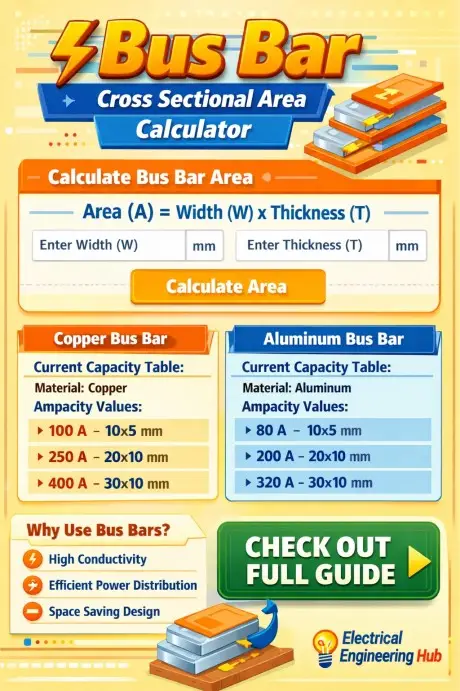
Table of Contents
Table of Contents
In this guide, you will learn how a Bus Bar Cross Sectional Area Calculator works, the factors affecting busbar sizing, formulas used, and practical examples.
Bus Bar Cross Sectional Area Calculator
Bus Bar Cross Sectional Area Calculator
Estimate required bus bar copper or aluminum cross section based on rated current, temperature rise class, and installation environment
Bus Bar Parameters
Calculation Results
How to Use This Calculator
- Enter rated current. Use the design current the bus bar will continuously carry, not the breaker trip setting.
- Select conductor material. Copper carries higher current density than aluminum for the same temperature rise.
- Choose the temperature rise class. This reflects how much the bar is allowed to heat above ambient under full load.
- Select installation condition. Enclosed panels run hotter than open ventilated chambers, lowering the safe current density.
- Select surface finish. Plated or painted surfaces dissipate heat differently than bare bright conductors.
- Set parallel bars per phase. If the phase current is shared across multiple bars, the tool divides the load accordingly.
- Review the results. Match the calculated area to the nearest standard bar size from the reference table, rounding upward.
Technical Notes
Bus bar sizing accounts for continuous current carrying capacity, permissible temperature rise above ambient, conductor material, and the cooling effect of the installation environment. Enclosed panels trap heat and therefore require a larger cross section than open ventilated busbar chambers for the same current. Surface finish affects radiative heat dissipation, with darker painted or plated surfaces typically dissipating heat more effectively than bright bare conductors. Where multiple bars are run in parallel per phase, spacing between bars should allow adequate air circulation, since closely stacked bars reduce the effective cooling of inner surfaces. Final bar selection should also consider short circuit withstand capability, mechanical support spacing, and terminal connection requirements at switchgear and transformer ends, which may require a larger size than the thermal calculation alone indicates.
What is a Bus Bar Cross Sectional Area Calculator?
A Bus Bar Cross Sectional Area Calculator is an electrical calculation tool used to determine the required width and thickness of a busbar. It calculates the total area needed to safely carry electrical current without exceeding temperature limits.
Busbars are metallic strips made mainly from copper or aluminum. They distribute electrical power in substations, control panels, and industrial plants.
The calculator simplifies the process by using current rating, current density, and conductor material properties.
The basic equation used is:
Cross Sectional Area = Current / Current Density
This formula gives the minimum area required in mm².
Why Busbar Cross Section Matters
Busbar cross section directly affects electrical performance. A larger area reduces resistance and heat generation, while a smaller area increases losses.
Here are the main reasons why it matters:
- Prevents overheating
- Maintains voltage stability
- Improves fault withstand capability
- Reduces power loss
- Extends equipment life
Using a Bus Bar Cross Sectional Area Calculator helps avoid under-sizing or over-sizing.
Busbar Material Current Density Table
Current density depends on the conductor material.
| Material | Current Density (A/mm²) | Common Application |
|---|---|---|
| Copper | 1.2 to 2.0 | High-performance panels |
| Aluminum | 0.8 to 1.2 | Cost-effective installations |
| Tinned Copper | 1.0 to 1.8 | Corrosion-prone environments |
Copper busbars are more compact because they carry more current per square millimeter.
How to Calculate Bus Bar Cross Sectional Area
To use a Bus Bar Cross Sectional Area Calculator, follow these steps:
Step 1: Determine Load Current
Find the full load current of the system.
Example:
If load power is 250 kW at 415V, three-phase:
- Current = P / (√3 × V × PF)
- Assuming power factor = 0.9
- Current = 250000 / (1.732 × 415 × 0.9)
- Current = 386A
Step 2: Select Busbar Material
Assume copper with current density of 1.5 A/mm².
Step 3: Apply Formula
Area = 386 / 1.5
Area = 257.3 mm²
This means you can select:
- 50 mm × 6 mm = 300 mm²
- 40 mm × 8 mm = 320 mm²
Both are acceptable.
Key Takeaways
- A Bus Bar Cross Sectional Area Calculator helps determine safe busbar sizing quickly.
- Copper offers better conductivity than aluminum.
- Current density plays a major role in busbar design.
- Temperature rise must always be considered.
- Standard busbar sizes should be selected above the calculated minimum.
- Proper sizing improves safety and system reliability.
Factors Affecting Busbar Cross Section
A Bus Bar Cross Sectional Area Calculator considers several practical factors.
Current Carrying Capacity
Higher current means larger busbar area.
Ambient Temperature
High surrounding temperature reduces heat dissipation.
Installation Method
Enclosed busbars have lower cooling compared to open-air installations.
Short Circuit Rating
Busbars must withstand fault currents.
Material Resistivity
Copper has lower resistivity than aluminum.
Standard Busbar Sizes Table
This table shows common busbar dimensions.
| Width (mm) | Thickness (mm) | Area (mm²) |
|---|---|---|
| 25 | 3 | 75 |
| 25 | 5 | 125 |
| 40 | 5 | 200 |
| 50 | 5 | 250 |
| 50 | 10 | 500 |
| 75 | 10 | 750 |
| 100 | 10 | 1000 |
These sizes are commonly used in low-voltage switchgear.
Busbar Size Selection Example
Here is a quick reference:
| Current (A) | Copper Area (mm²) | Suggested Size |
|---|---|---|
| 100 | 67 | 25 × 3 |
| 250 | 167 | 40 × 5 |
| 400 | 267 | 50 × 6 |
| 630 | 420 | 50 × 10 |
| 1000 | 667 | 80 × 10 |
For a faster and easier calculation, you can also use our Busbar Size Calculator to instantly find the best busbar dimensions for your system.
Benefits of Using a Bus Bar Cross Sectional Area Calculator
Manual calculations take time and can lead to errors. A Bus Bar Cross Sectional Area Calculator offers several advantages:
- Faster results
- Accurate sizing
- Reduced design mistakes
- Better thermal management
- Improved compliance with IEC standards
This tool is useful for panel builders, electrical engineers, and maintenance teams.
Common Mistakes in Busbar Sizing
Avoid these common mistakes:
Ignoring Derating Factors
Always apply correction factors for temperature and grouping.
Selecting Exact Size
Choose a slightly higher standard size for safety margin.
Overlooking Short Circuit Strength
Thermal capacity is not the only factor.
Not Considering Future Expansion
Leave room for additional load.
A Bus Bar Cross Sectional Area Calculator helps reduce these errors.
Busbar Sizing for Copper vs Aluminum
Choosing between copper and aluminum affects design.
| Property | Copper | Aluminum |
|---|---|---|
| Conductivity | High | Medium |
| Weight | Heavy | Light |
| Cost | High | Low |
| Corrosion Resistance | Better | Moderate |
| Size Requirement | Smaller | Larger |
Copper is preferred where space is limited.
Related Guide & Tools
Conclusion
A Bus Bar Cross Sectional Area Calculator is an essential tool for designing safe and efficient electrical distribution systems. It helps calculate the exact busbar area based on current demand and material type.
By using proper formulas and considering factors like temperature, installation method, and fault current, you can choose the right busbar dimensions with confidence.
For engineers and technicians working on electrical panels, switchgear, and industrial systems, this calculator saves time and improves design accuracy. It also ensures compliance with electrical safety standards and reduces long-term maintenance issues.
FAQs
How do you calculate busbar cross sectional area?
Divide the load current by the allowable current density of the material.
What is the standard current density for copper busbars?
It usually ranges from 1.2 to 2.0 A/mm² depending on cooling conditions.
Can aluminum busbars replace copper?
Yes, but aluminum requires a larger cross-sectional area for the same current.
Why is busbar thickness important?
Thickness affects heat dissipation, mechanical strength, and short circuit withstand capacity. Use our online tool Busbar Size Calculator – Accurate Sizing According to IEC and NEC Standards
Is a Bus Bar Cross Sectional Area Calculator accurate?
Yes, it provides accurate estimates when correct input values are used. For final designs, consider derating and standard regulations.
Get new guides in your feed. Follow Electrical Insights on LinkedIn for new electrical standards guides, calculators and design tips from Azad Circuit Hub.
#BusBarCrossSectionalAreaCalculator,#BusbarSizing,#ElectricalCalculations,#BusbarDesign,#PowerDistribution,#CurrentCarryingCapacity,#ElectricalEngineering,#VoltageDrop,#BusbarCalculator,#IndustrialElectrical
Bus Bar Cross Sectional Area Calculator

Use the Bus Bar Cross Sectional Area Calculator to quickly determine the right busbar size for safe current carrying capacity and efficient design.
Price Currency: USD
Operating System: Web Browser
Application Category: UtilitiesApplication