
EHT Cable Laying Procedure
Installing extra high tension cables is a critical part of any power distribution system. A proper EHT Cable Laying Procedure ensures safety, long service life, and reliable power transmission. Since EHT cables carry high voltages, even small mistakes during installation can lead to insulation failure, overheating, or system breakdown.
From route planning to final testing, every stage needs careful execution. In this guide, you will learn the complete EHT Cable Laying Procedure, important standards, safety requirements, and best practices used in modern electrical projects.
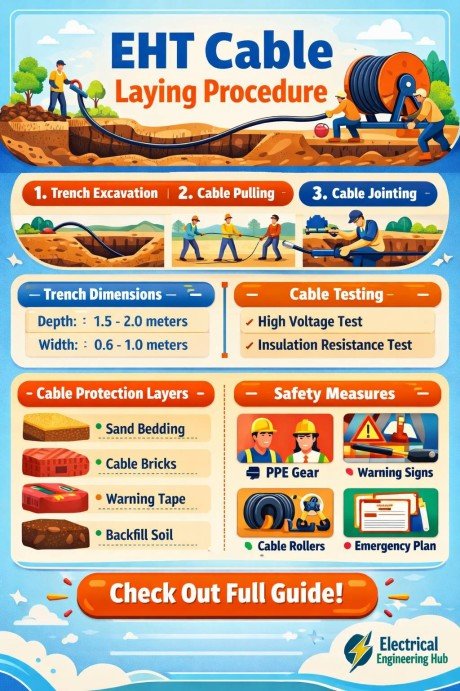
Table of Contents
Table of Contents
What is EHT Cable Laying?
EHT stands for Extra High Tension. These cables are usually rated above 33kV and are used for bulk power transmission in industrial plants, substations, and utility networks.
Unlike LT and HT cables, EHT cable installation requires advanced planning, strict bending radius control, jointing expertise, and thermal considerations.
Use our online tool Armoured Cable Size Calculator
The EHT Cable Laying Procedure includes:
| Stage | Purpose |
|---|---|
| Route survey | Identify the laying path |
| Trench preparation | Ensure proper depth and width |
| Cable pulling | Avoid mechanical damage |
| Jointing and termination | Maintain insulation integrity |
| Testing | Confirm cable health |
Importance of Proper EHT Cable Installation
A poor installation can reduce cable life significantly. Following the correct EHT Cable Laying Procedure helps in:
- Preventing insulation damage
- Reducing partial discharge risks
- Improving thermal dissipation
- Maintaining system reliability
- Ensuring compliance with IEC standards
EHT cables are expensive. Proper laying protects this investment.
Find all about High Voltage Cable Testing Standards
Pre-Installation Planning
Before starting the actual work, planning is necessary.
Route Survey
The cable route must be inspected carefully. Engineers should check:
- Underground obstacles
- Existing utility lines
- Soil condition
- Waterlogging risks
- Road crossings
A well-planned route minimizes future maintenance.
For better underground installation planning, understanding proper cable trench design is essential.
Material Inspection
Inspect all cable drums for:
| Inspection Point | Check Requirement |
|---|---|
| Drum damage | No physical cracks |
| Cable sheath | No cuts or dents |
| Length verification | Match project drawings |
| Test certificates | Must be available |
Never install damaged EHT cables.
Learn more about earthing cable size as per iec
Equipment Preparation
Common equipment required:
- Cable rollers
- Hydraulic winch
- Cable socks
- Dynamometer
- Drum jacks
- Communication radios
Trench Preparation
Trench preparation is one of the most important parts of the EHT Cable Laying Procedure.
Typical trench dimensions:
| Voltage Level | Depth | Width |
|---|---|---|
| 33kV | 1000 mm | 600 mm |
| 66kV | 1200 mm | 800 mm |
| 132kV | 1500 mm | 1000 mm |
The trench should be free from sharp stones.
Explore details on iec standard for underground cable laying
Sand Bedding
A 75mm to 100mm layer of soft sand is laid at the bottom to protect the cable sheath.
Benefits include:
- Better heat dissipation
- Mechanical protection
- Uniform cable support
This is a standard part of professional laying cable practices.
Cable Drum Positioning
Cable drums should be placed near the trench route. Correct drum orientation is important.
Key points:
- Drum should rotate in cable pulling direction
- Use drum jacks properly
- Avoid sudden drum movement
- Keep the cable straight during pulling
Improper drum placement can create twists.
Use our online tool HV Cable Bending Radius Calculator
Cable Pulling Procedure
The actual cable pulling phase is highly sensitive.
The EHT Cable Laying Procedure requires controlled pulling tension.
Steps for Pulling
- Place rollers at regular intervals.
- Align cable route properly.
- Attach cable sock firmly.
- Connect winch rope.
- Start pulling slowly.
- Monitor pulling tension.
Find all about 11kV Cable Bending Radius
Important Limits
| Parameter | Recommended Limit |
|---|---|
| Pulling speed | 10–15 meters/minute |
| Sidewall pressure | As per manufacturer |
| Minimum bending radius | 15–20 x cable diameter |
Exceeding limits may damage insulation layers.
Cable Bending Radius
EHT cables have strict bending requirements.
The bending radius depends on:
- Cable type
- Core design
- Insulation thickness
Know more about Wire Bending Radius NEC
Example:
| Cable Type | Minimum Bending Radius |
|---|---|
| Single-core XLPE | 15D |
| Multi-core XLPE | 12D |
Here D means cable overall diameter.
Sharp bends create stress points.
Cable Jointing Procedure
Long routes often need cable joints.
Jointing must be performed in a clean environment by certified jointers.
Jointing Steps
- Strip outer sheath carefully
- Prepare insulation layers
- Install stress control tubes
- Connect conductors
- Apply insulation restoration
- Seal outer sheath
Poor jointing is one of the top reasons for EHT cable failure. Find all about IEC 60364 Part 5-54
Cable Protection and Backfilling
After laying, cable protection must be provided.
Protection methods:
- Sand covering (100mm)
- Cable tiles
- Warning tape
- RCC slabs where required
Backfilling sequence:
| Layer | Material |
|---|---|
| First layer | Soft sand |
| Second layer | Protective tiles |
| Third layer | Excavated soil |
Proper backfilling completes the physical protection stage of the EHT Cable Laying Procedure.
Use this tool if you are trying to calculate cable size for underground cables. Try here Underground Cable Size Calculator – Find Correct Wire Size for Long Distance Runs
Key Takeaways
Here are the most important points to remember:
- Always inspect cable drums before installation
- Maintain proper trench depth
- Follow manufacturer pulling tension limits
- Use recommended bending radius
- Ensure professional jointing and termination
- Conduct testing before energization
- Use proper cable trench design for better heat management
Following these practices improves cable performance and reduces maintenance.
Testing After Installation
Testing is mandatory before energizing.
Common tests include:
| Test Name | Purpose |
|---|---|
| Insulation Resistance Test | Check insulation health |
| Sheath Integrity Test | Detect sheath damage |
| VLF Test | Verify dielectric strength |
| Partial Discharge Test | Detect weak points |
Testing confirms installation quality.
Know more about Why Power Cables Insulation Rated for High Voltage
Safety Precautions During EHT Cable Installation
Safety must always come first.
Important precautions:
- Use PPE at all times
- Maintain communication between teams
- Barricade work areas
- Check for live utilities
- Avoid cable dragging on sharp surfaces
- Use calibrated pulling equipment
EHT cable work involves high-risk conditions.
Common Mistakes to Avoid
Avoiding mistakes can save time and cost.
Common errors:
- Insufficient trench depth
- Excessive pulling force
- Wrong bending radius
- Poor jointing environment
- Inadequate sand bedding
- Missing warning tapes
These mistakes often shorten cable life. Find all about IEC 60634 Cable Design
Conclusion
A proper EHT Cable Laying Procedure is essential for reliable high-voltage power systems. Every step, from route survey to final testing, directly affects cable performance and operational safety.
By following standard installation methods, maintaining correct trench dimensions, controlling pulling tension, and ensuring quality jointing, engineers can achieve long-term reliability. Whether it is a substation project, industrial plant, or utility network, proper laying cable techniques always improve efficiency and reduce failures.
Understanding this process and applying best practices ensures that EHT systems remain safe, durable, and efficient for years.
For Accurate and Easy Cable Capacity, use our online tool Cable Trench Fill Calculator
FAQs
What is the minimum trench depth for EHT cables?
The minimum depth usually starts from 1000 mm for 33kV cables and increases with voltage level.
Why is sand bedding used in EHT cable laying?
Sand bedding protects the cable sheath and improves heat dissipation.
What is the bending radius for EHT cables?
Typically, it ranges from 12 to 20 times the cable diameter, depending on cable type.
Which test is mandatory after EHT cable installation?
Insulation resistance test and sheath integrity test are commonly mandatory.
Can EHT cables be laid directly in soil?
Yes, but only with proper sand bedding, protection tiles, and warning tape as part of the standard EHT Cable Laying Procedure.
Get new guides in your feed. Follow Electrical Insights on LinkedIn for new electrical standards guides, calculators and design tips from Azad Circuit Hub.
#EHTCableLayingProcedure,#CableLayingStandards,#UndergroundCableInstallation,#HighVoltageCable,#ElectricalEngineering,#PowerDistribution,#CableInstallationGuide,#EHTSystems,#ElectricalSafety,#TransmissionCables
