Factors Affecting Busbar Current Carrying Capacity: Best Guide
Busbars are widely used in switchboards, distribution panels, motor control centers, and industrial power systems. Their current carrying capacity depends on more than the copper or aluminum cross-sectional area. Temperature rise, installation conditions, busbar arrangement, surface condition, and enclosure design can all affect how much current a busbar can safely carry.
Understanding the Factors Affecting Busbar Current Carrying Capacity helps engineers select suitable busbar dimensions while keeping temperature rise within the limits of the applicable standard.
| Factor | Effect on Current Capacity |
|---|---|
| Busbar cross-sectional area | Larger area generally allows higher current |
| Material | Copper and aluminum have different electrical and thermal properties |
| Ambient temperature | Higher temperature reduces allowable loading |
| Busbar arrangement | Spacing and orientation affect heat dissipation |
| Surface finish | Can influence heat transfer and contact performance |
| Enclosure | Restricted airflow can increase operating temperature |
| Frequency | Higher frequency can increase AC losses |
| Number of parallel bars | Changes current distribution and heat dissipation |
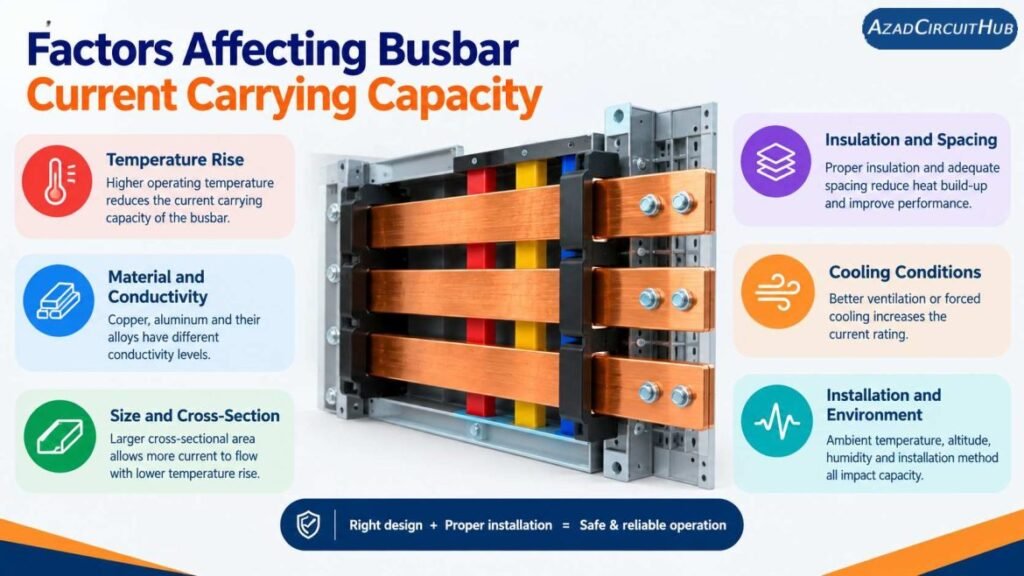
Table of Contents
Table of Contents
Factors Affecting Busbar Current Carrying Capacity
Busbar Material and Cross-Sectional Area
Material is one of the main Factors Affecting Busbar Current Carrying Capacity. Copper has higher electrical conductivity than aluminum, so a copper busbar can generally carry more current for a similar cross-sectional area.
The busbar dimensions also have a direct effect on resistance and heat generation. Increasing width or thickness increases the available conductor area and can reduce current density.
| Busbar Material | Typical Characteristics |
|---|---|
| Copper | High conductivity, compact design, good thermal performance |
| Aluminum | Lower weight and cost, but requires larger area for similar conductivity |
However, current capacity should not be selected from area alone. The permissible temperature rise and installation conditions must also be checked.
For a practical starting point, use the Busbar Current Carrying Capacity Calculator to estimate the required busbar size before checking the applicable design standard.
Ambient Temperature and Temperature Rise
Ambient temperature has a major impact on busbar ampacity. A busbar operating in a cool environment can dissipate heat more effectively than one installed in a hot electrical room.
When current flows through the conductor, electrical resistance produces heat. If this heat cannot escape fast enough, the busbar temperature increases.
Important thermal considerations include:
- Ambient air temperature
- Maximum allowable conductor temperature
- Heat generated by I²R losses
- Heat transfer through the enclosure
- Natural or forced ventilation
- Nearby heat-producing equipment
The allowable current therefore needs to account for the complete thermal environment rather than only the conductor dimensions.
Busbar Arrangement and Spacing
The physical arrangement of busbars affects cooling and electromagnetic behavior. Closely spaced bars can reduce available airflow and increase thermal interaction between conductors.
| Installation Condition | General Thermal Effect |
|---|---|
| Widely spaced bars | Better heat dissipation |
| Closely spaced bars | Greater thermal interaction |
| Open installation | Better natural cooling |
| Enclosed switchboard | Heat can accumulate |
| Forced ventilation | Improves heat removal |
Orientation can also affect natural convection. Vertical and horizontal arrangements may have different cooling characteristics depending on the enclosure and surrounding components.
These installation details are important Factors Affecting Busbar Current Carrying Capacity and should be considered during panel design.
Enclosure and Ventilation
A busbar installed inside a sealed panel does not have the same cooling conditions as an exposed conductor. Heat from circuit breakers, contactors, cables, transformers, and other components can further increase the internal temperature.
Ventilation openings, fans, enclosure size, and internal layout can therefore influence allowable busbar loading.
In large switchboards, thermal testing or calculations may be required to confirm that the temperature rise remains within the permitted limits.
Electrical Losses and Current Distribution
Busbar resistance creates heat according to the basic relationship:
P = I²R
Where P is power loss, I is current, and R is resistance.
As current increases, resistive losses rise rapidly. This is why a small increase in current can produce a much larger increase in heat generation.
Parallel busbars must also be arranged carefully so that current divides reasonably between the conductors. Uneven current sharing can cause one bar to operate hotter than another.
For a quick design check, the Busbar Current Carrying Capacity Calculator can help estimate current requirements before detailed thermal verification.
Surface Condition and Connections
Busbar joints, bolted connections, contact surfaces, and plating can influence local heating. A loose or poorly prepared connection can develop higher contact resistance and create a hot spot.
Regular inspection should check:
- Joint tightness
- Contact surface condition
- Signs of discoloration
- Oxidation or corrosion
- Localized overheating
- Correct joint hardware
A busbar may have adequate cross-sectional area but still experience excessive temperature at a poor connection.
Frequently Asked Questions
What determines busbar current carrying capacity?
It depends on conductor material, cross-sectional area, allowable temperature rise, ambient temperature, installation arrangement, enclosure conditions, and cooling method.
Does copper busbar carry more current than aluminum?
For the same cross-sectional area, copper generally has higher electrical conductivity than aluminum. Aluminum busbars may therefore require a larger cross-sectional area for a comparable current rating.
Does busbar temperature affect ampacity?
Yes. Higher ambient or operating temperature reduces the available thermal margin and can lower the permissible continuous current.
Does busbar spacing affect current rating?
Yes. Spacing influences heat dissipation and thermal interaction between adjacent conductors. The effect depends on the busbar arrangement and enclosure design.
Why do busbars heat up?
The main cause is electrical resistance producing I²R losses. Additional heating can result from poor connections, nearby heat sources, enclosure conditions, and electromagnetic losses.
Get new guides in your feed. Follow Electrical Insights on LinkedIn for new electrical standards guides, calculators and design tips from Azad Circuit Hub.
#BusbarCurrentCapacity, #BusbarSizing, #BusbarAmpacity, #ElectricalEngineering, #BusbarDesign, #ElectricalPanels, #PowerDistribution, #CopperBusbar, #AluminiumBusbar, #ElectricalSafety