Busbar Size for 100A/200A/400A Panel (Quick Reference)
Selecting the correct busbar is one of the most important parts of panel design. An undersized busbar overheats, increases voltage drop, and reduces equipment life. An oversized busbar adds unnecessary cost without providing practical benefits.
This quick reference guide provides practical sizing tables, worked examples, and engineering considerations for common panel ratings. Whether you are designing a distribution board, MCC, PCC, or industrial control panel, these recommendations help you choose an appropriate copper or aluminum busbar while complying with good engineering practice.
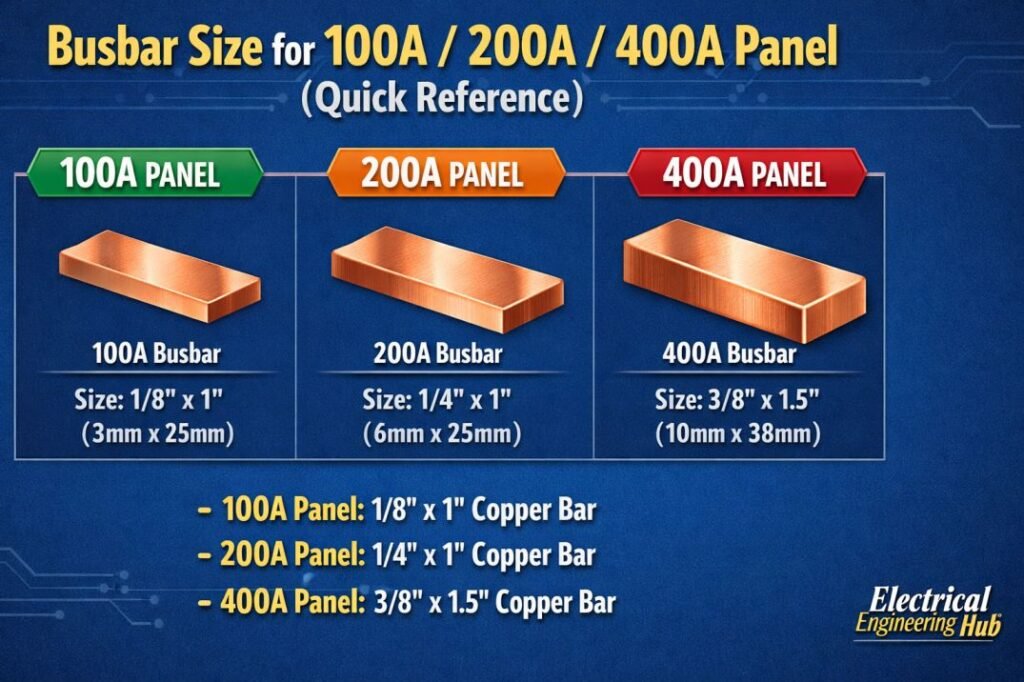
Table of Contents
Table of Contents
Quick Reference Chart – Copper Busbar Sizes
| Panel Rating | Recommended Copper Busbar | Cross Section (mm²) | Typical Current Density | Common Application |
|---|---|---|---|---|
| 100A | 20 × 5 mm | 100 mm² | 1 A/mm² | Small distribution boards |
| 125A | 25 × 5 mm | 125 mm² | 1 A/mm² | Residential main panels |
| 160A | 30 × 5 mm | 150 mm² | 1.07 A/mm² | Commercial DB |
| 200A | 40 × 5 mm | 200 mm² | 1 A/mm² | Industrial distribution panel |
| 250A | 40 × 6 mm | 240 mm² | 1.04 A/mm² | MCC panels |
| 320A | 50 × 6 mm | 300 mm² | 1.07 A/mm² | Process industries |
| 400A | 50 × 10 mm | 500 mm² | 0.8 A/mm² | PCC and switchboards |
| 630A | 80 × 10 mm | 800 mm² | 0.79 A/mm² | Main LT panels |
Quick Reference Chart – Aluminum Busbar Sizes
| Panel Rating | Recommended Aluminum Busbar | Cross Section |
|---|---|---|
| 100A | 25 × 5 mm | 125 mm² |
| 200A | 50 × 5 mm | 250 mm² |
| 400A | 80 × 8 mm | 640 mm² |
| 630A | 100 × 10 mm | 1000 mm² |
Copper remains the preferred choice where space is limited because of its higher conductivity, lower resistance, and better mechanical strength.
After checking these quick recommendations, use our bus bar size calculator to verify dimensions based on material, current density, and operating conditions before finalizing your design.
Why Busbar Size Cannot Be Selected by Current Alone
Many engineers assume that matching the current rating with a busbar cross-sectional area is enough. In practice, several additional factors influence the final size.
These include:
- Busbar material
- Ambient temperature
- Enclosure ventilation
- Continuous loading
- Future expansion
- Short-circuit withstand capability
- Mounting arrangement
- Permissible temperature rise
Ignoring any of these factors may result in overheating even if the theoretical current capacity appears acceptable.
Busbar Size for 100 Amp Panel
The busbar size for 100 amp panel commonly used in industrial and commercial distribution boards is:
| Material | Recommended Size | Area |
|---|---|---|
| Copper | 20 × 5 mm | 100 mm² |
| Aluminum | 25 × 5 mm | 125 mm² |
This size provides adequate current carrying capacity under normal ambient conditions with proper ventilation.
Practical Example
A workshop has:
- 63A lighting load
- 20A socket load
- 12A control equipment
Total connected load equals 95A.
Using a 20 × 5 mm copper busbar provides sufficient capacity while allowing a small operating margin.
Busbar Size for 200 Amp Panel
The busbar size for 200 amp panel generally selected for industrial applications is:
| Material | Recommended Size | Area |
|---|---|---|
| Copper | 40 × 5 mm | 200 mm² |
| Aluminum | 50 × 5 mm | 250 mm² |
This configuration is widely used in:
- Motor control centers
- Manufacturing plants
- Commercial buildings
- Utility distribution panels
Example
An industrial panel supplies:
| Load | Current |
|---|---|
| Three motors | 90A |
| HVAC system | 45A |
| Lighting | 30A |
| Spare feeder | 20A |
Total demand becomes approximately 185A.
Selecting a 40 × 5 mm copper busbar gives sufficient operating margin without excessive material cost.
For projects with higher ambient temperatures or continuous operation, engineers often increase the busbar dimensions instead of operating at maximum current density.
Busbar Size for 400 Amp Panel
For larger industrial switchboards, the recommended sizes are:
| Material | Recommended Size | Area |
|---|---|---|
| Copper | 50 × 10 mm | 500 mm² |
| Aluminum | 80 × 8 mm | 640 mm² |
These sizes are commonly installed in:
- PCC panels
- Generator synchronization panels
- Large MCCs
- Utility substations
- Manufacturing facilities
Example
A factory distribution panel supplies:
- Production line: 180A
- HVAC: 95A
- Compressors: 70A
- Lighting: 35A
Maximum demand equals 380A.
A 50 × 10 mm copper busbar comfortably supports this load while maintaining acceptable temperature rise.
Copper vs Aluminum Busbar Comparison
| Property | Copper | Aluminum |
|---|---|---|
| Conductivity | Excellent | Moderate |
| Mechanical strength | High | Medium |
| Weight | Heavy | Light |
| Corrosion resistance | Excellent | Good |
| Initial cost | Higher | Lower |
| Maintenance | Low | Moderate |
| Space required | Less | More |
Copper is generally preferred in compact switchboards where available space is limited.
Busbar Current Density Guide
| Material | Recommended Current Density |
|---|---|
| Copper | 0.8–1.6 A/mm² |
| Aluminum | 0.6–1.0 A/mm² |
Many industrial designers select approximately 1 A/mm² for copper to maintain lower operating temperatures and provide future expansion capacity.
How Temperature Changes Busbar Selection
Higher enclosure temperatures reduce current carrying capability.
| Ambient Temperature | Design Recommendation |
|---|---|
| 30°C | Standard sizing |
| 40°C | Verify current density |
| 50°C | Increase busbar area |
| Above 50°C | Perform thermal calculation |
Panels installed outdoors or inside process plants frequently require larger busbars than indoor air-conditioned installations.
Example Using Current Density
Assume:
Current = 250A
Chosen current density = 1 A/mm²
Required area
250 ÷ 1 = 250 mm²
A suitable standard copper busbar could be:
- 50 × 5 mm
- 40 × 6 mm
The final selection depends on available panel space and mechanical design.
For exact calculations based on current density, temperature, and conductor material, try the bus bar size calculator before selecting the final dimensions.
Common Mistakes During Busbar Selection
| Mistake | Result |
|---|---|
| Selecting by current only | Overheating |
| Ignoring enclosure temperature | Reduced life |
| No future expansion | Early replacement |
| Incorrect current density | Excessive losses |
| Using aluminum without compensation | Higher temperature rise |
| Ignoring short-circuit forces | Mechanical damage |
These mistakes often increase maintenance costs and reduce system reliability.
Design Tips Used in Industrial Panels
Experienced panel manufacturers usually follow several practical guidelines:
- Maintain adequate phase spacing.
- Use proper busbar supports.
- Tighten joints to the recommended torque.
- Apply anti-oxidation compound for aluminum.
- Minimize unnecessary joints.
- Keep busbars straight whenever possible.
- Verify fault withstand capability.
- Allow space for future feeders.
These practices improve cooling, reduce resistance, and simplify maintenance.
When Should You Increase Busbar Size?
Increasing the busbar dimensions is recommended when:
- Continuous load exceeds 80% of rated current.
- Ambient temperature is high.
- Panel ventilation is poor.
- Future expansion is planned.
- Harmonic currents are significant.
- Large motor starting currents occur frequently.
Although a smaller busbar may technically carry the required current, selecting the next standard size often improves long-term reliability.
You can also confirm whether your chosen dimensions provide sufficient safety margin by checking the bus bar size calculator, which estimates the required cross-sectional area for different operating conditions.
Frequently Asked Questions
Is a 20 × 5 mm copper busbar suitable for a 100A panel?
Yes. Under normal operating conditions, it is one of the most commonly used sizes for a 100A distribution panel.
What is the standard busbar size for 200A?
The busbar size for 200 amp panel is typically 40 × 5 mm copper or 50 × 5 mm aluminum, depending on design requirements and applicable standards.
Which busbar is recommended for a 400A industrial panel?
A 50 × 10 mm copper busbar is widely used for 400A switchboards because it provides good thermal performance and mechanical strength.
Can aluminum replace copper busbars?
Yes. Aluminum busbars are frequently used in large power distribution systems. However, they require larger cross-sectional areas to carry the same current as copper.
Related Guide & Tools
Conclusion
Choosing the correct busbar size improves safety, minimizes temperature rise, and extends the service life of electrical panels. While the busbar size for 100 amp panel and the busbar size for 200 amp panel shown in this guide work well for many standard installations, every project should also consider ambient temperature, enclosure design, short-circuit requirements, and future load growth. Using practical sizing charts together with engineering calculations helps ensure a reliable and cost-effective panel design.
Get new guides in your feed. Follow Electrical Insights on LinkedIn for new electrical standards guides, calculators and design tips from Azad Circuit Hub.
BusbarSize, #ElectricalPanel, #BusbarSizing, #NEC, #IECStandards, #PowerDistribution, #ElectricalEngineering, #Switchgear, #ElectricalDesign, #PanelBoard