
NEC Standards for Busbar Sizing: NEC 366, NEC 368, NEC 408
Busbar systems are widely used in switchboards, panelboards, busway installations, industrial power distribution, and commercial electrical systems. While engineers often focus on current-carrying capacity, the National Electrical Code (NEC) provides several requirements that directly or indirectly affect busbar sizing, installation, accessibility, and protection.
Understanding NEC Standards for Busbar Sizing helps designers select the correct busbar dimensions while ensuring code compliance. The most relevant articles include NEC 366 (Auxiliary Gutters), NEC 368 (Busways), and NEC 408 (Switchboards, Switchgear, and Panelboards). Each article addresses a different aspect of power distribution, making it important to know when each one applies.
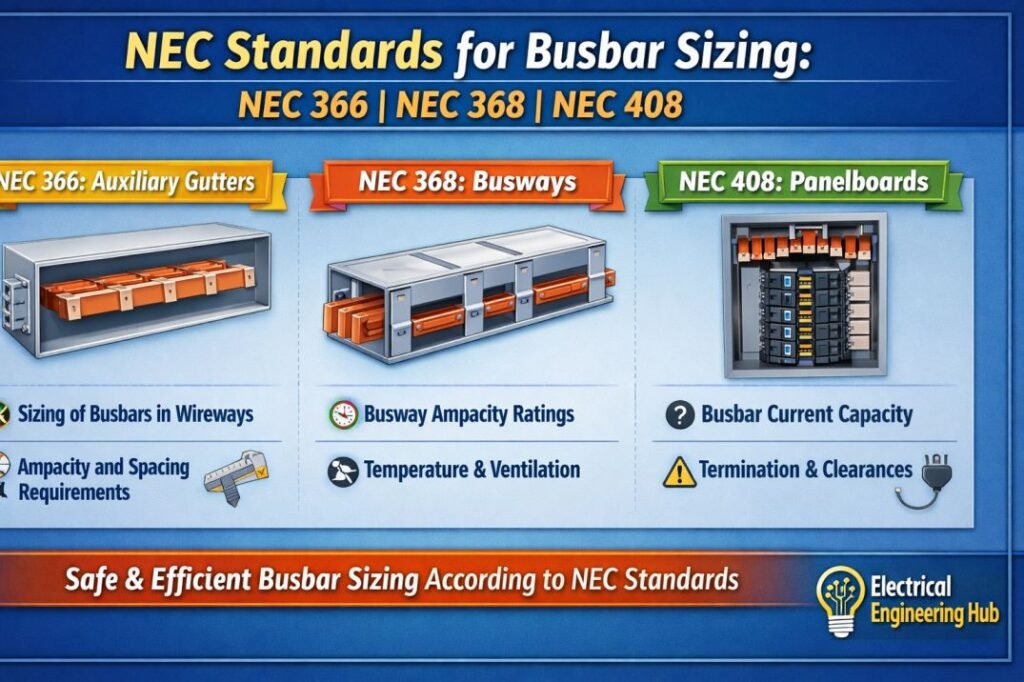
Table of Contents
Table of Contents
If you are determining conductor dimensions for a project, using a Busbar Size Calculator alongside NEC requirements simplifies the design process and helps reduce calculation errors.
Why NEC Standards Matter for Busbar Design
The NEC is primarily an installation code rather than a design manual. It does not provide a table that says a specific current requires a specific busbar width or thickness. Instead, it establishes safety requirements that influence busbar selection.
When sizing busbars, engineers normally combine:
- NEC installation requirements
- Manufacturer ratings
- Temperature rise limits
- Material properties (Copper or Aluminum)
- Short-circuit withstand ratings
- Applicable UL standards
This combination ensures that the selected busbar safely carries the intended electrical load throughout its service life.
| Design Factor | Purpose |
|---|---|
| Current Rating | Prevents overheating |
| Temperature Rise | Maintains insulation and equipment life |
| Short Circuit Rating | Withstands fault current |
| Busbar Material | Determines conductivity |
| Enclosure Ventilation | Improves heat dissipation |
| NEC Compliance | Ensures safe installation |
NEC Standards for Busbar Sizing
NEC 366 – Auxiliary Gutters
NEC Article 366 covers auxiliary gutters used for housing conductors, splices, taps, and busbar arrangements.
Although this article does not prescribe busbar dimensions, it establishes installation rules that influence busbar layout and available space.
Important requirements include:
- Adequate working space
- Proper conductor bending space
- Safe enclosure construction
- Accessibility for maintenance
- Compliance with fill limitations
When busbars are installed inside auxiliary gutters, engineers must ensure sufficient spacing between phases and enough room for heat dissipation.
How NEC 366 Affects Busbar Sizing
The available gutter dimensions often determine the maximum busbar width and thickness that can be installed.
Factors include:
- Number of conductors
- Busbar supports
- Clearance requirements
- Future expansion
- Heat ventilation
Instead of selecting the largest possible busbar, designers choose one that satisfies ampacity while fitting safely within the auxiliary gutter.
For practical sizing, many engineers first estimate the required conductor area using a Busbar Size Calculator before verifying the installation against NEC Article 366.
NEC 368 – Busways
NEC Article 368 specifically governs busway systems, making it one of the most important sections related to busbar installations.
Busways are factory-assembled systems containing busbars inside protective enclosures for distributing electrical power.
Common applications include:
- Manufacturing plants
- Commercial buildings
- Data centers
- Hospitals
- High-rise buildings
Key Requirements in NEC 368
NEC 368 covers several installation requirements such as:
| NEC 368 Requirement | Purpose |
|---|---|
| Busway Installation | Safe mounting |
| Support Spacing | Mechanical stability |
| Expansion Joints | Thermal expansion |
| Grounding | Personnel protection |
| Accessibility | Safe maintenance |
| Protection Against Damage | Reliable operation |
These provisions influence the physical design and selection of busbar systems.
Busbar Rating Under NEC 368
Busway manufacturers perform extensive testing to establish:
- Continuous current rating
- Short-circuit withstand capability
- Temperature rise
- Dielectric performance
- Mechanical strength
Because these systems are listed equipment, engineers typically select a busway based on its certified ampere rating rather than calculating individual busbar dimensions.
NEC 408 – Switchboards, Switchgear, and Panelboards
NEC Article 408 applies to switchboards, switchgear, panelboards, and similar distribution equipment.
These assemblies contain copper or aluminum busbars that distribute power from incoming feeders to branch circuits.
Although NEC 408 does not specify busbar width or thickness, it requires equipment to be installed according to its listing and labeling.
Important Considerations Under NEC 408
Engineers should verify:
- Equipment ampere rating
- Busbar current rating
- Main breaker rating
- Available fault current
- Working clearance
- Proper grounding
Manufacturers design internal busbars to comply with UL and NEC requirements for the equipment’s rated capacity.
For example, a 4000 A switchboard will contain busbars specifically designed and tested for that current rating.
Relationship Between NEC 366, NEC 368, and NEC 408
Each NEC article serves a different purpose during busbar system design.
| NEC Article | Equipment Covered | Effect on Busbar Sizing |
|---|---|---|
| NEC 366 | Auxiliary Gutters | Space and installation requirements |
| NEC 368 | Busways | Factory-rated busbar systems |
| NEC 408 | Switchboards and Panelboards | Equipment busbar ratings |
Understanding these differences prevents applying the wrong code section during electrical design.
Does the NEC Provide Busbar Size Tables?
No.
The NEC does not contain tables that directly specify busbar dimensions based on current.
Instead, designers use engineering calculations based on:
- Current carrying capacity
- Current density
- Allowable temperature rise
- Material conductivity
- Fault withstand rating
- Manufacturer specifications
The NEC ensures the installation is safe, while engineering standards determine the physical size of the busbar.
Typical Busbar Sizing Workflow
A practical busbar design usually follows these steps.
| Step | Action |
|---|---|
| 1 | Calculate design current |
| 2 | Select copper or aluminum |
| 3 | Determine allowable current density |
| 4 | Calculate required cross-sectional area |
| 5 | Verify temperature rise |
| 6 | Check short-circuit withstand rating |
| 7 | Confirm compliance with NEC installation requirements |
This workflow balances electrical performance with code compliance.
Additional Standards Used Alongside NEC
Professional engineers rarely rely on the NEC alone for busbar design.
Other widely referenced standards include:
- UL 857 for busway systems
- UL 891 for switchboards
- UL 67 for panelboards
- IEEE C37 standards
- IEC 61439 for low-voltage assemblies
- NEMA equipment standards
Together with the NEC, these standards provide complete guidance for safe and reliable power distribution.
Common Mistakes When Applying NEC Standards
Several misunderstandings frequently occur during busbar selection.
| Mistake | Better Practice |
|---|---|
| Using NEC as a sizing handbook | Use engineering calculations for dimensions |
| Ignoring short-circuit rating | Verify withstand capability |
| Selecting busbars only by ampacity | Consider temperature rise and installation |
| Overlooking enclosure size | Check NEC clearance requirements |
| Ignoring manufacturer ratings | Follow listed equipment specifications |
Avoiding these errors improves both safety and equipment reliability.
Choosing Between Copper and Aluminum Busbars
Both materials are accepted when properly designed.
| Property | Copper | Aluminum |
|---|---|---|
| Electrical Conductivity | Higher | Lower |
| Weight | Heavier | Lighter |
| Cost | Higher | Lower |
| Corrosion Resistance | Excellent | Good |
| Mechanical Strength | Higher | Moderate |
Copper remains the preferred option for compact, high-current installations, while aluminum is commonly used where lower weight and cost are priorities.
Best Practices for NEC-Compliant Busbar Installation
Following proven installation practices improves long-term system performance.
- Verify equipment ratings before installation.
- Maintain proper phase spacing.
- Ensure adequate ventilation.
- Use approved supports and mounting hardware.
- Follow manufacturer torque specifications.
- Inspect all busbar joints before energizing.
- Confirm grounding and bonding requirements.
- Leave sufficient working space for maintenance.
These practices complement NEC requirements and help extend equipment life.
When Should You Use a Busbar Size Calculator?
Manual calculations become increasingly difficult as current levels increase and multiple design variables must be considered.
An online Busbar Size Calculator can quickly estimate the required cross-sectional area based on current, material, and current density. After obtaining the calculated size, designers should verify the installation against NEC Articles 366, 368, and 408, as well as manufacturer recommendations.
Using a reliable Busbar Size Calculator during the early design stage also helps compare different copper and aluminum configurations before final equipment selection.
Conclusion
NEC Standards for Busbar Sizing provide the installation framework necessary for safe electrical systems, but they do not specify the physical dimensions of busbars. NEC 366 focuses on auxiliary gutters, NEC 368 governs busway installations, and NEC 408 covers switchboards, switchgear, and panelboards. Together, these articles ensure that busbar systems are installed safely, properly protected, and suitable for their intended application.
Follow Us on Social:
Subscribe our Newsletter on Electrical Insights for latest updates from Electrical Engineering Hub
NECStandardsForBusbarSizing, #NEC366, #NEC368, #NEC408, #BusbarSizing, #ElectricalEngineering, #NECCode, #PowerDistribution, #ElectricalDesign, #BusbarStandards
