IEC 60364-1 Explained: Essential Guide for Safe Electrical Design
Electrical installations must be designed and constructed with safety, reliability, and efficiency in mind. Across many countries, the IEC 60364-1 standard serves as the foundation for low-voltage electrical installations. Engineers, consultants, contractors, and facility managers rely on this standard to ensure that electrical systems meet internationally recognized safety requirements.
Understanding IEC60364-1 is important for anyone involved in electrical design. The standard provides the basic principles, objectives, and requirements that guide the planning and implementation of electrical installations. It establishes a framework that helps reduce electrical hazards, improve system performance, and protect people, livestock, and property.
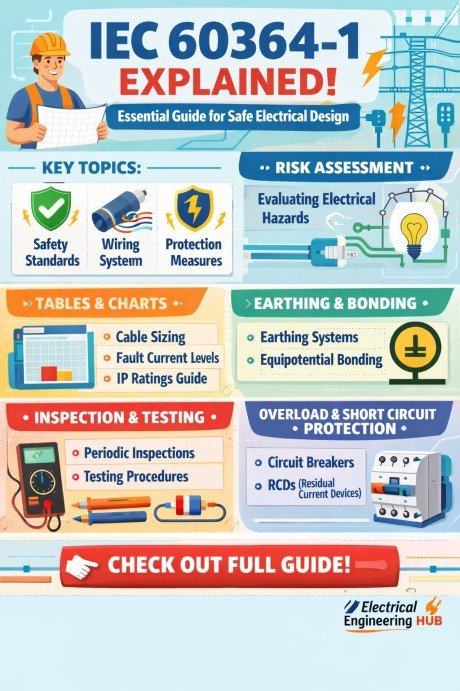
Table of Contents
This guide explains the key concepts of IEC 60364-1, its scope, objectives, design considerations, and practical applications in modern electrical systems.
What Is IEC 60364-1?
IEC 60364-1 is the first part of the IEC 60364 series, published by the International Electrotechnical Commission (IEC). It defines the fundamental principles, assessment criteria, and general requirements for low-voltage electrical installations.
The standard applies to installations operating at:
| System Type | Maximum Voltage |
|---|---|
| AC Systems | Up to 1000 V |
| DC Systems | Up to 1500 V |
Rather than focusing on specific installation techniques, IEC60364-1 establishes the overall safety philosophy that all subsequent parts of the IEC 60364 series follow.
It serves as the starting point for understanding electrical installation requirements in residential, commercial, industrial, and infrastructure projects.
Use our online tool Creepage Distance Calculator
Why IEC 60364-1 Is Important
Electrical systems can present significant risks if not designed correctly. These risks include electric shock, fire, equipment damage, and service interruptions.
IEC60364-1 helps address these challenges by providing a structured approach to electrical design. The standard ensures that installations:
- Protect people against electric shock
- Prevent thermal effects such as overheating and fire
- Protect against overcurrent conditions
- Ensure reliable operation of equipment
- Maintain service continuity where required
- Support safe maintenance practices
Organizations that follow IEC60364-1 often achieve higher levels of electrical safety and compliance throughout the lifecycle of an installation.
Know more about Phase to Phase Clearance as per IEC 61439
Main Objectives of IEC 60364-1
The primary purpose of IEC 60364-1 is to establish fundamental safety principles for electrical installations.
The standard focuses on the following objectives:
| Objective | Description |
|---|---|
| Safety of Persons | Protection against electric shock and injury |
| Protection of Property | Reduction of fire and equipment damage risks |
| Functional Reliability | Ensuring proper operation of electrical systems |
| Environmental Compatibility | Safe operation under expected environmental conditions |
| Maintainability | Facilitating safe inspection and maintenance |
These objectives form the basis of all electrical design decisions made under the IEC framework.
Scope of IEC 60364-1
IEC 60364-1 applies to a wide variety of installations, including:
- Residential buildings
- Commercial complexes
- Industrial facilities
- Educational institutions
- Hospitals
- Data centers
- Public infrastructure
- Renewable energy systems
The standard covers electrical installations from the point of supply to the connected equipment within the installation.
See our comprehensive guide on cable bending radius iec standard
However, it does not generally apply to specialized systems such as:
- Electric traction systems
- Aircraft electrical systems
- Ships and offshore installations
- Public electricity distribution networks
These systems are typically governed by separate standards. Explore all about methods of earthing
Fundamental Principles of IEC 60364-1
The entire IEC 60364 framework is built upon several core principles.
Know more about Wire Bending Radius NEC
Protection Against Electric Shock
One of the most critical requirements in IEC60364-1 is protection against electric shock.
Electrical installations must prevent:
- Direct contact with live parts
- Indirect contact due to fault conditions
Common protective measures include:
- Insulation of live conductors
- Protective earthing
- Equipotential bonding
- Residual current devices (RCDs)
- Automatic disconnection of supply
These measures significantly reduce the likelihood of injury or fatal accidents.
Protection Against Thermal Effects
Electrical faults can generate excessive heat, leading to fire hazards and equipment failure.
IEC 60364-1 requires designers to minimize risks associated with:
- Overheating conductors
- Arcing faults
- Combustible materials near equipment
- High-temperature equipment surfaces
Proper cable sizing and protective device selection play a major role in achieving compliance.
Find all about 11kV Cable Bending Radius
Protection Against Overcurrent
Overcurrent conditions occur due to overloads or short circuits.
The standard requires installations to include suitable protective devices such as:
- Circuit breakers
- Fuses
- Motor protection devices
These devices must operate quickly enough to prevent damage to cables and equipment.
Protection Against Voltage Disturbances
Modern electrical installations often contain sensitive electronic equipment.
IEC 60364-1 emphasizes the need to consider:
- Voltage dips
- Voltage surges
- Transient overvoltages
- Electromagnetic disturbances
Proper surge protection and grounding strategies help improve system reliability.
Use our online tool HV Cable Bending Radius Calculator
Design Considerations Under IEC 60364-1
Electrical designers must evaluate multiple factors when applying IEC60364-1 requirements.
Characteristics of the Supply
The designer should assess:
- Supply voltage
- Frequency
- Earthing arrangement
- Available fault current
- Utility requirements
These factors influence the overall design and selection of equipment.
Know more about Wire Sizing for Motors
Load Assessment
Accurate load calculations are essential.
Designers must consider:
- Maximum demand
- Diversity factors
- Future expansion requirements
- Continuous and intermittent loads
Proper load assessment helps prevent overloading and unnecessary costs.
Environmental Conditions
The operating environment directly affects electrical equipment performance.
Important considerations include:
| Environmental Factor | Impact |
|---|---|
| Temperature | Affects cable ampacity |
| Humidity | Influences insulation performance |
| Dust | May require special enclosures |
| Corrosive Atmospheres | Requires protective materials |
| Mechanical Stress | Impacts equipment durability |
Environmental evaluation is a key requirement of IEC 60364-1.
Know more about IS 14255 Explained
Relationship Between IEC 60364-1 and Other IEC 60364 Parts
IEC60364-1 serves as the foundation for the entire IEC 60364 series.
The remaining parts provide detailed requirements for specific aspects of electrical installations.
| IEC Part | Subject |
|---|---|
| IEC 60364-1 | Fundamental principles and general requirements |
| IEC 60364-4 | Protection for safety |
| IEC 60364-5 | Selection and erection of equipment |
| IEC 60364-6 | Verification and testing |
| IEC 60364-7 | Special installations and locations |
For a complete understanding of international installation requirements, readers should explore the comprehensive guide on IEC 60364, which explains how all parts of the standard work together.
Explore all about IEC 60364 5 52
Verification Requirements
IEC60364-1 emphasizes the importance of verifying electrical installations before they are placed into service.
Verification typically includes:
Visual Inspection
Inspectors check:
- Equipment installation
- Cable routing
- Earthing arrangements
- Protective devices
- Identification markings
Testing
Common tests include:
- Continuity of protective conductors
- Insulation resistance
- Earth fault loop impedance
- RCD operation
- Polarity verification
These tests confirm that the installation meets safety requirements.
Know more about insulation resistance test standard
Benefits of Following IEC 60364-1
Organizations that implement IEC 60364 1 gain several advantages.
Improved Safety
The standard reduces risks associated with:
- Electric shock
- Fire
- Equipment damage
International Recognition
Many countries adopt or align their regulations with IEC standards.
This makes IEC 60364-1 widely recognized across global projects.
Better System Reliability
Proper design practices improve:
- Equipment performance
- Service continuity
- Fault management
Easier Compliance
Projects designed according to IEC 60364-1 often face fewer compliance issues during inspections and audits.
Find out more about iec 61439 busbar clearance
Common Applications of IEC 60364-1
The principles outlined in IEC 60364 1 are used in many sectors.
Residential Buildings
Applications include:
- Lighting circuits
- Power outlets
- Earthing systems
- Consumer units
Commercial Facilities
Examples include:
- Office buildings
- Shopping centers
- Hotels
- Educational institutions
Industrial Installations
Industrial facilities use the standard for:
- Motor control systems
- Distribution boards
- Process equipment
- Backup power systems
Renewable Energy Systems
Modern solar and energy storage installations frequently apply IEC 60364-1 principles to ensure safe integration with electrical networks.
Discover everything about cable bending radius iec standard
Challenges in Applying IEC 60364 1
Although the standard provides clear guidance, implementation can be challenging.
Common difficulties include:
- Understanding complex technical requirements
- Coordinating multiple standards
- Managing changing technologies
- Designing for future expansion
- Meeting local regulatory requirements
Regular training and continuous professional development help engineers stay updated with evolving standards.
Conclusion
IEC 60364-1 is one of the most important standards for low-voltage electrical installations. It establishes the fundamental safety principles that guide electrical design, installation, inspection, and maintenance. By focusing on protection against electric shock, thermal effects, overcurrent, and voltage disturbances, the standard helps create safer and more reliable electrical systems.
Whether working on residential buildings, industrial facilities, commercial developments, or renewable energy projects, understanding IEC 60364 1 is essential for achieving compliance and ensuring long-term operational safety. As electrical technologies continue to evolve, the principles defined in this standard remain the foundation of effective electrical installation design worldwide.
Learn more about earthing cable size as per iec
Frequently Asked Questions
What is IEC 60364-1?
IEC 60364-1 is the first part of the IEC 60364 series that defines the fundamental principles, general requirements, and objectives for low-voltage electrical installations.
What voltage range does IEC 60364-1 cover?
The standard applies to AC installations up to 1000 V and DC installations up to 1500 V.
Is IEC 60364-1 mandatory?
The standard itself is not automatically mandatory. However, many countries adopt it directly or incorporate its requirements into national electrical regulations.
Who should use IEC 60364 1?
Electrical engineers, consultants, contractors, inspectors, facility managers, and maintenance professionals commonly use IEC 60364-1 during project planning and execution.
How does IEC 60364-1 improve electrical safety?
IEC 60364 1 provides requirements for protection against electric shock, overcurrent, thermal effects, and other electrical hazards, helping ensure safe and reliable installations.
Get new guides in your feed. Follow Electrical Insights on LinkedIn for new electrical standards guides, calculators and design tips from Azad Circuit Hub.
#IEC603641,#IECStandards,#ElectricalEngineering,#ElectricalInstallation,#LowVoltageSystems,#ElectricalSafety,#WiringRegulations,#PowerDistribution,#ElectricalDesign,#InternationalStandards