Phase to Phase Clearance Chart by Voltage Level
Electrical clearance between live conductors is one of the most important design parameters in switchgear, busbar systems, substations, and overhead line installations. A proper Phase to Phase Clearance Chart by Voltage Level helps engineers, electricians, and panel builders maintain safety, avoid flashovers, and comply with IEC standards.
This guide provides quick-reference clearance values for low voltage and medium/high voltage systems, making it easier to compare minimum conductor spacing across common voltage levels.
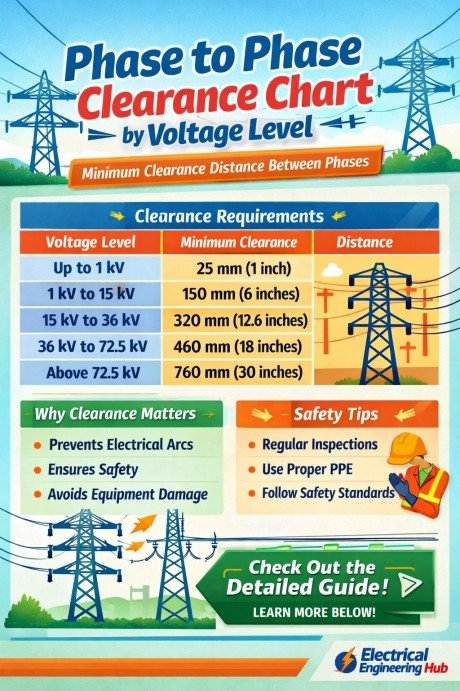
Table of Contents
Table of Contents
Phase to Phase Clearance Quick Reference Chart
The Phase to Phase Clearance Chart by Voltage Level below gives a fast overview of the most commonly used system voltages and their recommended minimum spacing.
| Voltage Level | Minimum Phase-to-Phase Clearance | Standard Reference |
|---|---|---|
| 240V | 20 mm | IEC 61439 |
| 415V | 25 mm | IEC 61439 |
| 690V | 30 mm | IEC 61439 |
| 11kV | 120 mm | IEC 62271 |
| 33kV | 320 mm | IEC 62271 |
| 66kV | 630 mm | IEC 62271 |
| 132kV | 1250 mm | IEC 60071 |
| 220kV | 2100 mm | IEC 60071 |
| 400kV | 3400 mm | IEC 60071 |
These values are general engineering references. Actual clearances may vary based on insulation coordination, altitude correction factors, pollution degree, and installation type.
Know more about Phase to Phase Clearance as per IEC 61439
Low Voltage (LV) Phase to Phase Clearance
Low-voltage systems are the most common in industrial control panels, motor control centers, and distribution boards. In low-voltage assemblies, phase spacing is mainly determined by insulation material, overvoltage category, and pollution level.
The Phase to Phase Clearance Chart by Voltage Level for LV systems is especially important for busbar trunking and switchboard design.
LV Clearance Table
| System Voltage | Minimum Clearance | Typical Application |
|---|---|---|
| 240V | 20 mm | Residential distribution |
| 415V | 25 mm | Industrial panels |
| 690V | 30 mm | Heavy machinery and MCCs |
For 415V systems as per IEC 61439, the standard minimum air clearance is usually 25 mm between phases under normal indoor conditions. Use our free tool Phase to Phase Clearance Calculator
Important points for LV systems:
- Busbar supports should maintain stable spacing.
- Humidity can reduce insulation performance.
- Compact enclosures may need reinforced insulation.
- Higher fault levels can increase arcing risks.
Find all about Busbar Clearance as per IEC 61439: Minimum Distance Chart
For panel builders, maintaining proper conductor separation improves dielectric strength and reduces short-circuit failures.
11kV Phase to Phase Clearance
11kV systems are widely used in distribution networks, industrial substations, and ring main units. This voltage class requires much greater air insulation compared to low voltage because the risk of flashover increases sharply.
According to the Phase to Phase Clearance Chart by Voltage Level, 11kV systems usually require 120 mm minimum phase spacing.
11kV Clearance Table
| Parameter | Value |
|---|---|
| System Voltage | 11kV |
| Minimum Phase-to-Phase Clearance | 120 mm |
| Typical BIL | 75kV |
| Standard | IEC 62271 |
Common applications include:
- Pole-mounted transformers
- Indoor switchgear
- Outdoor VCB panels
- Feeder pillars
Factors that can increase this requirement:
- High-altitude installation
- Coastal pollution
- Outdoor contamination
- High transient overvoltage
For outdoor 11kV overhead systems, conductor swing due to wind must also be considered.
Know more about IEC Standard for Busbar Clearance
33kV Phase to Phase Clearance
The 33kV network level is a critical part of medium-voltage transmission and distribution. It is commonly used for primary substations and industrial power networks.
Many engineers search for 33kv phase to phase clearance because it directly affects substation busbar design and overhead line spacing.
Based on the Phase to Phase Clearance Chart by Voltage Level, the recommended clearance for 33kV is around 320 mm.
33kV Clearance Table
| Parameter | Value |
|---|---|
| Voltage Level | 33kV |
| Minimum Clearance | 320 mm |
| Impulse Withstand Voltage | 170kV |
| Standard | IEC 62271 |
Key design considerations:
| Factor | Effect on Clearance |
|---|---|
| Pollution Level | Higher contamination increases spacing |
| Humidity | Reduces dielectric margin |
| Equipment Age | Older insulation may degrade |
| Switching Surges | Can exceed nominal voltage |
Explore in detail IEC 61936 Clearance Table
In overhead lines, conductor sag and wind displacement often require larger practical spacing than minimum standard values.
132kV Phase to Phase Clearance
At 132kV, systems move into high-voltage transmission class. Clearance requirements become significantly larger because electrical stress increases with voltage.
Substations operating at this level use larger busbar spacing, insulator strings, and structural support distances.
According to the Phase to Phase Clearance Chart by Voltage Level, the standard minimum for 132kV systems is approximately 1250 mm.
132kV Clearance Table
| Parameter | Value |
|---|---|
| Voltage Level | 132kV |
| Minimum Phase-to-Phase Clearance | 1250 mm |
| Lightning Impulse Level | 550kV |
| Standard | IEC 60071 |
Common installation areas:
- Grid stations
- Transmission substations
- GIS and AIS yards
- Utility interconnection points
At this voltage level, insulation coordination becomes more complex because switching impulses and lightning surges heavily influence spacing.
Typical 132kV Design Factors
| Design Factor | Impact |
|---|---|
| Altitude above 1000m | Increases clearance requirement |
| Pollution class | May require wider spacing |
| Insulator creepage | Works with air clearance |
| Surge arresters | Can reduce insulation stress |
Know more about IEC Standard for Creepage Distance
How Voltage Level Affects Minimum Clearance
The relationship between voltage and electrical clearance is not linear. As system voltage increases, the insulation requirement grows faster because air breakdown strength has limits.
Higher voltage means stronger electric fields between conductors. If spacing is too small, ionization of air can occur, leading to arc flash or dielectric failure.
Here is a simple comparison:
| Voltage | Relative Clearance Need |
|---|---|
| 415V | Low |
| 11kV | Medium |
| 33kV | High |
| 132kV | Very High |
Main reasons clearance increases:
- Higher operating voltage
- Larger switching surge magnitude
- Increased lightning impulse levels
- Greater insulation coordination demands
- Environmental contamination effects
This is why the Phase to Phase Clearance Chart by Voltage Level is essential for proper switchgear and transmission design.
Phase to Phase Clearance vs. Phase to Ground Clearance by Voltage
Phase-to-phase and phase to ground clearances are related but not the same. Phase to phase clearance measures spacing between two live conductors, while phase to ground clearance measures spacing between a conductor and earth.
Phase-to-ground requirements are often smaller in some systems but depend heavily on earthing method.
Comparison Table
| Voltage Level | Phase-to-Phase Clearance | Phase-to-Ground Clearance |
|---|---|---|
| 240V | 20 mm | 15 mm |
| 415V | 25 mm | 20 mm |
| 11kV | 120 mm | 95 mm |
| 33kV | 320 mm | 280 mm |
| 132kV | 1250 mm | 1100 mm |
Key differences:
- Phase-to-phase sees full line voltage.
- Phase-to-ground depends on system grounding.
- Unearthed systems may need larger ground clearance.
- Fault conditions can affect ground spacing.
Both values must be checked during panel design, bus duct installation, and substation layout planning.
Frequently Asked Questions
What is the phase to phase clearance for 415V as per IEC?
For 415V systems under IEC 61439, the typical minimum phase-to-phase clearance is 25 mm. This may increase depending on pollution degree and insulation category.
What is the minimum clearance for 11kV systems?
The minimum phase spacing for 11kV systems is generally 120 mm according to IEC switchgear practices. Outdoor installations may need larger spacing.
What is the phase to phase clearance for 33kV lines?
For 33kV lines and switchyards, the standard minimum phase-to-phase clearance is around 320 mm. Practical field spacing may be greater due to sag and wind loading.
What is the phase to phase clearance for 132kV systems?
For 132kV transmission systems, the minimum phase-to-phase clearance is approximately 1250 mm based on insulation coordination and IEC 60071 recommendations.
Using a reliable Phase to Phase Clearance Chart by Voltage Level makes system design faster, safer, and more compliant with international electrical standards. Whether you are working on LV panels, 11kV feeders, 33kV substations, or 132kV transmission systems, correct conductor spacing is a critical part of electrical safety and performance.
Get new guides in your feed. Follow Electrical Insights on LinkedIn for new electrical standards guides, calculators and design tips from Azad Circuit Hub.
PhaseToPhaseClearanceChart, #VoltageLevelClearance, #ElectricalClearance, #PowerSystemSafety, #HighVoltageEngineering, #SubstationDesign, #ElectricalStandards, #SwitchgearSafety, #TransmissionLines, #ElectricalEngineering