IEC 61936 Clearance Table | Complete Safety Distances Guide, Standards, Requirements & Compliance
Electrical installations operating at medium, high, and extra-high voltage levels require strict safety measures to protect personnel, equipment, and surrounding infrastructure. One of the most important aspects of electrical safety is maintaining adequate electrical clearances. The IEC 61936 Clearance Table serves as a key reference for engineers, consultants, contractors, and utility companies when designing substations and power systems.
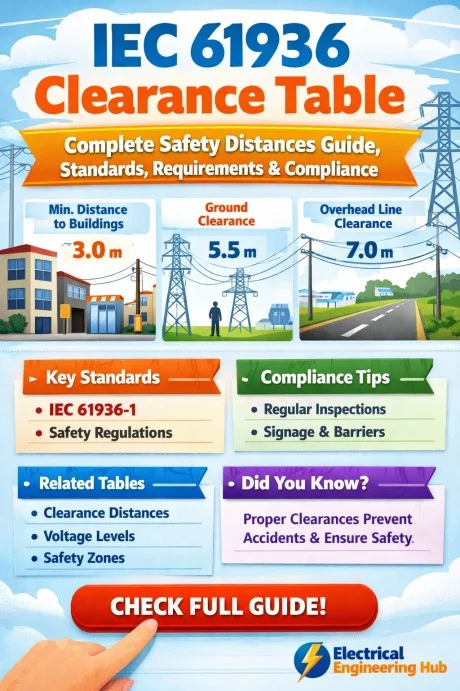
Table of Contents
Understanding the IEC 61936 Clearance Table helps ensure compliance with international standards while minimizing the risk of flashovers, electrical faults, and accidents. This guide explains clearance requirements, safety distances, design considerations, and compliance requirements in a practical and easy-to-understand manner.
What is IEC 61936?
IEC 61936 is an international standard developed by the International Electrotechnical Commission (IEC). It provides requirements for the design and construction of electrical power installations exceeding 1 kV AC and 1.5 kV DC.
Know more about Phase to Phase Clearance as per IEC 61439
The standard covers:
- Electrical safety requirements
- Substation design
- Insulation coordination
- Equipment spacing
- Protection against electric shock
- Operational and maintenance safety
One of the most frequently referenced parts of the standard is the IEC 61936 Clearance Table, which specifies the minimum distances required between live parts, structures, equipment, and accessible areas.
Why Clearance Distances are Important
Proper electrical clearance is essential for safe operation and long-term system reliability. Insufficient spacing can result in:
- Flashover between conductors
- Electrical arcing
- Equipment damage
- Power outages
- Personnel injuries
- Regulatory non-compliance
The IEC 61936 Clearance Table helps engineers determine safe distances based on voltage levels and installation conditions.
Use our online tool Creepage Distance Calculator
IEC 61936 Clearance Table
The following table provides commonly referenced minimum phase-to-phase and phase-to-earth clearances based on IEC 61936 recommendations.
Actual project requirements may vary depending on altitude, insulation coordination studies, environmental conditions, and utility specifications.
| Highest System Voltage (kV) | Phase-to-Phase Clearance (mm) | Phase-to-Earth Clearance (mm) |
|---|---|---|
| 3.6 | 60 | 40 |
| 7.2 | 90 | 70 |
| 12 | 120 | 100 |
| 17.5 | 160 | 140 |
| 24 | 220 | 200 |
| 36 | 320 | 320 |
| 52 | 480 | 480 |
| 72.5 | 650 | 650 |
| 123 | 1100 | 1100 |
| 145 | 1300 | 1300 |
| 170 | 1600 | 1600 |
| 245 | 2200 | 2200 |
| 420 | 3600 | 3600 |
These values are often used during substation layout development and insulation coordination studies.
Find all about Phase to Phase Clearance in 132 kV
Types of Clearances Defined in IEC 61936
Phase-to-Phase Clearance
This is the minimum distance between energized conductors of different phases. Maintaining adequate spacing prevents flashovers caused by overvoltages and switching surges.
Phase-to-Earth Clearance
This clearance refers to the distance between live conductors and grounded structures such as steel supports, equipment frames, or earth grids.
Section Clearance
Section clearance is required between energized equipment and adjacent disconnected sections. It allows safe maintenance activities while nearby circuits remain energized.
Use our free tool Phase to Phase Clearance Calculator
Safety Working Clearance
This distance provides sufficient space for operators and maintenance personnel to safely perform inspections and repairs.
Factors Affecting Clearance Requirements
Several factors influence the values shown in the IEC 61936 Clearance Table.
System Voltage
Higher voltage levels require greater insulation distances due to increased electric field strength.
Altitude
Air insulation strength decreases with altitude. Installations located at elevations above 1000 meters generally require correction factors.
Find all about Phase to Phase Clearance in 132 kV
Environmental Conditions
Pollution, humidity, dust, salt contamination, and industrial emissions can reduce insulation performance and may require larger clearances.
Insulation Coordination
Equipment insulation levels must match the expected overvoltage conditions. Surge arresters and insulation coordination studies often affect final clearance values.
Utility Requirements
Many utilities adopt IEC standards but apply additional safety margins based on local regulations and operating experience.
Clearance Requirements for Outdoor Substations
Outdoor substations rely heavily on air insulation. Therefore, proper spacing between equipment is critical.
| Equipment Location | Typical Clearance Consideration |
|---|---|
| Busbar to Busbar | Phase-to-phase clearance |
| Busbar to Structure | Phase-to-earth clearance |
| Circuit Breaker Terminals | Equipment insulation level |
| Transformer Bushings | Voltage and surge withstand capability |
| Disconnect Switches | Open-gap and safety clearance |
The IEC 61936 Clearance Table is frequently used during the design of AIS (Air Insulated Switchgear) substations.
Know more about IEC Standard for Busbar Clearance
Clearance Requirements for Indoor Installations
Indoor substations and switchgear rooms often have limited space. Designers must ensure compliance while optimizing layouts.
Important considerations include:
- Access corridors
- Maintenance zones
- Emergency exits
- Equipment operating clearances
- Arc flash risk mitigation
Modern GIS (Gas Insulated Switchgear) installations require less physical clearance because insulation is provided by gas rather than air.
Compliance with IEC 61936
Compliance involves more than simply applying clearance distances. Organizations should ensure:
- Proper engineering design
- Insulation coordination studies
- Equipment certification
- Site safety assessments
- Regular inspections
- Documentation of calculations
- Maintenance planning
Following the IEC 61936 Clearance Table helps demonstrate adherence to internationally accepted engineering practices.
Know more about IEC Standard for Earthing System
Common Design Mistakes to Avoid
Engineers should avoid the following mistakes:
- Using outdated clearance values
- Ignoring altitude correction factors
- Overlooking future system expansion
- Not considering switching overvoltages
- Inadequate maintenance access space
- Failure to coordinate with local utility requirements
Proper planning during the design phase can prevent costly modifications later.
Best Practices for Electrical Safety
To maximize safety and compliance:
- Follow IEC standards and utility guidelines.
- Verify equipment insulation ratings.
- Conduct insulation coordination studies.
- Maintain proper grounding systems.
- Perform periodic inspections.
- Train personnel on safe working distances.
- Review substation layouts before construction.
These practices improve reliability while ensuring compliance with the IEC 61936 Clearance Table.
Know more about IEC Standard for Insulation Resistance Test
Conclusion
The IEC 61936 Clearance Table is a fundamental reference for designing safe and reliable electrical installations. It provides minimum spacing requirements between energized conductors, grounded structures, and accessible areas to reduce electrical hazards and ensure operational reliability. By applying the correct clearance distances, considering environmental factors, and following insulation coordination principles, engineers can achieve full compliance with IEC standards while maintaining the highest level of electrical safety. Know more about IEC Standard for MV Cable Testing
Frequently Asked Questions (FAQs)
1. What is the purpose of the IEC 61936 Clearance Table?
The IEC 61936 Clearance Table provides minimum electrical clearances required for power installations above 1 kV to ensure safety, insulation integrity, and regulatory compliance.
2. Does altitude affect IEC 61936 clearance requirements?
Yes. Higher altitudes reduce the insulating strength of air, which may require increased clearance distances according to IEC recommendations.
3. Is the IEC 61936 Clearance Table applicable to substations?
Yes. It is widely used for designing air-insulated substations, switchyards, transformers, busbars, and other high-voltage installations.
4. What is the difference between phase-to-phase and phase-to-earth clearance?
Phase-to-phase clearance is the distance between two energized conductors, while phase-to-earth clearance is the distance between a live conductor and a grounded object.
5. Can local utilities modify IEC 61936 clearance values?
Yes. Many utilities adopt IEC standards but may specify larger clearances based on local regulations, environmental conditions, and operational experience.
Get new guides in your feed. Follow Electrical Insights on LinkedIn for new electrical standards guides, calculators and design tips from Azad Circuit Hub.
#IEC61936,#IEC61936ClearanceTable,#ElectricalClearance,#SubstationDesign,#PowerSystemSafety,#ElectricalStandards,#HighVoltageEngineering,#IECStandards,#ElectricalEngineering,#SafetyCompliance