Phase to Ground Clearance as Per IEC 61439: Standard & Values
Electrical safety is one of the most critical aspects of power system design and operation. Among the many safety parameters used in electrical installations, Phase to Ground Clearance as per IEC plays a vital role in preventing electrical faults, flashovers, equipment damage, and safety hazards. Proper clearance between energized conductors and ground ensures reliable system performance while protecting personnel and infrastructure.
The International Electrotechnical Commission (IEC) has established comprehensive standards that define minimum electrical clearances for different voltage levels. These requirements help engineers, contractors, and utility companies maintain safe distances in substations, transmission lines, switchgear installations, and industrial electrical systems.
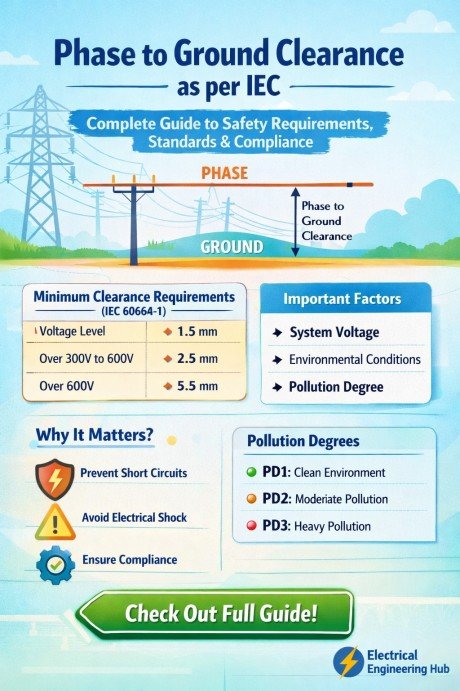
Table of Contents
Table of Contents
This guide explains Phase to Ground Clearance as per IEC, including safety requirements, applicable standards, calculation factors, compliance requirements, and practical considerations.
Use our online tool Creepage Distance Calculator
What is Phase to Ground Clearance?
Phase to ground clearance refers to the minimum distance maintained between an energized phase conductor and any grounded object, structure, equipment, or earth surface. This distance prevents electrical breakdown through air and minimizes the risk of arcing.
The required clearance depends on several factors, including:
- System voltage
- Overvoltage conditions
- Environmental conditions
- Pollution level
- Installation altitude
- Equipment type
- Safety margins
Maintaining adequate clearance is essential for ensuring insulation coordination and operational safety.
Phase to Earth Clearance as Per IEC 61439
The term phase to earth clearance is commonly used in IEC-based electrical installations and has the same practical meaning as phase to ground clearance. Under IEC 61439, the required clearance depends on the rated insulation voltage (Ui), pollution degree, and overvoltage category.
Designers must maintain the minimum air gap between live conductors and any grounded metal enclosure to prevent flashover and ensure safe operation of low-voltage switchgear and controlgear assemblies.
Phase to Earth Clearance Values (IEC 61439)
| Rated Insulation Voltage (Ui) | Minimum Phase to Earth Clearance* |
|---|---|
| 250 V | 3 mm |
| 400 V | 5.5 mm |
| 690 V | 8 mm |
| 1000 V | 14 mm |
Values based on IEC 61439 insulation coordination. Always verify the applicable product standard and environmental conditions.
Quick Reference Chart
| Voltage Range | Typical Air Clearance |
|---|---|
| Up to 250 V | 3 mm |
| 400–690 V | 5.5–8 mm |
| Up to 1000 V | 14 mm |
This phase to earth clearance chart helps engineers, panel builders, and inspectors quickly verify that switchboards comply with IEC 61439 while maintaining safe insulation distances between energized parts and grounded metal components.
Importance of Phase to Ground Clearance as per IEC
The purpose of maintaining proper electrical clearance extends beyond regulatory compliance. It directly impacts the reliability and safety of the electrical network.
Key benefits include:
- Prevention of flashovers
- Protection of personnel from electric shock
- Improved equipment lifespan
- Reduction in maintenance costs
- Enhanced system reliability
- Compliance with international safety standards
- Reduced risk of outages and faults
Without sufficient clearance, high-voltage systems may experience insulation failure, resulting in severe operational and safety consequences.
IEC Standards Governing Electrical Clearances
Several IEC standards address electrical clearances and insulation coordination.
Relevant IEC Standards
| IEC Standard | Description |
|---|---|
| IEC 60071-1 | Insulation Coordination – Definitions and Principles |
| IEC 60071-2 | Application Guide for Insulation Coordination |
| IEC 61936-1 | Power Installations Exceeding 1 kV AC |
| IEC 60664-1 | Insulation Coordination for Low Voltage Equipment |
| IEC 62271 Series | High Voltage Switchgear and Controlgear |
| IEC 60826 | Design Criteria for Overhead Transmission Lines |
These standards collectively establish requirements for safe electrical distances and insulation performance.
Use our free tool Phase to Phase Clearance Calculator
Factors Affecting Phase to Ground Clearance as per IEC
Several technical and environmental parameters influence the required clearance.
Operating Voltage
Higher voltages require larger clearances due to increased electric field strength.
Switching Surges
Transient overvoltages generated during switching operations may exceed normal operating voltage levels.
Lightning Impulses
Lightning strikes can create extremely high temporary voltages that influence insulation design requirements.
Altitude
At higher elevations, air density decreases, reducing dielectric strength. IEC standards require altitude correction factors above 1000 meters.
Pollution Levels
Industrial pollution, coastal salt deposits, and dust contamination reduce insulation performance and may require larger clearances.
Environmental Conditions
Humidity, rain, fog, and temperature variations affect insulation characteristics and air breakdown voltage.
Typical Phase to Ground Clearance Values
The following table provides general reference values commonly used in power installations. Actual values should always be verified according to the applicable IEC standard and project specifications.
| System Voltage (kV) | Typical Phase to Ground Clearance (mm) |
|---|---|
| 11 kV | 150 – 250 |
| 33 kV | 320 – 450 |
| 66 kV | 650 – 850 |
| 132 kV | 1200 – 1500 |
| 220 kV | 2100 – 2500 |
| 400 kV | 3500 – 4500 |
These values may vary depending on insulation coordination studies and environmental factors.
Clearance Requirements in Substations
Substations contain multiple energized components operating at various voltage levels. Proper clearance design is essential to avoid flashover between live parts and grounded structures.
Areas Requiring Clearance Verification
- Busbars
- Circuit breakers
- Disconnectors
- Current transformers
- Voltage transformers
- Surge arresters
- Power transformers
- Cable terminations
Engineers typically perform clearance checks during the design stage to ensure compliance with IEC requirements.
Example of Substation Clearance Planning
| Equipment | Clearance Consideration |
|---|---|
| Busbar | Distance to support structure |
| Circuit Breaker | Distance to grounded frame |
| Transformer Bushing | Distance to tank and structures |
| Disconnect Switch | Open-gap insulation clearance |
Proper equipment layout significantly contributes to electrical safety.
Overhead Line Phase to Ground Clearance Requirements
For transmission and distribution networks, ground clearance is a critical design parameter.
Phase to Ground Clearance as per IEC for overhead lines must account for:
- Maximum conductor sag
- Wind loading
- Temperature effects
- Ground elevation changes
- Crossing structures
- Road crossings
- Vegetation growth
The minimum clearance is measured under the worst operating conditions, including maximum conductor sag during high temperatures.
Typical Overhead Line Design Considerations
| Factor | Impact on Clearance |
|---|---|
| High Temperature | Increases conductor sag |
| Strong Wind | Causes conductor swing |
| Uneven Terrain | Changes effective ground distance |
| Ice Loading | Alters conductor behavior |
Utilities regularly inspect transmission corridors to ensure these clearances remain within safe limits.
Insulation Coordination and Clearance Design
Insulation coordination is the process of selecting insulation levels that can withstand expected overvoltages while remaining economically practical.
IEC 60071 provides the framework for insulation coordination.
The design process generally includes:
- Determining system voltage.
- Identifying expected overvoltages.
- Selecting insulation withstand levels.
- Establishing minimum air clearances.
- Applying environmental correction factors.
- Verifying safety margins.
Proper insulation coordination helps optimize both safety and project costs.
Compliance Requirements for IEC Standards
Compliance with IEC requirements is essential for utilities, industrial facilities, renewable energy plants, and electrical infrastructure projects.
Know all about ieee and iec standards
Compliance Steps
- Follow applicable IEC standards.
- Conduct insulation coordination studies.
- Verify equipment manufacturer specifications.
- Perform site-specific risk assessments.
- Consider environmental conditions.
- Document clearance calculations.
- Conduct periodic inspections.
Many regulatory authorities and utility companies incorporate IEC requirements into their project approval processes.
Common Mistakes in Clearance Design
Several design errors can compromise electrical safety.
Underestimating Environmental Effects
Designers sometimes overlook pollution, humidity, or altitude corrections.
Ignoring Future Expansion
Additional equipment may reduce existing clearances if future growth is not considered.
Inadequate Maintenance
Vegetation growth, structural movement, and equipment modifications can reduce safe distances over time.
Know more about IEC Standard for Neutral to Earth Voltage
Incorrect Voltage Assumptions
Clearance calculations must consider temporary overvoltages rather than only nominal voltage levels.
Avoiding these mistakes helps maintain long-term compliance and reliability.
Best Practices for Maintaining Phase to Ground Clearance
Electrical installations should be regularly monitored to ensure continued compliance.
Recommended practices include:
- Conduct periodic visual inspections.
- Measure clearances during maintenance activities.
- Trim vegetation near overhead lines.
- Inspect support structures for movement.
- Verify conductor sag limits.
- Review system modifications before implementation.
- Update documentation after equipment replacement.
These practices support safe operation throughout the lifecycle of the installation.
Future Trends in Electrical Clearance Management
Modern power systems increasingly rely on digital technologies for asset management and safety monitoring.
Emerging trends include:
- Drone-based inspections
- LiDAR clearance measurement
- Digital substations
- Predictive maintenance systems
- Real-time conductor monitoring
- AI-assisted asset management
These technologies help utilities identify clearance issues before they become safety risks.
Related Guides & Tools
- Phase to Phase Clearance as per IEC 61439
- Busbar Clearance as per IEC 61439
- Minimum Electrical Clearance as per IEC
- IEC 60364 Earthing Requirements
Conclusion
Phase to Ground Clearance as per IEC is a fundamental requirement for ensuring electrical safety, system reliability, and regulatory compliance. IEC standards provide a structured framework for determining appropriate clearances based on voltage level, environmental conditions, insulation coordination, and operational requirements.
Whether designing substations, transmission lines, switchgear installations, or industrial power systems, maintaining proper phase-to-ground distances is essential for preventing flashovers and protecting both personnel and equipment. By following IEC guidelines, performing regular inspections, and implementing sound engineering practices, organizations can achieve safe and reliable electrical system operation for many years.
Explore details on iec 61508 functional safety
Frequently Asked Questions (FAQs)
What is Phase to Ground Clearance as per IEC?
Phase to Ground Clearance as per IEC is the minimum safe distance required between an energized conductor and any grounded object to prevent flashover, arcing, and insulation failure.
Which IEC standard is primarily used for insulation coordination?
IEC 60071-1 and IEC 60071-2 are the primary standards used for insulation coordination and determining electrical clearances in power systems.
Why does altitude affect electrical clearance requirements?
Higher altitude reduces air density, lowering its insulating capability. Therefore, larger clearances are often required to maintain safety.
How is phase-to-ground clearance determined?
It is determined based on system voltage, insulation coordination studies, expected overvoltages, environmental conditions, pollution level, and applicable IEC standards.
Is periodic inspection necessary after installation?
Yes. Regular inspections are essential to verify that clearances remain compliant despite conductor sag, vegetation growth, equipment modifications, or structural changes.
Get new guides in your feed. Follow Electrical Insights on LinkedIn for new electrical standards guides, calculators and design tips from Azad Circuit Hub.
#phaseToGroundClearance,#IECStandards,#ElectricalSafety,#GroundClearance,#IECCompliance,#ElectricalEngineering,#PowerSystems,#IndustrialSafety,#ElectricalInstallation,#SafetyStandards